EXPLAINER: If Blood Is Donated for Free, Why Are Patients Paying for It?
Here's what you're actually paying for—and what you shouldn't be.
Published on Nov 27, 2026
(SPOT.ph) When a loved one needs a blood transfusion, the last thing you want to worry about is another medical expense. After all, we know that blood is donated voluntarily and isn't supposed to be sold. So why does getting a bag still come with a price tag?
A recent Threads post about an experience at a Philippine Red Cross (PRC) facility has brought the question back into the spotlight. The poster was waiting for blood bags for their aunt when they overheard another woman pleading with a teller to release a bag of blood. According to the post, the woman was told she needed to bring a replacement donor and pay P2,300 before she could get the blood.
Although the poster complied to get the blood their aunt needed, they questioned why families still had to pay thousands of pesos despite donating blood themselves, and why a replacement donor was necessary in the first place. The post also included a picture of a PRC receipt dated November 22, showing a total of P4,800.
To explain why, the PRC issued an advisory clarifying the actual fees and requirements.
Also read: Patients Can Get Treated for Free at These 87 DOH Hospitals—Here’s What You Need to Know
Yes, the blood is free. However, turning it into a safe medical product is not.
Under Republic Act No. 7719, or the National Blood Services Act of 1994, blood donation is voluntary and without remuneration. Section 2(b) specifically describes the provision of blood for transfusion as “a professional medical service and not a sale of a commodity.” In other words, patients and their families shouldn’t have to “buy” the blood itself.
Here’s the catch: donated blood is not automatically ready for transfusion. As the PRC explained in its Facebook advisory, citing Department of Health (DOH) Administrative Order (AO) No. 2026-0003, blood service facilities need to screen donors, collect blood, run laboratory tests, and process and store the units. All these services are covered by the Blood Service Fee, which includes the cost of:
Donor recruitment, selection, and blood collection
Testing for transfusion-transmissible infections, hemoglobin levels, and blood typing
Processing and storage
Professional services
A reasonable allowance for spoilage
In short, the fee pays for the screening, handling, and laboratory services required to make blood safe for patients to receive.
The amount you'll pay depends on which blood component you need. The viral Threads post mentioned a P2,300 charge, but this is the maximum allowable Blood Service Fee specifically for packed red blood cells (PRBCs).
Under DOH Administrative Order No. 2026-0003, blood service facilities nationwide can collect fees up to the prescribed maximum for each blood component. These rates apply to government-run, private, local government, and PRC facilities.
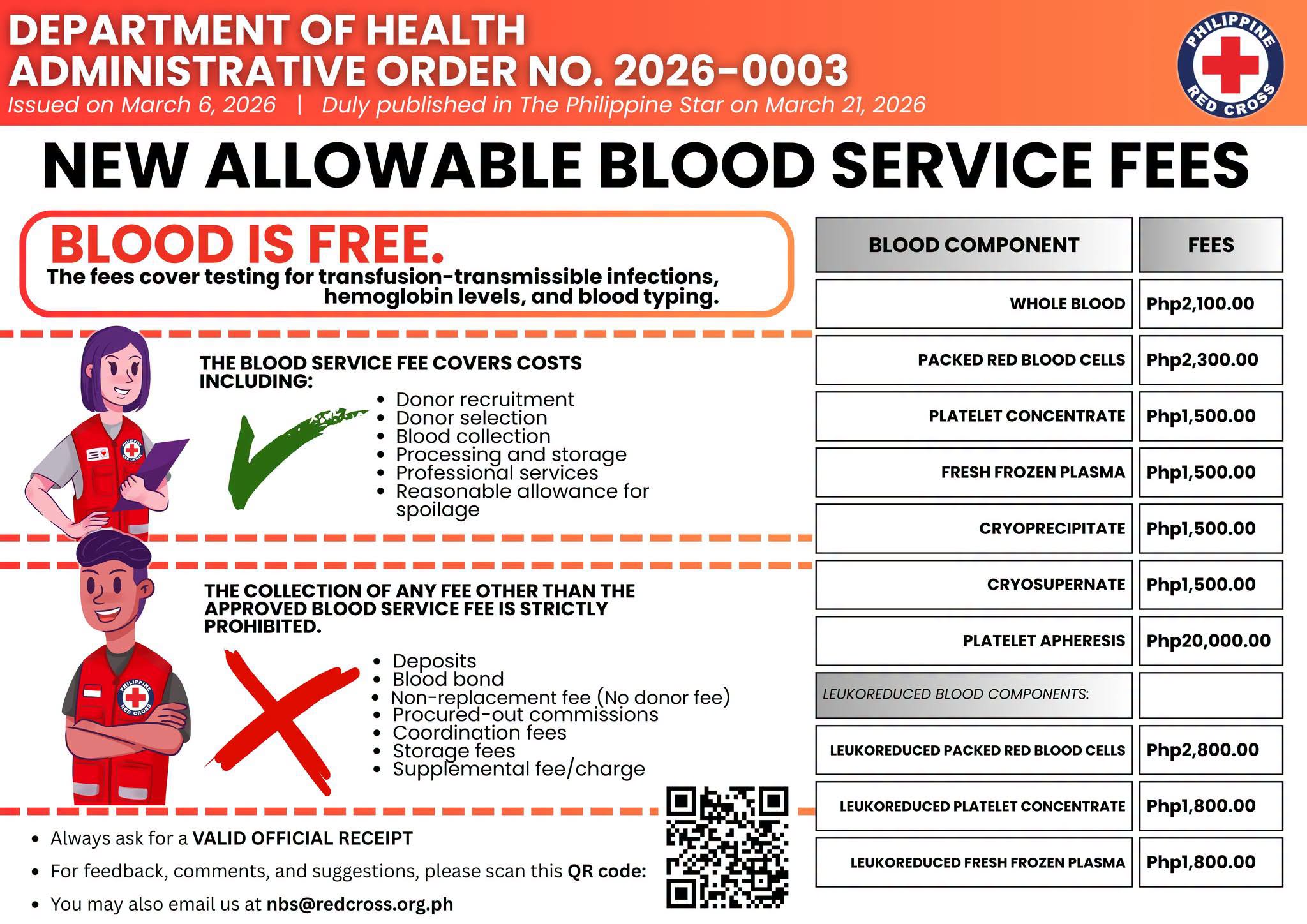
The order also specifies maximum fees for certain tests and procedures, including nucleic acid amplification testing (P1,800), antibody screening (P600), pathogen reduction (P4,000), and blood irradiation (P1,100).
It’s important to look closely at the receipt, though. While blood service facilities are allowed to collect the approved Blood Service Fee, they cannot charge more than the prescribed rate or impose additional fees for blood services. These prohibited charges include:
Deposits
Blood bonds
Non-replacement fees (“no donor” fees)
Procured-out commissions
Coordination fees
Storage fees
Supplemental fees or charges
Under Section V Item D of AO No. 2026-0003, there is a limited exception: transport or delivery fees. However, these must be listed separately on the receipt, charged per transaction, and based on the typical cost of specialized medical transport in the area.
Blood banks welcome family and friends who volunteer to donate, but you don't need to bring a replacement donor to receive available blood, as confirmed by the Philippine Red Cross.
The DOH administrative order also clearly states that facilities are prohibited from collecting “non-replacement fees,” which refer to extra charges imposed on patients who can’t provide voluntary blood donors.
Keep in mind that blood donation isn't a one-to-one exchange, meaning donated blood goes into the general supply rather than being automatically set aside for a loved one. Plus, every unit still has to undergo the necessary testing and processing before it can be used for transfusion, which is why donating blood does not automatically waive the fee or entitle someone to a free unit later.
For Filipinos struggling to pay the fee, options exist beyond paying out of pocket. According to the PRC, patients can ask about the Blood Samaritan Program at any PRC blood service facility. They can also approach the hospital's social service office to ask about available government medical assistance programs.
If you do pay a fee at a facility, always ask for a valid official receipt. And should you get charged more than the approved fee—like a “no donor” fee—you can raise the concern through PRC’s official channels: hotline 143, nbs@redcross.org.ph, or this feedback form.
Also read: GUIDE: How to Apply for PhilHealth YAKAP to Get Free Check-Ups, Lab Tests + P20K in Meds
Celia Nachura writes to pay for plane tickets, tennis classes, and a pile of books she’ll never have the time to read. She is also the emotional support human to two dogs, Daisy and Nacho.