NAIA Ranked 47th Out of 47 on TIME’s Best Major Airports List
Hey, it’s still a spot among the world’s best.

Published on Nov 25, 2026
(SPOT.ph) Here's a bit of unexpected news: Ninoy Aquino International Airport (NAIA) just landed a spot on TIME’s first-ever list of the World’s Best Major Airports of 2027. Of 47 airports included in this category, Manila’s main gateway came in last.
TIME partnered with data platform Statista to develop the rankings, grouping airports into four categories based on their annual passenger traffic instead of comparing all airports in a single list. NAIA falls under the major airports category, competing against other busy hubs handling at least 50 million passengers every year. Our airport class includes other major terminals like Singapore's Changi Airport, South Korea's Incheon International Airport, and the Hong Kong International Airport.
Here's how NAIA performed against these aviation hub giants.
NAIA received an overall score of 76.46, putting it 47th out of 47 major airports. It lies at the bottom of the list and is the only airport in the category to score in the 70s. For comparison, Singapore’s famous Changi Airport topped the list with 91.74, while Germany’s Frankfurt Airport, which ranked just above NAIA, scored 80.64.
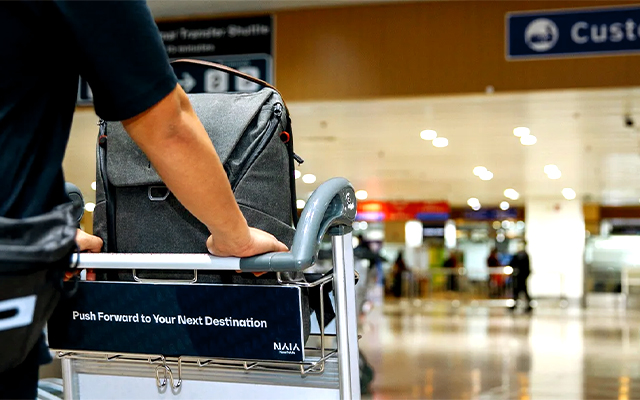
But how did TIME and Statista come up with the scores, anyway? According to the published methodology, they first limited the pool of eligible airports. To qualify, airports must serve at least one million passengers per year and have enough survey and flight-data coverage for a reliable evaluation. They also excluded airports involved in major accidents or critical safety violations.
Each qualified airport was then classified in one of the four categories based on annual passenger volume: major airports (50 million or more passengers a year), large airports (25 million to fewer than 50 million), mid-sized airports (10 million to fewer than 25 million), and smaller airports (fewer than 10 million).
For context, the large airports category includes Japan’s Narita International Airport and Australia’s Sydney and Melbourne Airports. Mid-sized airports include New Zealand’s Auckland Airport and Thailand’s Phuket International Airport, while South Korea’s Daegu International Airport is among the smaller airports.
To rank the qualified airports, TIME and Statista used two main data sources: a global passenger survey and independent flight-performance data.
The survey asked travelers to rate airports they had used in the past three years on aspects of the airport experience, including security, baggage handling, cleanliness, connectivity, facilities, lounges, and overall satisfaction.
On the other hand, operational data considered factors such as punctuality, cancellation rates, and flight destinations. Provided by aviation analytics company OAG, the data covered more than 30 million flights from July 2025 to June 2026.
There’s a silver lining to the last-place ranking—or at least according to New NAIA Infra Corp. (NNIC), which took over the Manila airport in September 2024. In a statement, the airport operator described NAIA’s inclusion on TIME’s list as “a step forward.”
“We placed 47th, but for an airport that spent years being called one of the worst in the world, being measured alongside the world's biggest hubs is a step forward, and a place to start climbing,” NNIC said.
The consortium also noted that NAIA handled heavy passenger traffic beyond its terminal capacity over the past year. It thanked government agencies, airlines, ground handlers, concessionaires, and airport staff for helping keep the airport running.
Since taking over, NNIC has introduced a wave of upgrades across NAIA terminals, including new dining options, free Wi-Fi, lounge improvements, biometric check-in facilities, and immigration e-gates, among others.
For now, NAIA has a lot of catching up to do, but the NNIC is determined to move up the rankings. “Next year, we aim to be higher on that list.”
For more information, visit the NAIA Facebook page.
Also read: Guide: Here Are the Updated Terminal Assignments in NAIA
Celia Nachura writes to pay for plane tickets, tennis classes, and a pile of books she’ll never have the time to read. She is also the emotional support human to two dogs, Daisy and Nacho.