Architects of Christmas: Meet The Folks Who Spruce Up Makati For the Holidays
A behind-the-scenes look at how the business district gets a glow up for the season.

by Leana Vibal
Published on Dec 19, 2025
(SPOT.ph) On most days, Makati can feel like the textbook definition of an urban jungle—skyscrapers of concrete, steel, and glass keeping watchful eyes over the sea of workers, commuters rushing to catch the last ride home, malls buzzing with pure transactional energy. Everywhere, there’s an urgency to close a deal and call it a day.
But once a year, the city shifts.
The same towers reflect a warm glow from their entrances. Office workers slow their pace, and phones are picked up not to check for an email but to snap a picture. Streets, shops, and hotels soften into places that are welcoming and something unmistakably Filipino. Parols are strewn onto street lamps, strings of fairy lights cascade from the trees—Christmas has hit Makati. For a few months, Makati trades its cold efficiency for the warm, inviting glow of the holidays.
When the -ber months strike, Makati transforms into a holiday destination in its own right. Parks light up, hotels brace for a slew of festive events, and shops take on a life of their own. It all feels effortless—as if there’s a Christmas switch that they just flip on each year. Newsflash: there isn’t.
Behind the city’s stunning holiday sights are designers, planners, and creatives who shape how Makati ushers in the season—whether across an entire avenue, inside a grand hotel lobby, or within window displays. This is a look at the architects of Christmas— and how they design joy at different scales, year after year.

Meet the city planners behind Makati’s biggest Christmas stage
One of the surest signs that Makati has slipped into festivemode is when parols and lanterns begin to glow along Ayala Avenue and that’s largely thanks to the team at Ayala Land. As the CBD’s longtime property developer, they take the lead in getting this part of the city holiday-ready each year.
“Ayala has been doing this for as long as I can remember,” says Sharon Vital, Marketing Manager for Ayala Land’s Makati Estate. “In fact, when we were doing our research for future designs, we found a photo in our archives of Ayala Avenue and its Christmas decorations from the 1960s.”

Like clockwork, a week or two after undas, the lights turn on across the avenue’s two-kilometer stretch—spilling into Paseo de Roxas and Makati Avenue before converging at Ayala Triangle Gardens. For many Makatizens, this moment quietly signals the start of Christmas in the city.


“Preparing Ayala for Christmas takes almost a year. In fact, as we’re speaking, we’re already finalizing the plans for next year,” says Vital. It’s a timeline that makes sense when you consider the scale at which they operate: close to 50 hectares of public space.
For Misha Quimpo, Ayala Land’s Project Development Manager for Makati Estate, this season is the time when the team goes all in—creatively, logistically, and financially.

“It really takes a while because when you look at the scale we’re working with, it’s a lot,” she says. Preparing the CBD involves months of sourcing materials, fabrication, and rigorous safety checks, eventually mobilizing a team of nearly 120 people.
“We want people to be able to come close to the installations and interact with them safely,” Quimpo explains. A fun tidbit: the decor are built to withstand up to intensity seven earthquakes and strong typhoons—non-negotiables in a city like Makati. “Every year, right after we install, a strong typhoon hits,” she laughs. “So tested agad. We don’t want capiz lanterns flying into traffic.”

And long before installations go up or safety inspections begin, the real work has already started behind the scenes. Quimpo and Vital spend months shaping a concept the entire team can rally behind—one that feels festive, familiar, and unmistakably Makati.
“When we plan our decorations, we always keep in mind that Makati has always brought a sense of pride to Filipinos, “ Vital explains. “It’s a progressive city. So, you know, when we talk about it, we always keep in mind that the decorations should reflect that. It has to have that local Filipino flavor, but at the same time, it has to be at par with what you see globally. Like if you put it side by side with the decorations, say in London, it shouldn't pale in comparison.”

“Christmas is always a season of hope. It’s really something we look forward to, especially us Pinoys. It becomes a beacon. That’s why we continue to do this,” Quimpo adds.
That sense of hope is also why Ayala Land designs its Christmas displays with longevity in mind. While the lights may only shine for a few months, the thinking behind them stretches far beyond the season—favoring pieces that can be refreshed, reimagined, and reused, rather than built to be discarded come January.
Case in point: some of last year’s Ayala Avenue decorations have found a second life at another Ayala Land estate, Circuit Makati. A few familiar capiz lanterns have even made a quiet return. For Quimpo and Vital, dressing the CBD each year doesn’t mean starting from scratch—it means building on what is already there.
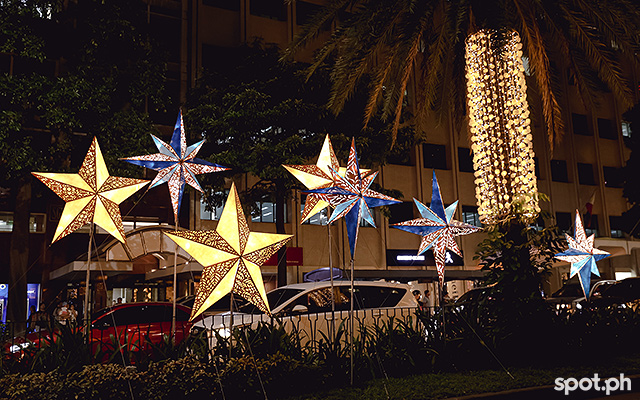

Sustainability, they say, is no longer an afterthought, but a guiding principle. In recent years, this has translated into a more timeless visual language: classic parols over novelty shapes, warm lights over trendy and flashy displays, and installations designed to feel just as resonant today as they might be a decade from now.
At first glance, this year’s decorations may feel more muted, more understated—but that doesn’t make them any less joyful. Instead, Ayala Land has quietly reframed what it means to hold a Christmas festival in the city.

Rather than anchoring the season on a handful of large, one-off spectacles, they’ve curated a series of smaller, thoughtfully programmed experiences spread across the weeks leading to January. Cultural performances, artful installations, and showcases of Filipino talent take centerstage.


It’s a Christmas that favors meaning over grandeur—one that invites people not just to look, but to linger, return, and make it part of their own holiday rhythm.
While Ayala Avenue’s Christmas unfolds across hectares of public space, another kind of holiday magic happens just a few steps away—indoors, more intimate, and meticulously choreographed.
At The Peninsula Manila, Christmas isn’t just designed to be seen. It’s designed to be experienced.
Inside Christmas at The Peninsula Manila
Stepping inside The Peninsula Manila during the holidays feels like crossing into another world. The city’s rush fades almost instantly, replaced by a soft glow bouncing off marble floors, the feel of plush carpets underfoot, and an atmosphere that makes people instinctively slow down. The effect is most striking in its iconic Lobby.
“The Pen is the Lobby, and the Lobby is The Pen,” quips longtime Director of Brand Communications Mariano Garchitorena (or Garch as he likes to be called)—and that is most evident during the holidays.

There’s no missing it: a towering 45-foot Christmas tree rises from the center, lit to perfection; trumpeting angels line the balconies and pillars; smaller trees flank the space; garlands line the negative space on the walls; a life-sized gingerbread house stands off to the side, and a massive wreath anchors it all. Regal, elegant, and unapologetically grand, the scene feels straight out of a storybook, less like a hotel lobby, but more like a grand palace dressed for the season.
But while it may look seamless, Christmas at The Pen is anything but effortless. Preparations begin as early as March, with months of careful planning ensuring each year’s celebration feels fresh—while staying true to the hotel’s signature elegance and sense of transportive escape.
“Every year, like clockwork, as soon as October rolls in, the decor comes out,” Garchitorena shares. Over several weeks, nearly a hundred hotel employees—from housekeeping and engineering to front-of-house and marketing—work together to bring Christmas at The Pen to life. There’s no single person in charge. It’s a full-scale, all-hands-on-deck effort, powered by institutional memory, hospitality, and collective pride built through years of repetition.
And while decor sets the stage, Christmas at The Pen has always been about more than how the Lobby looks. The ceremonial tree lighting may signal the official start of the season, but the holidays here are designed to be experienced, not just admired in passing. At its core, Christmas at The Pen is a musical tradition.
Beyond the expected Christmas and New Year’s balls—fixtures in most luxury hotels—The Peninsula Manila anchors its season around two musical mainstays, or what Garch fondly calls “The Pen’s Christmas DNA.”
Come November, the Lobby fills not just with light, but with song. Every Friday, choirs like the MAPÚA Cardinal Singers and the St. Scholastica’s College Chamber Singers lend their voices to the space. Familiar carols rise above the usual lobby hum, gently pausing conversations and foot traffic alike. For about an hour every week, the Lobby stops being a thoroughfare and becomes what it was always meant to be: a place to gather.

Then there’s the Christmas Concert—arguably the most beloved Pen tradition of all, now marking its 40th season.
This event has quietly become a holiday institution in its own right. Through the years, it has featured performances by artists like Bituin Escalante, Arman Ferrer, Kuh Ledesma, National Artist Ryan Catabyab, and the Ateneo Chamber Singers, with accompaniment from 48 or 51-piece orchestras like the Manila Symphony Orchestra. Every year, the program is a grand display of Filipino musical talent, weaving together performances of classic carols, film scores and Disney favorites, light opera selections, and beloved holiday pieces, culminating in the rousing “Hallelujah Chorus” from Handel’s Messiah.

During the Christmas concert, more than 1,500 people fill the Lobby—sitting side by side —and yet, somehow, it never feels crowded, only communal. Though often held weeks away from Christmas day, for Garch and the staff at The Pen, it might as well be, as the stakes are always high. Imagine delivering a show of this calibre for 40 straight years—the pressure never lets up, it only gets more intense.
According to Garch, families of multiple generations attend the concerts, as it has become their own tradition to celebrate at The Pen. “We would see families who had their weddings here, come back with their families, and through the years, we’d see the family grow. Celebrating Christmas at The Pen becomes a tradition, and to be the place they choose to celebrate in is an honor,” says the PR vet.
“Although Christmas is celebrated across all 12 Peninsula properties worldwide, there’s something unmistakably different about celebrating it in the Philippines,” adds Garchitorena. And it shows, especially at The Peninsula Manila, where that warmth—that hospitality—is deliberately turned up during the holidays.

“I always say the saddest time to go to The Pen is in January, when all the decorations are gone,” Garch admits. “Don’t get me wrong—it’s still beautiful. But Christmas at The Pen gives the hotel a different warmth. It makes it feel lived in. You really have to experience it to understand.”

From majestic lobbies, orchestral finales, and elegant balls, Christmas in Makati eventually leads you back outside—past glowing avenues and grand hotel doors—to a quieter, more intimate kind of holiday magic.
One that unfolds not across hectares or beneath chandeliers, but behind glass facing sidewalks.
A peek inside Rustan’s iconic Christmas displays
Along Ayala Avenue, as traffic hums and pedestrians weave their way home, Rustan’s Makati has a way of slowing people down—and it has nothing to do with markdowns or holiday sales. Instead, it’s the window displays: meticulously crafted scenes that turn retail to storytelling, and a simple sidewalk pause into a moment of quiet wonder.

“Displays at Rustan’s always have to look luxurious and sophisticated,” says Jackie Avecilla, Head of Marketing at Rustan’s. “But more than that, they have to carry emotional meaning for the shopper.”
At Christmas, that emotional pull is everything. “The goal is to transport the viewer into a fairytale, a wonderland, somewhere they don’t always get to experience,” she adds.
Each year, the unveiling of Rustan’s Christmas windows is another quiet signal that the season has arrived. Whether dressed in frosted whites for a winter fantasy or wrapped in deep reds and greens that evoke classic holiday warmth, the displays are unmistakably Chritsmas. Ask anyone who regularly walks along Ayala Avenue: a Rustan’s window has likely stopped them in their tracks, made them slow down, or at least made them look twice.

While the windows may serve as a backdrop for merchandise, you can think of them more as portals that transport you to scenes that “spark nostalgia and invite imagination.” Childhood memories, familiar symbols, and storybook imagery are translated through the language of a luxury department store, helping shoppers envision what Christmas could look like in a dozen different parts of the world.
Behind that moment of pause is a year-long collaboration between Rustan’s marketing and visual merchandising teams. Marketing sets the narrative—the theme, the mood, the world they want to invite people into. Visual merchandising then translates that idea into a concrete storyboard, carefully staging each window so the story unfolds through texture, light, scale, and detail.
It’s meticulous work, often planned a year in advance, and according to Avecilla, Christmas remains Rustan’s biggest moment of the year. In fact, plans for Christmas 2026 are already underway.
Part of that preparation involves looking outward. Rustan’s regularly studies how global luxury retailers approach the holidays—stores like Harrods and Selfridges in London, Le Bon Marché in Paris, and even luxury fashion houses like Tiffany & Co., Dior, and Gucci.
“We really look up to these stores globally,” says Avecilla. “Some of our managers get to visit them during buying trips, so they experience the displays firsthand. We share ideas, impressions—what worked, what felt magical—so when we translate it locally, it still feels authentic.”
It’s a practice Rustan’s has sustained for decades. The brand has been creating Christmas displays for as long as Avecilla can remember—stretching back to the ’80s, if not earlier—cementing the windows as a free, look-all-you-can holiday tradition in their own right.
When asked about her personal favorite, Avecilla recalls a pre-pandemic display—a winter wonderland rendered in whites and icy blues, complete with larger-than-life polar bears, sleds, and snow-dusted scenes.
“We don’t have snow here in the Philippines,” she says. “Even when we travel, we don’t always get to experience it. That display really transported me. It made me want to be there—to play in the snow, to be part of that world. That feeling stayed with me.”
For Avecilla, that feeling has since become her benchmark. Every Christmas display she works on must offer that same feeling, especially for families and children.
What is a Makati Christmas?
It’s often said that Christmas in the Philippines is unlike anywhere else in the world. In Makati, that difference shows up not in one overwhelming spectacle, but in the details: an avenue lit with parols, a lobby filled with song, a window that makes you stop mid-step.
The season here isn’t defined by a single grand display or one perfect night. It’s shaped by layers of care, creativity, and intention—by people who, despite a hundred other things on their plate, still show up to bring a sense of the holidays to everyone in the city.
In Makati, Christmas doesn’t arrive all at once. It unfolds gradually—across weeks, across spaces, across scales. It’s built through repetition and refinement, through traditions that are familiar yet never stale, festive without ever feeling forced.
In a city known for speed, efficiency, and the constant push forward, Christmas offers a rare pause. It asks people to slow down, look up, and linger a little longer—and behind that pause are the architects who quietly design joy into the season, year after year.
Leana is Spot's go-to for Arts & Culture and Things to Do. On any given day, she’s either glued to her screen—or gliding underwater like the mermaid she swears she is. Contact: leana@spot.ph