People
Inside the Personal Pugad of Cartoonist Pol Medina Jr.
The creator of Pugad Baboy on legacy, longevity, and being "anonymously famous."
by Pam Pastor
Published on Aug 17, 2025
(SPOT.ph) “Ikaw si Pol Medina?!? Hindi nga?? Buhay ka pa?!?”
That’s what one surprised Komiket attendee blurted out when the Pugad Baboy creator offered to sign the book the former bought at Medina's booth last year—a moment the cartoonist would later turn into a comic strip.
Yes, Apolonio “Pol” Medina Jr. is very much alive, and just days before this weekend’s Komiket (on its last day today, August 17, at Ayala Malls Manila Bay), we are waiting for him in a Seattle’s Best in Las Piñas. He picked the location—one just across Perpetual Help Medical Center, which happens to be near his residence. He couldn’t go far, he says; he needs to rush home because he still has books to sign. He has online orders to fulfill.
People have been buying his Pugad Baboy 34, the latest compilation of his long-running comic strip that famously stars a community of often overweight characters, through whose adventures Medina gets to express his satirical and humorous takes on Filipino life, politics, and society.
That’s what one surprised Komiket attendee blurted out when the Pugad Baboy creator offered to sign the book the former bought at Medina's booth last year—a moment the cartoonist would later turn into a comic strip.
Yes, Apolonio “Pol” Medina Jr. is very much alive, and just days before this weekend’s Komiket (on its last day today, August 17, at Ayala Malls Manila Bay), we are waiting for him in a Seattle’s Best in Las Piñas. He picked the location—one just across Perpetual Help Medical Center, which happens to be near his residence. He couldn’t go far, he says; he needs to rush home because he still has books to sign. He has online orders to fulfill.
People have been buying his Pugad Baboy 34, the latest compilation of his long-running comic strip that famously stars a community of often overweight characters, through whose adventures Medina gets to express his satirical and humorous takes on Filipino life, politics, and society.
.jpg?fit=cover&width=960&q=82)
Click to Enlarge
Pol Medina Jr. photographed by Paul Sugano. Behind him, a few of the characters he made famous in his iconic Pugad Baboy comic strip. Cover design by Warren Espejo..
The guy has come out with so many books he has lost count. “There are 34 Pugad Baboy compilations,” he tells Spot, making an attempt to keep track. “Two Polgas comics, two graphic novels. The Dagul v Brando cookbook, my Sunday comics compilations, my compilations of editorial cartoons. And there will be more because I’m working on new ones.”
Medina’s books are so popular some of them have had 30,000 print runs—when the usual print run in this country is 1,000 to 2,000 copies. He’s also had to reprint his first book, Pugad Baboy One, multiple times.
These days, you can no longer find his books in bookstores. Instead, he sells them at comic shops like Comic Odyssey, Filbar’s, and Secret HQ; at comics conventions; and online through social media. "People order through Messenger. It's really low-tech. I deputized my son Ato to take orders."
Medina, now 65, has devoted decades of his life to his art—and to Pugad Baboy.
Medina’s books are so popular some of them have had 30,000 print runs—when the usual print run in this country is 1,000 to 2,000 copies. He’s also had to reprint his first book, Pugad Baboy One, multiple times.
These days, you can no longer find his books in bookstores. Instead, he sells them at comic shops like Comic Odyssey, Filbar’s, and Secret HQ; at comics conventions; and online through social media. "People order through Messenger. It's really low-tech. I deputized my son Ato to take orders."
Medina, now 65, has devoted decades of his life to his art—and to Pugad Baboy.
Click to Enlarge
Drawing on Walls
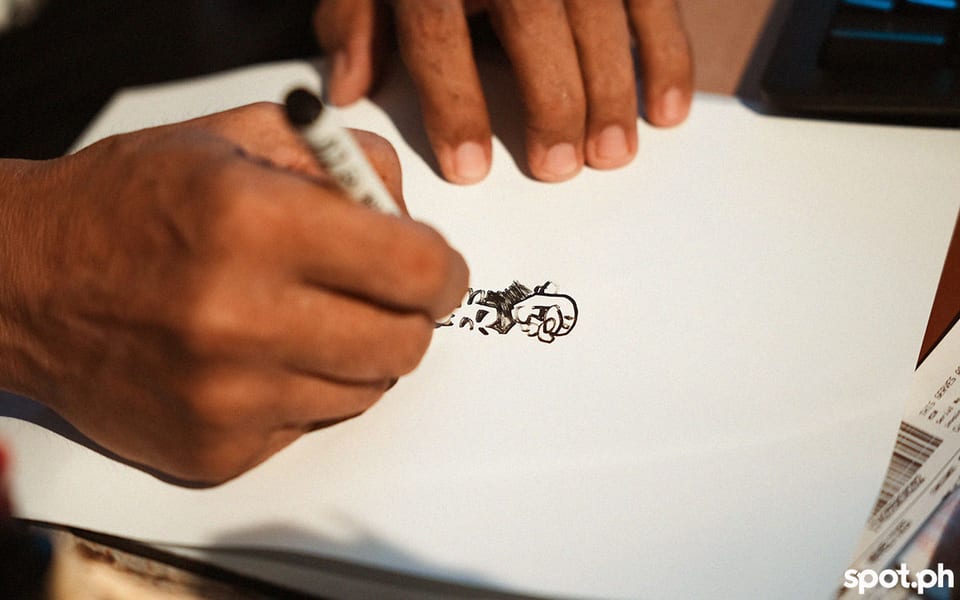
He started drawing before he could even walk, using charcoal—or uling—that he picked up in the family house to doodle on their wall. In first grade, when the teacher told their class to draw a cat, he was already being extra. “My classmates did ‘small circle, big circle,’” Medina says. “My drawing was like Garfield. That’s when I knew I wanted to be an illustrator.”
At 14, he was invited to be a cartoonist for his parish newsletter in Parañaque.
"But I didn't know how to do comics. My drawings were anatomical. I would draw Superman, Batman... May abs eh." But he gave it a shot and the move proved to be pivotal. “That’s when I realized my comedy style is satirical.”
The priest, however, wasn’t amused. “Why is this cartoonist attacking us?” he asked.
The comics were scrapped after just two strips. “Na-sesante ako (I got fired),” Medina laughs. “Okay lang, wala namang bayad (It’s okay, they weren’t paying anyway).”
“Na-sesante ako” is a phrase he knows all too well. But we’ll get to that.
Around 24, Medina—by then an Architecture graduate from the University of Santo Tomas—wanted to return to comics. But it was too risky. “Tinitira ko yung gobyerno under Marcos. Sabi ko, ‘di uubra ’to. (I was criticizing the Marcos government. I said, this won’t work.) But I couldn’t force myself to create something wholesome like Peanuts. Satire and social commentary were really my style.”
Two years later, he’d head to Iraq—this was during the Iran-Iraq war—to work for an Italian construction company. "Nabuang ako doon eh, ang lungkot kasi. (I went crazy there because it was so sad.) I was so sad that I wasn't designing. So I started drawing. That's where I released my frustrations about the government, about Marcos."
At 14, he was invited to be a cartoonist for his parish newsletter in Parañaque.
"But I didn't know how to do comics. My drawings were anatomical. I would draw Superman, Batman... May abs eh." But he gave it a shot and the move proved to be pivotal. “That’s when I realized my comedy style is satirical.”
The priest, however, wasn’t amused. “Why is this cartoonist attacking us?” he asked.
The comics were scrapped after just two strips. “Na-sesante ako (I got fired),” Medina laughs. “Okay lang, wala namang bayad (It’s okay, they weren’t paying anyway).”
“Na-sesante ako” is a phrase he knows all too well. But we’ll get to that.
Around 24, Medina—by then an Architecture graduate from the University of Santo Tomas—wanted to return to comics. But it was too risky. “Tinitira ko yung gobyerno under Marcos. Sabi ko, ‘di uubra ’to. (I was criticizing the Marcos government. I said, this won’t work.) But I couldn’t force myself to create something wholesome like Peanuts. Satire and social commentary were really my style.”
Two years later, he’d head to Iraq—this was during the Iran-Iraq war—to work for an Italian construction company. "Nabuang ako doon eh, ang lungkot kasi. (I went crazy there because it was so sad.) I was so sad that I wasn't designing. So I started drawing. That's where I released my frustrations about the government, about Marcos."
.jpg?fit=cover&width=960&q=82)
Click to Enlarge
With his latest book which is also headed for the Komiket this weekend. Medina calls the Filipino comics scene “vibrant.” “It’s a new renaissance, thanks to Comic Con, Komiket, PICOF, and comic book stores.” Photograph by Paul Sugano.
The Birth of Polgas
One day in Iraq, a dog started visiting Medina. “He wasn’t cute, but he became my friend,” he says. Medina gave him food from the mess hall, and the dog kept coming back. He named him Polgas.
They became inseparable, Pol and Polgas. “He’d sleep in our trailer. I’d talk and joke with him.”
One night, Medina mentioned wanting Italian shoes. The next day, a pair in his size mysteriously appeared. No one knew where they came from.
“It was like he understood me,” Medina says. “That’s how I created the character Polgas.”
Four months into his life in Iraq, Medina started building the world and creating the characters that would later be known as Pugad Baboy. They, along with the seemingly magical dog, kept him company through his loneliness overseas.
When it was time to return to the Philippines, Medina wanted to bring Polgas with him but he wasn’t allowed to. "Can you imagine, you could bring home a gun, a Kalashnikov? ‘No problem,' they said. I said, 'How about my dog?' 'Di daw pwede yung aso (No, not the dog)."
After two years together, saying goodbye was hard. But Medina found a fellow dog-loving Filipino in Iraq to care for Polgas, making sure he’d be treated well. "I really tried to find out sino talaga yung mabait sa aso kasi baka pabayaan lang (who is really kind to dogs because he might be neglected)."
He did get to bring Polgas home in another way—through his comics.
Polgas, the beloved anthropomorphic dog of Pugad Baboy, was just the beginning. The other characters were inspired by people in Medina’s life—friends, neighbors, members of his family. Some of the characters were inspired by Medina, too—Dagul, Utoy, even Polgas, the characters who wore an earring, because back then, Medina wore one as well.
They became inseparable, Pol and Polgas. “He’d sleep in our trailer. I’d talk and joke with him.”
One night, Medina mentioned wanting Italian shoes. The next day, a pair in his size mysteriously appeared. No one knew where they came from.
“It was like he understood me,” Medina says. “That’s how I created the character Polgas.”
Four months into his life in Iraq, Medina started building the world and creating the characters that would later be known as Pugad Baboy. They, along with the seemingly magical dog, kept him company through his loneliness overseas.
When it was time to return to the Philippines, Medina wanted to bring Polgas with him but he wasn’t allowed to. "Can you imagine, you could bring home a gun, a Kalashnikov? ‘No problem,' they said. I said, 'How about my dog?' 'Di daw pwede yung aso (No, not the dog)."
After two years together, saying goodbye was hard. But Medina found a fellow dog-loving Filipino in Iraq to care for Polgas, making sure he’d be treated well. "I really tried to find out sino talaga yung mabait sa aso kasi baka pabayaan lang (who is really kind to dogs because he might be neglected)."
He did get to bring Polgas home in another way—through his comics.
Polgas, the beloved anthropomorphic dog of Pugad Baboy, was just the beginning. The other characters were inspired by people in Medina’s life—friends, neighbors, members of his family. Some of the characters were inspired by Medina, too—Dagul, Utoy, even Polgas, the characters who wore an earring, because back then, Medina wore one as well.
Click to Enlarge
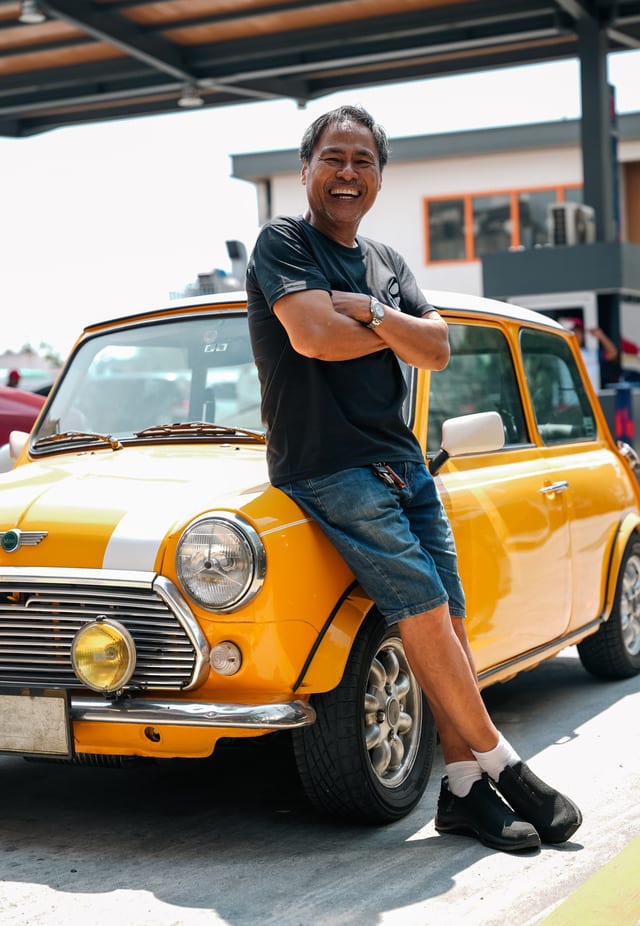
Medina, like the rest of his family, used to have a 50-inch waist, or so he claims. After his doctor told him he was prediabetic, he dropped the extra pounds. Photograph by Paul Sugano.
Land of the Fifty-inch Waistlines
"For Pugad Baboy, I made their bodies really big because the characters were modeled after my family. All of us, Tiny, my kuya, lahat kami at least 50 yung bewang (we all had 50-inch waistlines). Sabi ko, ‘Ituloy ko na kaya na lahat sila mataba? (I said, ‘What if I made them all really fat)?’”
The real people loved being turned into comic strip characters, Medina says. In fact, there were others who even asked to be included, telling the cartoonist, “Huy, 50 na yung bewang ko. (Hey, my waistline is now 50 inches.)"
When asked which other Pugad Baboy elements are from his life, he says, “All of them.”
The Pugad Baboy neighborhood was inspired by Marcelo Green Village in Parañaque where Medina used to live. And it wasn’t just his family members’ physical appearance or their surroundings that he captured in the strip. Medina credits them for Pugad Baboy’s humor. "All of them are funny except for me. I'm like a sponge. When they see my comics, my siblings would go, ‘Uy, joke ko yan ah (Hey, that's my joke).’”
His father, an Air Force general during the time of Ferdinand Marcos, and Pol's mom, an elementary and high school teacher, were also gifted with wit. "My parents were deadpan. Sarcasm was their thing."
Satire, meanwhile, was Pol's.
He didn’t pursue comics immediately after getting back from Iraq. Flush with dollars, he opened two businesses: a piggery in Cavite and his own architecture firm. Clients wanted a more established architect, so business was slow. The piggery also struggled—at one point its roof was blown away by a strong wind.
The real people loved being turned into comic strip characters, Medina says. In fact, there were others who even asked to be included, telling the cartoonist, “Huy, 50 na yung bewang ko. (Hey, my waistline is now 50 inches.)"
When asked which other Pugad Baboy elements are from his life, he says, “All of them.”
The Pugad Baboy neighborhood was inspired by Marcelo Green Village in Parañaque where Medina used to live. And it wasn’t just his family members’ physical appearance or their surroundings that he captured in the strip. Medina credits them for Pugad Baboy’s humor. "All of them are funny except for me. I'm like a sponge. When they see my comics, my siblings would go, ‘Uy, joke ko yan ah (Hey, that's my joke).’”
His father, an Air Force general during the time of Ferdinand Marcos, and Pol's mom, an elementary and high school teacher, were also gifted with wit. "My parents were deadpan. Sarcasm was their thing."
Satire, meanwhile, was Pol's.
He didn’t pursue comics immediately after getting back from Iraq. Flush with dollars, he opened two businesses: a piggery in Cavite and his own architecture firm. Clients wanted a more established architect, so business was slow. The piggery also struggled—at one point its roof was blown away by a strong wind.
Both businesses folded. "Ubos pera ko. (I ran out of money.) I needed money. I said, I need to do what I'm really good at. I worked for a big firm and became project architect—the highest position before partner—but I didn’t think I was good at it. I decided to focus on comics."
.jpg?fit=cover&width=960&q=82)
Click to Enlarge
Wrong Directions
Medina, then 28, worked on six strips and headed out, determined to bring his work to The Manila Bulletin.
In Intramuros, where the national daily’s headquarters was located, he was given the wrong directions and ended up at the Philippine Daily Inquirer. “While I was standing there, a junior editor saw me and said, "Uy, comics yan ah, come in, I'll introduce you to Jess."
That would be Jess Abrera, the Inquirer's editorial cartoonist.
Seeing Medina's work, Jess said, "Okay 'to ah." He told Medina he'd show it to the paper's editor-in-chief and if it was approved, it would be published in Inquirer's pages.
Medina protested, saying, "Hindi, ipe-peddle ko pa yan sa Bulletin. (No, I'm still going to bring this to Bulletin.)"
“Hindi, gago,” Jess told him.
“Si Jess mahilig mag-gago yun eh. ‘Magbu-Bulletin ka ba? Gago ka talaga, dito ka na lang.' Sabay alis. (‘No, you dumbass.’ Jess likes saying ‘dumbass’ a lot. ‘Are you going to Bulletin? You’re really a dumbass, just work here.’ Then he left.)"
Jess had gotten his strips, which were Medina’s original copies. "I took the jeep home. Before I even got there, Jess had already called. My mom said, 'Someone called looking for you, a Jess Abrera from Inquirer.' Jess said, 'Ilalabas ko na 'to, gago ka (I'm publishing these, you dumbass)'," Medina recalls, laughing.
But before that, he needed a title. "I said Barrio Bondat.”
In Intramuros, where the national daily’s headquarters was located, he was given the wrong directions and ended up at the Philippine Daily Inquirer. “While I was standing there, a junior editor saw me and said, "Uy, comics yan ah, come in, I'll introduce you to Jess."
That would be Jess Abrera, the Inquirer's editorial cartoonist.
Seeing Medina's work, Jess said, "Okay 'to ah." He told Medina he'd show it to the paper's editor-in-chief and if it was approved, it would be published in Inquirer's pages.
Medina protested, saying, "Hindi, ipe-peddle ko pa yan sa Bulletin. (No, I'm still going to bring this to Bulletin.)"
“Hindi, gago,” Jess told him.
“Si Jess mahilig mag-gago yun eh. ‘Magbu-Bulletin ka ba? Gago ka talaga, dito ka na lang.' Sabay alis. (‘No, you dumbass.’ Jess likes saying ‘dumbass’ a lot. ‘Are you going to Bulletin? You’re really a dumbass, just work here.’ Then he left.)"
Jess had gotten his strips, which were Medina’s original copies. "I took the jeep home. Before I even got there, Jess had already called. My mom said, 'Someone called looking for you, a Jess Abrera from Inquirer.' Jess said, 'Ilalabas ko na 'to, gago ka (I'm publishing these, you dumbass)'," Medina recalls, laughing.
But before that, he needed a title. "I said Barrio Bondat.”
.jpg?fit=cover&width=960&q=82)
Click to Enlarge
A Pugad Baboy artwork. "For Pugad Baboy, I made their bodies really big because the characters were modeled after my family," says Medina. "All of us, Tiny, my kuya, lahat kami at least 50 yung bewang.".
He thought of other names then he remembered a place in Bulacan—a friend's piggery. “I said to Jess, put Pugad Baboy. And he said, 'Are you sure? Hindi maganda pakinggan eh (It's not pleasing to the ears).' I said, 'They're all fat so Pugad Baboy.' He said, 'You're really sure? I will really come out with this, there's no turning back now.' 'Yes, Pugad Baboy by PMJR.”
This was the beginning of what would be Pugad Baboy's 25-year run at the Inquirer.
During those early days, Medina was being paid P35 for each comic strip. And because this was before the internet, he had to hand deliver his strips to the office, often riding a bike from Parañaque all the way to Inquirer in Intramuros and, later, on UN Avenue in Malate.
He supplemented his income from the paper with day jobs including the time he spent as a copywriter at McCann Erickson. “Kartunero”—that’s what McCann’s Emily Abrera called him.
Pugad Baboy was a hit with the readers. "Wala pang e-mail noon but they would send letters to the editor." Medina listened to what readers wanted. More political strips? Sure. More social commentary? Okay. But censorship was another thing. “Inquirer gave me a list of taboo subjects—religion, race... I violated all of them.”
This was the beginning of what would be Pugad Baboy's 25-year run at the Inquirer.
During those early days, Medina was being paid P35 for each comic strip. And because this was before the internet, he had to hand deliver his strips to the office, often riding a bike from Parañaque all the way to Inquirer in Intramuros and, later, on UN Avenue in Malate.
He supplemented his income from the paper with day jobs including the time he spent as a copywriter at McCann Erickson. “Kartunero”—that’s what McCann’s Emily Abrera called him.
Pugad Baboy was a hit with the readers. "Wala pang e-mail noon but they would send letters to the editor." Medina listened to what readers wanted. More political strips? Sure. More social commentary? Okay. But censorship was another thing. “Inquirer gave me a list of taboo subjects—religion, race... I violated all of them.”
Click to Enlarge
The St. Scho brouhaha
Some of his comic strips pushed the boundaries so far they never made it to print. It was one of these strips that would lead to Medina’s departure from Inquirer—the controversial comic strip that St. Scholastica's College threatened to sue the paper over.
According to the newspaper, the strip, which had two characters talking about lesbianism, nuns, and the hypocrisy of homophobic Christians had been archived without seeing print in April 2013. On June 4 of the same year, it was mistakenly published.
Inquirer announced it would not come out with the Pugad Baboy comic strips while they investigated. There was uproar. Many came to Medina’s defense, among them PDI columnist Conrado De Quiros who wrote, “The Inquirer has just lost the best comic strip in town.”
According to the newspaper, the strip, which had two characters talking about lesbianism, nuns, and the hypocrisy of homophobic Christians had been archived without seeing print in April 2013. On June 4 of the same year, it was mistakenly published.
Inquirer announced it would not come out with the Pugad Baboy comic strips while they investigated. There was uproar. Many came to Medina’s defense, among them PDI columnist Conrado De Quiros who wrote, “The Inquirer has just lost the best comic strip in town.”
Medina apologized to the school and resigned via a short letter to Inquirer editor-in-chief Letty Jimenez-Magsanoc. It read: “Ma'am: Sorry I dishonored you. I resign.”
Twelve years later, Medina tells Spot, “Nahiya ako kay Letty. Pinagtatanggol ako nun eh, nung kay Erap. (I was ashamed that I let Letty down. She was my defender, especially during Joseph Estrada’s time.)”
His wife Susan, who is good with finances, made smart investments when they started making money. She was convinced they’d be fine.
Did he ever think there would be such fallout as he worked on that strip? “No,” he says. “I’m like South Park, I really named the school. I should have just hinted at it. Mali talaga eh. (It was really wrong.)”
But not everyone from St. Scholastica’s was offended. In fact, there was even a Kulasas for Pol Medina, Jr. Facebook page.
He reveals that Inquirer asked him to return to the paper. “Gusto nila pagalitan yung nag-archive. (They wanted to scold the person who archived it.) But I said it wasn’t his fault. If I didn’t create that strip, none of this would have happened. They said, come back. But I said, St. Scho is still planning to sue… Para wala nang madamay, magre-resign na lang ako. (So that no one else gets dragged into this, I will just resign.)”
Medina still uses the word “sesante” (fired) when he talks about that time, even though he chose to go.
He says leaving the Inquirer was “liberating.” But didn’t he feel bad? “You know why? It’s because of my wife. Sabi niya, ‘Actually, you don’t need it. I’ll be your sugar mommy.’”
Medina still uses the word “sesante” (fired) when he talks about that time, even though he chose to go.
He says leaving the Inquirer was “liberating.” But didn’t he feel bad? “You know why? It’s because of my wife. Sabi niya, ‘Actually, you don’t need it. I’ll be your sugar mommy.’”
His wife Susan, who is good with finances, made smart investments when they started making money. She was convinced they’d be fine.
Did he ever think there would be such fallout as he worked on that strip? “No,” he says. “I’m like South Park, I really named the school. I should have just hinted at it. Mali talaga eh. (It was really wrong.)”
But not everyone from St. Scholastica’s was offended. In fact, there was even a Kulasas for Pol Medina, Jr. Facebook page.
.jpg?fit=cover&width=960&q=82)
Click to Enlarge
Going Online
It would also be a Kulasa who would offer Medina his next job—Maria Ressa of Rappler. She asked if he wanted to continue his comics. “Sabi ko, ‘Kahit hindi na.’ (I told her I don’t have to.) Sabi niya, ‘Sayang naman. (She said, ‘What a shame.’) Your readers are emotionally invested. Let’s continue it online.”
There were offers from other online outlets but what finally convinced him to go with Rappler was the pay. “I gave a ridiculous amount, thinking they wouldn't agree. But they did.”
He stayed with Rappler until—there’s that phrase again—“Na-sesante ako. My readership was huge in the first year but then it waned. My pay was no longer practical.” (SPOT.ph reached out to Rappler to confirm this. According to Executive Editor Glenda Gloria, "This was under the Duterte years when we were under attack and [Rappler] had to do belt-tightening, juggle priorities.")
As his time at Rappler was coming to an end, Medina started wrapping up the story of Pugad Baboy. He was ready to say goodbye. But his readers weren’t happy. “A lot of people wrote to me. ‘Ang kapal ng mukha mo, invested na kami dyan, bigla ka na lang aalis?’ (How dare you, we’re already invested and you’re just gonna leave?’” Medina shares, laughing.
That’s when he took the comic strip to The Philippine Star.
We ask: Why not Manila Bulletin—wasn’t that his original dream?
“Oo nga no?” he says, amused. “Roni Santiago could have gotten me.”
We ask if Santiago, Bulletin’s editorial cartoonist and creator of Baltic & Co., ever learned that Medina had originally wanted to offer Pugad Baboy to him. Yes, Medina said, adding, “When he found out, he said, ‘Dapat pala sa akin ka eh... Kung nasa sa akin ka eh di hindi ka sana na-sesante. (You should have been with me… if you had been with me then maybe you wouldn’t have gotten fired.)"
There were offers from other online outlets but what finally convinced him to go with Rappler was the pay. “I gave a ridiculous amount, thinking they wouldn't agree. But they did.”
He stayed with Rappler until—there’s that phrase again—“Na-sesante ako. My readership was huge in the first year but then it waned. My pay was no longer practical.” (SPOT.ph reached out to Rappler to confirm this. According to Executive Editor Glenda Gloria, "This was under the Duterte years when we were under attack and [Rappler] had to do belt-tightening, juggle priorities.")
As his time at Rappler was coming to an end, Medina started wrapping up the story of Pugad Baboy. He was ready to say goodbye. But his readers weren’t happy. “A lot of people wrote to me. ‘Ang kapal ng mukha mo, invested na kami dyan, bigla ka na lang aalis?’ (How dare you, we’re already invested and you’re just gonna leave?’” Medina shares, laughing.
That’s when he took the comic strip to The Philippine Star.
We ask: Why not Manila Bulletin—wasn’t that his original dream?
“Oo nga no?” he says, amused. “Roni Santiago could have gotten me.”
We ask if Santiago, Bulletin’s editorial cartoonist and creator of Baltic & Co., ever learned that Medina had originally wanted to offer Pugad Baboy to him. Yes, Medina said, adding, “When he found out, he said, ‘Dapat pala sa akin ka eh... Kung nasa sa akin ka eh di hindi ka sana na-sesante. (You should have been with me… if you had been with me then maybe you wouldn’t have gotten fired.)"
And so Pugad Baboy’s next home would be The Philippine Star. They matched his pay at Rappler. He would stay there for a year.
These days, Medina won’t have any use for that word "sesante" anymore. He’s been independent since 2019, coming out with his comics on Facebook and Instagram. “Now that I don’t have editors, no one’s curating my work. Back when I was with Inquirer, I’d write ‘badoodles,’ now I really put ‘betlog.’ Nothing is prohibited.”
No longer having to follow a newspaper’s rhythm means Medina doesn’t release comics daily. But he still makes sure to spend time in his studio every day. “Masama loob ko pag isang buong araw hindi ako makaupo dun kahit mag-pencil lang. Hindi buo ang araw ko. (I feel bad if a day passes and I can’t sit there, even just to pencil. My day doesn’t feel complete.”)
Does he ever run out of ideas? “George RR Martin asked Stephen King if he ever experiences writer’s block. Stephen King said no. I thought, 'Ang yabang naman nito.' Tapos inisip ko, pucha ako rin ah. (I thought, 'He’s so arrogant.' Then I realized, heck, me too.)"
Medina has a notebook where he jots down ideas. “Because otherwise, you’d forget.”
He still likes drawing by hand and he colors his work digitally. “But I’ve gone back to watercolor. You’ll see the difference. Plus, when you do it by hand, you’ll have an original that you can sell after you die,” he says with a laugh.
How has the internet affected the way he works? “Instantaneous yung reaction eh. (The reaction is instant.) When I was at Rappler, I’d submit and suddenly there would be all these comments. But I didn’t have to engage because it’s my readers who do the talking for me.”
It must be challenging for an artist as unfiltered as Medina to live in this increasingly woke and politically correct world, where people are so easily offended and so terrified of offending. His response was to create a new character named Severo Morales. “Severe morals. He’s the SJW (social justice warrior) in my comics. He’s the one saying ‘you can’t say that.’”
These days, Medina won’t have any use for that word "sesante" anymore. He’s been independent since 2019, coming out with his comics on Facebook and Instagram. “Now that I don’t have editors, no one’s curating my work. Back when I was with Inquirer, I’d write ‘badoodles,’ now I really put ‘betlog.’ Nothing is prohibited.”
No longer having to follow a newspaper’s rhythm means Medina doesn’t release comics daily. But he still makes sure to spend time in his studio every day. “Masama loob ko pag isang buong araw hindi ako makaupo dun kahit mag-pencil lang. Hindi buo ang araw ko. (I feel bad if a day passes and I can’t sit there, even just to pencil. My day doesn’t feel complete.”)
Does he ever run out of ideas? “George RR Martin asked Stephen King if he ever experiences writer’s block. Stephen King said no. I thought, 'Ang yabang naman nito.' Tapos inisip ko, pucha ako rin ah. (I thought, 'He’s so arrogant.' Then I realized, heck, me too.)"
Medina has a notebook where he jots down ideas. “Because otherwise, you’d forget.”
He still likes drawing by hand and he colors his work digitally. “But I’ve gone back to watercolor. You’ll see the difference. Plus, when you do it by hand, you’ll have an original that you can sell after you die,” he says with a laugh.
How has the internet affected the way he works? “Instantaneous yung reaction eh. (The reaction is instant.) When I was at Rappler, I’d submit and suddenly there would be all these comments. But I didn’t have to engage because it’s my readers who do the talking for me.”
It must be challenging for an artist as unfiltered as Medina to live in this increasingly woke and politically correct world, where people are so easily offended and so terrified of offending. His response was to create a new character named Severo Morales. “Severe morals. He’s the SJW (social justice warrior) in my comics. He’s the one saying ‘you can’t say that.’”
Click to Enlarge
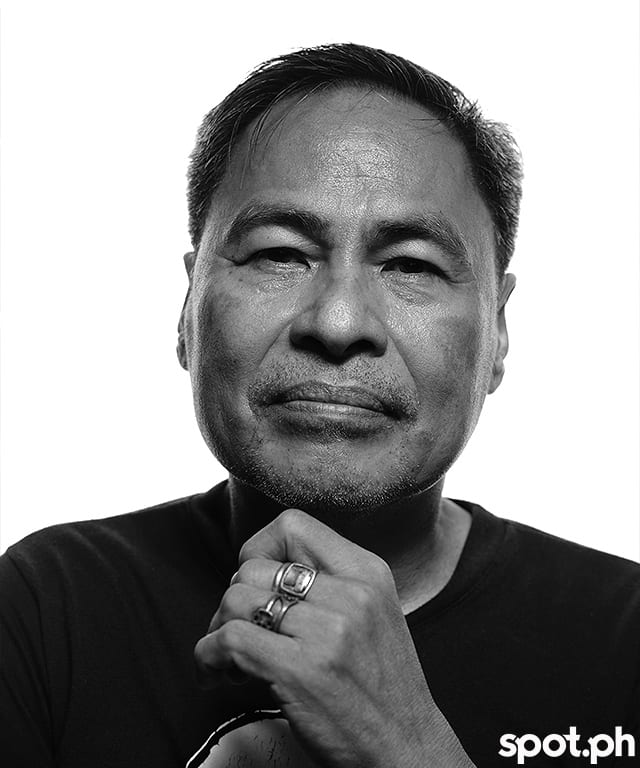
Does he run out of ideas? “George RR Martin asked Stephen King if he ever experiences writer’s block. Stephen King said no. I thought, 'Ang yabang naman nito.' Tapos inisip ko, pucha ako rin ah." Photograph by Paul Sugano.
Bakit Wala Pang Award si Pol Medina Jr?
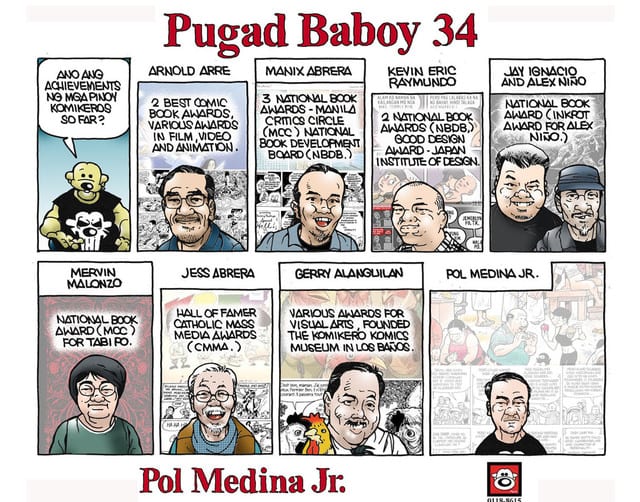
Medina recently posted a strip from Pugad Baboy 34 on Facebook. Each panel showed a Filipino komikero with a list of the awards they’ve received. There were many—Catholic Mass Media Awards, National Book Awards. The last panel showed Medina with no award to his name. It was a strip that made people wonder: “Oo nga, bakit wala pang award si Pol Medina Jr.? (Yeah, how come he doesn’t have an award yet?)”
But Medina isn’t surprised. “Hindi ako nagtataka eh. I stepped on a lot of toes. I’m not wholesome, no matter where you put me.”
In the comments section of that post, Medina was showered with awards by his fans and followers: “darling of the crowd award,” “Pol-itzer prize,” “most behaved,” “inspiration for thousands of komikeros.”
But Medina isn’t surprised. “Hindi ako nagtataka eh. I stepped on a lot of toes. I’m not wholesome, no matter where you put me.”
In the comments section of that post, Medina was showered with awards by his fans and followers: “darling of the crowd award,” “Pol-itzer prize,” “most behaved,” “inspiration for thousands of komikeros.”
Medina says, “Those are my friends that’s why they’re being nice. If you talk to the bishops, they’ll say, ‘Buti nga! (‘Serves him right!’)"
It makes him happy to see younger komikeros receive accolades. “Sila Manix [Abrera], all of them, they would tell me, ‘Salamat, Sir Pol, you paved the way for us.’ When they receive those awards, pucha, it feels like I’m the one getting them too.”
It makes him happy to see younger komikeros receive accolades. “Sila Manix [Abrera], all of them, they would tell me, ‘Salamat, Sir Pol, you paved the way for us.’ When they receive those awards, pucha, it feels like I’m the one getting them too.”
Click to Enlarge
A recent post on Medina's Facebook wall, and the inspiration for this story..
He has a beautiful relationship with the younger komikeros—he even collaborates with some of them. “I idolize them, I buy their books. They would see it and return my money.”
Kevin Eric Raymundo is the most vocal, Medina shares. He would say, “Kung walang Pugad Baboy, walang Tarantadong Kalbo (If there was no Pugad Baboy, there would be no Tarantadong Kalbo).”
One popular young artist, Allan Jeffrey C. Bacar or SSKAIT, was his daughter’s classmate. “Every time I’d pick her up, he’d be so happy to see me. He asked my daughter what I studied in college. Engineering, she said, and so he took up engineering. It was too late when he realized it was Architecture that I studied.” SSKAIT was the one who taught him the proper ratio for uploading his comics on Instagram.
Kevin Eric Raymundo is the most vocal, Medina shares. He would say, “Kung walang Pugad Baboy, walang Tarantadong Kalbo (If there was no Pugad Baboy, there would be no Tarantadong Kalbo).”
One popular young artist, Allan Jeffrey C. Bacar or SSKAIT, was his daughter’s classmate. “Every time I’d pick her up, he’d be so happy to see me. He asked my daughter what I studied in college. Engineering, she said, and so he took up engineering. It was too late when he realized it was Architecture that I studied.” SSKAIT was the one who taught him the proper ratio for uploading his comics on Instagram.
Medina calls the Filipino comics scene “vibrant.” “It’s a new renaissance, thanks to Comic Con, Komiket, PICOF, and comic book stores.”
Click to Enlarge
Family Affair
At the conventions, Medina, dad of six and grandpa of five, has one of his sons with him—the cartoonist even shares his booth with his son’s girlfriend who is an artist. His brother-in-law helps him run his printing house where they use a Heidelberg KORD 64, which Medina says is “the Mercedes Benz of printing machines.” Pugad Baboy has become a family affair for them.
It was his wife Susan who convinced him they should publish his books themselves so they could keep the revenue instead of just getting 15% for each book sold. Her business acumen and support aren't her only contributions to the Pugad Baboy empire—her humor has been part of Pugad Baboy too.
“Yung wife ko alaskador eh. Siya si Brosia eh," says Medina. "And she needed that sense of humor because when we first lived together, it was like a squatter’s area—a socialized housing in Villamor.”
When GMA 7 adapted Pugad Baboy into a short-lived sit-com in 1993, Susan used the money to buy a townhouse for the family. Today, they live in Las Piñas with some of their kids and their grandsons Caden and Clark. “Tuwang-tuwa ako kasi nakikita ko sila araw-araw (It makes me so happy to see them every day.) They like doing everything with me—even cleaning my car.”
Caden is a budding artist. His grandpa has already framed one of his paintings. “When I saw his first painting, I said, ‘Holy shit! Parang amphora…”
What if Caden tells him he wants to be a komikero too? “Ang sarap nun (That would feel so good).”
The only one among his kids who followed his footsteps was Maia who has recently chosen to focus on her career in HR. “Pinilit ko eh, sa Book 20 nilabas ko trabaho nya, sabi ko gawa ka pa. Gusto ko yung humor nya eh. (I published her work in Book 20, I told her to keep doing it, I like her humor.)”
Medina is also illustrating his youngest son Pablo’s first novel. It should be out by next year.
It is Medina’s hope that his family would continue his legacy. “Sana, sana. (I hope, I hope.)”
He wishes his parents could have seen his success. He remembers the first time he showed Pugad Baboy to his mom. ‘I told her, ‘Look at this new comic strip.’ She said, ‘Pwe.’ I said, ‘Ako gumawa niyan eh.' (I was the one who made that.) Sabi nya, 'Maganda.' (It’s nice.)’"
But she was disappointed that he chose to be a cartoonist. “Her shoulders would drop. She sent me to school for five years, put the word ‘Arch.’ before my name and I chose to be a clown.”
He continued, “They died disappointed. Daddy died while I was in Iraq. I couldn’t go home because Baghdad was in chaos and the airport was there. When I returned home and Pugad Baboy became popular, my mother became bedridden. They didn’t see me have my own houses, they didn’t see me succeed.”
Medina remembers talking to his bedridden mother one day. “I knew she was listening. I said, ‘Mommy, kilala ako sa buong Pilipinas and yung mga diasporic na Pilipino sa buong mundo kilala ako. Kilala ba nila si Nel?’ Si Nel yung nag-udyok sa akin maging architect. (‘Mommy, the whole country knows me, even Filipinos all over the world know me. Do they know who Nel is?’ Nel is the guy who convinced me to be an architect.)"
It was his wife Susan who convinced him they should publish his books themselves so they could keep the revenue instead of just getting 15% for each book sold. Her business acumen and support aren't her only contributions to the Pugad Baboy empire—her humor has been part of Pugad Baboy too.
“Yung wife ko alaskador eh. Siya si Brosia eh," says Medina. "And she needed that sense of humor because when we first lived together, it was like a squatter’s area—a socialized housing in Villamor.”
When GMA 7 adapted Pugad Baboy into a short-lived sit-com in 1993, Susan used the money to buy a townhouse for the family. Today, they live in Las Piñas with some of their kids and their grandsons Caden and Clark. “Tuwang-tuwa ako kasi nakikita ko sila araw-araw (It makes me so happy to see them every day.) They like doing everything with me—even cleaning my car.”
Caden is a budding artist. His grandpa has already framed one of his paintings. “When I saw his first painting, I said, ‘Holy shit! Parang amphora…”
What if Caden tells him he wants to be a komikero too? “Ang sarap nun (That would feel so good).”
The only one among his kids who followed his footsteps was Maia who has recently chosen to focus on her career in HR. “Pinilit ko eh, sa Book 20 nilabas ko trabaho nya, sabi ko gawa ka pa. Gusto ko yung humor nya eh. (I published her work in Book 20, I told her to keep doing it, I like her humor.)”
Medina is also illustrating his youngest son Pablo’s first novel. It should be out by next year.
It is Medina’s hope that his family would continue his legacy. “Sana, sana. (I hope, I hope.)”
He wishes his parents could have seen his success. He remembers the first time he showed Pugad Baboy to his mom. ‘I told her, ‘Look at this new comic strip.’ She said, ‘Pwe.’ I said, ‘Ako gumawa niyan eh.' (I was the one who made that.) Sabi nya, 'Maganda.' (It’s nice.)’"
But she was disappointed that he chose to be a cartoonist. “Her shoulders would drop. She sent me to school for five years, put the word ‘Arch.’ before my name and I chose to be a clown.”
He continued, “They died disappointed. Daddy died while I was in Iraq. I couldn’t go home because Baghdad was in chaos and the airport was there. When I returned home and Pugad Baboy became popular, my mother became bedridden. They didn’t see me have my own houses, they didn’t see me succeed.”
Medina remembers talking to his bedridden mother one day. “I knew she was listening. I said, ‘Mommy, kilala ako sa buong Pilipinas and yung mga diasporic na Pilipino sa buong mundo kilala ako. Kilala ba nila si Nel?’ Si Nel yung nag-udyok sa akin maging architect. (‘Mommy, the whole country knows me, even Filipinos all over the world know me. Do they know who Nel is?’ Nel is the guy who convinced me to be an architect.)"
Click to Enlarge
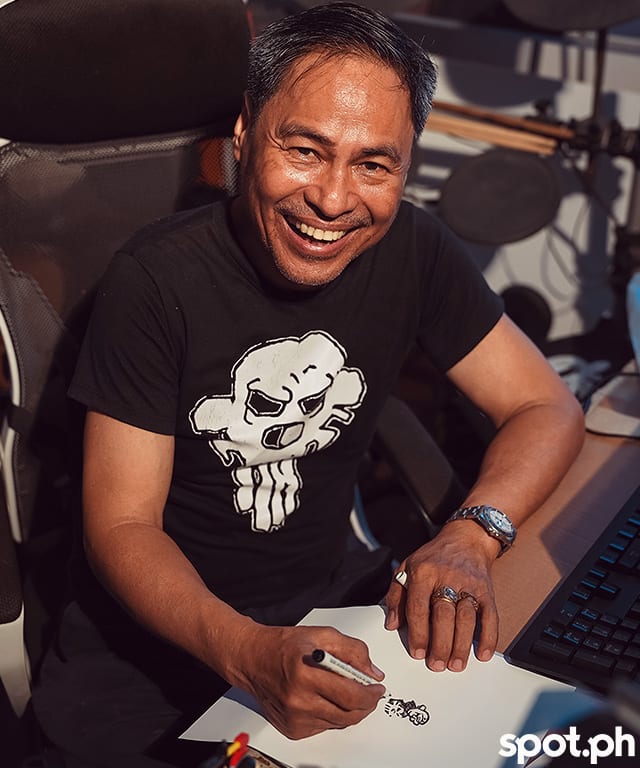
In his studio at home. “Masama loob ko pag isang buong araw hindi ako makaupo dun kahit mag-pencil lang. Hindi buo ang araw ko." Photograph by Paul Sugano.
'I Was Dreaming of a Pugad Baboy Land'
Medina doesn’t see himself ever retiring. “During his last days, Larry Alcala’s art had become shaky but he never stopped drawing. He kept going until he died. Charles Schulz was like that too. I want to do the same—yung pangit na yung drawing ko pero ginagawa ko pa rin (I want to get so old that my drawings turn bad and I’ll keeping doing it anyway).”
Longevity is important to Medina. It’s what made him change his diet and drop those pounds when his doctor told him he was prediabetic. His waist is no longer 50 inches.
He still has a lot of things he wants to do. “I was dreaming of a Pugad Baboy Land. I want to do animation but I don’t have time to study it.”
He’s working on his next books, a Brosia special and a compilation of his editorial cartoons from The Philippine Star. “My computer crashed and I lost my cartoons but they’ve been so helpful. Ang bait eh,” he said.
He also has to keep illustrating his son’s novel. “Hindi pwedeng pangitan ‘pag novel ng anak mo eh. (You can't make your child's novel look bad.)”
But first, he’s spending the weekend at Komiket in Ayala Malls Manila Bay where he’ll likely be hearing the same line he’s been hearing from people for years now: “I’ve been reading you since I was in grade school.”
"It’s always the same thing. My son finds it amusing," he says.
There are many who grew up with Medina and Pugad Baboy but new generations are also discovering his work. He even has a four-year-old fan. “He just finds Polgas cute. He doesn’t really read the strips. There are eight-year-olds who read but find the pilyo parts confusing.”
He recalls a 13-year-old who was so excited to meet him. “That girl really reads them. She was giggling and bouncing as I was signing her book.”
Pugad Baboy even has international fans, including a French guy whose wife translates the strips for him. “She must be funny if she’s able to translate them in French because she has to colloquialize them.”
Longevity is important to Medina. It’s what made him change his diet and drop those pounds when his doctor told him he was prediabetic. His waist is no longer 50 inches.
He still has a lot of things he wants to do. “I was dreaming of a Pugad Baboy Land. I want to do animation but I don’t have time to study it.”
He’s working on his next books, a Brosia special and a compilation of his editorial cartoons from The Philippine Star. “My computer crashed and I lost my cartoons but they’ve been so helpful. Ang bait eh,” he said.
He also has to keep illustrating his son’s novel. “Hindi pwedeng pangitan ‘pag novel ng anak mo eh. (You can't make your child's novel look bad.)”
But first, he’s spending the weekend at Komiket in Ayala Malls Manila Bay where he’ll likely be hearing the same line he’s been hearing from people for years now: “I’ve been reading you since I was in grade school.”
"It’s always the same thing. My son finds it amusing," he says.
There are many who grew up with Medina and Pugad Baboy but new generations are also discovering his work. He even has a four-year-old fan. “He just finds Polgas cute. He doesn’t really read the strips. There are eight-year-olds who read but find the pilyo parts confusing.”
He recalls a 13-year-old who was so excited to meet him. “That girl really reads them. She was giggling and bouncing as I was signing her book.”
Pugad Baboy even has international fans, including a French guy whose wife translates the strips for him. “She must be funny if she’s able to translate them in French because she has to colloquialize them.”
Click to Enlarge
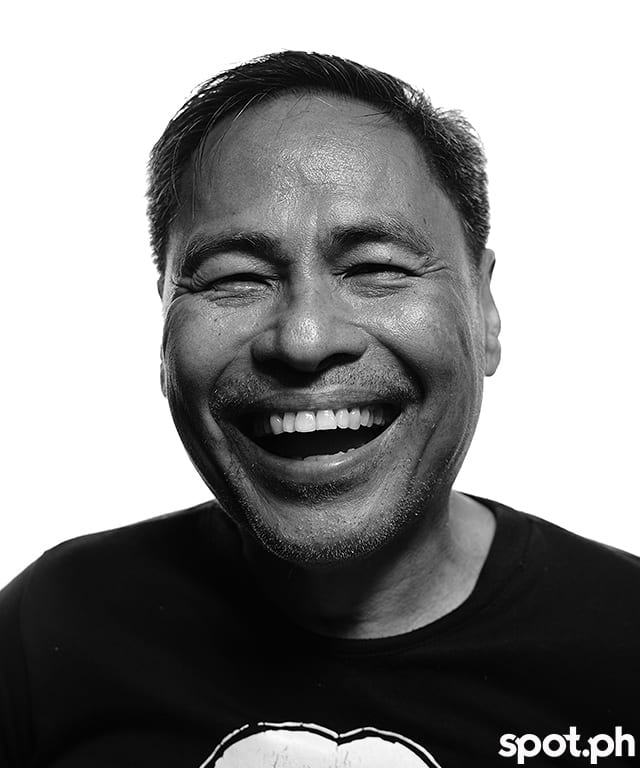
Of the younger comics artists, Kevin Eric Raymundo is the most vocal when it comes to expressing admiration for the veteran cartoonist's work, Medina shares. He would say, “Kung walang Pugad Baboy, walang Tarantadong Kalbo.” Photograph by Paul Sugano.
It’s his fans who keep him going. "It's really the readers. They're the ones who say, 'Wala ka bang gagawin tungkol sa Bini?' (Aren't you going to do a strip on Bini?)"
He'll be spending the weekend with them—his fans, not Bini—signing books, selling merch (including a chess set), and after, he'll get back to his life—creating more comics, cooking for his kids, shipping books, drinking Alfonso, spending time with his apos.
That's the best thing about being Pol Medina Jr., he said. “I’m anonymously famous. Kilala ako sa conventions pero pag labas ko walang nakakakilala sa akin. Hindi ako kagaya nila Nadine Lustre na hindi pwede bumili ng fishball na walang entourage. (They know me at conventions but outside, nobody recognizes me. I’m not like Nadine Lustre who can no longer go out to buy fishballs without an entourage.) My wife likes that.”
He'll be spending the weekend with them—his fans, not Bini—signing books, selling merch (including a chess set), and after, he'll get back to his life—creating more comics, cooking for his kids, shipping books, drinking Alfonso, spending time with his apos.
That's the best thing about being Pol Medina Jr., he said. “I’m anonymously famous. Kilala ako sa conventions pero pag labas ko walang nakakakilala sa akin. Hindi ako kagaya nila Nadine Lustre na hindi pwede bumili ng fishball na walang entourage. (They know me at conventions but outside, nobody recognizes me. I’m not like Nadine Lustre who can no longer go out to buy fishballs without an entourage.) My wife likes that.”
All photographs by Paul Sugano
Pam Pastor just said goodbye to her newspaper life after 27 years. Today she is juggling different writing projects and a bar she has opened with cousins and friends.
You Might Also Like