Performing Arts
The Art of Many: Behind the Collaborative Magic of Philippine Theater
From script to spotlight, discover how Philippine theater magic comes to life.

by Leana Vibal
Published on Sep 12, 2025
(SPOT.ph) Philippine theater has never felt more alive. Plays, musicals, and orchestra shows are popping up faster than people can mark their calendars. Social media is bursting with clips, reviews, and recommendations, proof that the stage is reaching people like never before. What was once a niche passion is steadily finding its way into mainstream culture.
Behind this resurgence is a very dedicated community. Because the sold out shows, the magic of theater, doesn’t begin only with the curtain call. Long before opening night, a village of creatives—writers, directors, designers, stage managers, and crew—has already been hard at work. Script revisions, rehearsal hurdles, quick-change scrambles: all of that and more forms the unseen labor that transforms into the magic audiences witness the minute the stage lights come on.
Behind this resurgence is a very dedicated community. Because the sold out shows, the magic of theater, doesn’t begin only with the curtain call. Long before opening night, a village of creatives—writers, directors, designers, stage managers, and crew—has already been hard at work. Script revisions, rehearsal hurdles, quick-change scrambles: all of that and more forms the unseen labor that transforms into the magic audiences witness the minute the stage lights come on.
.jpg?fit=cover&width=960&q=82)
Click to Enlarge
Soldiers of the stage: (clockwise from top left) Mio Infante, Ohm David, Rody Vera, Pat Valera, Krystal Kane, Phi Palmos, CJ Navato and Jenny Jamora. Photographed by Paul Sugano at Summit Media. Cover design by Warren Espejo. Shoot producer: Leana Vibal.
Act I: Pre-Production– Where Philippine Theater Productions Begin
To understand how this magic happens, we begin where every show starts: Pre-Production. This is where the vision takes root—where writers, directors, designers, and producers come together to form the spine of the story that will soon take the stage.
There are many ways to start: sometimes it's with an all-original, hot-off-the-press script—or even just a spark of an idea. Other times, it’s an adaptation, where the story already exists but needs (many) tweaks to land with today’s crowd. And of course, there are reruns or re-stagings, bringing a familiar material back to life. However it begins, it always starts with a vision—and a desire to tell a story.
Most people assume it all begins with a finished script. And yes, sometimes it does—as with staging a published piece—but not always. In fact, for Mula Sa Buwan director and writer Pat Valera, writing is the most difficult part of the theater experience. “It needs its own headspace, because every piece is always a new project and a new endeavor,” he says. Palanca Award-winning playwright Rody Vera—the man behind PETA's Walang Aray among many others —echoes the thought, reminding us that writing for the stage rarely starts with the perfect story in place. “In my lectures, I always share with my students this quote from Joseph Conrad: ‘A piece is never finished, it’s only abandoned.’”

Click to Enlarge
Pat Valera (left) and Rody Vera (right) reflect on the challenges of working on a script for theater. Photo by Paul Sugano and Dom Pamatmat..
True enough, most scripts start as fragments, outlines, or an idea born through lived experience. Some pieces stay an unfinished draft until they catch the attention of a company or a producer. From there, the story undergoes a metamorphosis, as a series of revisions shaped by research and workshops, with musicals gaining their music and lyrics along the way, until it is eventually fleshed out at rehearsals—dialogue, pacing, blocking, and all. After all, a script is only words until the rest of the company breathes it to life.
But for many productions, the process starts elsewhere—with the director. Theater companies and independent producers bring an idea or a “season theme” to a director whose ethos aligns with them, and collaboration begins from there. The brief could be as broad as “adapt this classic” or as simple as “explore this idea,” with the playwright coming in after the concept.
Together, director, writer, and producer scan texts, juggle possibilities, and explore new ways to stage the story.
Two-time Gawad Buhay Award-winning director behind Pingkian: Isang Musikal, Jenny Jamora, puts it simply: choosing the projects she works on is “a heart and gut thing.”

Click to Enlarge
For Jenny Jamora, choosing to work on a material means having a vision for it. Photo by Paul Sugano..
“For me, choosing a project is really about what speaks to me, and what I feel I can have a valuable contribution to,” she explains. “It has to stir something in me. For me to take something on, I have to feel like I have a vision for it.”
As unglamorous as it sounds, many productions start like any project— through meetings, presentations, and even pitch decks. Working in the theater isn’t all vibes and creative spirit; there’s a rhythm to it all, and the director is the conductor.
For Jamora, assembling her team is all about finding people who share the same vision. “I choose people whom I want to work with, whose vision I really appreciate,” she says. Once she’s gathered her creatives—set and costume designers, choreographers, musical directors, and more—the collaboration begins. Everyone presents their ideas, collectively contributing to her vision and building the world we see on stage. “Being a director is a lot of people management. It’s really constant communication throughout,” she adds.
Whether the idea comes first from a director’s vision or a playwright’s pen, this is just the beginning of theatrical world-building. Now with a clear story to tell, the rest of the creative team gets to work. Costume designers, technical and lighting directors, and scenographers collaborate to shape the visual world of the production, reinforcing the play's message and drawing audiences deeper into the narrative.
“It’s really about understanding the show. What is the objective of the story, where is it set, and where is it going to be staged?” says scenographer Mio Infante, whose design work includes sets for musicals like RENT, Little Shop of Horrors, Sweeney Todd, and many more. Infante’s world-building process begins with research, which he tells us is his favorite part. If the play is rooted in a real place, that could mean site visits and immersion. He recalls how, for Rak of Aegis, the team visited a flooded urban community in Manila to study how to recreate that lived reality on stage. If the world is entirely imagined, the process shifts to long conversations with the director and playwright to firm up a shared vision of how that universe should look and feel, coupled with library studies and museum visits in the pursuit of visual inspiration.

Click to Enlarge
For Mio Infante, creating the visual world for the stage requires looking for inspiration through research—something he greatly enjoys. Photo by Paul Sugano..

Click to Enlarge
This haunting image is from Liwanag Sa Dilim, one of the more recent projects Infante has worked on. Photo courtesy of 9Works Theatrical..
But even the most detailed research has to be anchored in the practical realities of the venue. “As a designer, knowing these things, especially the venue, is important. It’s trying to figure out how to use the space: What are the physical attributes of the theater, and how do you work within them?” Infante explains.
The reverence for planning, collaboration, and understanding the space is shared by set and lighting designer Ohm David, whose latest set work includes the recent staging of Into the Woods. For him, joining a production means being present every step of the way—from conceptualization and mock-ups to the final fabrication. Across all the shows he has mounted, he insists the secret lies in preparation. “Having a strong pre-production stage is key. It sets the tone for the production. When you have limited resources, having a clear concept [which you work on in pre-prod] is number one,” he explains.
Both Infante and David trace their instincts for what makes a great stage back to their time as actors. That experience, they say, helps them understand the stage from the performer’s perspective. “My experience in acting helps me know the geography of the stage. I see myself walking the stage as the characters, using the props, and that affects my design,” David shares.

Click to Enlarge
Anytime Ohm David is working on a production, he reminds himself that the story must always be the star. Photo by Paul Sugano..

Click to Enlarge
One of Ohm David's latest endeavors is creating the set design for Theater Group Asia's Into the Woods. Photo courtesy of Theater Group Asia..
Act II: Behind the Curtain – Rehearsals and the Invisible Work
After months of planning—often starting a year in advance, given how busy and thriving the local theater scene has become—the spotlight finally shifts. Scripts, concepts, and designs begin to move from paper to practice. This is where more moving parts join the machine: the actors, stage managers, and crew who will bring the vision to life.
Finding the right crew for the job is essential. For directors like Jamora and Valera, it often entails finding people they already trust, which could be crew they’ve worked with previously, or names vouched for by peers. After all, these are the people on the ground. The ones responsible for turning their idea into reality. “The magic, the lighting, the sounds on stage? That’s tech. The person managing the cues and telling people what to do during the show? That’s a stage manager,” Valera explains, breaking down how the behind-the-scenes magic begins to take shape during rehearsals.
But beyond assembling the working team behind the curtains, it’s just as crucial to nail down the right stars: the actors who will bring the story from the pages to the stage.
Casting usually happens through auditions and open calls, but just as often, it comes down to relationships built in past productions, and actors get offered roles directors think are perfect for them. But landing a part is only the beginning. It’s during rehearsals when actors begin to make the roles their own, bringing nuance, energy, and character to the parts.
“On the first day of rehearsals, walang higit na nakakaalam sa play kundi iyong writer. But eventually, in the course of rehearsals, the piece becomes theirs—the material and the process are now shared,” explains Vera, who, aside from being a celebrated playwright, has also taken the stage himself in productions like Into the Woods (as the narrator and mysterious man) and Tiny Beautiful Things (as the letter reader). Whether it’s because he is a writer or it’s simply his rehearsal strategy, Vera’s process is very faithful to the text. His mantra going into rehearsals? “Trust the material but make it your own.” An actor must not only memorize lines but also embody the intent behind them and make sure it aligns with the director’s vision and the cast dynamics slowly taking shape.

Click to Enlarge
Apart from being a revered writer, Vera also performs on the stage. Never for his own pieces though, but for materials by other writers that speak to his truth. Photo by Dom Pamatmat..
That same spirit of digging deeper shows up in veteran actress Sheila Francisco’s process, though she approaches it from a different angle. “There’s always a story behind a character. It’s not just, ‘She’s the funny best friend.’ Well, what makes her funny? What makes her that way? I love researching my character,” she says. Where Vera starts with the written word, Francisco begins with finding the person behind the role, whether that means fleshing out histories, quirks, and motivations or looking inward to find her personal connection with the part. These nuances may not be explicitly in the script, but they influence how a character lives on stage, and to her that’s where the sparkle lies.

Click to Enlarge
There are no small roles for Sheila Francisco. The veteran actress always finds the nuance, the quirks, and the depth in all her roles. Photo by Paul Sugano..
For Francisco, the charm of theater is in creating a fully realized persona that propels the narrative forward. Sure, her character may not be the lead, but as long as the role is vital to the main arc, she is here for it—and she’ll make it her own. A perfect example is her portrayal of Tiya Dely in Ang Huling El Bimbo. Though a minor character in the story’s larger arc, in Sheila Francisco’s hands—and through her expressive singing prowess—Tiya Dely’s blend of nurturing warmth and tough love gained an added emotional depth, making the role one of modern Philippine theater’s most beloved mother figures.

Click to Enlarge
Sheila Francisco powered through all shows of Ang Huling El Bimbo. She really made Tiya Dely her own. Photo courtesy of Newport World Resorts..
Veterans like Francisco and Vera may have their routines down pat, but for younger thespians like Krystal Kane and CJ Navato, rehearsals double as a workshop—a masterclass in discovering their process and honing their craft. For Navato, who has spent a good chunk of his younger years on TV (remember him in Goin' Bulilit?), the ability to rework a role and continue developing it with real-time feedback as the production evolves is one of theater’s unique joys. Since 2024, he’s been in back-to-back shows, including One More Chance, Liwanag sa Dilim, Side Show, and more are lined up this year. But he assures us he enjoys it. Navato thrives in this busyness, learning from his co-actors and directors and pushing his acting and singing chops when he can—theater allows him to do just that.

Click to Enlarge
CJ Navato says he's been bitten by the theater bug. He can't help it. Performing on the stage is now one of his favorite things. Photo by Paul Sugano..
In the same vein, Kane views rehearsals as involving a lot of trial and error to see what works. “Acting is reacting,” she says. “Sometimes I think a scene has to go a certain way, but someone attacks it differently.”
For the young Side Show star and the upcoming Princess Fiona in Shrek, rehearsals are key points in honing her craft. “Singing, acting, dancing, they’re not just talent. They’re skills. So much time is put into it, and I wish more people appreciated that when they see our performance.”

Click to Enlarge
Krystal Kane has been acting since she was 9 but it looks like she's not slowing down anytime soon. The actress has taken on back-to-back roles since 2024. Photo by Paul Sugano..
Rehearsals are often described as the most tiring part of the entire process. But for Delia D. Star Phi Palmos, it’s also when the theater is most alive. “Narealize ko kaya pala ako drawn sa theater ay dahil sa creative process, sa world building. ‘Yong nagpapalitan kayo ng opinyon. It’s the collaboration I really enjoy, and all that happens the most during rehearsals.”

Click to Enlarge
Phi tells SPOT.ph that before he takes on a new role, part of his rituals is to reset by watching the TV Series SMASH. Doing that gets him in the zone to start fresh and build his new character. Photo by Paul Sugano..
It’s at this time that characters are developed, sets are built and put in place, choreography and blocking perfected, and countless other details are polished in a short span of time. By the time the curtains rise, the shows we see have been staged a million times, and yet it’s still not finished—in fact, it has just begun its crescendo.
Act III: The Opening Night and the Live Theater Experience
After all the planning, rehearsals, and countless tweaks, the big night arrives. All the work that happened behind the curtain now converges in a single, living moment: the show.
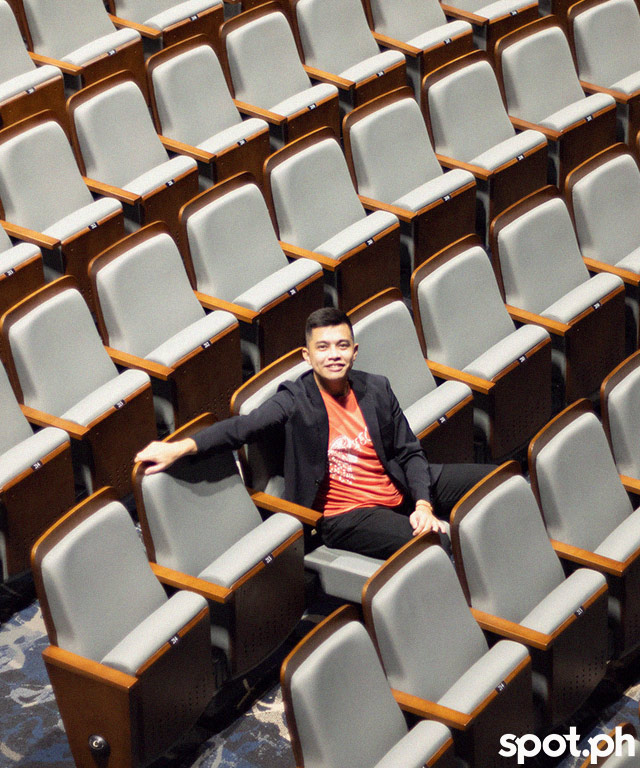
Rather than agonize over last-minute script tweaks or fret over every tiny detail of the performance, Valera finds the real thrill in feeling the audience’s response. Sure, he’s considered every possible reaction during rehearsals and pre-production, but his approach is to stay on his toes—because you never really know how something will land. Instead of watching the stage, he often positions himself at the back of the house, enjoying the laughter, applause, and even the silences that tell him if the audience has picked up on what he has put down.
Click to Enlarge
If you're watching one of his shows, don't be surprised to find Pat Valera in the back row, basking in the audience reactions. Photo from the SPOT.ph Archives/ Jilson Tiu..
But even with all the preparation, live theater is unpredictable. Even someone as seasoned as Vera recalls fumbling lines during early performances of Into the Woods. Palmos tells us about a near-miss illusion-shattering costume malfunction during a run of Delia D. Navato recalls his voice cracking during a performance of Side Show, and a time when he had to improvise because a co-actor changed his lines all of a sudden. Beyond performance missteps, there are a myriad of other things that could go wrong during a show, like a technical problem or miscommunication. But as they say, the show must go on.

Click to Enlarge
Despite having performed many roles here and abroad, Rody Vera still fumbles from time to time. Case in point, during the early days of this year's Into the Woods Vera shares that he had a hard time with some of his lines. But they worked through it, tweaking scenes to make the lines flow better. Photo courtesy of Theater Group Asia..

Click to Enlarge
Phi Palmos also shares a memorable stage emergency. During one quick change a co-actor accidentally stepped on his costume. Without flinching, Phi just went with the flow, praying he doesn't have a major wardrobe malfunction during the scene. Photo courtesy of Newport World Resorts..
“You can’t be frazzled. I think it’s a responsibility to not get frazzled, so you have to keep calm during your performance,” says Navato. The key to doing so? According to these thespians, it’s staying grounded. Every actor has their own coping mechanism, whether that's rubbing their hands together to calm down, doing vocal trills pre-show, but collectively, most directors and stage managers organize a quick prayer circle of energy pass pre-show just to keep everyone on the same page, attuned to each other, and in the zone.

Click to Enlarge
CJ Navato has found ways to cope with the unpredictability of performing. His favorite grounding technique is rubbing his hands together to feel warm and touching his heart. Photo by Paul Sugano..
And this grounding isn’t only for the actors, but for the crew too. Backstage, the same pressures quietly simmer: a stage manager whispering into a headset, the tech booth hyperaware and waiting for a cue, and make-up and costumes on standby for a quick change. At any moment, more moving parts are orchestrating the magic than the audience can see.
The scene that unfolds the synergy of a team sharing a vision, moving in sync to carry the story forward. Performing in the theater is about mindfulness—staying aware of co-actors, the crew, and the audience. It’s not about perfection; it’s about keeping the story alive and convincing the audience they’re being transported to another world.
The scene that unfolds the synergy of a team sharing a vision, moving in sync to carry the story forward. Performing in the theater is about mindfulness—staying aware of co-actors, the crew, and the audience. It’s not about perfection; it’s about keeping the story alive and convincing the audience they’re being transported to another world.
And that is theater’s beauty: preparation, collaboration, and live energy coming together for a performance that can never be perfectly replicated. Each opening night is both a finale and a beginning, the first step in a run that continues to grow, shift, and dazzle with every show.
Act IV: Beyond the Curtain Call: Why is Philippine Theater Thriving
So what makes a great show? For some, it’s simply the act of mounting it—the miracle of gathering dozens of people together to create something fleeting yet profound. For others, it’s the process, the people, the lessons learned along the way. But for most of the theater creatives we spoke to, it all circles back to one thing: storytelling.
“A good production takes people on a journey, allowing them to live through it vicariously,” says Jamora. Valera adds, “It doesn’t have to be spectacular, but the story must be clear and compelling.”
Filipinos, of course, are natural storytellers. It’s no wonder theater resonates with us—it’s in our DNA. And while the theater community has always been around, for the longest time, Philippine theater hasn’t always received the attention it deserves. With social media, content creation, and streaming platforms like YouTube and Netflix, the Philippine theater scene is reaching a new, eager audience. Take the pandemic-era run of Ang Huling El Bimbo: by posting the show for free on YouTube, it reached far beyond the theater seats. In democratizing the experience, audiences who had never set foot in a theater got a glimpse of Philippine stagecraft—many realizing, “Ah, kaya pala natin ito,” and seeing just how world-class it can be.
The rise of jukebox musicals like Rak of Aegis, Ang Huling El Bimbo, Buruguduystunstugudunstuy, Liwanag sa Dilim, and many more has also made theater more accessible. Fans come for the music they love, and along the way, they discover the thrill of storytelling live on stage. These productions often serve as a gateway, a first step into the larger world of theater.
Meanwhile, the ecosystem itself is thriving. More theaters are opening, more production companies are emerging, and more creatives—actors, directors, writers, crew—are being employed—and fingers crossed, able to make a living doing what they love: telling stories that matter. It’s a buzzing, vibrant scene, powered by people committed to their craft with a future brighter than what it used to be.
And most importantly, the excitement, the recognition, the “world-class” buzz—it’s never about just one person, one performance, or one group. It’s the synergy of countless hands, voices, and hearts working together: directors and actors, designers and choreographers, stage managers, crew, and musicians. Every contribution builds toward that magical albeit fleeting moment onstage when a story comes alive before an audience. That is the essence of Philippine theater—the collective effort, the shared passion, the magic that makes it unforgettable.
(Swipe to see more) From left to right: Jenny Jamora, Pat Valera, Rody Vera, Mio Infante, and Ohm David.
(Swipe to see more) From left to right: Sheila Francisco, CJ Navato, Krystal Kane, Phi Palmos
Yet, while the scene is thriving, it remains largely centered in Metro Manila—shouldn’t all of the Philippines get to shine as brightly? Local communities in other regions could stage familiar stories in their own way, or better yet, tell their own narratives rooted in their experiences and culture. Creatives are working toward this vision, but the community cannot exist in a vacuum. Recognition that performing arts are a cornerstone of Filipino culture and heritage is crucial—not just for audiences, but in how institutions and the government support and nurture the scene.
“There’s only so much we can do as a community,” says Palmos. “It’s time for performing arts to be seen as equally important as sports or cinema. Theater performers are doing world-class work, and with that recognition, we can reach far beyond the audiences we have today.”
“There’s only so much we can do as a community,” says Palmos. “It’s time for performing arts to be seen as equally important as sports or cinema. Theater performers are doing world-class work, and with that recognition, we can reach far beyond the audiences we have today.”
The hope is for a future where theater’s magic reaches every corner of the Philippines—a future where every story finds its stage, every creative finds their place, and audiences everywhere feel the spark that happens when many hands, working together, weave stories into moments of magic. After all, in Philippine theater, there truly are no small parts—just countless hands making imagination real for everyone in the audience.
Also read: Your Ultimate Guide To Theater Shows in the Philippines in 2025
Portraits by Paul Sugano & Dom Pamatmat
Videos by Jino Del Mundo
Hair and Make Up by: Muriel Vega Perez
Produced by Leana Vibal
Leana is Spot's go-to for Arts & Culture and Things to Do. On any given day, she’s either glued to her screen—or gliding underwater like the mermaid she swears she is. Contact: leana@spot.ph
You Might Also Like