LOOK: This Card Game Blends 'Albularyo' Culture and Organic Chemistry
Ateneo de Manila University chemists developed a game inspired by Traditional Filipino herbal medicine.
Published on Jul 22, 2026
(SPOT.ph) Herbal medicine has long been a part of our traditional healing practices. To this day, many households still turn to them as quick remedies for simple, day-to-day ailments. To be fair, a lot of them really work, but the actual science behind them remains less known and often misunderstood by most. Fortunately, the chemists of Ateneo de Manila University have developed an unconventional yet ingenious way to bridge the learning gap.
Enter the Herbularyo card game. In this game, players take on the role of traditional healers on a quest to cure illnesses using medicinal herbs. Inspired by—you guessed it—Filipino albularyo traditions, the game helps players learn organic chemistry concepts in a fun, interactive way rather than relying on memorization.
Introducing, Herbularyo, a card game that combines Filipino herbal medicine traditions with organic chemistry concepts
Herbularyo is the brainchild of researchers from the Ateneo de Manila University Department of Chemistry and Health Science. It's designed as a gamified learning experience that combines Filipino folk medicine traditions with the organic chemistry behind familiar medicinal plants.
It can be played by two to four players using cards that represent various herbs typically found in the albularyo toolkit. Players must not only identify the medicinal plant to use but also note its active organic compounds to match the illness. The first player to heal all their Sickness Cards wins.
To make things interesting, there are also special cards that add strategy and folk healing flair to the gameplay. The playing deck is composed of 12 Sickness Cards and 74 Action Cards.
The red-colored Sickness Card Deck includes 11 common illnesses plus the Special Sickness Card, a wildcard that any medicinal herb can cure.
Meanwhile, the Action Cards come in two kinds: blue-colored Healing Cards and Special Cards. The Healing Cards contain details about the organic molecules for healing certain illnesses and the medicinal herbs associated with them.
The Special Cards, on the other hand, include Helping Cards, which are used once to give the player an advantage before discarding them; Relapse (Binat) Cards that make healing harder for opponents; and Curse (Sumpa) Cards that stop an opponent from winning at any point in the game.
Using these cards, players must race against each other to cure the sickness they drew. A sickness requires three specific Healing Cards to get cured, while a Special Sickness Card needs any three Healing Cards. The game continues in a turn-based, draw-to-play fashion until someone is fully relieved of their ailments.
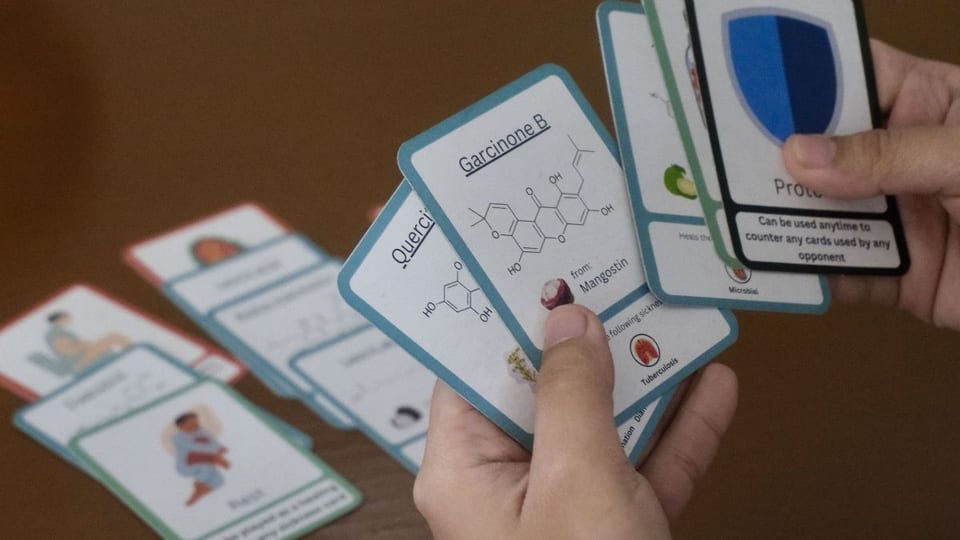
Herbularyo was developed through thorough research into Medicinal Plant Culture
The researchers turned to the Encyclopedia of Common Medicinal Plants of the Philippines, Volume 1, to select the plants featured in the game. Aside from identifying the medicinal plants commonly used in the Philippines, the book also outlines the scientific evidence that supports their therapeutic benefits. So, the concepts and mechanics explored in the card game are actually backed by science.
“We wanted to make a game that not only teaches organic chemistry and Filipino traditions, but also how these areas of knowledge can inform each other,” says Herbularyo co-developer Maryjane T. Magsino in a statement released by Ateneo. “We wanted to underscore the value of traditional Filipino medicine that has stood up to scientific testing yet is within easy reach practically in our own backyards.”
The research titled Herbularyo: A Card Game for Learning Organic Compounds of Medicinal Herbs and Their Therapeutic Benefits was published by Maryjane T. Magsino, Inah Marie Q. Rivera, Armando M. Guidote Jr., and Genejane M. Adarlo in the May 2026 issue of the Journal of Chemical Education.
As a proof of concept, the researchers also ran the card game with grade 8 students, 3rd-year chemistry students, and 4th-year health sciences students. They found that the high school students who played Herbularyo showed better test scores than the control group, while the undergraduate students also demonstrated similar improvements. In the survey and discussions that followed, the participants responded positively to the game, finding it an engaging and effective way to reinforce organic chemistry concepts while also promoting the cultural significance of medicinal plants.
Ateneo has yet to announce whether the game will be made accessible to the public or rolled out exclusively for the university’s use. We're keeping our fingers crossed that it's the former. Imagine the Herbularyo card game making its way to our science classes to supplement lessons and graded activities; it may actually make chemistry fun and less intimidating. Plus it also sounds like a really (nerdy) good time.
For more information, visit Ateneo De Manila University’s website.
Joy is a writer, film photographer, caffeine junkie, and part-time traveler. When not any of these, she’s either lost in a book, beating a game, or making a zine. Cat-mom to Noodle, Nori, and Mocha.