History Comes Alive Through This Next Generation of Philippine Reenactors
What does it take to recreate a world that disappeared more than a century ago?
Published on Aug 21, 2026
(SPOT.ph) Intramuros was still damp from a week of heavy habagat rain that Sunday morning. Even with the sun out, the weather could still turn at any moment, which is probably why the fort was unusually short on tourists that day. Somewhere in the quiet, you could hear someone shouting commands from inside the stone walls.
Following the sound to find the source, we stumbled upon almost 50 young men in 19th century military uniforms, rifles in hand, going through drills and formations Spanish and Filipino soldiers alike would have practiced more than a century ago.
This is how members of Historia Viviente Manila (HVM) choose to spend a weekend. The historical reenactment group takes its name from the Spanish equivalent of “living history.” While the uniforms make for great photos, dressing up for the part is only scratching the surface of what they do.

Making room for the ordinary
HVM stages two very different kinds of living history: military and civilian, each sector approaching the past from a very different angle with one event per month.
According to HVM President Iñigo Arcilla, most of its members came from another reenactment group where military representation was the primary focus. It was familiar ground to them, but they wanted to push the research further—and, eventually, look at life beyond the battlefield altogether.
“Reenactment in the Philippines has been more or less military-centric,” Miguel Feliciano, Director of Military Living History, tells SPOT.ph.
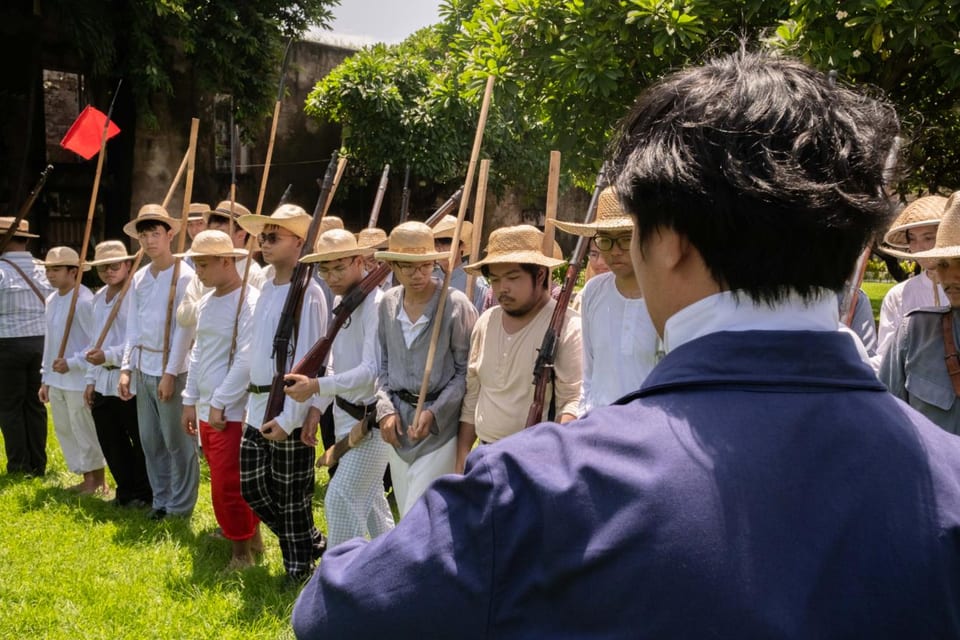
But battles could only tell so much of the story. Most Filipinos in the 19th century weren't living through war every day. They were eating, working, going to church, and finding ways to pass the time, just like we are now. This broader look at ordinary life became central to HVM when the organization was founded in 2023.
“For the elite to exist, there has to be someone below them. That’s where the idea started,” Arcilla says.
Where a military reenactor might have to research how a rifle was carried, a civilian reenactor faces a different set of questions: What would someone of a certain social class have worn? How would they behave? What did people actually do for fun? Those are the kinds of details Lucas Bucalig, Director of Civilian Living History, is tasked to piece together.
Fashion became an early entry point into that civilian world. Members had been drawn to Maria Clara-esque attire from the beginning, but when Andrea Gueco joined HVM in 2024, she helped turn that curiosity into a fuller study of 19th century women’s fashion in Manila.
.png?fit=cover&width=960&q=82)
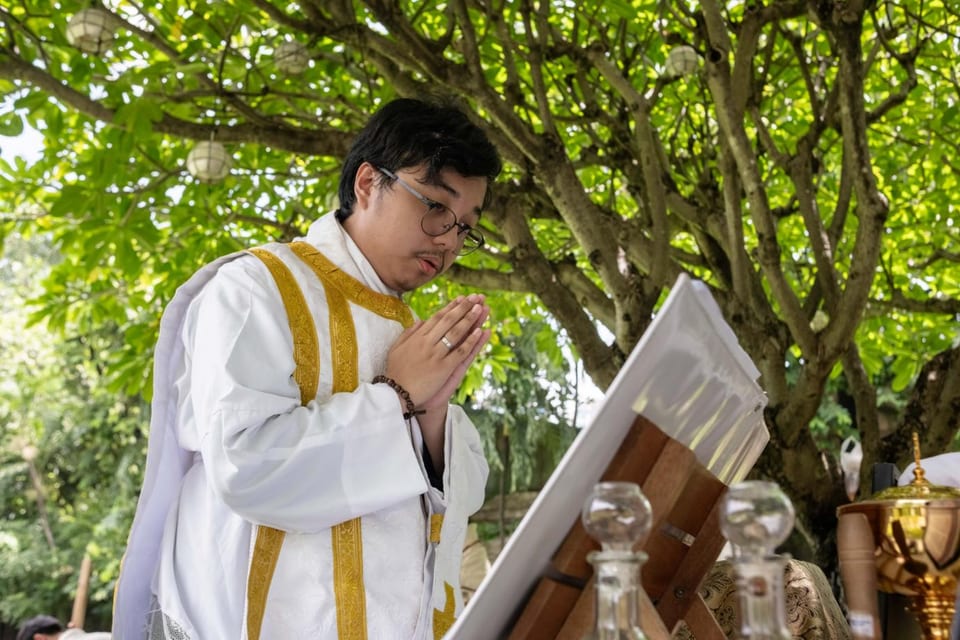
And what is 19th century life without religion? HVM members also take on the role of priests in recreations of the Tridentine Mass, or what is now commonly known as the Traditional Latin Mass.
Doing the homework
As one can imagine, pulling off a convincing reenactment takes a lot of digging. Members pore over textbooks, archival photographs, military reports, telegrams, and firsthand accounts—but finding a source is only the beginning. For the military sector, the problem is often not a lack of information, but too many versions of the same story.
“Ang mahirap sa military is you cannot just trust one account. It’s a conflict—there’s Side A and Side B. We always have to check kung ano ‘yung nagmamatch,” Feliano explains, citing a recent reenactment of the 1896 Battle of San Juan del Monte. In researching the battle, they are presented with two sides: Katipuneros claim that they forced Spanish soldiers into retreat, but Spaniards argue otherwise. According to the latter, troops were only pulling back to call for reinforcements. HVM does not accept either account at face value just because one sounds better.
“HVM is not fearful of the truth it portrays. What we want to bring to the public is that there is pride in everything that happened in our past. It doesn’t need to be na panalo tayo lagi, tayo ang good guys. In all honesty, there are times when we acted savagely, we acted out of pocket, but we embrace it nevertheless. That’s part of who we were, and it’s something that should shape us for the better,” Arcilla says.
.png?fit=cover&width=960&q=82)
The civilian sector has a completely different problem: sometimes, there isn’t much to work with at all. The everyday lives of ordinary Filipinos were simply not documented as extensively as military campaigns.
Even when records do survive, Bucalig points out that many are written in Spanish—a language HVM members cannot read themselves.
In many cases, HVM has better luck gathering information overseas than searching at home.
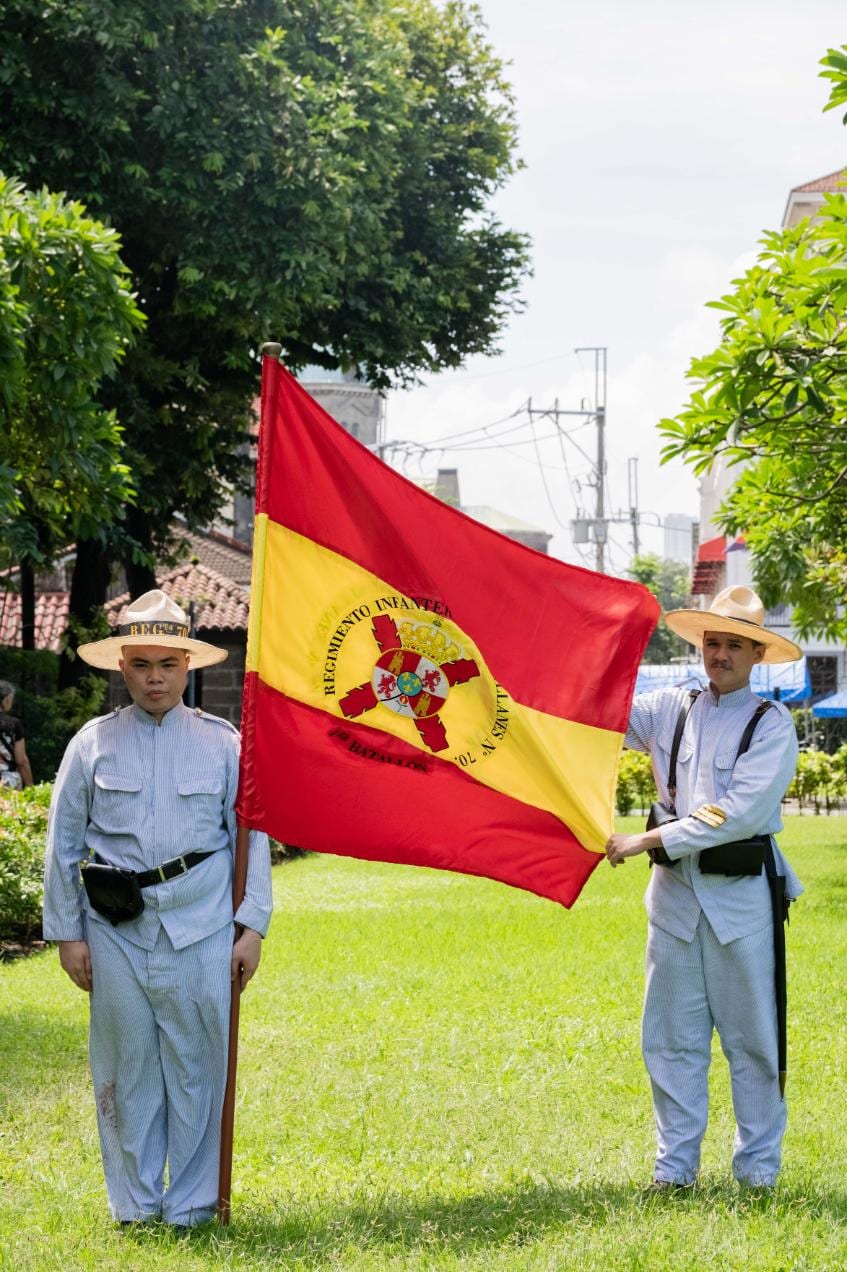
That was the case with the Spanish army unit it was portraying that Sunday: HVM found relevant material in an archive at the University of California. When they later needed the exact dimensions of the 70th Magallanes Infantry Regiment flag, they turned to Harvard's Peabody Museum for assistance.
“There’s not much sources here in the Philippines because all of the artifacts have been taken as war trophies,” Feliciano says, pulling a revolver from his pocket to illustrate his point. Unable to study an original here, he tracked down a Spanish reenactor who owned one and asked him to take its measurements so the group could reproduce the weapon as accurately as possible.
Also read: This Walking Tour Will Take You Back to the Days of Ibarra & Maria Clara
Getting into character
For all the painstaking research that happens beforehand, HVM doesn't rehearse the reenactment beat by beat. If anything, all that preparation is what makes a script unnecessary: Members are expected to know enough about the role they’re portraying to react accordingly.
Former HVM President Diego Magallona explains that during military reenactments, only the officers need to know how the event is meant to unfold. Everyone else acts as a soldier would: they receive orders and follow them.
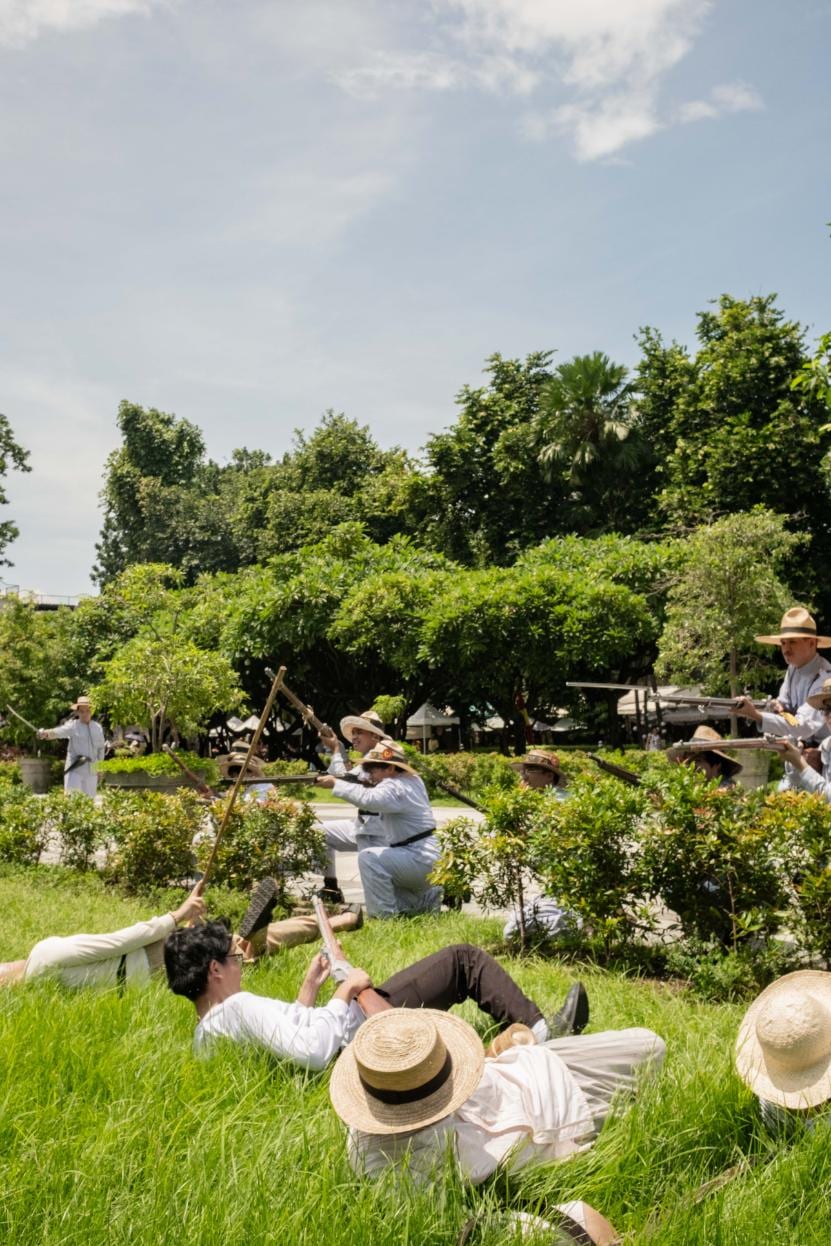
No officers are present to call the shots at civilian events, but the idea is the same: know the role well enough to let the scene unfold on its own.
Perhaps no other event shows this better than Bayang Tinawag, which was staged at Casa Manila last March. Reenactors filled the house with scenes from everyday life in the 19th century. Doñas occupied the sala, dons the antisala, and priests the oratory (a place of prayer). In other rooms, they passed the time with period games like chess, sungka, and Spanish cards (which consist of only 50 cards in a deck). When tourists wandered in, they treated them like guests arriving at the house.
To figure out how those interactions might have played out, Bucalig encourages the reenactors to look to the present for clues: “In portraying the accurate Filipino lifestyle, we tend to create a more sustainable way. Civilian reenactors can adapt easily by comparing the usual Filipino values we have right now and with the Filipino life that is being described in the books from the past.” In other words, HVM has to fill in the gaps where needed, as long as whatever they come up with could have reasonably happened at the time.
.png?fit=cover&width=960&q=82)
For Arcilla, that kind of historical weaving is part of what makes reenactment work so impactful.
“I think that’s the goal of reenactment. If everything is scripted, it feels artificial. When the reenactors know the role they’re portraying, when they know the history of the home, when they know the history of the time period, you’re able to learn about history in a much more unique way. You’re actually experiencing it,” Arcilla says.
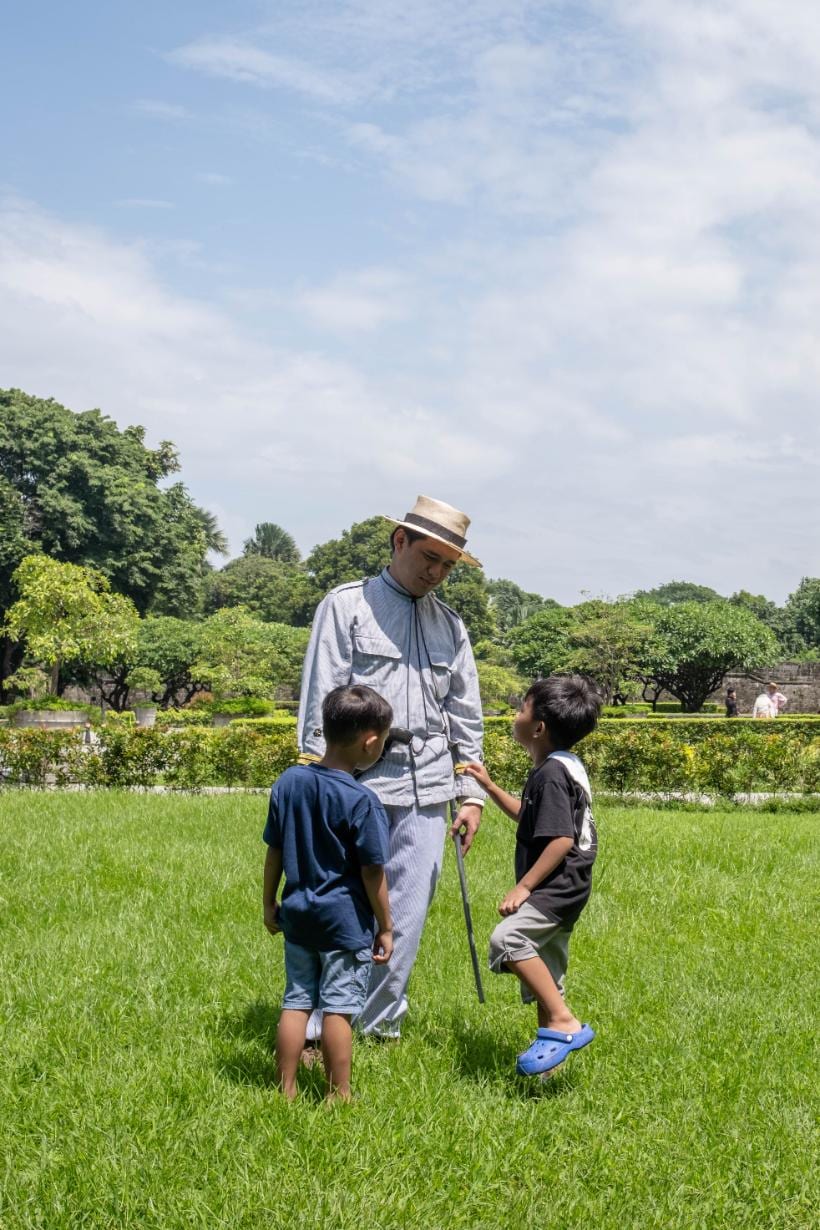
That room for improvisation only applies where the historical record has room for it. On details HVM can verify, the reenactment group sticks to what the evidence shows.
For example, reenactors are generally expected to keep a poker face throughout the reenactment unless the scene calls for it—or a tourist asks for a friendly photo. They take their cue from archival photographs, where subjects have a neutral expression because of the limitations of camera technology at the time.
“We hold ourselves to that particular standard. Bawal ‘yung culture na 'okay na ‘to, puwede na ‘to.' Sa HVM we really want to drive home the point na hindi puwede ang puwede na when it comes to history,” Arcilla says.
Earning the uniform
For a group so rooted in the past, the movers behind HVM are surprisingly young. Most of its board members, including Arcilla and Bucalig, are graduating seniors, while its members are usually between 16 and 22 years old. None of them are paid—all of this is purely voluntary work. And they do it for hours at a time on weekends.
Despite these, the organization has grown to more than 100 members, most of them men. HVM is also beginning to expand beyond Manila through its Northern Garrisons in Bulacan and Pangasinan, which aim to build reenactment communities in other parts of the country.
But getting in isn’t as simple as owning a costume and showing up.
.jpg?fit=cover&width=960&q=82)
To join HVM, applicants have to go through a rigorous process. After the initial interview, they are required to attend three reenactment events for two reasons: 1) so they can gauge what it feels like to take part in the hobby and 2) so they can gain historical information from fellow members.
Only after partaking in three events can applicants sit for a final interview before a panel of six to eight HVM members. That’s where their historical knowledge is put to the test. One question Feliciano likes to ask: “Ano itsura ng bigote ni Emilio Aguinaldo?” Laugh if you will, but it’s a question Feliciano takes very seriously—and one that applicants cannot afford to get wrong.
“You’re in the Philippine Republican Army. You should know who your president is. You should know who you’re defending, so for me, that won’t do if you cannot answer. It’s a very important question,” Feliciano says. (Hopefully, you know enough of history to know that he doesn’t have a moustache. It’s a trick question.)
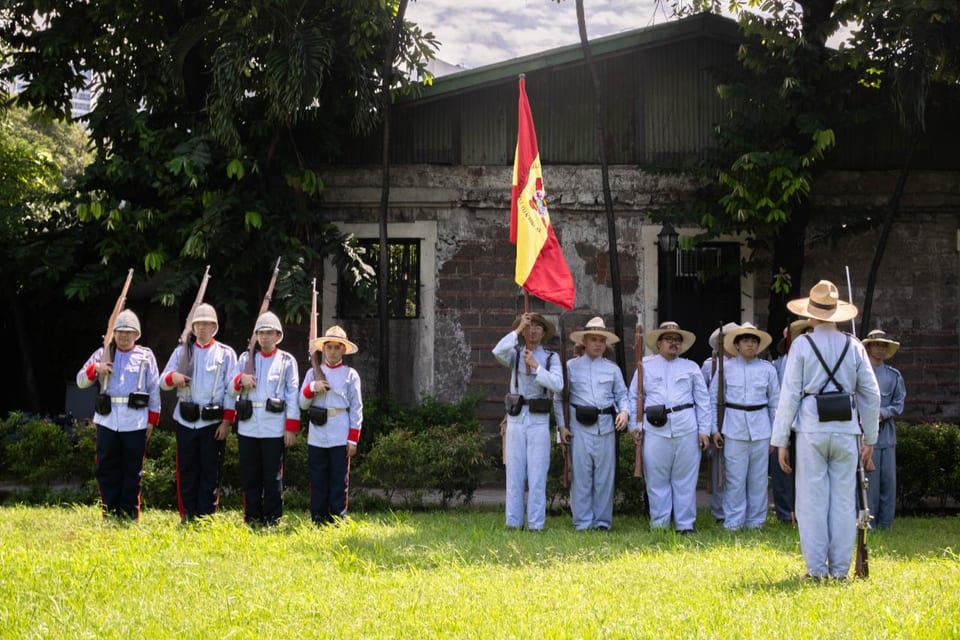
The attention to detail only gets stricter from there. Arcilla recalls turning away an aspirant for showing up in a white barong because the kind of barong they were portraying at the time called for piña fabric, whose natural color tends toward ivory or off-white rather than bright white. It’s that serious.
When procuring costumes, members have to make sure everything—from the fabric to the length—is right for the period, which often means commissioning pieces from specialized tailors.
For those entering the military sector, membership comes with its own progression. Aspirants begin as cuadrilleros, the armed rural police organized during the Spanish colonial period, wearing peasant clothing and carrying older weapons. As members progress, so do the roles they can portray, from Spanish soldiers to artillery units, expeditionary forces carrying more modern firearms, and eventually the Guardia Civil.
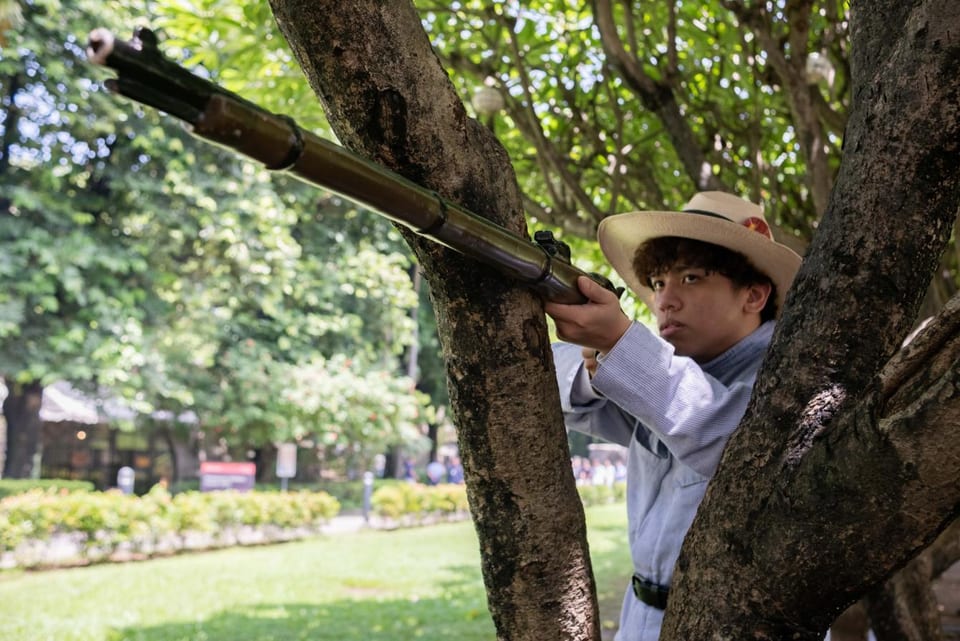
This progression through the ranks is not just a matter of prestige but practicality, too. Historical accuracy is expensive. Felianco states that more elaborate uniforms, such as those used for garrison troops or the Guardia Civil, can easily cost between P10,000 to P20,000—and that’s before shared props like embroidered flags enter the picture.
“There’s a path for your kit acquisition,” Feliciano says, adding that members would sometimes help sew one another’s uniforms, either as a favor or for a fee. “There’s like an inside barter system so everyone gets their own money to fund their own kit.”
Arcilla estimates that he has spent around P43,500 for over four years of reenactment, including P17,500 on five fiberglass rifles that he rents out to other members to earn some of the money back.
For now, much of that cost still falls on the members themselves. Magallona is currently working to register the group with the Securities and Exchange Commission (SEC), which would allow it to seek funding from heritage organizations. One of the first things HVM hopes to build once funding comes in: a reconstructed cannon.
Facing the public
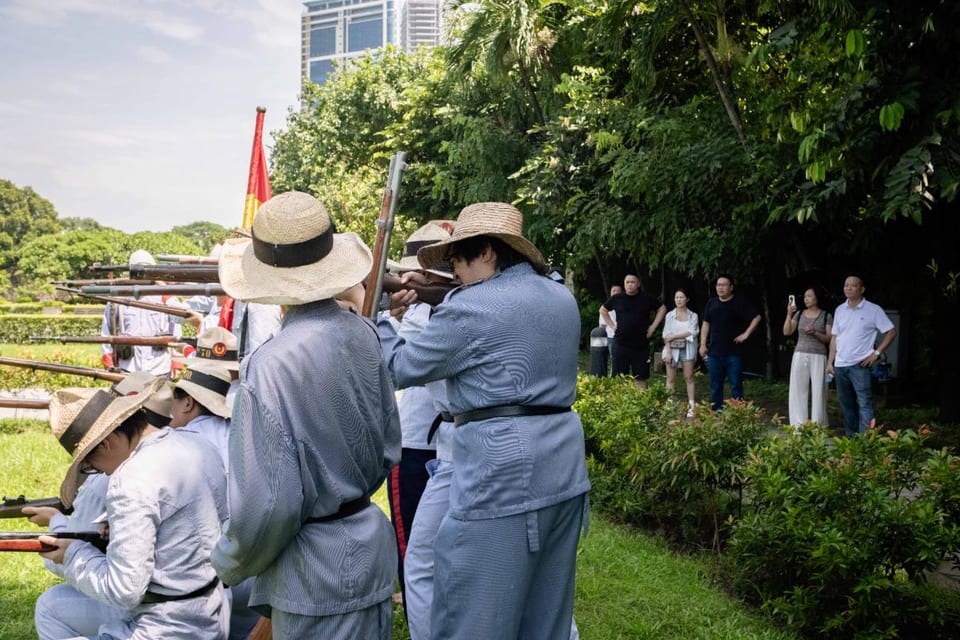
After three years of staging reenactments at Intramuros, HVM’s members have heard just about every guess about who they’re supposed to be. A man in uniform becomes José Rizal; a woman in period dress becomes Maria Clara. Members portraying Spanish troops have been mistaken for Japanese soldiers. One visitor even guessed Harry Potter. It’s a reality in a country where general knowledge of history is limited to only a handful of familiar figures.
“We correct them gently, in character. This is necessary because what we do is a form of public history education. What we’re doing is something that’s not just for ourselves, but for the Filipino public,” Arcilla says.
Fortunately, the guesses have become more informed over time. Arcilla says visitors are now more likely to recognize the two sides being portrayed—Katipuneros or Spaniards—a shift he finds reassuring.
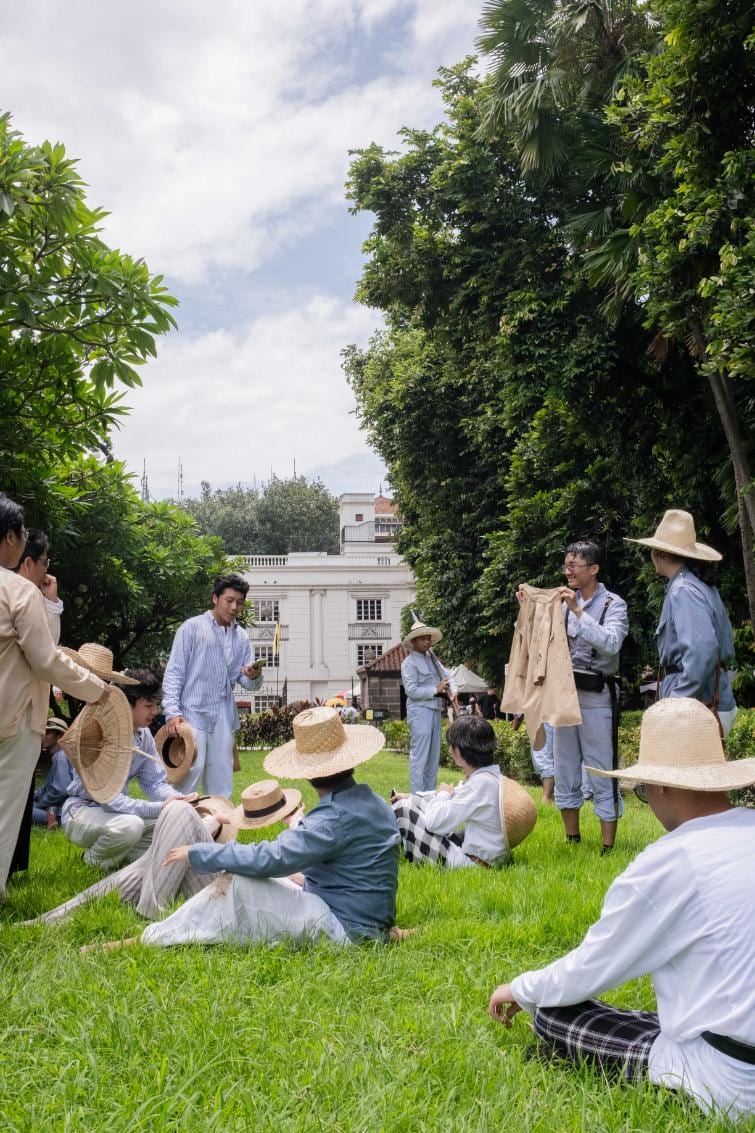
Still, the public is only one part of the experience. Even on quieter days, HVM members have their own reason for showing up. Because even when no one is watching, historical reenactment was—and still is—a hobby they enjoy for themselves.
Also read: Visita Historia: Manila's History Told Through Its Churches
Micah believes that writing is always political. Beyond the byline, you’ll find her bruising herself on a pole or doting on her beagle. Reach her at micah@spot.ph.