Visita Historia: Manila's History Told Through Its Churches
These houses of faith hold stories of beginnings, progress, and endurance through time.

by Leana Vibal
Published on Mar 27, 2026
(SPOT.ph) Like clockwork, every Sunday, people stream into their neighborhood churches—family members in tow, slipping into pews to hear Mass, offer prayers, and give thanks for another week. The Philippines may pride itself on interfaith coexistence, but it remains largely Catholic, and so this weekly ritual still unfolds most visibly in chapels and cathedrals shaped by a faith first brought by the Spaniards more than 300 years ago.
For an hour every week, these spaces fill with quiet devotion. But as the weekend bleeds into another busy workweek, most of these churches recede into stillness—their doors open but their pews largely empty.
But that stillness is deceptive. These churches have never been mere backdrops for Sunday worship. They were once the lifeblood of a populace, places of gathering, refuge, even governance—structures around which entire communities were built. Through centuries of colonization, war, migration, and rapid urban transformation, they endured, observant—silent witnesses to the lives, conflicts, and continuities that shape the city we know today.
To see churches this way requires shifting the lens beyond devotion alone. There are over 100 Catholic churches in Metro Manila. You likely already have your go-to—for prayer, for tradition, for proximity. But there’s always room to add (six) more, but this time let's see them not just as places of worship, but as entry points into the city’s past, present, and becoming.
A few weeks shy of Holy Week, we approached Diego Torres, historian and founder of Renacimiento Manila, with an idea to reframe the narrative that churches are only for the devout. As someone who studies both history and the built environment, he obliged—leading us to six churches that, together, trace the story of Metro Manila. Think of it as our version of visita iglesia—but in this case, it’s a visita historia.

A church of beginnings: San Agustin Church
“A settlement starts in the parish. When the parish is established, that's when officially the settlement becomes a city,” says Torres, explaining to us how Intramuros’ San Agustin Church started it all.
When Miguel López de Legazpi laid out Manila, the Augustinians were given prime ground to build both a church and a convent, in what is today the San Agustin Church. From here, missions expanded outward—to Tondo, to Pasig, and eventually to provinces as far as Pampanga and Ilocos.
.jpg?fit=cover&width=960&q=82)
San Agustin has witnessed everything the city has been through, and lucky for us, it has kept a record of it all, quite literally within its walls.
Completed in 1607, the church was designed to endure. Its exterior may look modest, especially against most churches of the time that favored elaborate ornamentation, but it hides engineering that made it last this long. Beneath the plain facade are its stone buttresses and stone vaulted ceiling—rare for their time—that have strengthened the structure, withstanding centuries of earthquakes, conflict, and change.

As Torres points out, San Agustin Church compensates for its restrained exterior with an interior that reflects the world that built it. Its Baroque architecture, expressed through its ornate interiors and theatrical detailing, speaks to the sensibilities of the Spanish colonial period—meant to inspire, to impress, and to assert presence. Paintings from the 1870s, woodwork from the 19th century, and 17th-century chandeliers from France remain intact today—a reminder that churches are, in many ways, museums in disguise.

Beneath it lie the remains of generations of prominent families in the country, key figures like Juan Luna and Maria Orosa, as well as Legazpi himself.
San Agustin was the only one of Intramuros’ seven churches to survive the Battle of Manila. While some might call that a miracle, history—and architecture—suggest otherwise. Its endurance was due in part to its robust design and its location, slightly removed from the heaviest fighting between Japanese and American forces.
But more than that, it was saved by the very people it sheltered. As the church became a refuge for civilians, those same civilians fought to protect it—putting out fires and rescuing artifacts whenever it came under attack. In that sense, San Agustin was not only shaped by its community, but quite literally saved by it.
An architectural wonder: San Sebastian Church
As the city expanded beyond Intramuros, so did the way its churches were built. In Quiapo stands San Sebastian Basilica, a structure that breaks from tradition—trading stone for steel.
.jpg?fit=cover&width=960&q=82)
Its story begins in the early 1600s when the Augustinian Recollects sought a place to build their monastery, a place of quiet reflection after fulfilling their missions. They settled on this property in Quiapo, which, according to Torres, belonged to a soldier who sold the property under the condition that whatever they built here would be dedicated to San Sebastian, the martyred saint of soldiers.
More than its origin story, the San Sebastian Church is best known for its all-steel frame, a feature unlike any other in the Philippines. When the 1880 earthquake destroyed a previous iteration of the San Sebastian Church, the Augustinian Recollects had had enough and abandoned the traditional stone structures in favor of the bold and innovative steel design.
"Naalala ko noong bata ako, dinala ako dito ng tatay ko. Hindi ako makapaniwala na all-steel siya—kinatok ko talaga at pinakinggan ’yong tunog," Torres recalls with a laugh. It’s a reaction many first-time visitors share, some even going as far as pressing magnets against the walls just to prove that it really is steel.
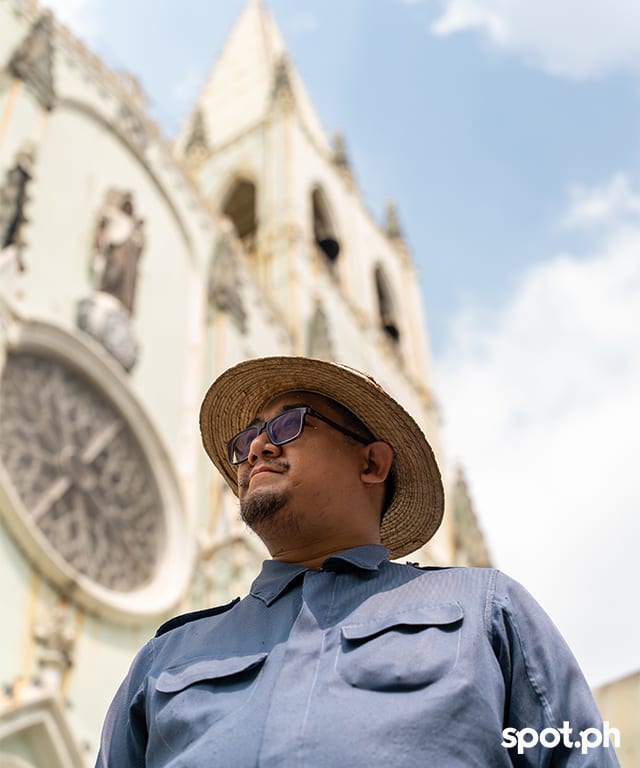
“If there’s one thing I want people to know, it’s that San Sebastian Church was not designed by Gustave Eiffel,” he adds, dispelling a long-standing myth. The church was actually designed by Genaro Palacios in the Neo-Gothic style, prefabricated in Belgium, shipped to Manila, and assembled on site. By 1891, it was the tallest building in Manila well into the 1960s.
And while in these modern industrial times, it is no longer the defining feature of the Quiapo skyline, San Sebastian still stands out thanks to its distinctly Gothic silhouette: its pointed spires, delicate finials, lancet windows, and pre-war German stained glass—all a welcome deviation from the mostly Baroque and Classical churches across the country.
.jpg?fit=cover&width=960&q=82)
.jpg?fit=cover&width=960&q=82)
San Sebastian's location was one of the first areas liberated during World War II, and as such, the church was spared from much of the destruction. But it stands more in danger today than before. Its greatest threat is not war but the elements. Corrosion is slowly eating away at the all-steel structure, and preserving it has become a race against time.
"The greatest remedy would really be additional funds to help with the restoration efforts," says Torres. "The church has been proactive in seeking donations. In fact, they also have tours here, and all the proceeds go to the conservation efforts," he adds.
Efforts to save this cultural treasure are well underway and done in phases. According to Torres, work is being done from the top down, starting with the dome to protect the altar, the spires, and the towers. And while the initial fixes have without a doubt helped, there's still a long way to go before we can all breathe easy for San Sebastian.
A church with a layered past: Santa Ana Church
Much like the churches of San Agustin and San Sebastian, which survived the darkest periods of Philippine history, another church at the edge of Manila tells its own tale of survival.
.jpg?fit=cover&width=960&q=82)
Nestled within a dense residential area on a quiet bluff, separating itself from the chaos around it is Santa Ana Church. Formally known as the National Shrine of Our Lady of the Abandoned, the church also survived World War II largely intact, with Torres describing it as "original for the most part"; much of the church dates back to the 1700s. Its Baroque features remain largely intact—every flourish meant to inspire awe and lure people into the faith in the 1700s is still present and still capable of doing the same today.
That is a feat in itself. But beneath the church lies a story that stretches even further back than the Spanish colonial era. In the 1960s, excavations within its grounds revealed a pre-colonial burial site dating to as early as 1000 AD. Pottery, Chinese trade wares, and even gold recovered from the site—now housed in the National Museum and Ayala Museum—point to a thriving community that existed in the area long before the arrival of the Spaniards.
But what's more interesting is that, in a single place, centuries of everyday life collapse into one another. What is now a Catholic church once stood as sacred ground for pre-colonial Filipinos; later, it became a religious center serving areas as far as present-day Mandaluyong, Makati, and Sampaloc; it survived war. And today, it maintains the same role it has had since.
More than a spiritual anchor, Santa Ana Church has long functioned as a social one. People gathered here not just for Mass, but for leisure, for community, for moments of quiet by the river. Long before the city grew dense and restless, this was a place to linger—and in many ways, it still is.
Churches reborn: Sto. Domingo Church and Nuestra Señora de Gracia
History, as we know, is not a story of uninterrupted triumph.
Manila bore the brunt of the Second World War, and with it came what Torres describes as “unimaginable cultural losses.” Much of Intramuros was reduced to rubble, its churches and religious structures destroyed—save for San Agustin. Beyond its walls, churches and monasteries across the city were not spared either.
Some, like Nuestra Señora de Gracia in Makati, were repurposed as garrisons and military outposts. Its walls saw horrible acts of war and trickled with blood. The horrors it saw left many locals believing it was haunted by the troubled souls that met their demise within it.
.jpg?fit=cover&width=960&q=82)
The once-beautiful monastery was burned to the ground, its massive adobe walls left scorched and riddled with bullet holes. What had once been a vibrant, serene religious compound atop a hill overlooking the Pasig River was nearly erased—save for its modest chapel, which survives today as one of Makati’s best-kept secrets.

.jpg?fit=cover&width=960&q=82)
In some ways, Nuestra Señora de Gracia was fortunate. It was rebuilt on its original site, preserving as much of the structure that once stood there as possible. Others were not afforded the same fate. And the best example of that would be the Sto. Domingo Church.
.jpg?fit=cover&width=960&q=82)
Even before the war, the church had already lived several lives. The structure that now stands in Quezon City is its sixth iteration. Originally built in Intramuros, the Dominican Church was repeatedly battered by the elements and rebuilt five times over the course of its stay within the walled city. When World War II reached Manila, it became the first church to be destroyed, taking with it much of its treasures and artifacts—save for fragments of its archives, the image of Our Lady of the Holy Rosary of La Naval, and a handful of surviving religious pieces.
In the aftermath of the war, the Dominicans relocated and rebuilt on newly acquired land in Quezon City. What rose in its place marked a clear departure from the past. Unlike the Baroque, Classical, or Neo-Gothic styles that defined earlier churches, Santo Domingo was designed in the Art Deco style of the time. Even today, it feels closer in spirit to American-period landmarks like the Philippine General Hospital or the University of the Philippines Diliman than to its Spanish colonial origins.
.jpg?fit=cover&width=960&q=82)
.jpg?fit=cover&width=960&q=82)
And while Sto. Domingo and Nuestra Señora de Gracia show how churches endure through loss and rebuilding; they also hold a reminder that the church is not just the structure—it is the community that sustains it.
The church as a political arena: Pasig Cathedral

Along the Pasig River, the cathedral that bears its name stands not just as a place of worship, but as a witness to the political and geographic forces that defined Metro Manila.
The unassuming church stands in the middle of a busy poblacion, flanked by a school and several commercial establishments. It’s quite easy to miss with everything going on around it. But the chaos of the area disappears once you step inside the Pasig Cathedral.
Recent renovations may have taken away its patina-crusted look, characteristic of old churches like those in Intramuros, but don’t let that fool you. The Pasig Cathedral has been around far longer than you think. It is after all where Metro Manila, as we know it, began to take shape.
But how could a church in the middle of Pasig poblacion be at the center of such a massive geopolitical moment?
As it turns out, it’s all because of strategic positioning, says Torres. Pasig poblacion—consequently, Pasig Cathedral— may not look like it today, amid the towering CBDs surrounding it, but it’s situated closely to the banks of the Pasig River and the surrounding Rizal mountainside. Thanks to its placement, the neoclassical-meets-baroque church bore witness to the movement of people and goods. More importantly, at a time of conflict, it was an essential stronghold, serving as a site for many encounters between the guardia civil and the Katipuneros. When Bonifacio and his allies eventually claimed it from the Spanish, they used the area as a pit stop for their men as they moved through the province of Manila.
But its most critical role was in 1901. Under American rule, the cathedral became a political stage when William Howard Taft used it as a venue for talks that would lead to the consolidation of the provinces of Manila and Morong, resulting in the creation of the province of Rizal, the blueprint for modern-day Metro Manila.
It’s easy to overlook spots like the Pasig Cathedral, especially when we forget how much the space it occupies has changed through time. “There was a time when churches were the highest points in town. It would be the towering figure in the skyline,” Torres reminds us. And while it's hard to imagine this church towering over much of Pasig, it’s an invitation to look at churches not just as beginnings but as markers of growth and of how far we’ve come.
Churches beyond religion
There is no doubt: churches hold meaning far beyond their role as places of worship. As Torres puts it, churches are where life unfolds in full—where people are married, where families say their final goodbyes. “May kuwento sila ng bayan, may kuwento sila ng mga tao,” he says, reminding us that these structures carry not just stories of faith, but of entire communities. From a heritage standpoint, they are often the most enduring landmarks we have—outlasting generations, holding steady as the city around them changes, quietly preserving a sense of continuity.
To walk into these churches is to read the city differently: to see not just stone and space, but layers of memory, and appreciating them isn’t reserved for the devout. You don't need to be a Catholic to value these buildings—you just have to love your city enough to look closer, and be curious about its history enough to listen.
Leana is Spot's go-to for Arts & Culture and Things to Do. On any given day, she’s either glued to her screen—or gliding underwater like the mermaid she swears she is. Contact: leana@spot.ph