Rizal’s Poetry Album Gifted to Leonor Rivera Up For Auction This Weekend
It's an important memento of their brief love story.
Published on Dec 3, 2025
(SPOT.ph) A poetry album titled “Colección de composiciones inéditas de los más notables escritores de España, ilustradas con magníficos grabados,” once gifted by José Rizal to his beloved Leonor Rivera, carries a romance as tender as it is tragic. And it is coming up for auction this weekend—on December 6, Saturday to be exact.
The 199-page volume, published in 1884 in Barcelona by the Establecimiento Editorial Ramón Molinas for the magazine La Ilustracion Iberica as a freebie to the latter’s subscribers, contains short poems in the romanticist vein. They are written by Spain’s leading poets at that time such as Gabriel Nuñez de Arce, Salvador Rueda, and Ramon de Campoamor.
The copy to be auctioned is signed by Rivera herself—“Es propiedad de Leonor Rivera.” It also bears a dedication from Rizal on the frontispiece: “Á Leonor Rivera, Recuerdo” (“To Leonor Rivera, A Remembrance”), framed with two lovebirds. Its significance resonates beyond the physical artifact: it is a witness to a love that shaped the young patriot’s emotional life.

Rizal’s bond with Rivera, his cousin from Camiling, Tarlac, began in their youth while he studied at the University of Santo Tomas. Their engagement blossomed quietly, with Rivera signing letters to Rizal as “Taimis,” Tagalog for “sweet,” a secretive token of intimacy.
Yet, fate intervened: Rivera’s mother favored an English suitor, and despite Rizal’s enduring affection, he bowed to family expectations.
The heartbreak weighed heavily on him. His friend Ferdinand Blumentritt sought to console the grief-stricken reformist, reminding him that Rivera’s renunciation revealed her unsuitability: he told Rizal she was “not the woman for you.”

Sonnets by Rueda
Two sonnets by Rueda in the poetry album seem to speak of the fate of the two star-crossed lovers. The first sonnet burns with desire and the torment of distance. Rueda writes:
“…más me muero cuanto más te miro
y más te miro cuanto más me muero”
(“…the more I gaze, the more I die—
and the more I die, the more I gaze…”)
Rizal, then a young lover in Manila, perhaps saw in these lines his secret yearning for “Taimis”—Leonor’s clandestine signature in her letters.
The second sonnet — a lament of exile — seems to foretell his fate:
“Ay del pobre sin patria y sin hogares…”
(“Alas for the poor one without homeland and shelter…”)
Here is the lonesome expatriate’s hunger for home, the moonlit ache of remembered tenderness—“el monotonо son de los cantares / con que su madre le adormió en la cuna …” (“Alas, if he remembers, in the moonlight, the monotonous sound of the songs with which his mother lulled him in the cradle!”)
Years later, when Leonor married an Englishman, Blumentritt consoled Rizal, telling him that a nobler beloved—"the Motherland”—awaited.
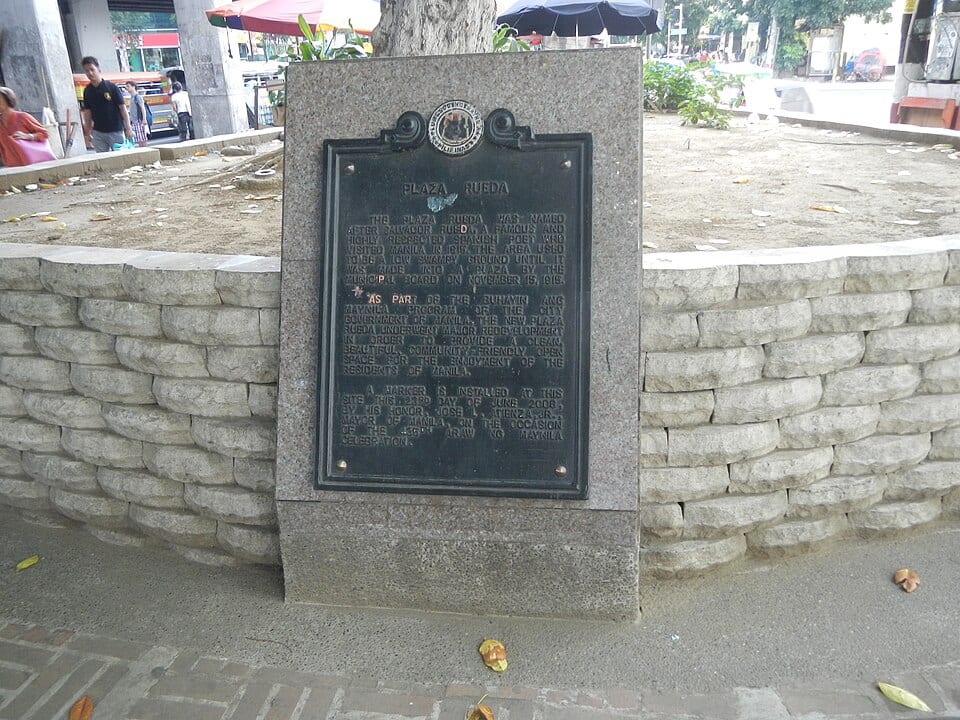
Rueda would one day visit Manila in 1915, feted by Spanish-Philippine poets whose own verses he had shaped. Cecilio Apostol even penned a poem in his honor, and the Plaza Rueda was constructed with a government historical marker commemorating the 1915 visit. (It is still there on Taft Avenue, across Medical Center Manila.)
With a floor price of P500,000, this album is more than a collector’s item—it is a tangible window into the private emotions and early heartbreaks of the Philippines’ national hero.
Noli, Fili set
Another important Rizaliana item in the auction is Lot 83 which features the exceedingly rare first editions of Rizal’s Noli Me Tangere (Berlin, 1887) and El Filibusterismo (Ghent, 1891).
These historic volumes — foundational to the Philippine struggle for nationhood — are exquisitely bound in hand-painted speckled Moroccan leather with six raised and ornamented bands, gilt-stamped title panels, and marbled endpapers.
Each spine bears the engraved initials “AGM.” Sourced from a distinguished private collection in Madrid, Spain, the pair is valued at a floor price of ₱6 million, offering collectors a profound piece of Philippine history.

Ivory Masterpiece
Also up for bidding is a luminous 19th century ivory sculpture of St. Thomas Aquinas; it emerges not only as an object of devotion but also as a relic steeped in Philippine and Catholic history.
St. Thomas appears in Dominican habit, quill and scroll in hand, symbols of his towering works like the Summa Theologiae. A radiant sun marks his brilliance in virtue and doctrine, while the fallen medieval Arab philosopher Averroes underfoot signifies the Angelic Doctor’s triumph.
Carved by the 19th-century Manila master Espiridion Arevalo, the work was presented by the Spanish Dominican friars from the Philippines to Pope Leo XIII in April 1888 — in celebration of his sacerdotal jubilee.
Leo XIII had issued Aeterni Patris in 1879, calling for a revival of St. Thomas’s teachings; in 1902, he would declare UST a pontifical university — a lasting legacy etched in its identity.
Now traced to the noble House of Braganza of Portugal, this 11-inch marvel returns to Manila’s gaze, with a floor price set at ₱1,000,000 — its story gleaming as brightly as the sunburst symbolizing wisdom on the saint’s chest.