The Food Our Heroes Loved
From humble everyday meals to one grand luncheon in Malolos, food offers a revealing glimpse into how Filipinos remembered home and imagined a republic.
Published on Jun 12, 2026
(SPOT.ph) Jose Rizal loved food. A close reading of Noli Me Tangere, whether for school or for leisure, would reveal just as much.
Take Chapter 23, for instance. While on a fishing excursion, a conversation between Capitana Tica, Sinang, and Albino turns to the pressing question of what one should drink before hearing mass: salabat and rice cakes, coffee, tea with galletas, or chocolate. In the same chapter. we see Andeng, Maria Clara’s foster sister, who “had the reputation of being an excellent cook,” make fish sinigang with rice water, tomatoes, and kamias. As they disembark, Tia Isabel, with great urgency, requests that the sinigang be cooked as soon as possible, “so that the live fish can pass from the water to the broth.” Further in the chapter, Tia Isabel assigns the fish to their proper dish: ayungin for sinigang, biya for escabeche, dalag and buan-buan for pesa.
 (1).jpg?fit=cover&width=960&q=82)
This remarkable level of detail reveals a few things: Rizal’s culinary literacy, familiarity with local ingredients, and a kind of indigenous knowledge. Fish had their proper dishes. Sourness had multiple agents. It also makes a fairly persuasive case that when it comes to sinigang, freshness trumps all.
What our heroes ate
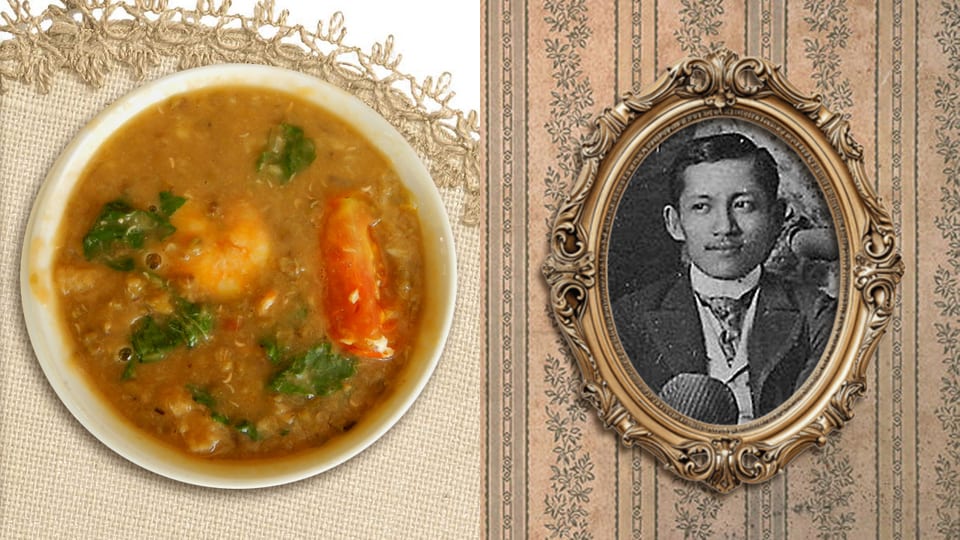
But in my quest to find out more about our national heroes’ favorite foods, what turns up most often for Rizal is not a grand dish, but the humble, ever-present Friday lunch staple: guisadong monggo with tinapa. It was a meal he ate often while in exile in Dapitan, where he wrote hundreds of letters to his family, many of them containing requests for food from home. He asked for Laguna kesong puti, mangoes, and foie gras. When vegetables and viands were scarce, he asked for tokwa, monggo, and dried fish.
For other heroes, the record is a little thin but no less enjoyable. Most notable is a list by the late food historian Milagros Santiago-Enriquez, whose 1993 cookbook Kasaysayang Kaluto ng Bayan details recipes dating back to the 17th century. Enriquez, who was related to Gregorio del Pilar and Pio Valenzuela, recorded the favorite dishes of several heroes from memory and family recollection.
According to this list, Emilio Aguinaldo’s favorites make for a curious spread. He is said to have favored asparagus soup and bibingkang may sariwang gatas ng kalabaw. According to historian Ambeth Ocampo, Bibingka appears again in the revolutionary government’s expense ledgers, particularly in a line item that reads: “bibinquera ng presidente.” Aguinaldo, it seems, hired his own bibingka maker.
In an article by food historian and writer Ige Ramos, however, he is recalled through more ordinary Caviteño food: pinangat na isda and camote tops. Pinangat is fish cooked with tomatoes and something sour, reduced into a sharp, savory dish eaten with rice. Paired with camote tops, often boiled and served with bagoong, it gives us a picture of the first president’s everyday appetite.

On the other side of the Katipunan, Andres Bonifacio, a native son of Tondo, is said to have loved nilitsong manok sa saha: chicken wrapped in the thick, non-woody stems of the banana trunk and cooked over coals and fire. Some accounts suggest the method produced less smoke than cooking meat directly over a fire, ergo helping him avoid detection. However, it is easy to imagine that it also kept the meat tender while lending it some flavor.
 (1).png?fit=cover&width=960&q=82)
The list goes on. According to Enriquez, Gregoria de Jesus, Bonifacio’s wife and a daughter of Caloocan, liked adobong igat and pinatisang alimango. General Anacleto Enriquez, known in the Katipunan as “Matanglawin,” came from Bulacan and loved tambalolo: a large bangus filled with chopped salted egg, onion, ginger, and garlic, wrapped in leaves and steamed.
These details are appealing because many of the foods remain familiar: monggo, tinapa, pinangat, camote tops, alimango, and bangus. Society may have changed drastically in the past 128 years, but perhaps appetites have a much longer memory.
What the exiles missed
The food that we love is often interchangeable with the food that we miss, especially when we’re away. By the late 19th century, after more than 300 years of Spanish rule, life in the colony was changing. Wealthy indios, Chinese mestizos, and Spanish creoles moved through an increasingly mixed social world of blurring social categories. Business opportunities brought more foreigners into the islands; families with means sent their children to Manila, and eventually Europe, for schooling.
For many of them, Europe was not a brief stop. Rizal spent much of the decade between 1882 and 1892 abroad; Marcelo H. del Pilar left for Spain in 1888 and never made it home; Graciano López Jaena went to Spain in 1880 and died in Barcelona sixteen years later. Going home required money, time, and in some cases, involved real risk. It makes sense then that Filipinos abroad gravitated toward one another, and in missing home, you naturally miss the food you know.
.jpeg?fit=cover&width=960&q=82)
And Rizal and his friends gathered often. In The Foods of Jose Rizal, food historian Felice Prudente Sta. Maria notes that these homesick schoolboys met to sing kundimans and eat sotanghon and adobo in profusion. Rizal himself wrote to his family in 1889 that the Filipinos in Paris gathered several times a week: Wednesdays at Doña Tula’s, Thursdays at Félix Resurrección Hidalgo’s, Fridays at Madame Boustead’s, Saturdays at Juan Luna’s, and Sundays at Doña Juliana’s.
Doña Juliana was Juliana Gorricho, wife of Félix Pardo de Tavera and mother of Paz Pardo de Tavera, who would eventually marry the tempestuous Juan Luna. Juliana compiled dozens of notebooks containing handwritten records of Filipino food as interpreted overseas, along with notes on the guests who came, when they visited, and what she served. Sotanjon noodles for pancit was popular with the expatriate community. Her recipe for ucoy included the usual shrimp, but also panocha, or unrefined sugar. Proof perhaps that our love for sweet and savory transcends time and borders.
Even if the label “Filipino food” did not yet exist in the way we use it now, her recipes were seen as the savors of the homeland: lumpia, arroz caldo, menudo, and paksiw, to name but a few.

When Rizal and Maximo Viola visited Ferdinand Blumentritt in Leitmeritz in 1887, they were reportedly served Filipino food by Blumentritt’s wife, Rosa. One account, citing Harry Sichrovsky’s biography of Blumentritt, lists the spread as adobo, lechon, lumpia, kare-kare, pancit, and arroz a la Valenciana. What is most striking is that neither of the Blumentritts had ever been to the Philippines.
What these expatriate families and foreigners served was not yet Filipino cuisine in any formal sense, but distance has a way of clarifying things. These were dishes whose origins may have been mixed (whether Spanish or Chinese), but whose meaning had come to represent one place: home. It was food made through adaptation and translation, using available ingredients and recreated from a memory of taste.
What a nation served
In September 1898, when the Malolos Congress ratified the declaration of Philippine Independence, the occasion was marked with a banquet. The proponents of the meal have been traced to the kitchens of Sulipan, Apalit, Pampanga, where the Arnedo family was known for entertaining at the highest level, including royalty.
According to accounts by the chef Gene Gonzalez, a descendant of the Arnedos, the banquet was prepared by master pastry maker Juan Padilla and head chef Emilio Gonzales.
.jpeg?fit=cover&width=960&q=82)
We know the luncheon menu because it was photographed and later published in Harper’s History of the War in the Philippines in 1900. It was written in French, the language of diplomacy and fine dining. There were oysters, shrimp, buttered radish, olives, Lyon sausage, sardines in tomato sauce, and salmon with hollandaise. Then came the larger dishes: coquilles de crabes, vol-au-vent à la financière, abatis de poulet à la Tagale, côtelettes de mouton à la papillote, dinde truffée à la Manilloise, filet à la Chateaubriand, and jambon froid aux asperges.
At first glance, the menu sounds almost entirely European. But when you look closely, they are most likely Filipino dishes. Coquilles de crabes could suggest tortang alimasag. Abatis de poulet à la Tagale has been read as chicken adobo. Dinde truffée à la Manilloise calls to mind relleno or galantina, served Manila-style.

The years that followed would make the claim to nationhood long and difficult. American occupation would arrive soon after the end of Spanish rule, and the republic declared at Malolos would be interrupted almost as soon as it was announced.
But Malolos remains powerful because, however brief, it was a moment when Filipinos were no longer only petitioning for reform, writing from exile, or imagining a country from afar. They were attempting to represent themselves as a nation, and the banquet was one way of making that nation visible.
The intimacy of history
While the luncheon could never represent the entirety of Filipino food, the road to Malolos had already passed through many kitchens and texts: Rizal’s precise descriptions of sinigang, pesa, and escabeche in Noli Me Tangere; Juliana Gorricho’s expatriate recipes in Paris; Rosa Blumentritt’s adobo, lechon, lumpia, kare-kare, pancit, and arroz a la Valenciana in Leitmeritz.
At their most basic, these historical records tell us what people ate. Through food, we get a glimpse of the more intimate aspects of our culture: the practice of hospitality, kinship and occasion, the adaptations demanded by displacement, and the things we preserve under duress. Perhaps most tenderly, they show how the humblest everyday meals persist across generations because we keep returning to them. They remind us that identity is an ongoing process, made as much through declarations and grand rituals as through the material of everyday life: the food we eat, share with others, and remember time and time again.
Toni Potenciano is a writer based in Manila and a partner and creative director at Kodawari, a casual Japanese restaurant. She writes essays and profiles on art, design, and culture.