At Marikina's Digámo, History Lessons Come in Delicious Plates
Chef Francis Lacson's food will put a smile on your face.
Published on May 16, 2026
Digámo
GCN Commercial Building, Northwest Narra Street, Marikina Heights, Marikina City.
For bookings, visit their Instagram at: https://www.instagram.com/digamo.mnl/
Open Wednesday to Sunday, with 5:30 and 8 p.m. seatings
(SPOT.ph) “Why not Marikina?” Chef Francis Lacson asserts, his voice clear and crackling with excitement. Many have suggested that Digámo, his Neo-Colonial Filipino food concept, belongs in another city, in the busier lifestyle and business centers of the Metro. But the chef and his wife, Diana Lacson, clearly think differently. They want to be in a place with a heritage and vibe that their latest project can resonate with.
“We’re probinsyanos. We identify most with Marikina because it’s a ‘probinciudad,” says the Capiz-raised Francis who is now a Marikeño. “Here, culture is still alive…so it has a lot of soul.”
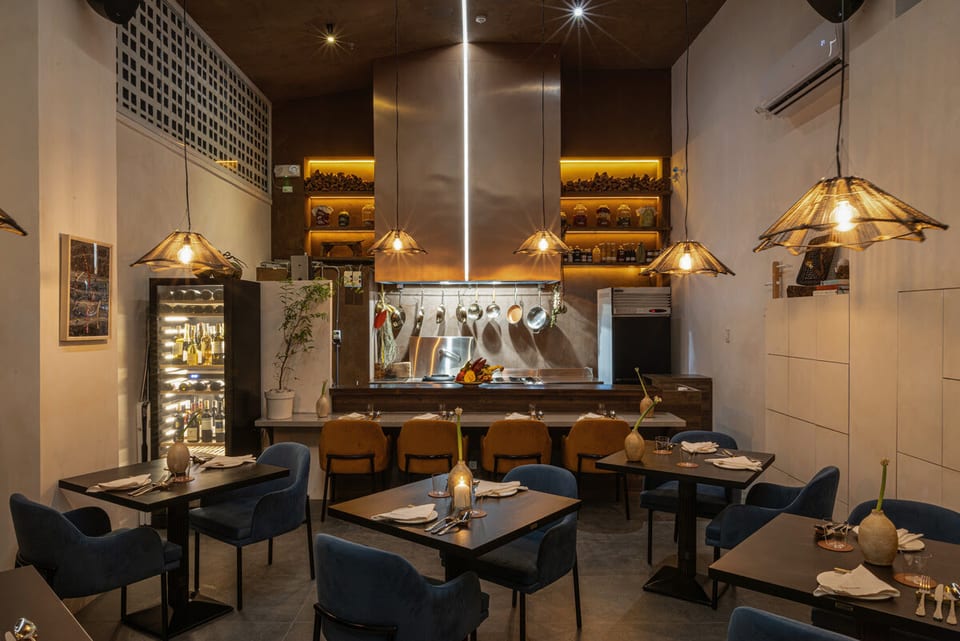
And so Digámo, which aims to take diners thru Philippine history and geography through food, finds itself in the quiet, low-key neighborhood of Marikina Heights, in a building just across local landmark St. Scholastica’s Academy. A beautiful blue door opens to the dimly lit, 14-seater fine dining set-up. The “dirty kitchen”, where Chef Francis and his team work, anchors the entire space—visible to everyone dining and equipped with bar seating should guests like to engage with the chef or take an occasional peek at the treats being made.
What Digamo really means
The menu is a guided adventure through our colonized past up to present day, as well as a trip around different culinary spots in the Philippines. As such, we get to taste caramelized pineapple and floral honey from Bukidnon, a variety of vinegars from the country’s various regions (sukang paumbong, sasa, tuba, and iloko), the ulang or river prawn from Antique, the tangy Bicolano libas leaves dashed atop a brothy and savory custard, and so much more.
Of the ingredients and inspirations he's brought here from different places, perhaps the most important transplant is the chef itself. “Digámo” in Hiligaynon is literally the “act of cooking.” But it is also a verb meaning “to set in order”—something Chef Francis recalls his father often said. It used to serve as a starting pistol for the Lacson kitchen to start long preparations for big handaans, where they host friends and family and the whole barangay. It’s this tradition that Chef Francis now brings to Marikina, this time extending the invite to other fans of refined Filipino artisanship.
 .jpg?fit=cover&width=960&q=82)
Chef Francis tapped Marikina’s artisans to help set the stage for the dining experience he’s created at Digamo. “Most of our suppliers are from Marikina,” he says proudly. “The Filipino cocktail spirits are curated by Proudly Promdi… even the furniture are from Marikina, the chairs...” He picks up a nearby serviette and runs his thumb against the embroidered logo. “This is from the Olive Tree; sa kabilang kanto lang namin sila.” Needless to say the chef’s dress shoes worn throughout service is from the shoe capital, too. “They are by Tatay Oly Shoes, one of the oldest shoemakers in Marikina.”
Chef Francis has filled his humble joint not only with objects from this town and its nearby environs—the earthy scent that fills the room is from Antipolo-based perfumer Oscar Mejia III—but also with personal sources of inspiration. There are depictions of the Angono quarries and lush Mt. Maculot, courtesy of contemporary artists Kim Oliveros and Geraldine Javier. The cookbooks he's learned from are on the bookshelves: among them the iconic The French Laundry Cookbook, as well as books by pillars of Filipino writing, Doreen Gamboa Fernandez and Nick Joaquin.
.jpg?fit=cover&width=960&q=82)
What to expect from the Playful Evolution menu
Supporting the 10-course dinner are snacks, sides, and cocktails that flank, transition to, and cap off the different dishes plotted into a menu resembling a map of Marikina. And of the stars of this inaugural repertoire, here’s what we enjoyed the most:
From the Precolonial Era, the Tenga at Tenga at Tenga. Imagine an intensely fatty, savory, and succulent bite of barbecue composed of crisp tenga ng daga (wood ear mushroom), chewy pork tenga (pig’s ear), and decadently soft abalone (sea ear). You almost don’t need the corn smut dip it comes with until you realize it’s there to even things out in your palate with its hint of sweetness and mild acidity. The Nipa Highball is a perfect match to the sinful skewer, the drink's slight Pinakurat notes taking us into another moment in time.
.jpg?fit=cover&width=960&q=82)
Then there's the Kulawo. Perhaps it’s the sight of the humble and familiar puto that made this dish so disarmingly scrumptious. It turns out the savory warm kakanin made of galapong was just a canvas for what this dish was truly about: the rich and delicious kulawo pretending to be a side show, topped with burnt brown sugar and finished with extra virgin coconut oil. So little goes so far, as every dip releases intense smokiness born from the charcoal-burnt coconut, the char-grilled eggplant, and the spices macerated into creamy perfection. The watermelon jam, an alternate dip, makes for an effective palate cleanser that makes it all feel like a pipe dream. If there’s something bad to say about this dish, it’s that it ended too soon.
Next is the Sarsa Confusion. Menudo, Kaldereta, and Mechado. Are we sure they’re not just interchangeable triplets? What Digamo does, with tongue-in-cheek humor, is put them all on a single plate, giving us the chance to finally taste them right beside each other. The confusion suddenly feels like an incredibly silly yet rewarding conundrum. The differences are so indelibly, ridiculously stark that the unbidden giggle and unwitting smile it sparks as you chew only adds to the enjoyment.
.jpg?fit=cover&width=960&q=82)
The Menudo here is confited Batangas kurobota pork cheeks with a blood-flavored pinuneg crumble. The sweet-savory, clean, and red bell pepper-forward coating is meant to accentuate the rare, tender meat. The Kaldereta is slow-cooked, braised, and deep-fried goat meat. with a creamy kesong puti green pea puree as well as a curry-like, fragrant sauce with that distinct, slight funk of stewed caprine. The Mechado sauce, for its part, successfully brings out the meatiness of the round cut of lean beef embracing a yellow, melty pork fat wick. It is accompanied by calamansi gelee.
.jpg?fit=cover&width=960&q=82)
Finally, there's the dessert called Five Stages of the Coconut. “The Pianono is just a vessel (here),” Chef Francis says of the tender cut of cake soaking up sweet, refreshing coconut juice. More important is the cream spiraled in, the chewy sweet jellies sprinkled around, the crunchy tuile on top, and other textured accoutrements—all variations and expressions of the coconut fruit at different stages of its life. More than a play on textures and flavors, the dish is a play on how time, technique, and creativity can transform one humble ingredient into a complex multilayered delight.
But apart from being a triumphant experiment in capturing a coconut’s lifetime in one spoonful, for Chef Francis, it's the one dish that asks the question: "Where are we going with our food?" It’s a big, overwhelming question, but the man of the kitchen has an answer. He says keeping traditions is okay, but tradition needs to stay relevant and evolve for it to stay alive. He should know, having done a lot of research on our cuisine and experiments on our ingredients. He also belongs to a family of community cooks often tasked to prepare feasts armed with gigantic sandoks that look like sagwans. It’s refreshing to know that for him the answer is not in the deification and petrification of culture, but rather in encouraging the Filipino to freely play with his food, and look at it with a renewed sense of wonder.
Playful Evolution, the 10-course Tasting Menu by Chef Francis Lacson is at ₱3,500+ (main dining area) and ₱3,950+ (dirty kitchen/chef’s table).
Jasper Castro is a Makati-based hermit/artist/writer/mental health advocate/feminist who will occasionally see the light of day for movies, art, and good food. Napping betwixt two poodles, she promises her next masterpiece is coming.