What's New
From Serving Time to Serving Brews: This Coffee Cart Pop-up Taps Ex-Felons as Baristas
Brought to you by the Philippine Jesuit Prison Service.
Published on Aug 5, 2025
(SPOT.ph) The phone is ringing off the hook—wait, do you guys remember phones being hooked up? Never mind. Actually, the DMs of the Philippine Jesuit Prison Service Foundation, Inc. (PJPS) are blowing up with inquiries for—wait for it—a coffee cart run by ex-convicts.
Well, PJPS would rather that we all say PDLs (persons deprived of liberty) moving forward. The pop-up itself, Ex-Preso, was born from Debbie Tan (Chief of Staff at MVP Group of Companies and PJPS benefactor), her own love of coffee, and the tireless work of Jesuit priests like Fr. Jun-G Bargayo.
PJPS Launches Ex-Preso at Ateneo
Ex-Preso is one of the Jesuit organization's latest projects, but it comes after three decades of any number of efforts and varying degrees of success. Since 1994, they’ve worked toward the holistic rehabilitation of PDLs and their restoration to society. “They have even gone as far as finding housing for families who move to be near [New Bilibid Prison] and raising funds for the affected kids,” says Tan, in a conversation with SPOT.ph.
This time, though, it seems as if the non-profit organization has walked right into a perfect storm of conditions: A burgeoning local coffee culture, growing social awareness of vulnerable groups at the margins, and benefactors like Tan make not the perfect business—it is decidedly not one—but one of the most creative and approachable ways for the caffeine-driven public to rethink what might have previously been considered a given.
Just Desserts?
We’ve seen the infographics and photo posts pop up on social media every once in a while, over the past decade or so—those brightly lit images and promising statistics, showing how well former convicts in places like Norway do in prison and when they’re back outside because of how humane the conditions are. While the low recidivism rates are real, it all seems so far away and impossible to the Filipino imagination—both because even the ordinary day to the average person can feel like one in a string of a life sentence, and because of how we’re taught to look at the concept of justice itself.
This isn’t a dig at us as a culture; it’s easy to see how we arrived here. “If I were to sit across from a man who confesses to me that he’s guilty of murder,” explains Tan, “I would have a reaction. I know I would, it’s useless denying that. But that doesn’t change that he’s a person, and I wouldn’t know what his story is just from that confession.”
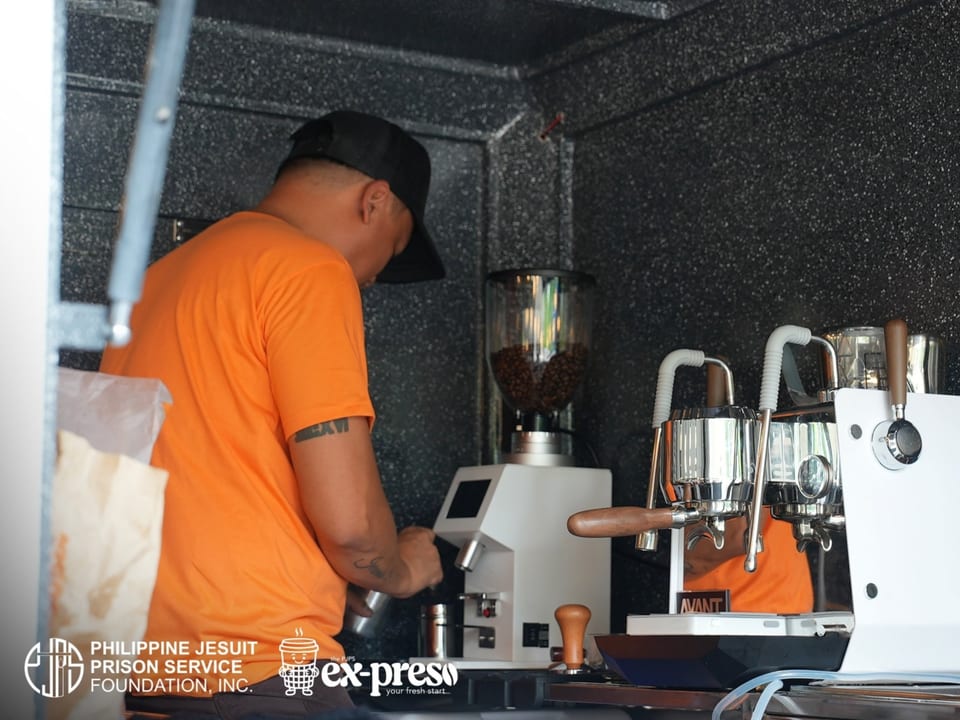
Click to Enlarge
Second chances are brewing with PJPS and their coffee-themed project, Ex-Preso. Photo courtesy of Philippine Jesuits (Facebook)..
Yet most of us act as though we would. Moreover, we often talk as though we also know exactly what that man deserves.
It could be boiled down to a simple but pervasive misunderstanding of the law (e.g., the frankly alarming fact that most people don’t know that the degrees of murder that an accused person might be charged with are not determined by how gruesome the incident in question might have been, but by provable intent), but it could also be as frightening as a collective emotional satisfaction over the very idea of retribution. An eye for an eye sounds about fair, right?
PJPS doesn’t quite agree, however biblical that might sound. And that word—'deserve'—does a lot of heavy lifting.
Masks Off
"You see, some people are in jail for a number of years that could be wildly disproportionate to what they actually did, or what they were capable of consenting to. But no matter what, there's that label—a weight on them, unless we do something to give them another chance."
Oftentimes, that also means people who live to see release from prison feel as though they have no connection to the world. Unfortunately, for some, the feeling reflects reality.
"Some of them are in there for twenty years," Tan tells SPOT.ph, "and not a single visitor."
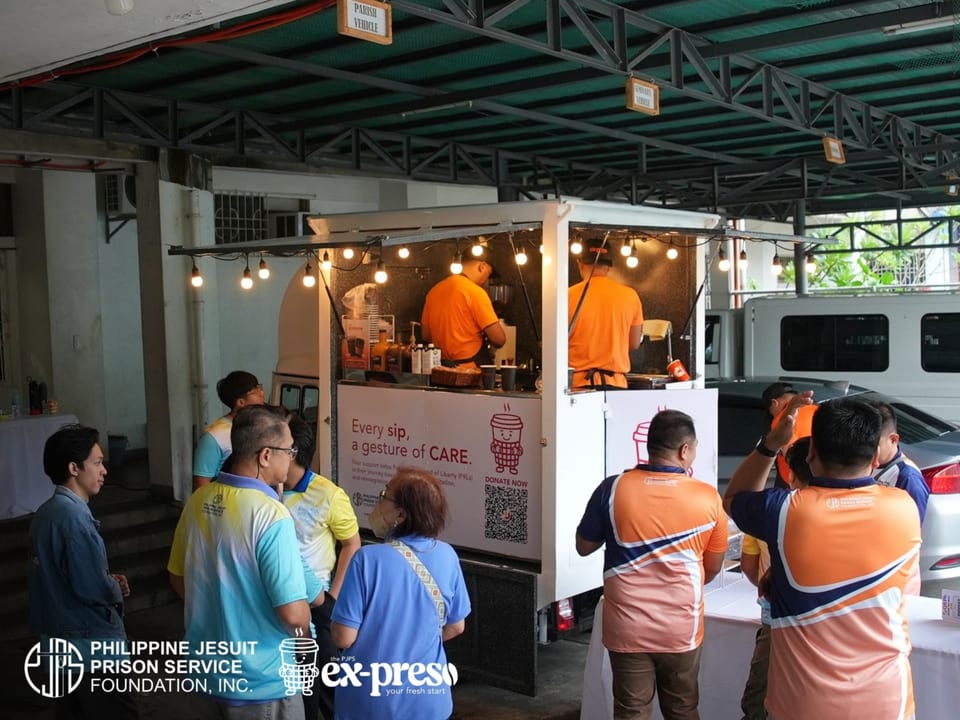
Click to Enlarge
Order up—these baristas may have once served time, but are now ready to serve communities. Photo courtesy of Philippine Jesuits (Facebook)..
Fr. Bargayo goes on: "Upon release, they're then faced with three different [sources of stigma]. First, from the general population; second, the bureaucracy; and maybe the worst of these is from within themselves. And because of that—well, we may not see them back in jail, but it's happened that they return to a life of crime because they truly believe there is nothing else for them. We realized, after almost 30 years, we had to make that second chance even simpler for them."
For the Ex-Preso in particular, he and the other priests weren't sure what to expect. On an intellectual level, it should all pan out well: Those once behind bars now work behind a bar counter, and after enough time become the independent owners of the mobile kiosk. It's both a tangible lifeline for themselves and a sensible, low-risk way for the average citizen to assist in the restoration of liberty. In fact, when the idea hit the table a year ago, donations and resources seemed to fall into place over time; people were excited.
But as launch day (July 27) neared, Fr. Bargayo would learn that the former PDLs had every intention of hiding their faces during the event. "They were so, so ashamed," he shares. "It made me sad, but I understood."
But then something remarkable happened.
Our interviewees tell us that about halfway through the launch, these convicts-turned-baristas took their masks off to smile back at customers. "Hindi lang ito about yung pwede nilang pagkakitaan," shares Fr. Bargayo. "Actually, they even forgot na galing sila sa kulungan. Somehow, they were able to see themselves through a new lens."
And to think, they ultimately only had about a week to prepare; such was the excitement around the idea of Ex-Preso before it was even fully formed. "It started with the donation of the small food truck," Tan recalls, "and it snowballed. My God, did it snowball."
Click to Enlarge
Click to Enlarge
Click to Enlarge
Click to Enlarge
Rev up your next party with caffeine and a good cause. Posters courtesy of Philippine Jesuit Prison Service Foundation, Inc.
At time of writing—that is, before any of the new servers or baristas have gained independent ownership of their own cart—coffee isn't sold per cup. Interested parties can refer to the Ex-Preso donation packages named for the degrees of security of correctional facilities, starting at P15,000 for 100 cups and a table setup; all packages include classic drinks like Americanos and Spanish Lattes, which we're told are already gaining popularity. We recommend that you don't wait too long before booking them; judging by the public's response, their calendars may be filling up soon.
The other term that PJPS would have us use is PRL, or persons restored to liberty. "We believe in and work for restorative justice, not just rehabilitation," shares Fr. Bargayo. "Just as a cup of good coffee can feel restorative... like you said, it's a perfect storm, all the copy and storytelling kind of came together."
"The priests had to ask people hold off on trying to book the Ex-Preso cart before it even launched," laughs Tan. "But what a wonderful thing, all this enthusiasm."
But as much as the concept relies on the foundation, so too does its long-term success hinge on the empathy and generosity of the many—or at least, the number who are capable. As for the least of us—or perhaps even the skeptical—Fr. Bargayo asks only, "Pray for us."
Find out more about the Philippine Jesuit Prison Service Foundation, Inc. how you can help by visiting their website. Inquire about Ex-Preso donation packages through 0961 002 6909 or their Instagram.
If you’ve never been afraid of how much someone loves food, you’ve never met Michiko Manalang. She predictably has multiple cats; she less predictably can row 70 pounds.
You Might Also Like