What's New
These New Dishes at La Spezia BGC Are Playful Updates on Italian Favorites
Carbonara with a 63-C egg, scallops with strawberries + more reasons to go back.
Published on Aug 3, 2025
(SPOT.ph) La Spezia isn’t one to do what everyone else is doing, at least not when it comes to Italian food. Sure, the cuisine is one often thought to be rule-bound, and its people notoriously traditionalist. Yet here they are, stuffing handmade ravioli with roast goose and foie gras, and pairing together dry-aged Chinese yellow chicken with deeply savory morels at their BGC outpost, which opened earlier this year.
They take this a step further with recently introduced specials at the said branch—specials that turn well-loved Italian classics on their head, into more present-day works that are as eye-opening as they are, well, delish.
New dishes to try at La Spezia BGC
In opening the BGC branch, the La Spezia team purposely made it so that it would maintain a distinct identity from their first location in Tomas Morato, Quezon City. Whereas the latter is a homey neighborhood spot—a hole-in-the-wall to some—their BGC store is bigger and brighter with high ceilings, which lend an elegance to the space without it coming across as pompous or stuffy. The difference in their identities is reflected in the food, too, in part because they’ve naturally grown in the nine years that have passed since they first opened in QC, but also because they tend to a higher-end, more international clientele in BGC. This enables them to be more adventurous—in owner Vin Yuquimpo’s words, the BGC location is a “canvas to try [to do] things a little bit different.”
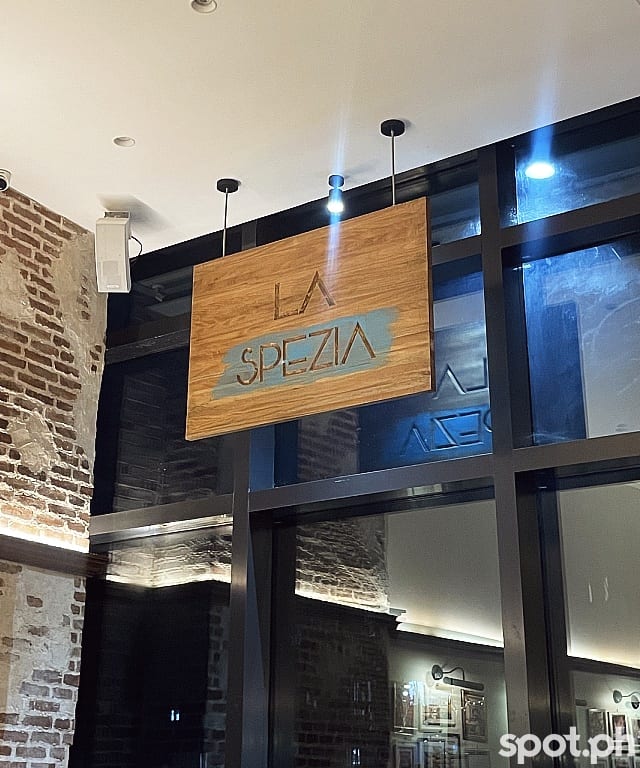
Click to Enlarge
The sign to La Spezia's BGC location, which opened earlier this year. Photo by Patricia Baes.
La Spezia’s offerings in their early days leaned more toward tradition: ”medyo nag-start kami na purist,” Yuiquimpo says with a laugh. Whenever he'd eat out with his family or with La Spezia’s Chef Aaron Shiu, they would primarily go for “pure restaurants”—those that focus on classic, mostly-unadulterated iterations of whatever genre they were eyeing at a time. Still, the restaurateur acknowledges the limitation of being, ultimately, an outsider. “We can't say we’ve nailed [classic Italian cuisine]. Kasi first of all, hindi naman kami Italians. We didn't grow up there. We only have the idea of what Italy can be for us.”
Still, their focus on getting the classics as right as they can make it gave them insight into the more fundamental principles of the cuisine. “Kasi parang foundation-based 'yung [approach] namin," Yuquimpo explains. And then, from there, “pwede natin i-evolve.”
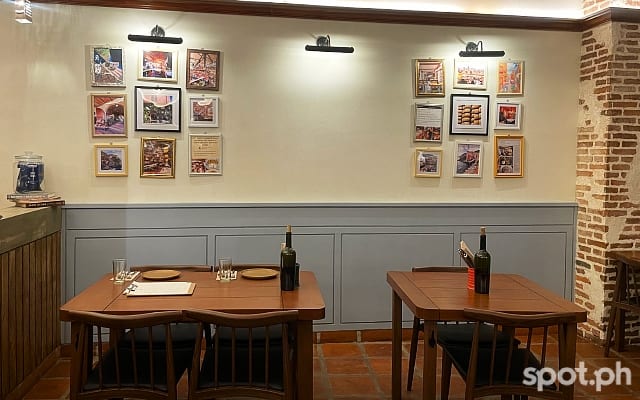
Click to Enlarge
Inside. Photo by Patricia Baes.
In evolving the cuisine, the team draws inspiration from a wider range of cuisines around the world—a topic Shiu and Yuiquimpo had much familiarity with, as they also enjoy traveling and dining at restaurants of different specializations. “That made us think na hindi naman one-dimensional ang flavor,” says Yuquimpo. “It can grow naturally… [so] why not? It works naman, it's balanced. ‘Yun ang importante. Basta balanced. Nando’n ‘yung main profile.”
They take liberties not to overwrite the rules, Yuquimpo explains, but to expand on the basics of Italian food and let diners see the cuisine in a more creative, present-day light. “[What we do], it’s not quite fusion, but it has the soul of Italy,” he shares in an exchange with SPOT.ph. “[Italian cuisine] is simple, straightforward, and [uses] fresh [ingredients]. So ‘yung elements namin, fresh and simple, pero different flavor.”
Click to Enlarge
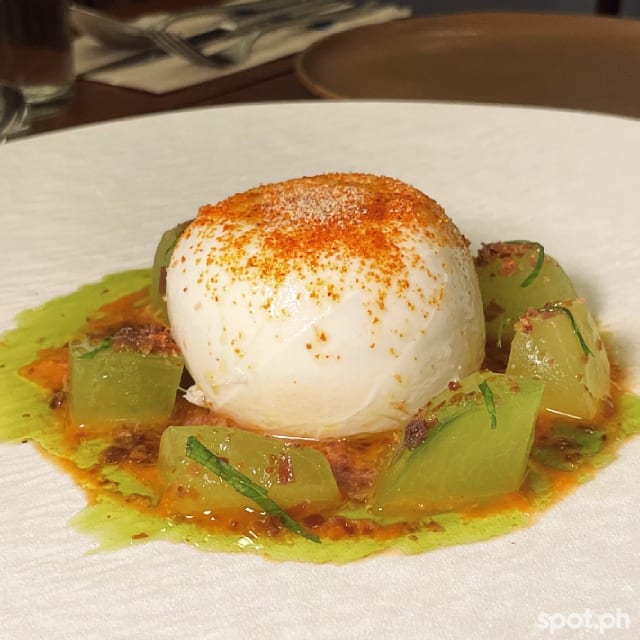
Burrata—mozzarella di Bufala, tomato gazpacho, compressed Hami melon, mint. Photo by Patricia Baes.
Italian Food, Seen Through La Spezia’s Lens
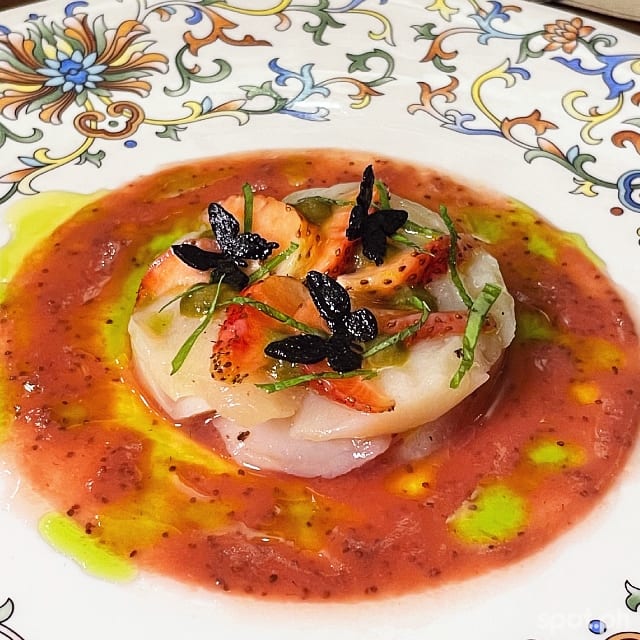
In the Burrata (P880) we see a refreshing take on the classic Caprese combo, with tomato gazpacho providing zing; fresh mint lending herbiness; and compressed Hami melon adding a crisp, juicy counterpoint to the creaminess of the Mozzarella di Bufala. The Ceviche di Capesante (P980)—labeled a ceviche but is closer to crudo in format and balance of flavors—is an especially eye-opening one, with slivers of Hokkaido scallops (cooked just a touch to enhance its scallop-y taste, but kept succulent); sliced strawbs and strawberry coulis for a fruity note; kamias gel for brightness; and dots of basil oil.
Click to Enlarge
Ceviche di Capesante—Hokkaido scallops ceviche with strawberries, kamias coulis, and basil oil. Photo by Patricia Baes.
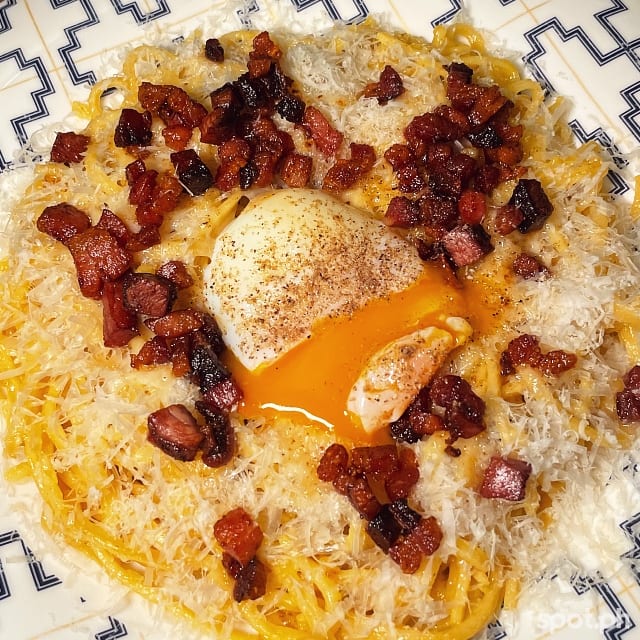
Carbonara the traditional way (with zero cream) is no longer the rare unicorn in Manila that it once was, but La Spezia’s version—simply titled Carbonara (P690)—lingers long in our memory, even weeks after our last forkful. The equation here is simple: spaghetti made in-house, cooked ‘til al-dente; crisped-up chunks of guanciale, which leave a salty-smoky note in the yolk-centric sauce; 18-month Parmigiano-Reggiano, whose nutty, deeply savory taste we can’t escape; and as a contemporary touch, a 63-C sous-vide egg, whose golden, runny yolk gushes out as it’s poked open.
Click to Enlarge
Carbonara, made especially schmexy with the addition of a 63-C sous-vide cooked egg. Photo by Patricia Baes.
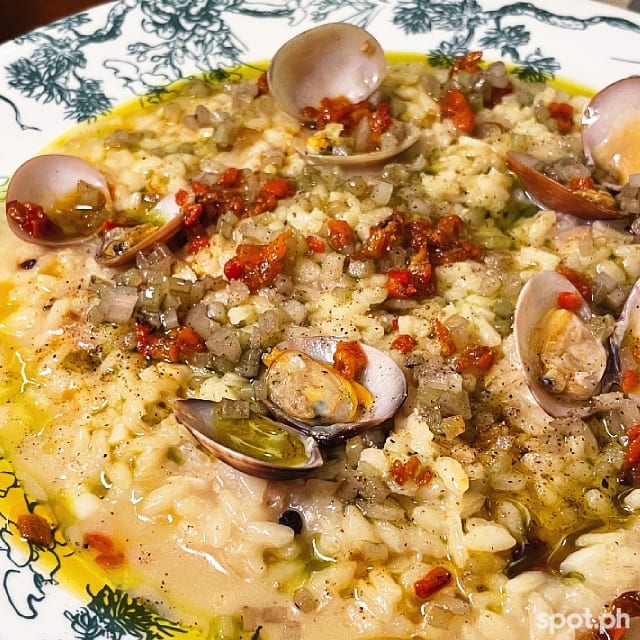
Then there’s the Clam Risotto (P720)—essentially vongole in risotto form, starring clams and arborio rice in a deeply flavorful broth of clam stock and saffron. The dish gets a bit of a Mediterranean uplift with bell pepper and smoked paprika oil—both just the thing to balance out the risotto’s long umami finish.
Click to Enlarge
Clam Risotto—essentially Vongole in risotto form. Photo by Patricia Baes.
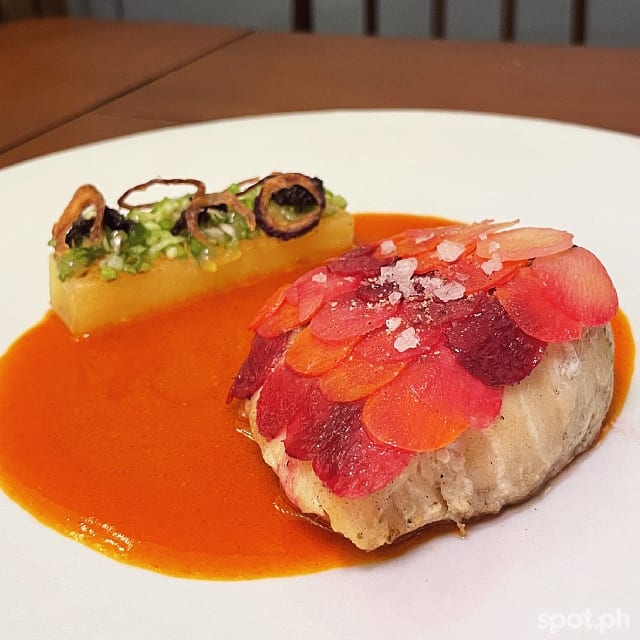
We’re all for their occasional use of theatrics in serving, as in the on-the-spot pouring of beurre blanc in the playful-meets-sophisticated Gindara (P1,350). The emulsified butter sauce, infused with spicy nduja, brings out the delicate sweetness of the fish, which is grilled and covered in a layer of root vegetable “scales.” A buttery block of potato confit dotted with sweet-tangy black garlic serves as the fish’s equally sultry companion.
Click to Enlarge
Gindara, with root vegetable “scales” and the silkiest beurre blanc infused with nduja. Photo by Patricia Baes.
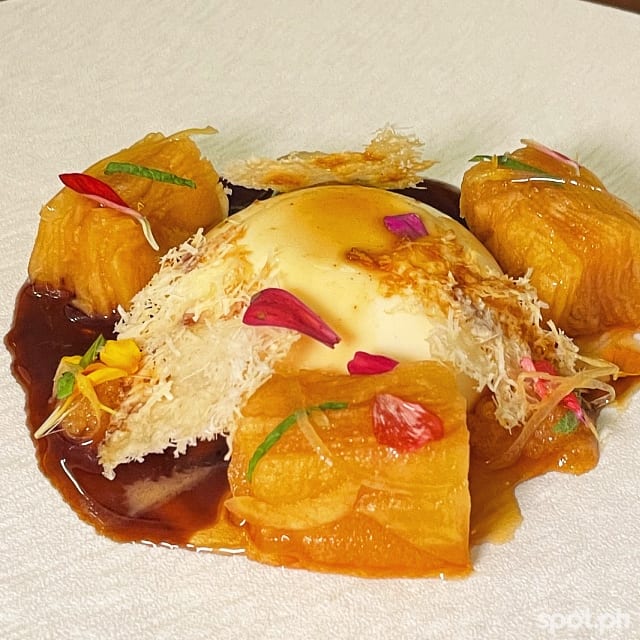
More unconventional is the Panna Cotta (P350), a savory-sweet meal ender that plays on the duo of apples and cheese—a surprise match made in heaven, if you’ve ever had apple pie with cheddar on the side. Try and get a little of all components: the lightly gelled cream, infused with 18-month Parmigiano Reggiano, which lends the pudding subtle umami and a natural sweetness; paper-thin slices apples, bathed in a syrup of white balsamic vinegar and lemon; and burnt rice coffee poured right over as the dessert lands on your table.
Click to Enlarge
Panna Cotta—anything but your textbook version with 18-month Parmigiano Reggiano, apples, and burnt rice coffee. Photo by Patricia Baes.
Novelty of these dishes aside, Le Spezia maintains in them an Italian soul that diners can ultimately relate to—in the overall flavor profiles, in the use of high-quality ingredients and proper techniques (no shortcuts here!) that produce sublime results. Safe to say La Spezia isn’t looking to reinvent the wheel exactly, so much as explore and expand on the Italian cuisine's possibilities.
For Trish, food is as much a source of pleasure and fuel as it is an outlet for creativity; a medium by which stories can be passed on; and a way to connect with others.
You Might Also Like