What's New
Inside the Low-Key Makati Restaurant Serving the World’s Oldest Burger
Think of rougamo as the porkier grandaddy of the modern burger.
Published on Jul 28, 2025
Momojia
L/2 The Grid Co-Living, Barangay San Antonio, Makati City
Contact: 8634-3815
Instagram: www.instagram.com/momojia_ph
Open from 10 a.m. to 10 p.m., Monday to Sunday
(SPOT.ph) Dim sum, roast duck, sweet and sour pork, birthday noodles: these are often the first things that’ll pop into your head if we asked you to picture Chinese food. You’d likely think of slurpy, umami Cantonese, Taiwanese, and Hokkien food dominating Metro Manila everywhere from Binondo and Banawe street to Greenhills and New Manila, with perhaps some representation from the sprinkling of Sichuan and Hunan spots defiantly burning tongues and stomach linings.
All of this together should give you the context needed to understand the utter audacity of a little spot in a quiet Makati neighborhood to serve a completely obscure Shaanxi-style street snack that, unexpectedly, now has people (even actor Jericho Rosales) going out of their way to try.

Click to Enlarge
You'll find Momojia on the second level of a condo. Photo from Facebook/Momojia.
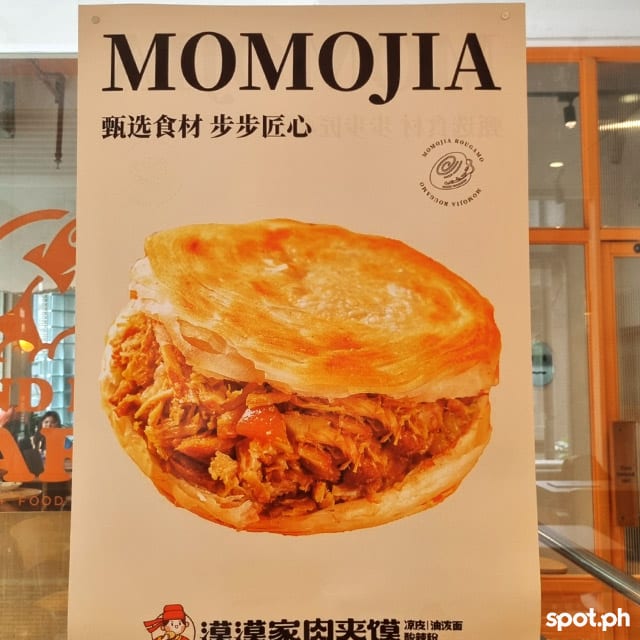
A few doors down from Santi’s Delicatessen along Yakal street, you’ll find an unassuming little restaurant called Momojia right by the stairs on the second floor of The Grid Co-Living. Though the place is relatively plain, you’ll know you’re in the right place when you see its open kitchen and the giant banner of their star product: roujiamo, also known as rougamo or simply momo (hence the eatery's name, which literally means “house of momo”).
Click to Enlarge
The specialty here? Rougamo, essentially the porkier grandaddy of the modern burger. Photo by Patricia Chong.
Also read: 10 Must-Try Chinese Restaurants in Makati
Momojia at The Grid Co-Living, Makati
For all intents and purposes, roujiamo is a minced meat sandwich. However, that definition misses out on the fact that, more than intense slow-cooked meat, what really makes it a favorite is actually its ultra-crispy and flaky flatbread—think a cross between a croissant and Taiwanese suncakes. The combination of savory meat and addicting texture has made roujiamo a street market staple in the Muslim quarter of end-of-the-Silk-Road Xi’An since it was first recorded a whopping 2,000 years ago.
But how does an obscure street snack from the opposite side of China end up setting up shop in Makati?
Click to Enlarge
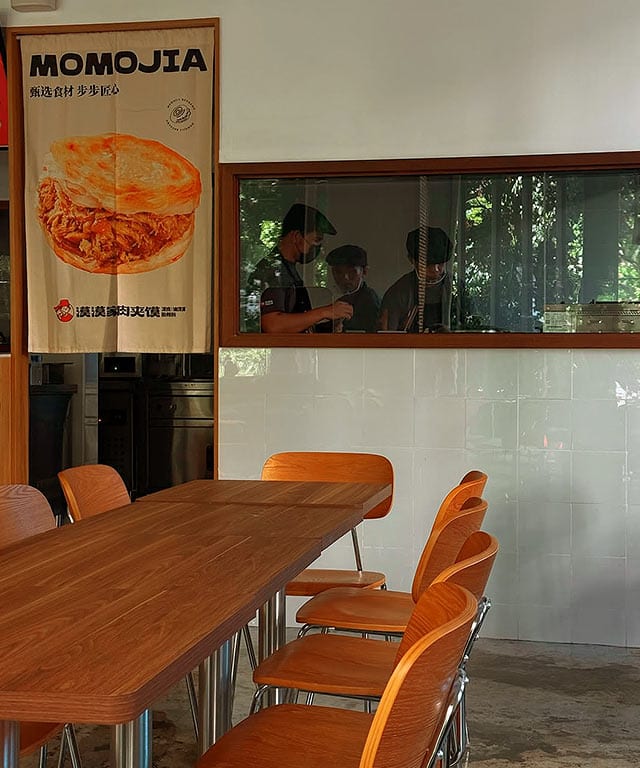
The dining area. Photo from Facebook/Momojia.
“Momojia started because of my obsession with rougamo,” says co-owner Philip Astorga. A former government employee, he now runs the restaurant with his wife Zhou Qiao, a Doctor of Classical Music originally from Xian itself. “Every time we visited China, rougamo, along with lamb skewers were [what] I always looked forward to. The first time I ate it, I was surprised by how flaky the flatbread was. Combined with the savory pork filling, it became one of my favorite snacks.”
Seeking it out whenever he came home to the Philippines would prove a challenge. Astorga would find similar versions in restaurants, but these were often changed to cater to the Filipino palate. The biggest let-down in nearly every one he tried: the absence of the flatbread he had fallen in love with.
“When my wife and I got married last year, we had an idea,” he says. “We wanted to see if these authentic flavors would be appreciated by the Filipino palate.”
Click to Enlarge
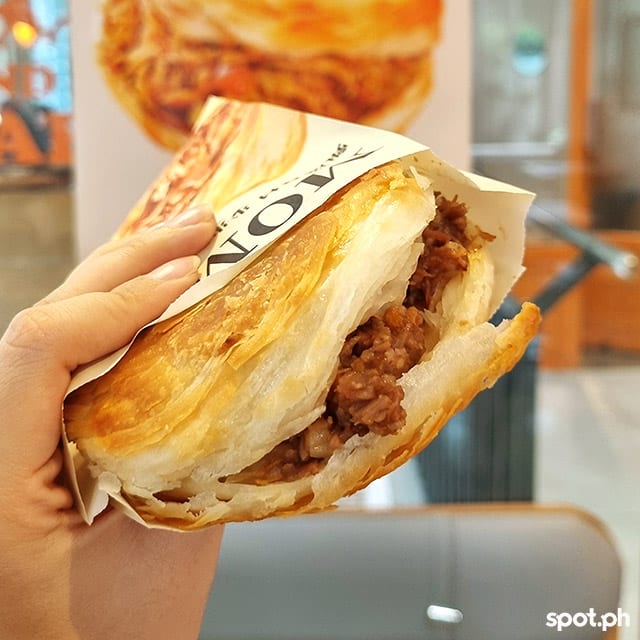
It was co-owner Philip Astorga's "obsession" with the Chinese street snack that led to the opening of Momojia. Photo by Patricia Chong.
And so, Momojia was born—and it definitely doesn’t pull its punches trying to keep it as authentic as possible: Their Classic Pork Rougamo (P250) is actually made with traditional flatbread brought in from China, cooked first in a pan to give it its distinctive crispiness and flakiness before getting a scoop of savory minced pork slow-cooked with Chinese herbs and a special sauce made in-house.
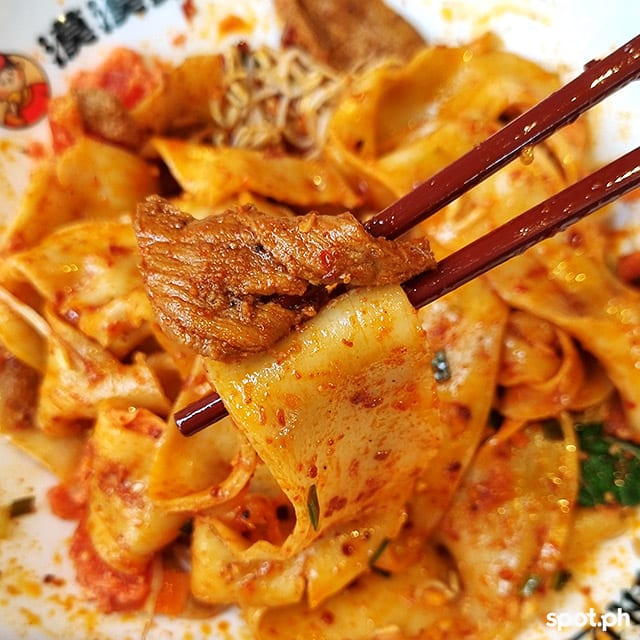
But while rougamo is the main attraction at Momojia, you’ll actually find other hard-to-find specialities from Xian on the menu, including their spicy Biang Biang Handmade Noodles (P330) made with wide, chewy noodles they handpull themselves. This is topped with ground Chinese chili, mixed veggies, a fluffy tomato omelet, and an intensely flavorful spiced pork—brought into bright, peppery harmony with a splash of sizzling hot oil poured over it all. (Pro tip: you can watch them do this from the window of their open kitchen!)
Click to Enlarge
Those looking for heat can also try the Biang Biang Chinese Noodles, featuring their hand-pulled noods. Photo by Patricia Chong.
Their You Po Handmade Noodles (P280)—which you may have heard of after watching White Spoon chef Jun Ji-Sun preparing it in the convenience store battle of Culinary Class Wars—are also made with a pour of hot oil over fragrant spices and vegetables. A lighter alternative for those who prefer less pain.
Leaning more towards smoke and spice (without the punishment of Sichuan-style heart), the uncommon flavors of Shaanxi-style cuisine has earned Momojia fans right out the gate. Some customers coming back specifically for the rougamo’s uniquely crispy flatbread and the low-lying heat of their biang biang noodles—transporting you to the scents and tastes of a street market in the ancient city of Xi’An without needing to buy a plane ticket and showing off a side of Chinese cuisine many in the Metro haven’t seen before.
“It’s something new, and many are pleasantly surprised by how flavorful and different it is,” says Astorga. “It’s been really nice to see people appreciate the taste of Xi’An-style food here in the Philippines [because] Momojia is very personal to us. It started with a simple craving, but it became something bigger. We’re not just serving food, we’re sharing flavors that are close to our hearts.”
Patricia Chong is a writer, collage hobbyist, and marketing girlie who talks about food as @pachoeats on Instagram.
You Might Also Like