What Really Happens When We Call the Palitaw "Coconut Mochi"
When we forget the name of a dish, we risk forgetting the story.
Published on Feb 23, 2026
(SPOT.ph) When I hear the youth refer to palitáw as "coconut mochi," I do not feel anger. I feel tenderness.
For context, palitáw is the Tagalog name for a flat cake made from glutinous rice. Traditionally, the grains are washed several times until thoroughly cleaned, then soaked in an equal amount of water for three to five hours, or until they have plumped in size. They are then ground in to a thick slurry known as galapóng. Today, however, flour extracted from glutinous rice—a revolution spearheaded by Ciriaco Tuason in the 1930s—has allowed home-cooks to prepare palitáw and other labour-intensive kakanín with greater ease. The slurry is portioned, flattened, and shaped into discs.
The galapóng patties are poached in gently simmering water, and this is where the name originates. Palitáw is derived from the root word litaw, meaning “to float”, as the patties are considered cooked once they rise to the surface. Sesame seeds are toasted and mixed with sugar. The cooked patties are then rolled in grated coconut and the sesame sugar. And it is from this final coating that prompted the “coconut mochi” comparison.
I understand why they say it. In a globalized world, we reach for the nearest reference point. We translate what we do not fully know into something more familiar. No one told them otherwise.

Perhaps it began as a joke. Perhaps some chimed in playfully, aware of the humor. But what begins light-heartedly can take on a life of its own. Not everyone is in on the joke. And when repetition replaces context, misidentification hardens into assumption.
And yet, that is precisely what unsettles me.
Because when a name is replaced, something subtle begins to fade. You see, a dish is not just texture and flavour. It is language, geography, and memory carried through hands that shaped rice dough long before we were born. When we forget the name, we risk forgetting the story. When we forget the story, we loosen our grip on who we are.
Of misidentification and memory: when renaming cultural markers becomes dangerous
Let us return to palitáw. It is commonly served at breakfast or merienda. As litáw can also mean “to shine”, it is eaten as a symbol of good fortune.
In Alfonso, Cavite; it is referred to as palutáng and is consumed during Christmas, the New Year, and on the fourth day after someone’s passing. It is also known as muási in Ilonggo–Hiligaynón and pepálto in Kapampáñgan.
In Bolinao, Pangasinan, a counterpart known as masíkoy features rice patties simmered in coconut milk with sesame seeds; the resulting reduction is served as an accompanying caramel sauce.
While the precise origins of palitáw remain unclear—we do know that sesame seeds, possibly introduced by Indian or Chinese traders, have been present locally since at least 1609, and that similar rice cakes exist elsewhere in Asia: kozhukkatta in Tamil India; nuomici in Southern China; and klepon in Indonesia, among others—this Tagalog rice cake, along with its cousins across the Philippine archipelago, has shaped itself in to an integral part of native heritage.

Our food-ways are quiet archives. They hold migrations, trade routes, survival, improvisation, celebration. They tell us how our ancestors made sustenance from necessity; from trials and tribulations. They tell us what grew in our soil and what was carried across oceans. When we become unfamiliar with them, we are not just losing recipes. No, my friends; we are losing fluency in our own inheritance.
This is why I made it my mission to speak about our food. First through recipe films, and now through products and work-shops. I am not one to scold; I am forgiving. I am not one to gate-keep; I am here to re-introduce. It is important for me to make our cuisine feel lived in again rather than distant. We already lost so much. Manileños no longer recognise how pan de sal originally looked, just as Cebuanos no longer remember the spices that once defined húmbà. How much more must we allow this to happen?
If some kid innocently calls it "coconut mochi," I will still offer them a piece. But I will also say its real name. And I will tell them where it comes from.
But to the adults who know what pinákbet is and still advertise it as "Ilocano ratatouille," or who are aware of kinílaw yet call it "Filipino ceviche"; I expect more from you. You are conscious about what you are doing and are therefore complicit to the dissolution of our cultural identity.
Because preservation does not always require grand gestures. Sometimes it simply requires saying the name... clearly, lovingly... and passing it on.
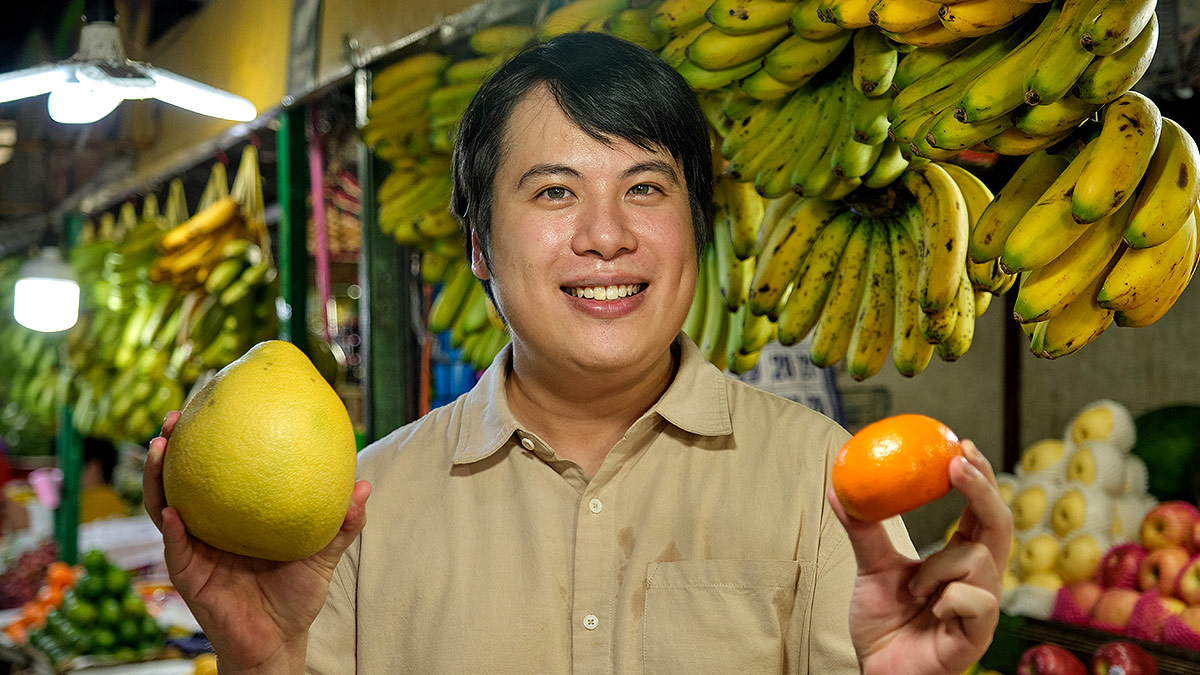
Roberto Villarcabral is a journalist and documentarian advocating for Filipino food heritage through imaginative short films and hands-on cooking workshops under his independent platform, the Histolinarya Collective. Off the plate, he is also a social critic who relishes employing his acerbic wit and pop culture savvy to scratch the nation exactly where it itches.