What's New
Soulful Tom Yum, Fried Fermented Pork: Sabai BGC Serves Thai Classics + Specials
Plus Thai-style cocktails in a vivid, swanky space.
by Pao Vergara
Published on Jul 23, 2025
Sabai
Shangri-La The Fort, 30th Street corner 5th Avenue, Bonifacio Global City
Contact: 0995-643-7283
Instagram: www.instagram.com/eat.sabai
Open from 11 a.m. to 12 a.m. (Sunday to Thursday); 11 a.m. to 3 a.m. (Friday and Saturday)
(SPOT.ph) Owing to its well-executed excursions in fusing disparate flavor profiles, Thai cuisine continues as a favorite source of comfort around the world—especially in the Philippines, where Filipinos get to experience relatively new configurations of familiar ingredients growing around the pantropics.
Nowadays, Thai restaurants for all budgets dot Metropolitan Manila, serving dishes which we’ve come to embrace as our own: green curry, tom yum, pad thai, and others that we popularly associate with “Thai cuisine."
Click to Enlarge
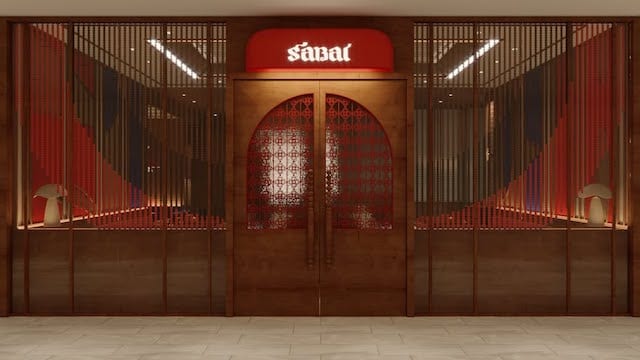
The recently opened Sabai at Shangri-La the Fort, BGC. Photo from Instagram/eat.sabai.
Recently, a new Thai restaurant opened in Shangri-La the Fort in Bonifacio Global City, which aims to introduce parts of Thai cuisine not fully familiar with Filipino palates, while also offering playful, elevated spins to the classics mentioned above. We're talking about Sabai, helmed by Thai chef Assavadathkamjorn Puwadol, who's worked at notable Bangkok establishments—including Sühring, holder of two MICHELIN Stars and No. 22 on The World's 50 Best Restaurants 2025 list; and Løyrom, with former Noma chef Cuan Greene.
Sabai in BGC
Comfort on Plates
It was, ahem, a dark and stormy night when SPOT.ph visited the restaurant, and the weather bureau over the car radio raised storm warnings as traffic ground to a halt. But it didn't take too long before their selection of dishes arrived on our table. Cue sense of respite; homeostasis if you will. No wonder—‘Sabai’ is a Thai word which can translate to comfort, and that was exactly what we needed then.
Inside the restaurant. Photo from Instagram/eat.sabai
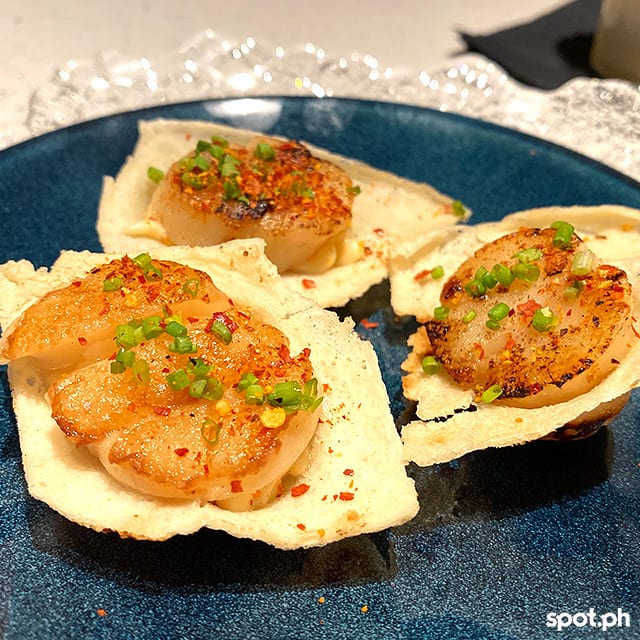
We started out with a plate of Kanom Krok Na Hoi Shells (P550), or seared scallops nestled in coconut cream pudding on a bed of crispy rice wrapper. The order of toppings is important, essentially creating a three-part story where the fresh-but-savory spiced scallops gain sophistication from the coconut cream’s richness, all of which finds a cleansing, satisfying denouement with the rice wrapper, essentially preparing you for the next bite! Take it as a playful spin on the Buddhist concept of reincarnation, with each scallop acting as a new round of life.
Click to Enlarge
Kanom Krok Na Hoi Shells, or seared scallops in coconut cream pudding over crispy rice wrappers. Photo by Pao Vergara.
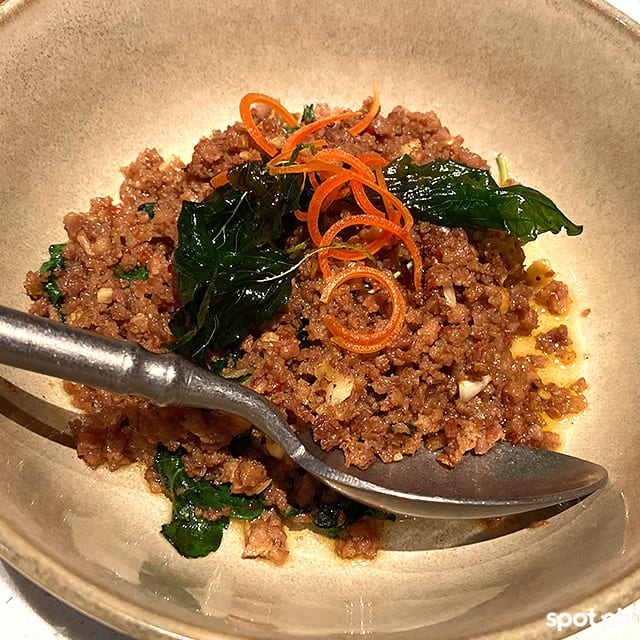
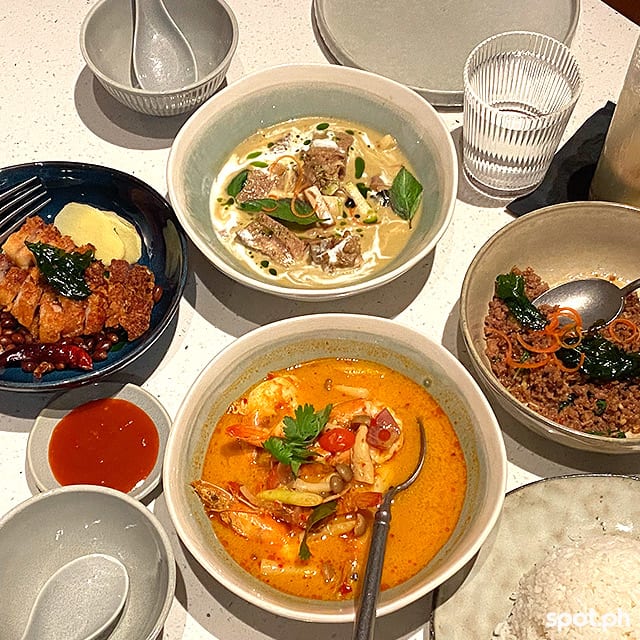
To ease us into the main course, we had the Pad Kaprao (P520), a minced meat entrée (in chicken—pork and beef versions are also available) that might bring to mind spiced-up, herbed-up giniling. The garnishes of crispy holy basil and julienned carrots add essential balance, with the former ingredient resonating with memories of munching on crispy spinach chips served in Filipino restaurants in the late 1990s and early 2000s.
Click to Enlarge
Pad Kaprao with chicken, their take on the popular street dish. Photo by Pao Vergara.
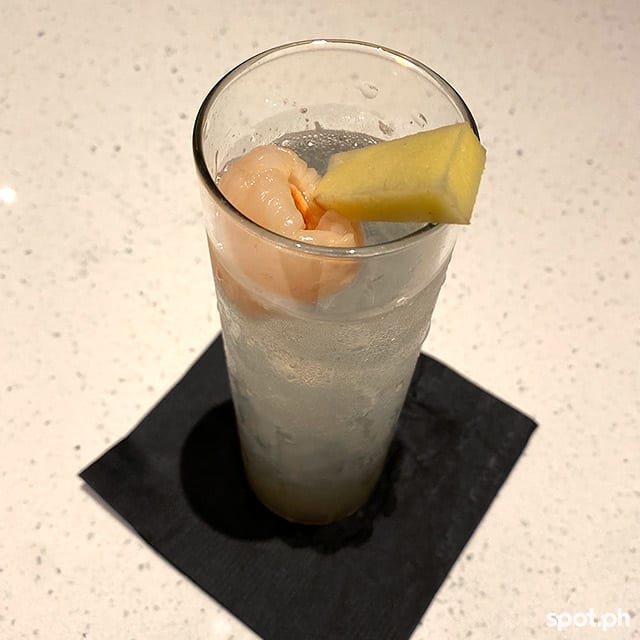
All of the above and the entrees to follow paired well with the Lychee Zing Zing cocktail (P450), where nothing is forced, the alcohol kick merging seamlessly with the fresh lychee juice.
Click to Enlarge
Lychee Zing Zing. Photo by Pao Vergara.
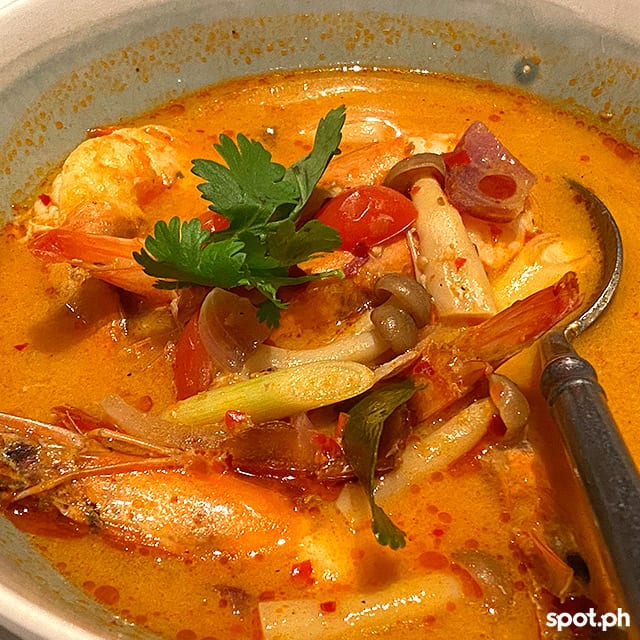
The Tom Yum Kung (P850) was just the thing to warm us up amid the ongoing downpour. Worth commending are Sabai’s efforts towards sourcing only the freshest prawns (so fresh the taste of the sea gets infused into the broth), lemon grass shoots, and limes. The additional garnishes of cherry tomatoes and enoki mushrooms add dimension on the taste and texture front.
Click to Enlarge
Tom Yum Kung—perfect when it's cold out. Photo by Pao Vergara.
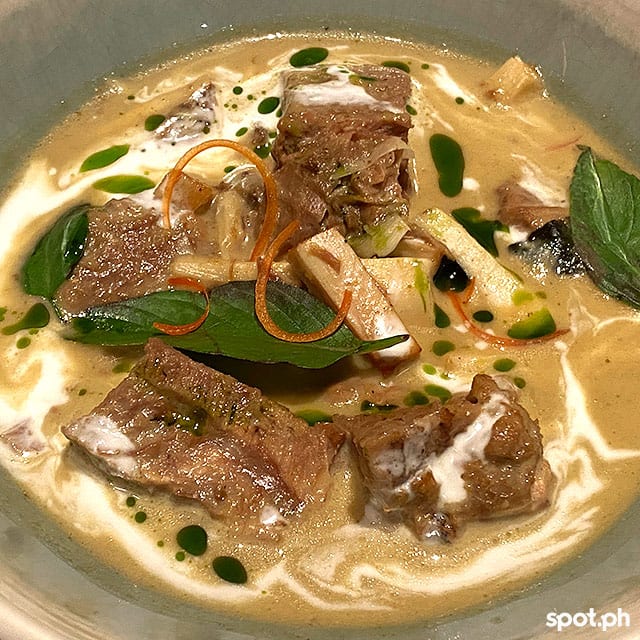
No Thai meal is complete with curry, and we went for the Panang Beef Curry (P1,150, pork option available), described in the menu as “a hug disguised as dinner.” And rightfully so, as this was another three-part story, where the first sip of soup echoed but was distinct from the last bite of beef, where, like with the Tom Yum above, the meat’s freshness infused itself into the stew. The bamboo shoots nodding at Thai traditional vegetable carving added nice bass notes to this sweet, creamy curry.
Click to Enlarge
Panang beef curry—said to be“a hug disguised as dinner.” (They're right.) Photo by Pao Vergara.
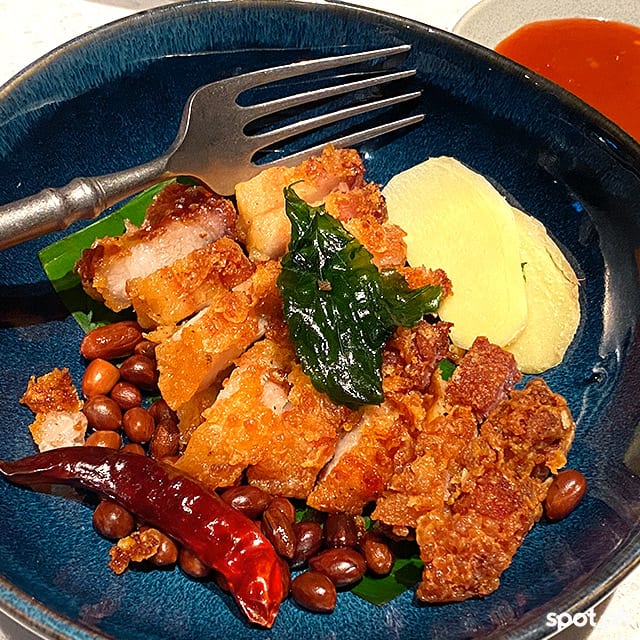
Ever imagined how char-grilled liempo would do coated in breading a-la tonkatsu? Look no further with Sabai’s Naem Sam Chun Tod (P580) or fermented pork. Simple on its own, it’s best eaten with the garnishes served on the side, among them freshly sliced ginger—give it a chance, your life will be divided into a Before and After if you do—and adobo peanuts with chili and a notable light caramelization. It’s been a while since I tried peanuts like this; I wonder why local vendors stopped caramelizing their peanuts.
Click to Enlarge
Naem Sam Chun Tod, or fermented pork that's breaded and fried. Photo by Pao Vergara.
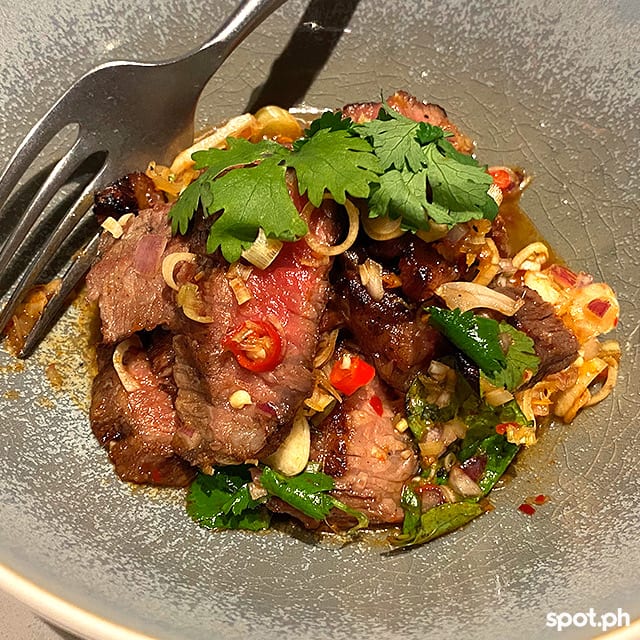
We capped the savory side of dinner off with some Pla Nuea Yang (P890) or grilled Wagyu beef served in a light sauce sprinkled with fresh herbs. I never realized grilled beef could work stewing in a sour base, like ceviche. This all interestingly reminded me of the liempo in a once-popular but now-closed stall in the University of the Philippines Diliman’s Sunken Garden, which my parents and my friends’ parents took us youngsters to. The way the pork was smoked and seared became the benchmark I’ve since sought whenever I'd try liempo around the Philippines, and I never expected a Thai restaurant to bring me something so close to it—albeit in a beef dish!
Click to Enlarge
Pla Nuea Yang, or grilled Wagyu beef plus a smattering of fresh herbs. Photo by Pao Vergara.
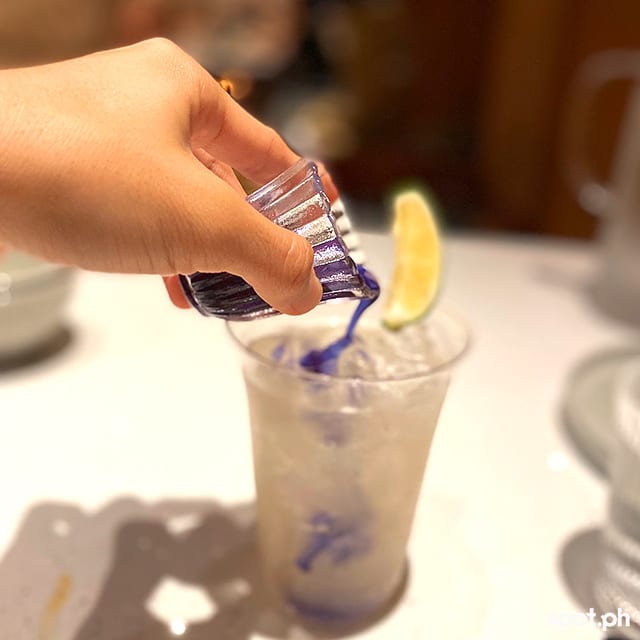
For dessert, we washed down the meal’s complexities with another refreshing cocktail, the Sabai Blue Bliss (P450), a vodka-based highball with butterfly pea syrup served in a shot glass meant to be drizzled over the main drink. This and the Lychee Zing Zing above each have non-alcoholic options available.
Click to Enlarge
Sabai Blue Bliss, which gets its color from the butterfly pea syrup served in a shot glass for pouring over. Photo by Pao Vergara.
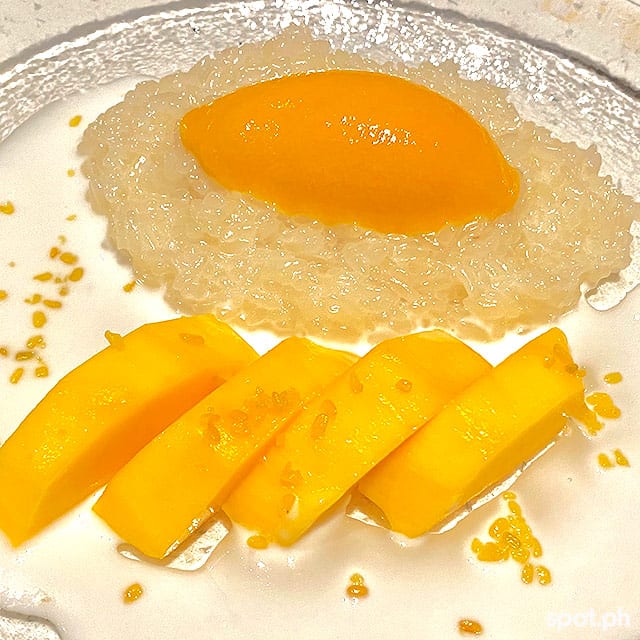
The Bliss paired interestingly and intuitively well with the OG of Thai desserts: Mango Sticky Rice (P420). Sabai’s version adds a kick with sea salt lightly sprinkled onto the coconut cream; worth noting, too, is the blanket of mango jam served over the rice, and fresh mango slices drizzled with sesame seeds.
Click to Enlarge
Mango Sticky Rice. Photo by Pao Vergara.
Homes Away From Home
Owing to BGC’s cosmopolitan appeal, there’s a bevy of visitors speaking different languages here in Sabai, all under the soft warm lights and soft luxury interiors. I’m not surprised if a few will rent out the different spaces for their gatherings.
I chat up a kababayan across me and find out she’s recently home from a long trip to Thailand. Over Sabai’s blues-influenced playlist, she manages to hear my question on whether the food here is close to what she ate there. Yes, she mouths, and I pick up that she finds the spice level toned down “for Filipino tastebuds.”
But everything else? “Authentic!”
Alex Offe, co-founder of Sabai (and also of Uma Nota Manila), shares the team spent close to a year visiting different restaurants and eateries around Thailand before discovering Assavadathkamijon and his cooking, which echoes a childhood in the family som tam shop in Hat Yai at Southern Thailand. Presently, Sabai employs seven Thai cooks on the team, each hailing from Michelin-starred restaurants in their home country.
Bounded by two major seas—the Andaman and the South China—Southern Thailand understandably experiences similar monsoon moods to what we have here in the Philippines. Here, one can track how distinct flavor profiles and dishes from the region have evolved to soothe diners amidst such weather and also influence the national cuisine of Thailand, especially through chilies and spices.
“What’s served here channels home-cooked meals from their childhood, with unique inputs from the cooks,” Offe shares, referring to the preparation methods and ingredient selections deployed by Chef Tob and his crew of compatriots.
Click to Enlarge
Sabai's chefs take inspiration from the dishes they grew up with. Photo by Pao Vergara.
Looking at how I experienced the food served and my writing about it, small wonder then that resonances from my childhood meals were frequently referenced.
Some words have no direct translations, but flavors, tastes, and memories sometimes don’t need words to get communicated across language barriers—or the South China Sea for that matter.
That feeling of finding comfort in a Friday night under grandma’s roof and amidst her cooking, sheltering from the rain after a round of football with your schoolmates for one, is true sabai, true comfort, that goes beyond language.
Pao grew up trying different cuisines and dishes thanks to grandparents, parents, aunts, and uncles who cooked and served what they ate as kids from the provinces instead of what they thought kids should like. Pao came of age discovering the works and advocacies of OGs like Anthony Bourdain, Doreen Fernandez, Fernando Zialcita, Ige Ramos, and Ambeth Ocampo, to name a few. He hopes to play his part in continuing the mission.
You Might Also Like