The World Is Saying Ube is The New Matcha—But Wait, It's Not Ready
We need to calm down, Pinoy Priders.
Published on May 6, 2026
(SPOT.ph) The vanilla of the Philippines,” said a Filipino chef abroad trying to describe the ingredient to a foreign audience. “Hints of fig and cinnamon,” described a French syrup company now selling it to cafés worldwide. “A purple patch for coffee and dessert lovers,” announced a British newspaper — which also called it a potato. Twice. A different kind of fun and sad, watching the world try to pronounce ube, then describe it with colonial confidence. Then brand it. Then sell it back to us.
Ube cold foam settles over espresso. Soft serve curls into purple towers. Menu boards race to make purple anything — limited, signature, trending, a vibrant twist on a spring favorite. From vivid violet to light lavender, ube purple is the color of now. Ube went from your nilupak filling to the twelve-dollar clear cup in New York to the ube brûlée latte in London to the ube espresso martini at Starbucks Reserve to the ube-inspired lip gloss at Huda Beauty, to a global viral feed full of violet where the Filipino farmer is nowhere in the frame. This is how the global market works: color first — indulgent, premium, exportable. The Filipino story comes later, softened into nostalgia and feel-good heritage, often carefully reduced to something faintly reminiscent of a more familiar ingredient — the vanilla of the Philippines, the purple pistachio of Southeast Asia, take your pick. The farmers, the processors, the small Filipino businesses priced out of their own ingredient — last to be mentioned, if at all.
But for those of us who eat and cook from here, what the world now treats as a global aesthetic has always been, first of all, a universal vivid memory. Ube is the halaya stirred to exhaustion by someone’s grandmother or aunt — an endurance so particular to Filipino life it became "Halukay Ube," the SexBomb Girls song that was somehow both a dance craze and a guiding light for an entire generation. It is the ube in ube keso ice cream— the dessert that follows fried chicken and Pinoy spaghetti, making up the holy trinity of the Filipino birthday party. The star of the Holy Week binignit. The ube in halo-halo, always in competition with leche flan.
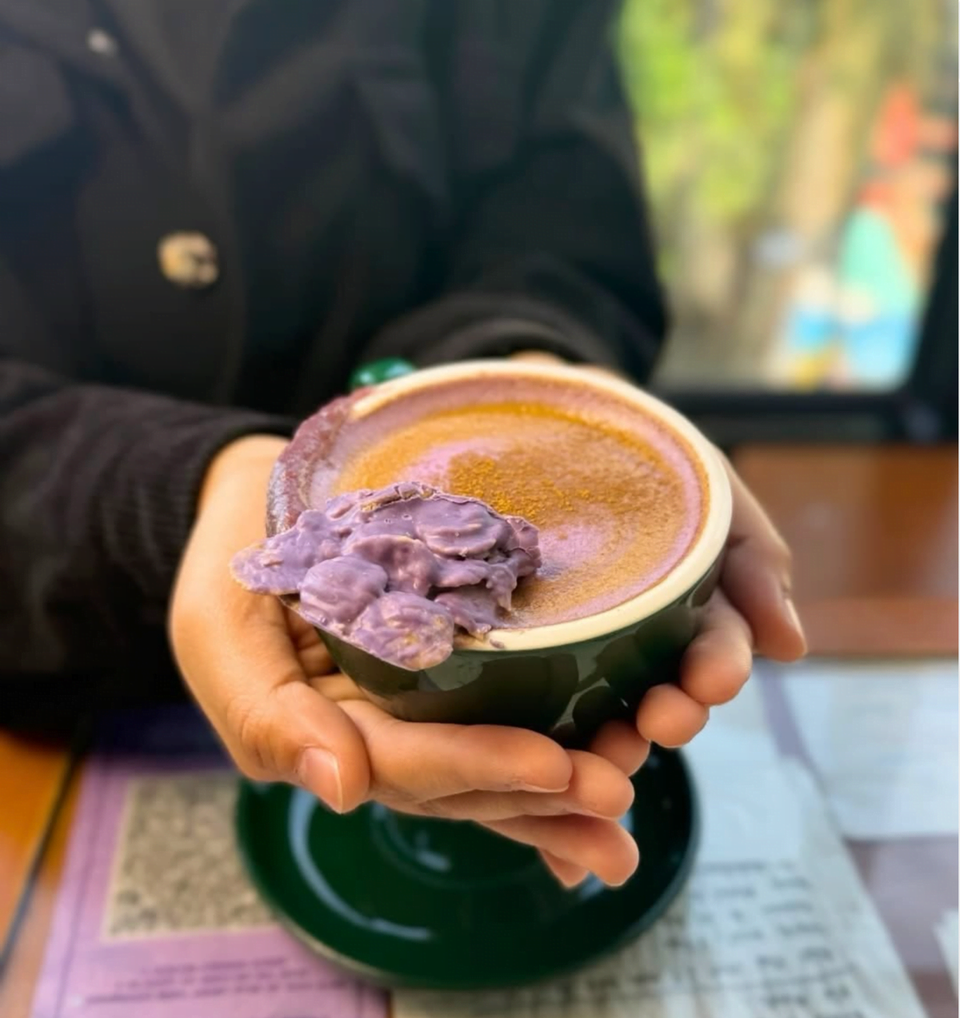
It doesn’t have to be your favorite, but it will be your safe constant. It’s incredibly good at being ordinary too. A personal favorite is ube just boiled, with a side of dipping salt. It’s the flavor of being loved without being told, meant to be enjoyed in solitude.
Then the world learned to price its color.
The distance between that boiled root and the world’s appetite for ube is now measured in hundreds of millions. The global ube market is valued at $455 million and is projected to move toward a billion by 2035. Frozen ube desserts alone already sit at $1.13 billion. In 2025, the Philippines exported only $3.2 million worth of ube products from that entire pie. The country that grew this root into memory, dessert, merienda, pasalubong, and celebration is capturing almost none of the value its own ingredient now generates.
The numbers are more brutal at the farm level. Production has fallen every year, from 14,150 metric tons in 2021 to 12,483 in 2025, while demand keeps climbing. The Philippines is now importing ube from Vietnam to cover a market it helped make desirable but failed to prepare for. Agricultural workers earning around ₱322 a day, barely $5.50, are being asked to grow more while a billion-dollar market rises above them.
.jpg?fit=cover&width=960&q=82)
How to protect ube like the Japanese protect matcha
So ube is the new matcha. Wohoo. We should be so lucky. But Japan knew what matcha was worth before the world turned it into a café aesthetic. Uji matcha is a word people say with intention. A region named, a price attached to a place, farmers who are called by what they grow. You order it and the origin comes with it. That’s not an accident, but infrastructure built before the trend arrived, not scrambled together after.
Here, you can still walk to the palengke and buy the crop. Still find the small stand where someone makes the halaya, still talk to the maker, still know exactly where it came from. That intimacy is real. It is also entirely informal, entirely unprotected, entirely dependent on proximity. The moment ube leaves the local market and enters the global supply chain, the traceability disappears, and with it the story, the farmer, the maker, and for the most part, the margin.
This is a problem of attention, infrastructure, and institutional protection — and we are failing at all three. Without commitment to protected designation, traceable origin, equitable return, ube becomes another victim of unrestrained consumption dressed as celebration. We’ve been down this road before. Hello, muscovado. Pineapple. Cavendish. Coconut. Cacao. We should know by now how this ends.
And yet here we are again
Ube should go global. It just shouldn’t go before it’s ready, and without the systems that protect where it comes from. The work is already unfolding: in cooperatives learning to process at scale, in research centers developing better cultivation, in indigenous farming communities organizing ancestral domains around ube as a livelihood and not just a crop.
But the pattern is old and stubborn: the Philippines grows the thing, someone else turns it into a premium product, and the finished version comes back to us at a price we can barely afford. Breaking that pattern begins before export, before branding, before a foreign café decides purple can sell. It begins with farmers who can keep the land they plant on, with processing close enough to the fields that the crop leaves as product and not as raw material, with small producers who can certify, package, and sell under their own names. It begins with cooperatives treated as businesses with capital and market access, not as backdrops for ribbon-cutting. Ube does not need more applause. It needs a system that lets Filipinos earn from what Filipinos already know.
The knowledge exists. The crop exists. The ideas for what ube can be — held by the people who have grown and cooked and stirred it for generations — exist. What has never fully existed is the political will to build around the Filipinos who grow it before the world squeezes it dry and moves on to the next color.
The world has found our ube. Now the Philippines has to make sure it doesn’t lose it.
Jayson Gaspar Maulit is a chef, writer, advocacy & communications strategist, and systems builder whose work at Trining’s Kitchen Stories explores grief, memory, and cultural inheritance.