Why Cinemalaya's 'Mag-iina' and '2 Valid IDs' Are Worth Braving The Rains For
One is weird, wild fun; the other a hopeful reminder of what we can be.

by Philbert Dy
Published on Aug 12, 2026
Mag-iina
Giancarlo Abrahan directs an adaptation of Guelan Varela-Luarca’s play Corridors. It stars Janine Gutierrez as Anj, who returns to her ancestral home just before the 40th day of her father Yñigo’s passing. Her mother, played by Agot Isidro, is losing herself to madness. Her aunt, played by Cherry Pie Picache, has adopted a young boy who she's renamed Yñigo. Her grandmother, played by Jackie Lou Blanco, has mostly confined herself to her room, painting. The family’s helper, Katte (Ness Roque), is trapped along with them, a witness to the generational suffering, and a victim of the family’s abuse.
It’s not hard to imagine audiences being turned off by this completely, as it is a film that takes some pretty wild swings as it depicts the rot that exists in this family. Suffice it to say that things aren’t normal, and the film veers hard into Gothic, supernatural territory as it builds this allegory that speaks of the history of the country as a whole, name-checking the Marcoses while speaking of an irreparable harm that haunts the house and the characters. It is perhaps a little too heady, the script dense with metaphor and symbolism, lending very little help for the audience watching.

But also: it’s just kind of a blast. The movie just goes places that one doesn’t expect, all of it fueled by clear, focused anger and held up by keen observations of the sins of the upper class – their explicit acceptance of generational evil that has kept the country in an endless loop of abuse. And this is all performed by four really great actresses, all of them with a notable commitment to the greater concepts that the film is trying to convey. It’s a good time, if you’re just open to its weirdness.
Rating: 4.5 stars
2 Valid IDs
Marietta Subong (Pokwang) plays Sylvia who, when trying to claim the money remitted to her by a relative from abroad, is told she needs two valid IDs. The money is for the treatment of her ailing husband (Joey Marquez), and while she watches his condition get worse, Sylvia tries to apply for various forms of government-issued identification, struggling through long lines and arcane processes.
Here’s the thing about Ma-an Asuncion-Dagñalan’s 2 Valid IDs: you know exactly where it’s going. That’s partly because there is a tradition of Cinemalaya films that largely tackles government bureaucracy and how they fail to serve the needs of the poorest among us. But mostly, it’s because anyone who’s had to get identification in the Philippines knows how difficult it can be. Knows of the tragedy implicit to the indifference of our institutions.
 (1).png?fit=cover&width=960&q=82)
But predictability is not necessarily a bad thing. 2 Valid IDs feels real, and often finds something transcendent in the most mundane things. What really sets it apart, though, is how it juxtaposes the cruelty of systems with the kindness of strangers. The film shows us the community that’s built around the patients in the hospital and their caretakers, all of them offering help to each other even though they’re all already in need. It is through this depiction of kindness that the film becomes more than just a screed against how bad things are in the country. It leaves us to imagine instead what the Philippines could be if our institutions could show the same kindness that people regularly show to each other. That’s just really nice.
Rating: 4 stars
Tayo Lang Ang Nakakaalam
Martin del Rosario is Neil, who has spent the last few days at the hospital caring for his sick boyfriend, Bong (Miguel Odron). Neil is close to Bong's family (Yayo Aguila and Epy Quizon), and it is no secret the two boys are in a relationship. Eventually, it comes out that Bong’s sickness has to do with him contracting HIV. Neil and Bong have known about this for three years, and kept it a secret from his family. And over the next few days, they deal with the consequences of that choice.
All credit goes to the movie for clearly having its heart in the right place. It advocates for people getting tested, pushing them to overcome stigma and dealing with their issues in an open and honest way. That's all great. Having said that, the movie can be terribly unexciting. It is so much more about what cannot be undone, than it is about what the characters can still do. It often has characters talking awkwardly about services that are available to Bong, who for the most part is depicted as being resigned to being a tragic cautionary tale.
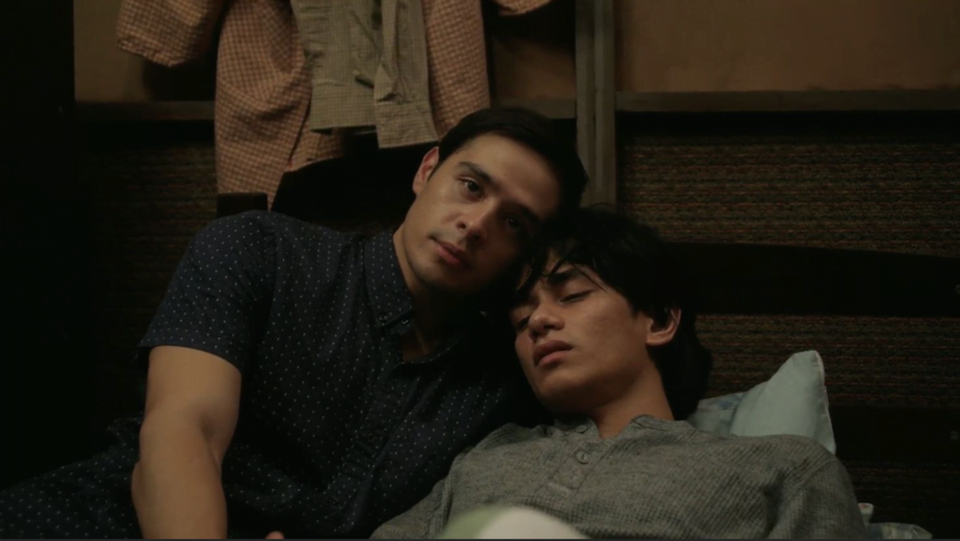
It feels like the film is actively avoiding drama at points, keeping the characters from confronting people with the truth about what happened to Bong, and his real relationship with Neil. It’s a valid approach, I suppose, hewing closer to the kind of avoidant personalities that just want things to go peacefully. I just think the movie could have afforded a small triumph to these characters, who to the end will feel as though their very existence seems to be something that needs to be hidden from the general public.
Rating: 2.5 stars
Kaka sa Wayan
Kaka sa Wayan translates to “Brothers by the River,” and it concerns Niko (played in adulthood by Beaver Magtalas, and as a child by Bryce Nicol), who is brought to Mindoro by his father to reconnect with his estranged mother. Uncomfortable with his new situation, Niko tries to run away and ends up making friends with Ayan (Dennis Datu as a child, Benedix Ramos as an adult), a Mangyan boy. The adult Niko returns to Mindoro after years away, reconnecting with his past, and remembering the friendship.
There comes a point where it’s clear where the movie is headed, and it becomes a problem for the forward action. The scenes in the present involve a lot of vague lines about an incident in the past, and it all feels pretty unnatural. I think it’s a problem that the movie is so much more about Niko and his recollection of his Mangyan friend. Inasmuch as the film clearly shows its appreciation to the Mangyan people, it’s still mostly viewed through the lens of this Manila kid, who throughout the story never really seems to fully reckon with his privilege.

Viewed generously, the movie is sweet enough. It’s always nice to have kid-friendly entertainment in these film festivals. I wish it could have imagined something other than what it ends up doing, though. Maybe a better fate for its characters.
Rating: 2.5 stars
A.ni.mál
Dustin Celestino’s latest begins with provincial mayor’s daughter Lily (Maxine Ignacio) catching her godfather, the governor of the province, in a compromising position with his pet dog. She takes a video, shows it to her parents, and talks herself into becoming a hero by threatening to release it to the public, unless her godfather hands over the dog to her.
What follows is an episodic jaunt through the lives of these characters, all of them involved in politics, and all of them knee deep in corruption scandals. In typical Celestino fashion, the characters are prone to monologing, much of it to do with how critics of corruption and scandal are inutilely yelling into echo chambers, and how the electorate is generally too dumb to elect someone other than these entrenched political operatives.

It’s exhausting. The cast is great, with Ignacio really showing out as the foolishly delusional Lily, and Bituin Escalante absolutely destroying as the governor’s wife. But all the movie really does is make it feel like everything is futile, as though it can’t imagine life in the Philippines getting better in any way. Maybe that’s true, but maybe there ought to be more to this movie than scolding people for caring about things. Also, the way it’s shot isn’t very appealing, and at two hours it starts to feel punishing.
Rating: 2 stars
Philbert Dy has been writing professionally for over two decades. He is often found walking in Quezon City, looking for something to write about.