Forgotten Island Is a Joyful, Manic Filipino Fiesta—Even With The American Accents
It's Pinoy folklore meets 'Puss in Boots' animation.
by Philbert Dy
Published on Sep 18, 2026
(SPOT.ph) Forgotten Island takes place some time in the 90s, in an unidentified town outside of Manila, where best friends Jo and Raissa (voiced by H.E.R. and Liza Soberano) have just recently graduated from high school, and are on the verge of splitting up. Raissa is headed to college in the US, and Jo seems to be completely directionless. The two initially made their bond over the stories of Jo’s grandmother of an island called Nakali, where the creatures of Philippine mythology roam. And on the eve of Raissa’s flight, they find a magical artifact that takes them to the magical island.
The girls wake up the next morning on Nakali, with no memory of what went on the night before. And to make their way back home, they need to piece together what happened and recover their memories. Along the way, they gather a coterie of mythical creatures, among them a weredog, a tiyanak, and a merman, and face off against the island’s most fearsome creature, the dreaded manananggal.
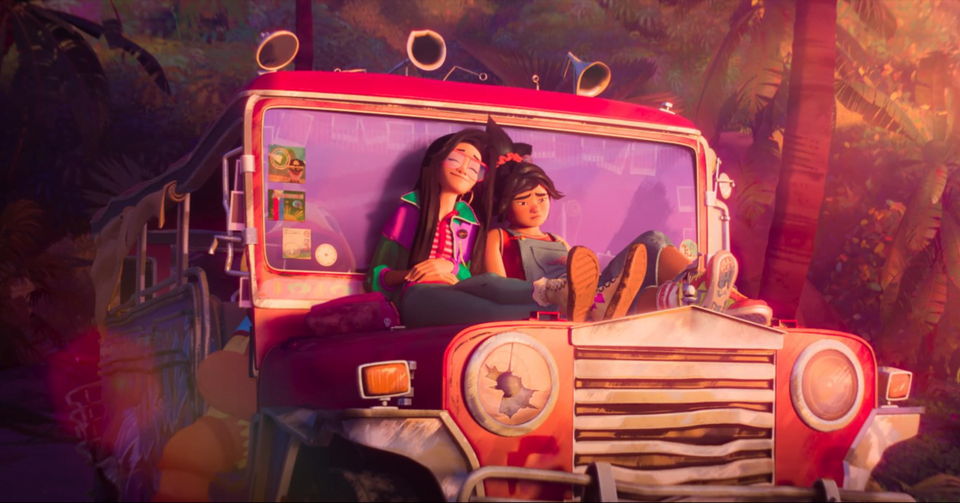
The movie is set in the Philippines, but as a Hollywood film it’s mostly in English, though it is surprising just how much Tagalog they put in there. It gets a little distracting as someone who actually speaks Tagalog to hear all these American accents coming from characters that are meant to be local, especially since some of the phrases spoken are pretty vital to the plot. Jo and Raissa keep saying, “tayo na,” to each other, and it’s a little distracting when H.E.R.’s Jo says it in a way that feels distinctly American. Soberano fares much better in this regard. The two sound great together, though, and the voice cast in general is a lot of fun.
I’d love to see what a full Tagalog dub of the movie would look like, but as it is, it’s already a celebration of the FIlipino culture in a way that hasn’t been seen in a major Hollywood production before. The characters ride a giant sarimanok, deal with duwende, and sing Karaoke with kapre. The movie references batok tattoos, throws a party where everyone can’t stop talking about lechon, and has characters pointing at things with their lips. It doesn’t always feel natural, but it’s hard to deny the enthusiasm that the film has for just being able to show these things. The affection is clear, and it goes a long way in making a lot of it feel right.
This is all brought to life with some really vibrant animation. It’s very stylized, eschewing realism for sheer expressiveness, much like the directing duo’s previous film Puss in Boots: The Last WIsh. But they push it even further, often just breaking out into a completely different style of animation to get a point across. It feels a little manic, but it’s also very compelling. It’s colorful and energetic in a way that matches the energy of the characters, but it’s also capable of reflecting the dread that the film’s villain represents, or the strange sadness that’s at the heart of the story.
It’s a story about friendship, but it’s also about memory. And the story speaks of people willing to give up their memories, and a monster that keeps memories hidden away. It is probably not intentional, but that feels oddly appropriate for a film set in the Philippines, a nation where the past has been made malleable. More than the references to elements of life in the Philippines, It is this strange wrinkle that makes Forgotten Island feels so resonant. Ultimately, this is a movie that in many ways wants to make us remember who we are.
Rating: 4 stars
Forgotten Island opens September 23, with Sneak Previews on September 19 and 20.
Philbert Dy has been writing professionally for over two decades. He is often found walking in Quezon City, looking for something to write about.