Spot Fitness: A Beginner's Guide to Muay Thai
Here's what you need to know about "the art of eight limbs."

by Bea Faicol
Published on Aug 18, 2026
(SPOT.ph) People find their way to Muay Thai for all sorts of reasons. For many, it’s a workout that feels far less monotonous than running on a treadmill or lifting weights. For others, it’s a way to release stress, burn off frustration, and momentarily switch off from the noise of everyday life.
Whatever brings you in, Muay Thai has a way of turning a workout into something you actually look forward to. There’s something uniquely satisfying about learning a skill while getting stronger, fitter, and a little more confident in the process.
If you’ve been thinking about giving Muay Thai a try, here’s everything you need to know before stepping onto the mat.
What is Muay Thai?

Muay Thai is Thailand’s national sport and martial art, with its name literally translating to “Thai boxing.” It is a full-contact combat sport and stand-up striking discipline known for using eight points of contact: the fists, elbows, knees, and shins—hence its nickname “the Art of Eight Limbs.”
Unlike boxing, which primarily relies on punches, and kickboxing, which generally prohibits elbow strikes and limits the use of knees, Muay Thai incorporates punches, elbows, knees, and kicks. It is not simply a combination of the two arts, but a distinct martial art with its own techniques, traditions, and fighting style.
The starting foundation of Muay Thai is establishing the proper stance and the proper footwork. The proper stance for Muay Thai is a wider, more squared stance—feet roughly shoulder-width apart—for balance and quicker defense. It is paired with footwork, or the “Muay Thai march,” a rhythmic shifting of one's weight between the lead and rear legs, creating a subtle rocking motion.
Once you've got a grasp of the stance and footwork, these are the Muay Thai movements you'll need to know:
Jab: A quick, straight punch thrown with the lead hand or the hand closest to the opponent.
Cross: A straight punch thrown with the rear hand or the hand closer to your chin.
Hook: A curved or circular punch thrown from the side, usually with the elbow bent to a 90-degree angle as the fist travels in an arc.
Uppercut: A punch going upward.
Elbow Strike: A close-range strike using the elbow. This can move in different directions, including horizontal, upward, and downward.
Teep: This is done by a pushing kick delivered with the ball of the foot or sole. Basically, a "foot jab."
Knee strike: A strike delivered with the point of one's kneecap.
Roundhouse Kick: This involves rotating the entire body—rotating your hips and pivoting on your base or supporting foot—and hitting the target with the shin.
Low kick: A roundhouse kick, but aimed lower, specifically at the opponent’s thigh or lower leg.
Block: Blocking involves using the arms, gloves, or legs to absorb a strike. This is done by bringing one's knee up and letting one's elbow (from the same side) touch it to close the gap.
What you need for Muay Thai
For beginners, you need to have three things: hand wraps, boxing gloves, and the proper activewear—preferably shorts so as to not hinder movement with the kicks. If you want to pursue the sport further, maybe even at a professional level, you'll need to invest in shin guards, a mouthpiece, and head protection.
Choosing your hand wraps

For adults, it is best to purchase 4.5- or 5-meter hand wraps (180 inches). The rule is that the longer the wraps are, the more padding and protection they offer to your fists. Kids or adults with relatively small hands can go for a shorter hand wrap, about 2.7 to 3 meters (120 inches).
Handwraps are widely available at sports stores, but gyms and training centers specializing in Muay Thai or boxing often sell them on-site as well.
Choosing your boxing gloves

Adults typically start with boxing gloves with weights ranging from 10-oz to 14-oz (this come in intervals of two); and choosing which specific weight depends on different factors: hand size, fit, and use. Lower-weight gloves are good for hitting heavy bags, while for sparring, it's best to go for 16 oz.
8- and 10-oz boxing gloves are best for people with lighter weight (under 55 kilograms) and are never used for sparring.
12- and 14-oz boxing gloves are great for working with mitts, heavy bags, and lighter pad workouts.
16 oz boxing gloves are a safe choice for sparring.
18 oz and above: used for people with heavier weight (over 90 kilograms).
Choosing proper attire

Muay Thai shorts are highly recommended for practitioners and are essential for those who want to compete, as this is considered to be the sport's uniform. These shorts have a distinct look to them: high slits on the sides to make it easier to move in, a wide elastic waistband to secure the core, and are made of quick-drying satin to prevent sweat buildup.
Muay Thai shorts aren't easily accessible in Metro Manila, but you can find them at the physical stores of The Lab and K-1 Extreme Sportshop. Another option is to buy them online.
What to know about Muay Thai if you're a beginner:
Walking into a Muay Thai-focused gym for the first time can feel intimidating, especially when you're surrounded by people who seem to know what they're doing, accompanied by the deafening sound of their punches and kicks meeting the mitts. But knowing what to expect can make the first step a lot less daunting.
We spoke with Coach Ivan, a coach and general manager at The Lab, and Muay Thai practitioner Raine Briones for practical advice, training insights, and beginner-friendly tips to help you feel more prepared before stepping into the ring or onto the mat.
Muay Thai isn’t just for professional fighters

According to Coach Ivan, the barrier to entry for Muay Thai is low: "Most gyms like The Lab Gym cater to all fitness levels, from complete beginners to professional fighters." He added that the coaches at The Lab adjust to the client's fitness level, which they establish during the introduction.
For Briones, that beginner-friendly approach made the first step much less intimidating. Having practiced Muay Thai at The Lab for six months, she said, "I wish I had started earlier and spent less time overthinking it. Looking back, I realized all I really had to do was show up. Gloves and wraps were available for rent, and the coaches already knew how to guide beginners through their first class."
While fitness level isn't an issue, there are limitations too, such as unresolved joint sprains, muscle strains or tears, or spinal injuries. Coach Ivan said it's best to consult with a doctor to determine whether Muay Thai is safe to pursue.
Muay Thai teaches to respect violence
People take up Muay Thai for more than just the physical workout—people take up the sport because of its psychological benefits, from helping relieve stress to sharpening focus and concentration—but that doesn't change the fact that it is a combat sport. Muay Thai is historically practiced as a fighting system, but within the practice, success isn't simply about hitting harder.
In fact, losing control can work against a fighter, making them tense, predictable, and less able to read their opponent. The violence of punches and kicks is simply part of the equation. As Coach Ivan put it, "It does not mean that violence is the whole dish. As you progress on your Muay Thai journey, the more you understand and respect violence."
Raine added, "What it actually promotes is confidence, discipline, and respect. It’s a sport that opens every bout with the Wai Kru, a traditional dance that a fighter does to honor their trainers and ancestors. I personally think that the more we do combat sports, the more we get defensive."
Coach Ivan shared the Thai concept of jai yen, or “cool heart”. This is a phrase that describes staying calm, composed and patient; keeping emotions in check; staying relaxed under pressure; reading an opponent's movement; and choosing when and how to strike.
“Developing a ‘cool heart’ is considered a massive strength and a sign of high-level mental discipline in Thai culture. Rather than rushing in wildly when struck, a fighter with jai yen stays relaxed, reads their opponent's rhythm, and counters intelligently.”
Adding strength training depends on you
You don't really need to do strength training if you only want to experience Muay Thai for the first time and learn the basics, but you should add strength training to your routine if you want to participate in the sport.
"Since Muay Thai is a high-impact sport, it is vital that we supplement our training with strength and conditioning to develop our skeletal and muscular systems to withstand the impact the sport demands. Strength training helps prevent injuries and minimizes aches and pains in the body," Coach Ivan said.
Briones sees strength training as a way to reinforce her form, balance, and movement.
"If Muay Thai teaches the technique, strength training helps build the stability, endurance, and support needed to perform it well," Briones said. "I also realized that many of the issues I discovered through Muay Thai were linked to muscle weaknesses. Strength and conditioning helps me address those areas and move more efficiently."
You can practice Muay Thai alone

Muay Thai can be practiced both individually and with a partner. A typical training session may include solo exercises such as shadowboxing, footwork drills, conditioning, and heavy-bag work, alongside partner-based drills like pad work, clinching, and sparring.
During pad work, a trainer holds the pads and calls out combinations for the practitioner to respond to, while sparring involves two practitioners practicing techniques against each other in a controlled setting.
If you want to practice Muay Thai alone (without the bags), shadowboxing is one of the easiest ways to start: you throw punches, kicks, knees, and defensive movements while imagining an opponent in front of you. Just keep in mind that solo practice can't fully replicate the experience of reacting to a real opponent, managing distance, or working against resistance.
Muay Thai Gyms in Metro Manila
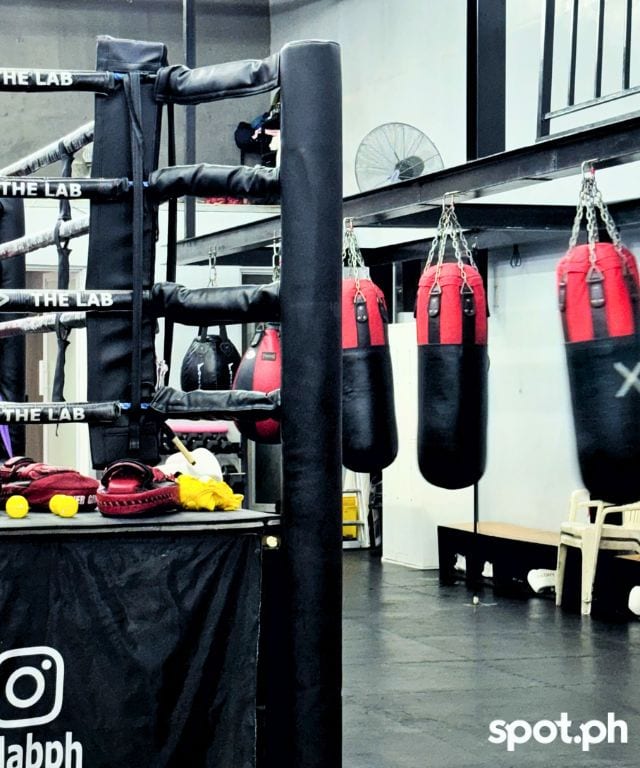
The Lab

Branches: Santolan Town Plaza in San Juan, Bonifacio High Street in Bonifacio Global City, Pioneer Center in Pasig City, and Plaza 100, Delarosa Street, in Makati City.
Operating hours: Open daily from 6 a.m. to 9 p.m.
Rates:
Member rates for one session: P500/semi-private session and P1,500/one-on-one session.
Member rates for multiple sessions: P1,400/semi-private 3-day pass with a 7-day validity, and P5,400/semi-private 12-session pass with a 30-day validity.
Rates for unlimited semi-private classes: P6,000/month, P16,200/3 months, and P30,000/6 months.
Rates for private classes: P10,000/8 sessions with a 30-day validity and P800/person for a private group class.
Non-member rates: P700/drop-in semi-private session, P1,700/private session, P1,800/semi-private 3-day pass with a 7-day validity, P13,000/8 private sessions with a 30-day validity, and P1,000/person for a private group class.
The Lab has several branches within Metro Manila, with San Juan as their newest branch. The gym offers classes in various combat sports, including Muay Thai, boxing, and mixed martial arts (MMA), catering to both beginners looking to get into combat sports and more experienced practitioners looking to sharpen their skills.
Elite Boxing & Muay Thai Gym
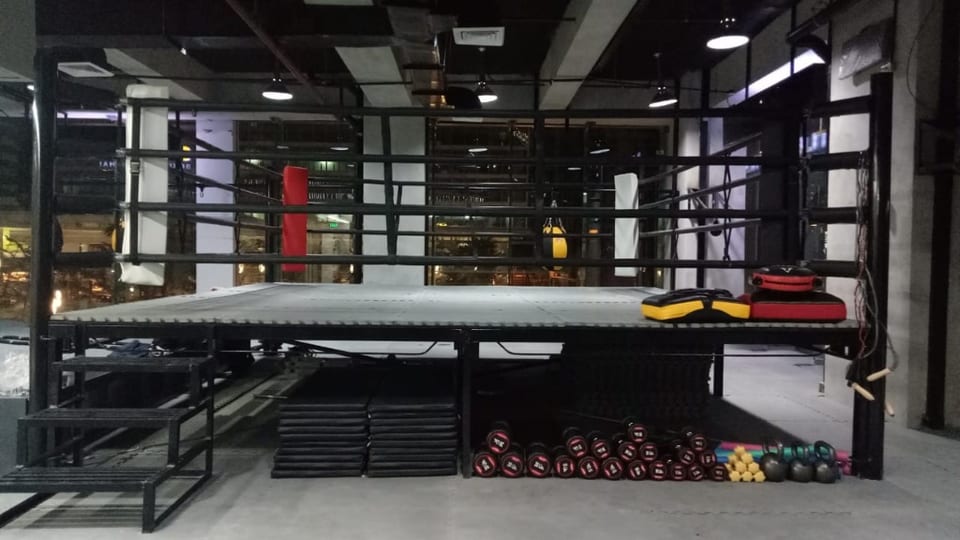
Branches: 2nd Floor, High Street Corporate Plaza, 9th Avenue corner 26th, Taguig.
Operating hours: Open Monday to Sunday, from 6:30 a.m. to 10 p.m.
Rates:
P600/trial (one-time only)
Member rates: P600/session, P5,400/12 sessions with a 30-day validity, P9,000/unlimited sessions for 30 days
Non-member rates: P800/session
Private (one-on-one) sessions: P1,750/session; and for members only: P13,125/10 1-on-1 sessions with a 6-month validity.
Rentals: P50/wraps and P100/gloves.
Elite Boxing & Muay Thai brings world-class boxing and Muay Thai training to BGC, with programs designed for everyone from complete beginners looking to get fit to seasoned fighters training for competition. At its core is a no-frills approach built on respect, discipline, and hard work—whether you're here to break a sweat, learn self-defense, or step into the ring.
Wildcat Boxing and Fitness

Branches: 2F, Ramon Magsaysay Center, Dr. J. Quintos Street, Annex, Malate.
Operating hours: Open Monday to Saturday, from 6 a.m. to 10 p.m., and on Sunday, from 8 a.m. to 10 p.m.
Rates:
P370/session for members and P470/session for non-members. The membership fee is priced at P1,500/year.
Wildcat Boxing and Fitness covers a wider variety of martial arts; aside from the usual combination of boxing and Muay Thai, this studio also offers lessons in mixed martial arts, Brazilian Jiu-Jitsu, and taekwondo. The studio extends the taekwondo lessons to kids, which is available on Fridays, Saturdays, and Sundays.
Bea Faicol runs on questionable amounts of coffee and matcha, and occasionally, a classic G&T.