Culture
Did You Know the Tennis Balls Used in Wimbledon Are Made in the Philippines?
In one remote factory in Central Luzon.
Published on Jul 8, 2025
(SPOT.ph) Every summer, the
world’s best tennis players step onto the pristine grass courts of the All
England Club in Wimbledon. What many don’t know is that the tournament’s most
essential piece of equipment—the tennis ball—has a surprising connection to the
Philippines.
Yup, the Wimbledon tennis
balls are manufactured right here, specifically in Mariveles, Bataan.
British sporting goods brand Dunlop Slazenger produces over 50,000 balls for the tournament every year since it became the official ball supplier in 1902. Although the partnership spans more than a century,
the production site shifted to Bataan in the early 2000s after the closure of
Slazenger’s factory in the United Kingdom. The move streamlined operations and
tapped into a broader global supply chain that now spans 11 countries and four
continents.
“At the Dunlop Slazenger factory
in Bataan there is a whole laboratory dedicated to the development and testing
of tennis balls. There are people in the company who spend their entire working
lives thinking ‘blue sky’ thoughts about the future of tennis balls. There are
academics in the engineering department at the University of Loughborough who
spend their days pondering the subject. There are professional tennis managers
in Cheltenham paid to test sample balls on court,” The Guardian reported in 2002.
From Bataan to Wimbledon, the production of tennis balls is a global effort
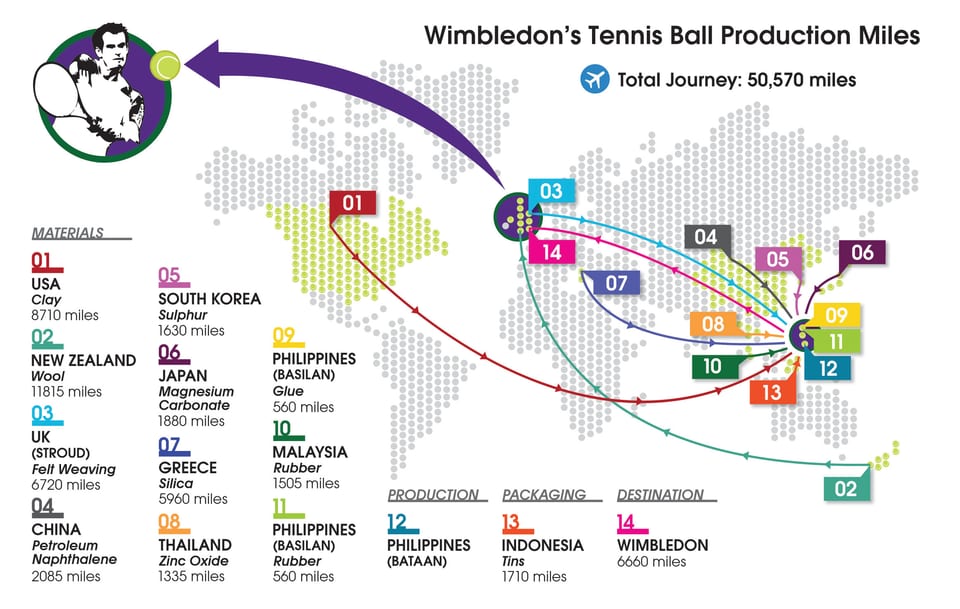
Click to Enlarge
A more breakdown of where each material is sourced. Illustration from Warwick Business School.
While the factory is in the Philippines,
the materials used to create the tennis ball come from all over the world. As
reported by the Warwick Business School, the rubber used in the core is sourced
from Malaysia, Thailand, and other Southeast Asian countries. There’s also clay
from South Carolina, sulphur from Korea, silica from mines in Greece. The wool
that gives the balls its signature felt surface comes from New Zealand, but is
processed in Stroud, England, and then shipped to the Philippines. Even
the canisters used for packaging are imported from Indonesia.
Professor Mark Johnson from Warwick
Business School called it “one of the longest journeys I have seen for a product… travelling more than
50,000 miles to make a tennis ball.”
Once all the components arrive in
the Philippines, the balls are assembled at Dunlop Slazenger’s plant in Bataan. There, workers oversee the multi-step
production process, from molding the rubber cores to heat-pressing the felt and
testing bounce consistency. The finished balls are then sent back to the United Kingdom in
time for the Grand Slam.
Micah believes that writing is always political. Beyond the byline, you’ll find her bruising herself in a pole studio or napping with her beagle. Reach her at micah@spot.ph.
You Might Also Like