ADVERTISEMENT
Policy

San Juan Recognizes Right to Care Card for LGBTQIA+ Couples

So life partners can make medical decisions for each other during emergencies.
Micah Avry Guiao

by Micah Avry Guiao

Published on Jun 13, 2025

right to care card
(SPOT.ph) Imagine rushing your partner to the hospital, only to be told you’re not “family” enough to make a medical decision. That’s the grim reality many LGBTQIA+ couples in the Philippines still face—but not in San Juan City, at least not anymore.

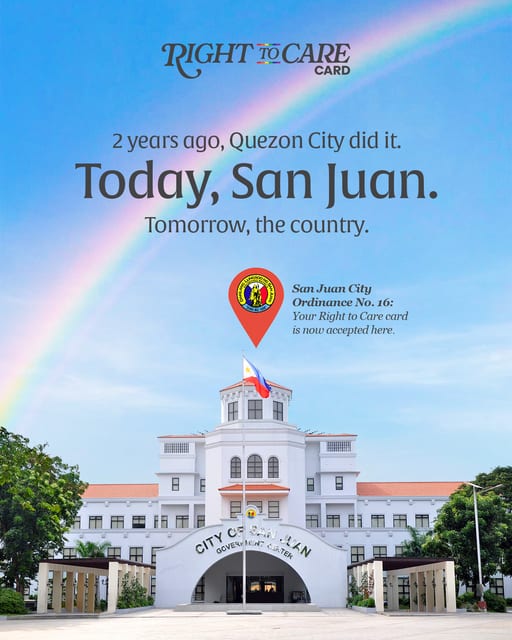
The city passed Ordinance No. 16 this week, which officially recognizes the Right to Care Card, a special ID that allows LGBTQIA+ partners to legally act as each other’s healthcare proxies.

Yup, no more sitting in the hallway while doctors wait for a blood relative to show up. Ordinance No. 16 mandates all public and private healthcare facilities in San Juan to recognize the Right to Care Card. This makes San Juan the second city in the country to adopt the policy, following Quezon City’s lead in 2023. 

What is the Right to Care card?

If you haven’t heard of it, the Right to Care Card is tied to a notarized legal document and comes with a physical card that includes your name, photo, and a QR code linking to the official legal document. With it, you can access your partner’s medical records, sign waivers, approve or refuse treatment, and make other critical decisions—even if you’re not legally married.

This legal document is known as a Special Power of Attorney (SPA), which allows someone to authorize another person to act on their behalf for a specific task or situation, like making medical decisions. The Right to Care card reflects this arrangement.

That kind of legal backup matters in a country where same-sex unions still aren’t recognized. Without it, queer couples are often left powerless in hospitals—even if they’ve been together for decades. The Right to Care Card doesn't fix the whole system, but it gives LGBTQIA+ Filipinos a much-needed layer of protection when it matters most. 

As mentioned earlier, Quezon City was the first to roll it out during Pride Month in 2023. Since then, over 460 LGBTQIA+ couples have gotten their cards, which are now recognized in QC General Hospital, Novaliches District Hospital, and Rosario Maclang Bautista Hospital. 
right to care card in san juan city
Click to Enlarge
Photo by Facebook/The Right to Care Card.
ADVERTISEMENT

How to get a Right to Care card in San Juan City

Implementation guidelines haven’t been released yet, so we don’t know the exact steps for San Juan City just yet (we'll update this article as soon as we get word!). However, if it follows Quezon City’s lead—and chances are it will—here’s what the process might look like:


You and your partner must be at least 18 years old and at least one of you should be a San Juan resident. 


Head to the Gender and Development Office at San Juan City Hall to register and bring three photocopies of a valid ID each (preferably with your San Juan address).


Then comes the paperwork: You’ll need to draft and notarize a document that gives your partner the right to make medical decisions for you. 


Once that’s done, submit everything to the GAD Office for review. You’ll probably sit through a short orientation about your rights and how the card works. After that, you’ll get your shiny new Right to Care Card—with a scannable QR code to prove that it’s legit at the hospital.


The ordinance will officially take effect 15 days after publication. In the meantime, couples can start preparing their documents so they're ready to go once applications open.

Micah Avry Guiao

Micah believes that writing is always political. Beyond the byline, you’ll find her bruising herself in a pole studio or napping with her beagle. Reach her at micah@spot.ph.

Read more stories about

lgbtright to caresan juan city
You Might Also Like