PWDs Asked to Register Again Under the Unified PWD ID System
So much for streamlining.

by Zoe Andin
Published on Nov 6, 2026
(SPOT.ph) For many persons with disabilities (PWD), a PWD ID makes it easier to access benefits like discounts on medicines, hospital bills, and meals; educational assistance, and automatic PhilHealth coverage.
But the government's move to streamline the PWD ID system comes with a catch: another round of registration. During a recent press conference, National Council on Disability Affairs (NCDA) Executive Director III Glenda Relova said that the new Unified PWD ID system (UPWDIS) will require all PWDs to register again, even those with valid PWD IDs.
“The Unified PWD ID System is a new database. Everyone will re-register, kahit valid pa yung ID nila. Punta lang sila para ma-issue-an sila [ng Unified ID],” Renova said, adding that the resubmission of disability certificates aims to further crack down on fake PWD IDs to protect PWDs, especially those with non-apparent disabilities.
“Kung [paano] sasabihin na nafa-fake yung diagnosis, kalimitan yung mga ganyan ay nasa non-apparent disabilities.”
The Persons with Disability Affairs Office (PDAOs) will upload the certificates to the database to verify and flag questionable certificates for submission to NCDA. For its part, NCDA will coordinate with its medical professionals and partner organizations for validation.
Also read: Restaurateurs Are Paying the Price of Fake PWD IDs
What’s new under the Unified PWD ID system?
According to an NCDA administrative order posted in September, the biggest difference between the Unified PWD ID and the current system is that PWDs with permanent disabilities will receive an ID with lifetime validity. Previously, all PWD IDs were valid for only five years.
Those with non-apparent disabilities will still undergo reevaluation every five years. This includes deaf/hard of hearing disability, intellectual disability, learning disability, Mental disability, psychosocial disability, non-apparent visual disability, non-apparent speech and language impairment, non-apparent cancer, and non-apparent rare diseases.
PWDs with these disabilities must also submit medical documents for verification through their local PDAOs or city or municipal social welfare office.
Meanwhile, those with apparent disabilities—or those with physical impairments or mobility issues like blindness or use of mobility aids such as wheelchairs, canes, and prosthetics—will not have to submit a new disability certificate.
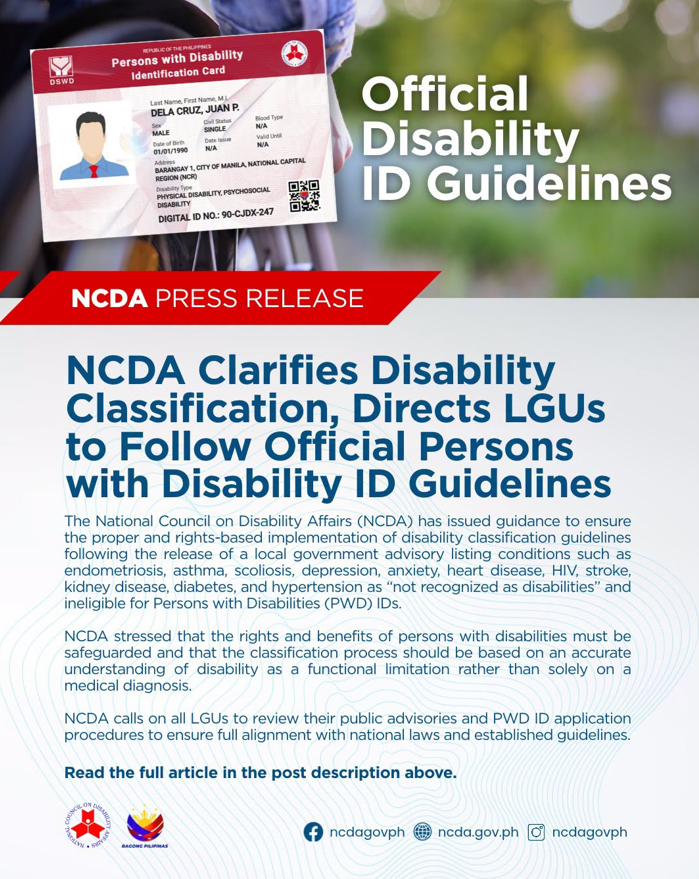
With the Unified PWD ID, IDs issued by the LGUs will now follow a standardized format that includes a unique alphanumeric ID number and a QR or barcode, along with the cardholder’s personal details.
The accompanying digital record will also contain details such as the type and severity of disability, cause of disability, functional limitations, validity details, and PhilSys number, if available.
The QR code will also allow merchants and offices to verify the authenticity of a PWD ID through verify.alaga.ph. Once scanned, the system will display the ID holder's name and reference number, which can be checked against the national database.
Prior to the UPWDIS, PWD IDs only had to contain an ID number, the cardbearer’s name, address, and date of birth.
Also read: GUIDE: How to Apply for a PWD ID in the Philippines
Zoe thinks a lot but forgets just as much. Writing helps her deal with both problems. When she isn't writing, she spends time baking sweets, wandering around, or staring up at the moon.