Safety First: Power Bank Do's and Don'ts
Charge your devices safely.

Published on Oct 6, 2025
(SPOT.ph) Be it on the daily commute or a long trip abroad, power banks have become an essential in the digital age. You might not think much of it once it's all juiced up and ready to charge your devices, but a power bank is still an electric device that poses risks if used excessively or incorrectly over long periods of time. Here's to hoping it's never you at the end of a power bank-related hazard, but it pays to be safe and lower the chances of harm.
As of late, posts regarding power bank accidents, recalls, and faulty units have been floating around social media. While manufacturers do their best to meet safety standards, modern tech still has its slip-ups, no matter how well-researched or tested. Below, we listed the dos and don'ts of power bank usage, so you can stop bad habits and start using your portable battery safely.
Also read: The SPOT.ph Ultimate Guide to Choosing the Best Power Bank
Here are power bank safety tips to keep in mind
Don't expose to extreme temperatures
Power banks don't fare well in extreme temperatures. Be it the sweltering summer heat or the frigid winters of a foreign land—both are a no-no. Heat may cause chemical reactions that can hasten the degradation of the battery, leading to leaks, swelling, and potential explosions.
Exposing a power bank to extremely cold conditions yields the opposite effect. Internal chemical reactions are slowed down, which can reduce the battery's capacity, increase internal resistance, and take a hit on charging efficiency. This can manifest in the battery draining faster, slower charging times, or even a complete shutdown if exposed to the cold for long periods of time.
Best to store in a cool, dry place that's far from direct sunlight, combustible gas, water, and othe liquids that could potentially damage the battery.
Don't leave it charging for too long
Most people have a habit of charging their power bank at night and unplugging it right before leaving for school or the office. Batteries with bigger capacities can benefit from a long, uninterrupted session of charging, but leave it plugged for too long and it can lead to overheating, which is never good for a power bank. Follow the recommended charging time to preserve the health of the internal battery.
Don't leave it unattended
Others may opt to leave their power banks plugged at home to charge while they're away at work or school so it's ready for the next day, or an upcoming trip. Most modern power banks are equipped with safety features, but it's still wiser to have it in a place where you can monitor it. In the same vein, avoid charging power banks on beds, blankets, and other flammable surfaces.
Don't store power banks near conductive materials
You can still store your power bank in your tote or backpack, but take caution against coins, safety pins, keys, and other small metal items. Any metal coming into contact with the ports or the internals of a power bank may cause a short circuit.
Don't drop power banks
We know, we know. Sometimes, you just can't help it especially if you're in a rush or your hands are full. Dropping power banks can result in dents or cracks that can compromise the integrity of the unit, which may result in leaking, overheating, or deformation. Power banks are not delicate by any means, but any effort put into keeping it far from the ground will lengthen its life.
Get a power bank with an indicator
Most power banks sold nowadays come with an indicator that tells users how much juice the unit has left. This can be a series of dots that light up, or a numerical indicator that ranges from zero to 100. Either way works, just try to get a power bank that has an indicator so you can tell if it's fully charged or if it needs to be plugged. Safety aside, it's always good to know how much power you have left on a trip, or if you can still lend it to a friend whose phone is low on battery.
Choose a power bank with safety features
Technology has come far, especially in the field of portable batteries. OGs will remember the heavy power banks with singular ports and lack of indicators, and today's slim, portable power banks definitely upgraded with the fast charging, bonus features, and color options. That aside, do you research and get a power bank that has protection against over-charging, short-circuit, and overheating. If you can, opt for a power bank that will automatically power off once it's fully charged even though it's still connected to a power source, or if it's still plugged to a device.
Buy from reputable resellers or retailers
We can't stress enough how important it is to purchase a power bank from a reputable brand or retailer. Aside from brand recall and marketing, trusted brands use their resources for research and development. It might set you back a few bucks more than a generic power bank on sale, but you can rest easy knowing that testing and expert insights went into the product you're using. Should anything go wrong, you can also raise concerns with the retailer and brand.
Keep that warranty
Jumping off from the previous point, keep the warranty of your power bank. You can never tell when it will malfunction or if it will even break down, but better be safe than sorry and keep that warranty. Most won't cover damages the user caused, but most manufacturers will repair or replace a power bank that suffers from internal issues under normal use. cover internal issues.
Just a heads up that warranties usually don't cover cracks, dents, liquid damage, normal wear and tear, self-repairs, or damage from misuse, accidents, or improper storage.
When to stop using a power bank
Some power banks are like tanks, built to last for years and durable enough to accompany you at every major trip, concert, and even breakdown. Still, it's time to let go once a power bank starts showing signs of decay; that's right, power banks are not meant to last forever! Lithium battery performance degrades naturally over time, so you're supposed to replace your power bank once it's time is up.
The following symptoms may lead to explosions or harm and are tell-tale signs to immediately stop using a power bank:
excessive heat during use
swelling or deformation
unusual odors
physical damage like big cracks or deep dents
leakage
major color changes on the outer casing
Power banks on the plane
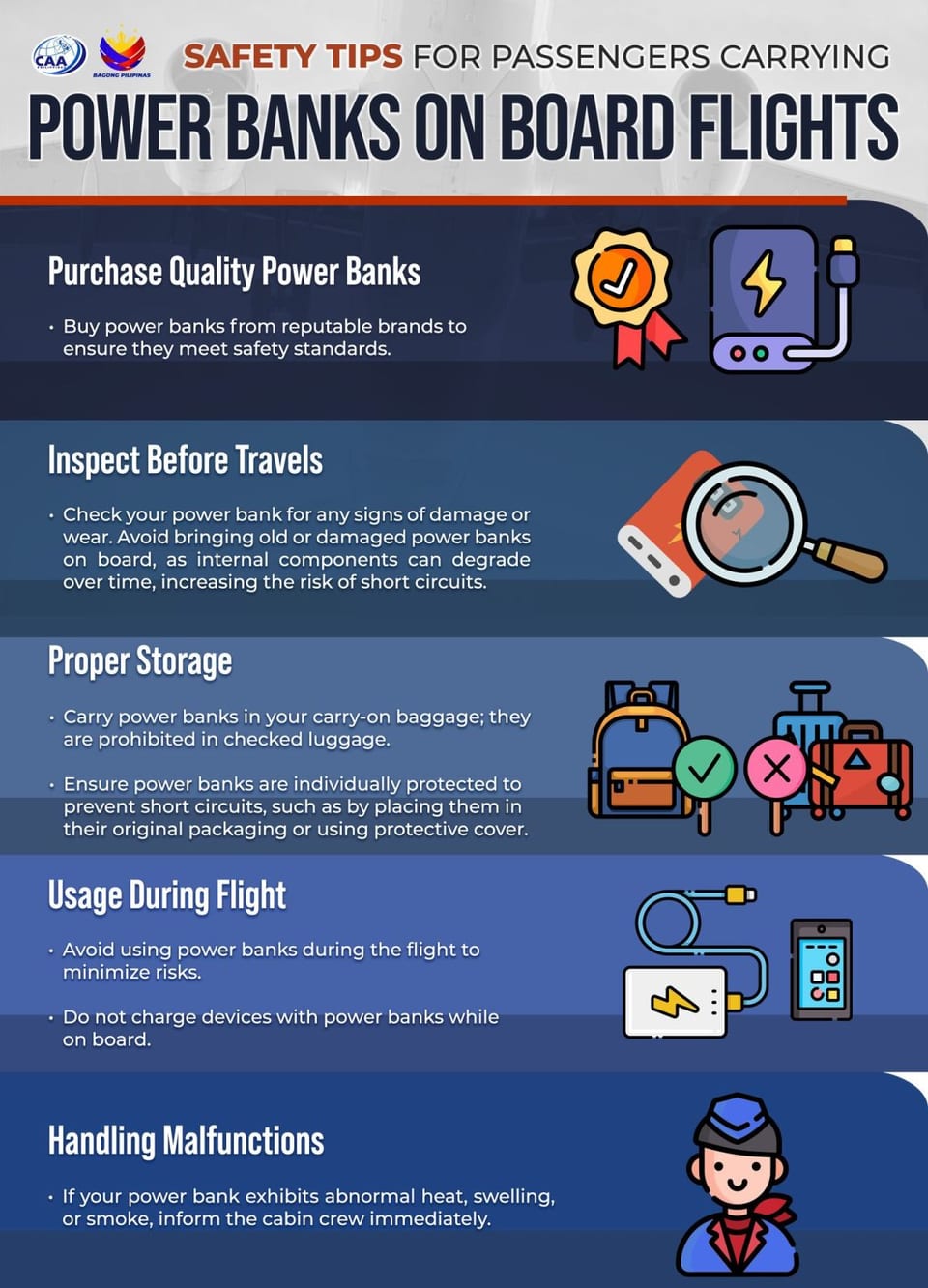
Local airlines comply with the Civil Aviation Aeronautics Board's memorandum on carrying power banks aboard aircrafts as part of their safety precautions. According to the CAAP memorandum, auxiliary batteries, spare lithium batteries not installed in devices, and power banks in general must not be placed in overhead bins or packed in checked-in baggage. It's allowed strictly as a carry-on item. That means it's in a bag that stays with you during the flight, or in the seat pocket in front of you or under your seat.
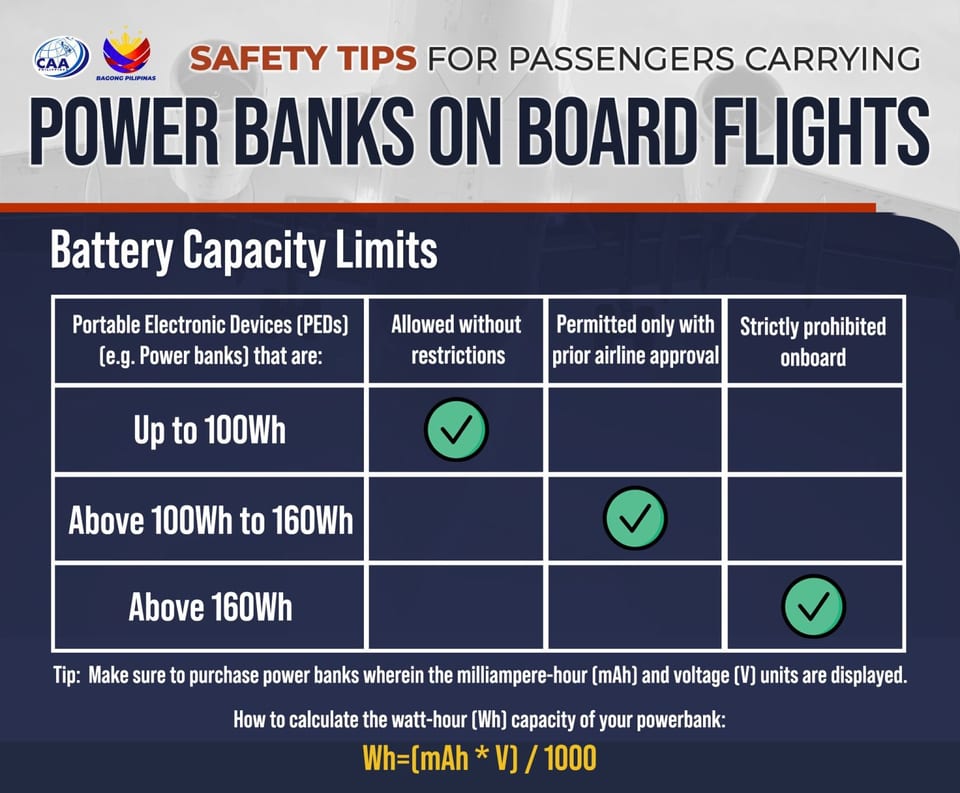
Power banks brought onto an aircraft must not exceed 160Wh. You won't ever need to bring 20 power banks at one time in this lifetime, but that's the maximum number ot 100Wh power banks you can bring according to the CAAP memorandum. We think one is good, two is safe, but three and above seems excessive. If your power bank falls between the 101Wh and 160Wh range, you're only allowed a maximum of two (2) per person.
It's recommended to pack them individually to prevent short circuits. Modern aircrafts have charging ports for phones now, but charging of power banks is strictly prohibited throughout a flight.
Should your power bank exhibit abnormal heat, swelling or smoke, inform the cabin crew immediately.
Also read: PSA: You Can No Longer Charge With Power Banks Aboard Planes
Clara is fond of dissecting song lyrics and finding out how films are made. She also likes astrology, green tea, and dogs.