Makati’s Baka Ramen Goes for a Lighter Broth—And It Pays Off
Here’s where you get the soul of ramen, without the weight of the typical tonkotsu style.

Published on Mar 6, 2026




(SPOT.ph) Manila’s love for ramen isn’t dying anytime soon, and we’re seeing more variations on the dish outside the ever-popular tonkotsu. Some places scale things up by piling on more toppings, more fat, more flavor—but Baka Ramen chooses to go the other direction. In owner Rafa Joseph’s words, “Less is more. Do one thing really well.”

The ramen shop can be found along Arnaiz Avenue, just a couple of steps away from Ralph’s Wine and Spirits (which houses Rafa’s other venture, Bar Koji). The space is narrow and cozy, its main area resembling a corridor with counter-style seating leading to a bar at the end. Owner Rafa Joseph puts his personality on display at Baka, decking the top shelves with action figures, colorful toys, and manga, as well as sake bottles and Japanese beer behind the bar. The walls, too, are zany to say the least, owing to the doodles and graffiti drawn by friends and other visitors. Clearly the man loves his Japanese pop culture.
It was around 2017 to 2018 that Rafa started experimenting in the kitchen to build the perfect bowl of ramen (of the decidedly heavy tonkotsu style at the onset) that he’d serve at pop-ups and to friends. He went all in during the pandemic, shifting from tonkotsu to a lighter, clearer broth, similar to the Japanese assari style of the noodle soup. “Since everyone was already doing [tonkotsu ramen], I realized, the key to my ramen… would be subtraction,” he tells us.

Simpler in this case does not equal easier. “In many ways, doing a cleaner ramen is a lot harder. Because you can't hide behind anything,” Rafa explains. The final form of Baka's broth uses a mix of pork, chicken, and bonito flakes boiled for “...a really long time” for the best balance of richness, body, and umami. The result pretty much speaks for itself—clear or translucent appearance of the soup aside, these bowls of ramen deliver layers of flavor from the first to the last slurp.
What to try at Baka Ramen in Makati
Ramen

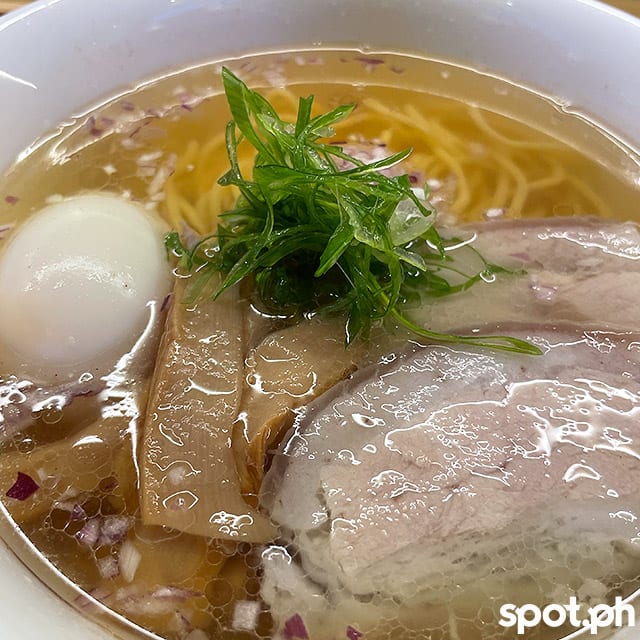
Baka’s core menu has just three items that all revolve around the basic Ramen (P450). Its default iteration comes with straight-type ramen noodles, cooked to the perfect firm bite; slices of chashu that dissolve like butter on the tongue; menma, or seasoned bamboo shoots for savory-sweet edge; and finely chopped red onions that lend just a hint of pungency for balance. The pork-chicken-bonito broth ties everything together beautifully—it’s got a velvety mouthfeel and just a touch of smoky, fishy flavor that stands up to the chashu’s richness, without it feeling overly heavy or cloying.
The ramen's great as it is, but can be spruced up with lashings of their house chili oil tinged with calamansi and dalandan. You can take things the heftier direction with the Ajitama Ramen (P500), which gives you an additional soy egg; or the Chashumen (P600), which has even more of that melt-in-your-mouth pork. (Photo by Patricia Baes)
Spicy Ramen

Though Rafa keeps his lineup short by design, he recently introduced upgrades that change the character of the bowl entirely—you can, for example, add P100 to your chosen ramen base to make it Spicy. Fermented chili and soybeans go into the broth, giving it a fiery orange-red color. But the actual heat level’s quite balanced—there’s just enough of a kick that the resulting ramen delivers warmth, in such a way that it's soothing. (Photo by Patricia Baes)
Lack of blatant advertising and minimalist approach aside, Baka Ramen’s built a small but steady following among local food folks in the know, as well as Japanese expats. Less really can be more when done right.
Also read: This Hidden Bar in Makati Is an Under-the-Radar Spot for Stellar Sushi + Sashimi
For Trish, food is as much a source of pleasure and fuel as it is an outlet for creativity; a medium by which stories can be passed on; and a way to connect with others.