What's New
Western Mindanao's Soulful, Aromatic Cuisine Inspires Hapag's Brilliant New Tasting Menu
Hapag is on a mission to give us a better understanding of Filipino food.
Published on Jun 16, 2025
(SPOT.ph) Menu after menu, the folks of Hapag strive to better understand Filipino cuisine—particularly the parts of it that aren’t as immediately visible or easily accessible to the everyday Manileño. Previously, they tackled the rich tapestry of flavors of Western Visayas; this time around, Hapag is zoning in on Western Mindanao—specifically Zamboanga, Basilan, and Tawi-Tawi, places the team visited to better understand the area's food, culture, and people.
In Chef Kevin Navoa’s words, the resulting tasting menu—filled with interpretations of the dishes they tried and loved during their explorations—is Hapag’s way of expressing that there’s “more to Filipino food than what we think we know.”
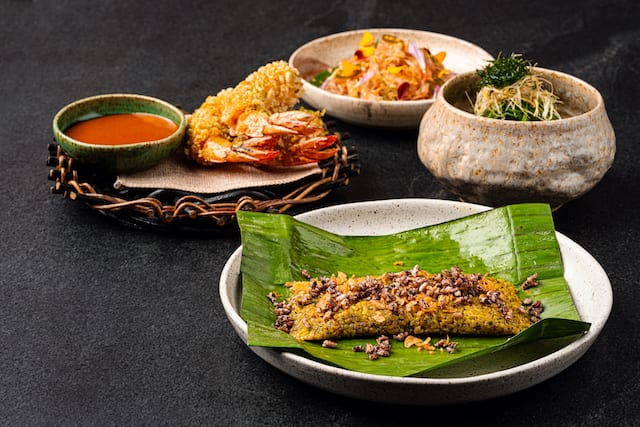
Click to Enlarge
The new menu features interpretations of dishes the team tried and loved following a six-day research tour to the southernmost provinces of the country. Photo courtesy of EAT Public Relations.
The Hapag team eating their way through Western Mindanao
Hapag’s foray into Western Mindanao cuisine began the way many great things do—with curiosity. Navoa admits the subject was initially unfamiliar to the team. “None of us really knew much about the cuisine from that part of the Philippines. As a Filipino chef, I felt it was important to understand regional food techniques and traditions,” he explains. “After working on the Western Visayas menu, we wanted to keep digging deeper into the country's diverse culinary roots. Zamboanga and its neighboring provinces stood out because they felt ‘foreign’ even to us, and we were intrigued by the strong Muslim and Malaysian influences in the region.”
The team embarked on a research tour seeking to lean more about Tausug, Yakan, and Chavacano food and their culinary traditions. Doing so also came with learning about the daily lives of the people, itself impacted by the area’s history, geography, and predominant religion.
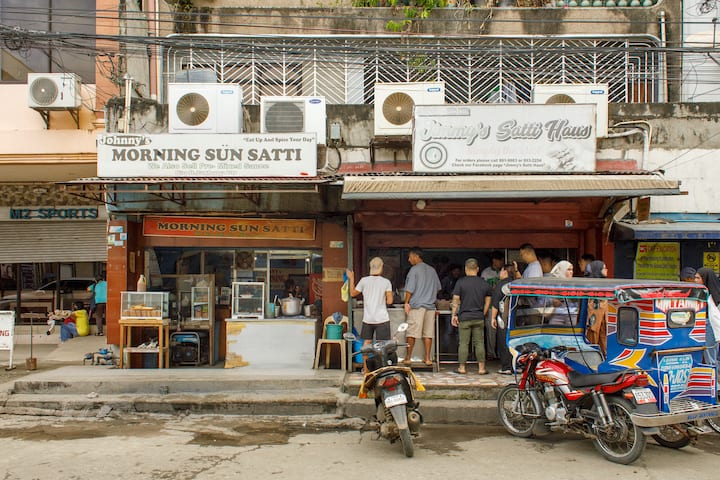
Click to Enlarge
Jimmy's Satti House, an institution for the dish of grilled meat skewers. Image courtesy of Hapag.
Hapag got help from Myra Abu Bakar, Undersecretary for Muslim Affairs and Mindanao Promotions of the Department of Tourism: “She connected us to everyone. Wads [Mohammad Wadzni Alih], our guide in Tawi-Tawi, was another key figure. His love for the region made everything click for us. And [Fan-fan Musa Amil], a young Tausug chef, gave us a modern take on Tausug cuisine that helped ground our understanding,” says Navoa.
Asked about the challenges, Hapag’s head sommelier Erin Ganuelas-Recto admits each day of the six-day trip “started early and ended late.” “Planning and coordination were also tough before the trip. Respecting local customs was crucial, like dressing modestly in predominantly Muslim areas.”
But it was a trip full of delights. The Hapag team visited local markets, “deeply localized” and distinct from other markets they've seen. “In Lamitan, Basilan, most goods came directly from the area or nearby Malaysia,” says Chef Thirdy Dolatre. “[There were] no big brands or outside products, aside from maybe candy from Zamboanga. Tawi-Tawi’s markets were especially eye-opening during Ramadan.” The chefs saw stalls selling the likes of mi goreng (stir-fried noodles) with hotdogs, and even murtabak (stuffed, pan-fried flatbread) with Milo. “Very Malaysian-inspired. It felt like a different world.”
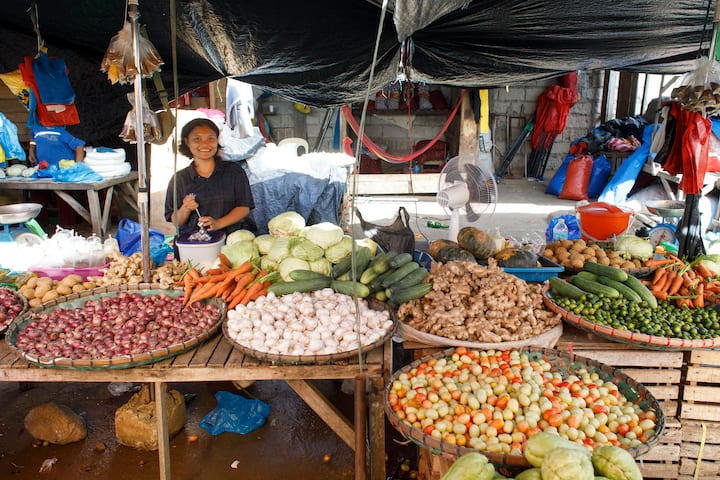
Click to Enlarge
At the local market in Basilan. Photo courtesy of EAT Public Relations.
The team ate their way through dishes of all kinds in the area—including tiyula itum, the Tausug beef soup that gets its blackened hue and smoky aroma from burnt coconut; and variations of piyanggang, another Tausug dish of grilled protein (typically chicken) marinated in burnt coconut and spices. At the Zamboanga icon Jimmy’s, they got to try satti, or skewered meat (similar to Malaysia’s satay) in a spicy-sweet sauce, which locals eat with puso (hanging rice pouches) at satti houses as early as 4 in the morning.
Some of the dishes the Hapag team got to try on the trip: satti and knickerbocker glory in Zamboanga; tiyula itum and tinagtag in Basilan; agal-agal, bang bang sug, mi goreng in Tawi Tawi. Photos courtesy of EAT Public Relations.
The team also encountered agal-agal, a kind of seaweed abundant in Western Mindanao often used to make ensalada with toasted coconut. There was also the Tausug pastil, comparable to empanada with a filling of togue or beehon noodles (this is not to be mistaken for the Maguindanao packed-rice dish of the same name). “[It’s] ripped into small pieces then topped with vinegar and optional chili sauce, and eaten like cereal,” Ganuelas-Recto tells us. And in Tawi-Tawi, the team paid a visit to Akantai, a local coffee shop serving pastries by the bilao (you only pay for what you eat, says the sommelier).
Dolatre shares how the sweetness of the dishes caught them by surprise. “Even seafood dishes like clams and crabs were sweet.” In other parts, he shares: “We were impressed by how subtle and refined Tausug flavors could be.”
ADVERTISEMENT
Bringing It Back to the Hapag Table
Translating all these tidbits of knowledge and wealth of experiences into a cohesive degustation was no easy feat. “The menu [features] dishes that reflect Tausug, Chavacano, and Yakan influences, but we only have 10 courses,” Dolatre says of the lineup. “We’re focusing on honest storytelling, showing how our understanding evolved. We’re being thoughtful about pairings, too—like whether to include wine alongside Muslim dishes.”
“The biggest challenge… is how we tell the story through food. We need to be accurate and respectful while making it accessible to diners,” Ganuelas-Recto adds.
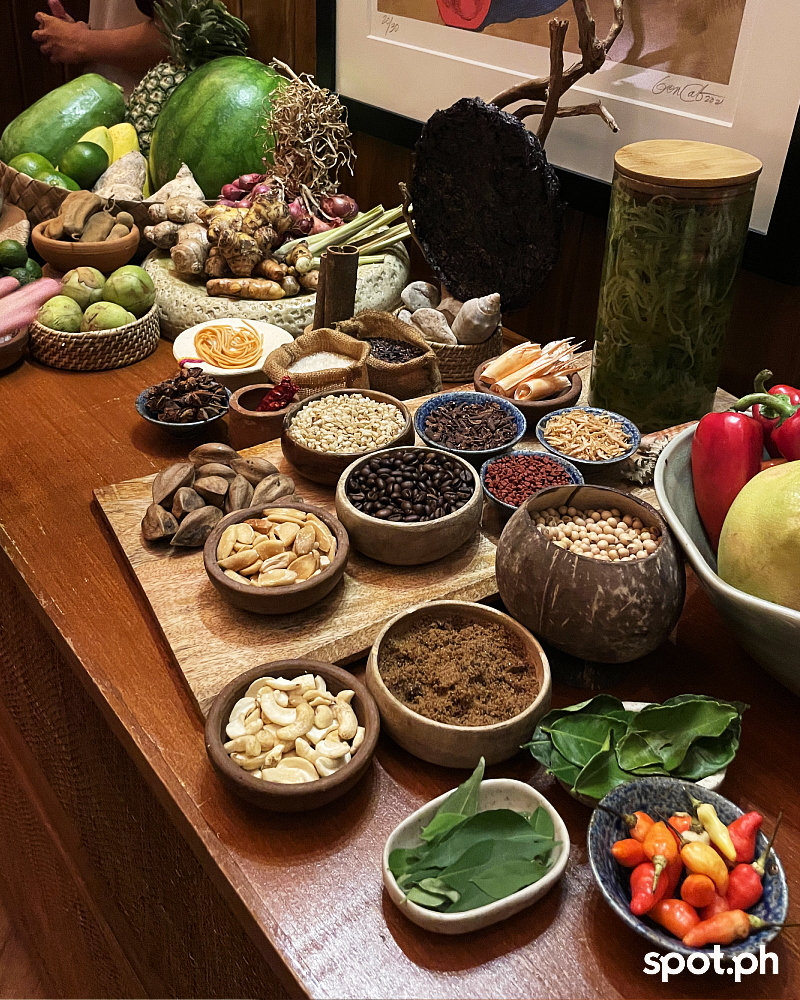
Click to Enlarge
A display of some of the ingredients used in the menu..
The finished plates in the Western Mindanao tasting menu (P7,500+) take after dishes they tried—soulful and full-flavored; abundant on the aromatics; bright in some places yet raspy and smoky in others. Still, they’re recognizably Hapag with their contemporary presentation, playful flavor combos, and the incorporation of ingredients from other parts of the globe. Some of these had appeared as sort of prototypes in a previous collaboration with Akar—and it’s now that we get to see them in their more final form. Pro tip, don’t miss their beverage pairings (wine pairing is an additional P2,800; there's also a non-alcoholic option at P2,000) as Ganuelas-Recto has lined up superb sips, designed to bring out the best of Hapag’s food lineup.
Click to Enlarge
Click to Enlarge
Click to Enlarge
Click to Enlarge
Champagne Dosnon Recolte Rosé Brut for a lively start; the menu cover, with art by Kristine Paz Yap; Tiyula Itum; Satti. Photos by Patricia Baes
The Tiyula Itum sets a deeply aromatic tone for what’s to come. Hapag streamlines the Tausug beef soup here, presenting its flavors in the form of a hearty broth served from a mug. It's anything but oversimplified, potent yet soothing, delivering the smokiness of burnt coconut and zing of ginger, galangal, turmeric, native shallots, lemongrass, and chili. (Should you go for the wine pairing, its partner Champagne Dosnon Recolte Rosé Brut—which has a peachy, strawberry-like profile and touch of minerality—is excellent.) Then there’s the Satti, for which Hapag presents four skewers with a variety of tastes and textures: rich, chewy beef tongue; robust-tasting beef rump; soft, juicy chicken isol; and beautifully charred chicken skin, all designed for dipping into a hearty sauce made of peanut, spices, and reduced chicken broth.
Click to Enlarge
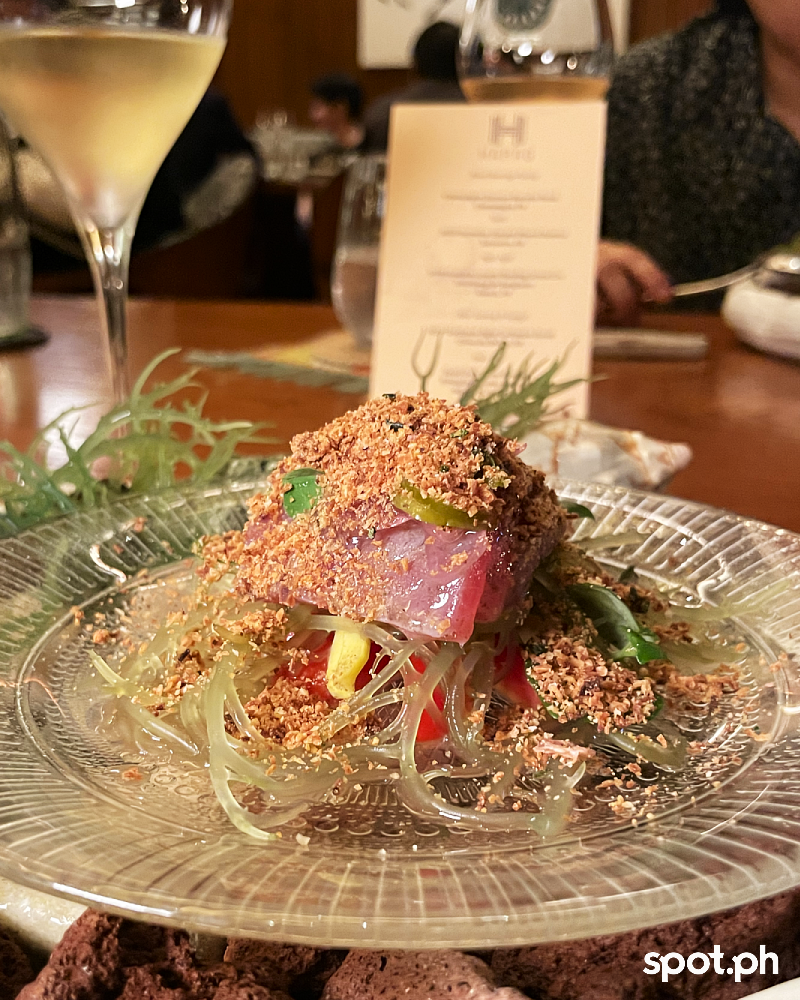
Agal-Agal. Photo by Patricia Baes.
Via the Agal-Agal, Hapag brings us a taste of the seaweed salad the team loved during their trip. Their version swaps the traditional soymansi with a shoyu dressing—just the thing to add gentle depth to the fresh seaweed. A topping of bubuk (toasted spiced coconut) makes for subtly spiced forkfuls, while succulent slices of yellowfin tuna kinilaw complete the party. Then there’s Mee Goreng, traditionally a stir-fried noodle dish from Indonesia that’s popular as a late-night snack in Zamboanga. Hapag’s take is savory-sweet and a touch saucy like the original, with added complexity from the al-dente noodles made in-house; their own scratch-made oyster sauce; zippy sambal; earthy, meaty mushrooms; and a tiny quail egg yolk to tie everything together.
Click to Enlarge
Click to Enlarge
Click to Enlarge
Click to Enlarge
Mee Goreng, stir-fried noodles topped with a quail egg yolk; Gustave Lorentz Riesling Grand Cru, an expressive Riesling that matched the body of the noodles; Siyagul + Roti Murtabak, an unexpected-delish pairing of dishes they tried at the local markets; Leche Flan (as a palate cleanser!). Photos by Patricia Baes
From there, Hapag goes for an unexpected pairing in the Siyagul + Roti Martabak, named after two dishes they had encountered at the local market. Siyagul is a dish of stingray, coconut milk, and aromatics; Hapag’s version uses swordfish in a coconut-turmeric-mornay sauce that highlights the fish’s mild flavor. It's served over a crust of sorts of crisp martabak—and the addition of herb pesto, fresh herbs, and Malagos Borracho cheese (made with fresh goat's milk aged in Cerveza Negra!) make for a pizza-esque flavor profile that we dig. This is followed by Leche Flan as a palate cleanser (!), taking after how, in Western Mindanao, the flan would typically be served with the main courses as a sort of relish to the other spicier viands on the table. Balancing out its creaminess is icy-tangy calamansi-tanglad granita; jelly-like nuggets of scoby; sweet-tart pickled hibiscus and cucumbers; and lightly bitter binahian leaves.
Click to Enlarge
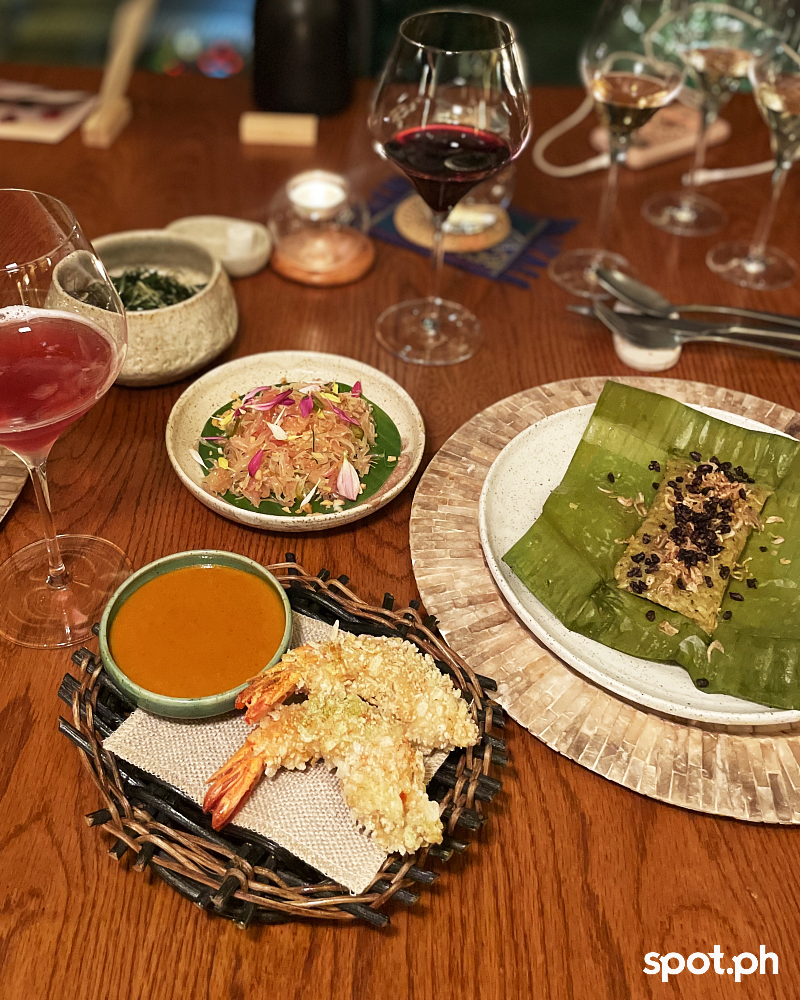
Salu-salo overview. Photo by Patricia Baes.
Hapag, of course, sure knows how to throw a feast—needless to say Salu-Salo, the restaurant’s party of mains, is as festive as it gets. The cast of characters in this round? Riyandang, taking after the Maranao style of beef rendang that’s a touch sweeter and more coconut-forward than Indonesian versions; Camaron Alavar, which has juicy prawns coated in a sourdough batter, rolled in pinipig (think tempura!), then deep-fried to a cronch and served with Alavar sauce; Junay, their take on the packed rice dish cooked in burnt coconut, here brightened by calamansi and sprinkled with kalkag (fried shrimp) and shallots; and a Pomelo-Pako Salad for refreshment in between forkfuls of the rest.
Tiyula Itum; Camaron Alavar; Junay; Pomelo Pako Salad. Photos by Patricia Baes
Dessert is an equally colorful affair, beginning with the Knickerbocker—Hapag’s ode to Zamboanga’s icy sweet icon, here combining compressed tropical fruit, pineapple jelly, langka jam, an amazake-pili nut foam for a touch of umami, and strawberry ice cream. Officially closing the meal on a whimsical note is the Bang-Bang Sug—a spread of bite-sized sweets, essentially petit fours, inspired by Tausug treats traditionally served with Kahawa Sug coffee. Palikambing, or deep-fried bananas in cinnamon sugar, comes as a smoked-banana bonbon with caramel and cinnamon in milk chocolate; Wadjit, a sticky rice cake similar to biko with black glutinous rice, is used here as a filling in a shell of dark chocolate; Biyaki, comparable to a sweet corn tamale, becomes a bonbon of corn mousse in white chocolate; and Putli Mandi, originally a glutinous rice cake filled with sweetened coconut, becomes a confection of chewy, bukayo-infused kakanin, a thin shell of white choc, and grated coconut.
Click to Enlarge
Click to Enlarge
Click to Enlarge
Click to Enlarge
Knickerbocker; Bang Bang Sug; Milalittra Ethopian coffee to go with the bonbons.
Filipino cuisine is a highly regional one, and it’s only right that we spotlight its lesser-explored, equally beautiful parts—as Hapag is happily doing. “This isn’t just about showcasing dishes," says Dolatre, "it’s about recognizing how much of the Philippines we’ve yet to explore and giving that food the care and respect it deserves."
Ganuelas-Recto adds: “Filipino food isn’t just adobo, sisig, or lumpia. It’s diverse and deeply regional… If diners walk away understanding that Filipino food includes tiyula itum and piyanggang, then we’ve done our job.”
Hapag is at 7/F Balmori Suites, Hidalgo Drive, Rockwell Center, Makati City. For more information, check out Hapag’s website.
For Trish, food is as much a source of pleasure and fuel as it is an outlet for creativity; a medium by which stories can be passed on; and a way to connect with others.
You Might Also Like