What's New
At Recent "Taco Omakase," Mexican Chef Served Lato, Grilled Eggplant + More Over Handmade Corn Tortillas
Filipino + Mexican cuisines have deep historical ties—and they go great together
Published on Jul 22, 2025
(SPOT.ph) It’s a connection that goes all the way back to the 16th century, in light of the Manila-Acapulco Galleon Trade—and the byproducts of it can still be felt today. The Philippines and Mexico have plenty in common, especially on the food front. Just ask Mexican chef Marco Garcia of Tokyo’s Los Tacos Azules, who was recently in the Philippines for a bit of a kitchen takeover—a taco omakase, they call it—at Los Tacos BGC.
Click to Enlarge
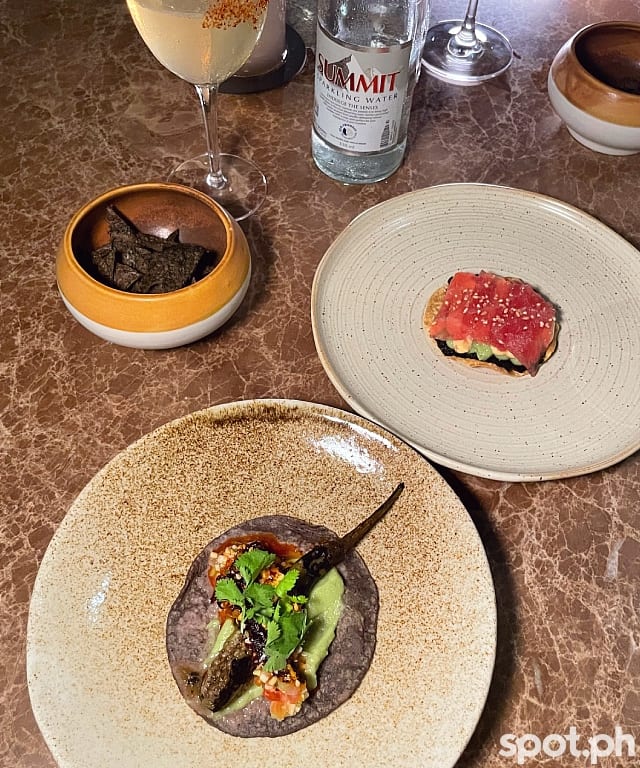
Los Tacos Azules put unexpected ingredients (seasonal Filipino produce, among others!) over corn tortillas during their recent taco omakase-slash-takeover at Los Tacos BGC. Photo by Patricia Baes.
The first Los Tacos Azules opened in the chef's home base of Monterrey, Mexico in 2011. But he had long dreamed of opening in Japan—and he did just that, moving to Tokyo and establishing the taqueria's first Japanese leg in Sangenjaya, Setagaya in 2018. (A second Japanese location followed in Ebisu, Shibuya.)
One might wonder how the idea of a taqueria can be executed in a completely different place like Tokyo—but Garcia goes by a simple philosophy: highlight local, seasonal (in this case, Japanese) ingredients—fresh produce, seafood, Wagyu beef, and so on. Together with the team, he puts together fresh and flavorful filling and topping combos, and serves these over their signature tortillas; these tortillas are made by hand using blue corn (sourced from Oaxaca, Mexico!), which is ground in-house then worked into a masa with the help of the process called nixtamalisation.
He brought this same approach over to Manila via the recent two-night pop-up, as he worked Filipino ingredients and flavors into his signature tortillas, alongside other elements brought in from Tokyo.
Click to Enlarge
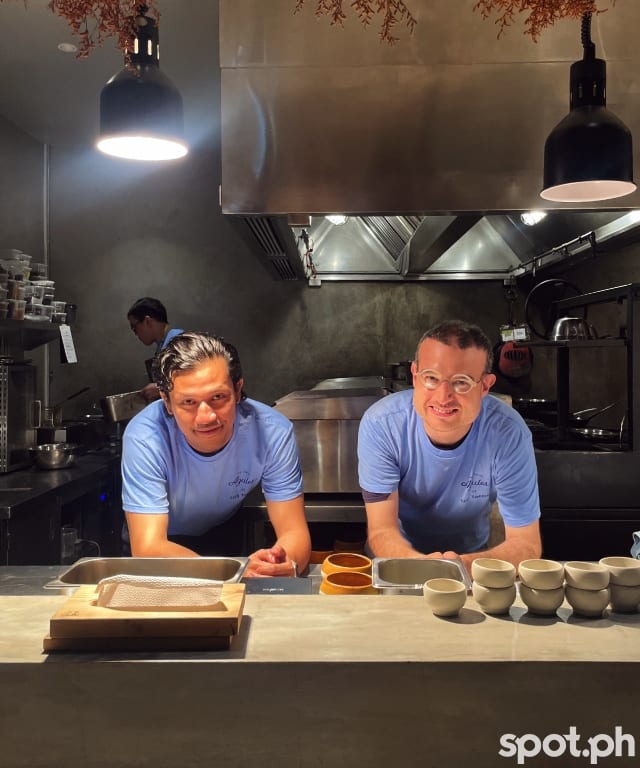
Los Tacos Manila's Chef Patrick Curitana poses with Los Tacos Azules' Chef Marco Garcia. (The name similarity between the two taquerias is completely coincidental.) Photo by Patricia Baes.
Guided by the team of our own Los Tacos, Garcia took the opportunity to explore the local markets here in Manila—particularly Farmer’s Market in Cubao, and the weekend markets of Salcedo and Legazpi Village. The starry-eyed chef then raved about the parallels he saw between the cuisines of his homeland, and our own.
“There's a lot of ingredients that I'm very familiar with,” he continues. “A lot of the ingredients that you guys have here, they actually come from the Americas, from Mexico, but also vice versa—[a lot of the ingredients we have in Mexico come from the Philippines]. Like, the mangoes I grew up with, they come from the Philippines. [Also] guava, and so many other things.”
Elsewhere, he shares, he encountered the same ingredients from Mexico and found that we use them in “completely different ways.” Avocados, for one, are primarily used in sweet applications here, and savory over in Garcia’s side of the world. We also have similar terms for certain foods, even though they have entirely different meanings—e.g. torta, which can refer to different things even among different regions in the two countries. (In the Philippines it can refer to a sponge cake or omelette; in Mexico it can be a sandwich or an almond-based cake.)
More scenes from the pop-up earlier this month, which had a brief—but very much memorable—two-night run. Photos by Patricia Baes
Los Tacos Azules at Los Tacos BGC
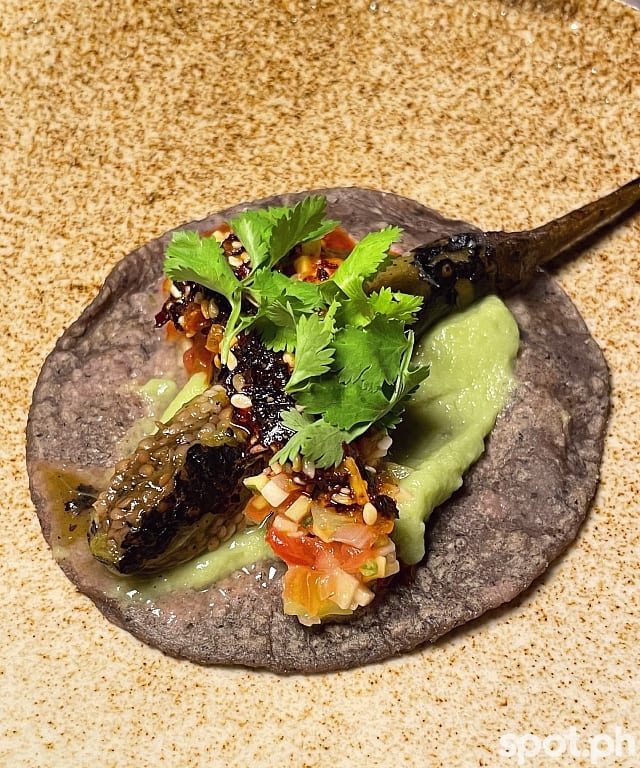
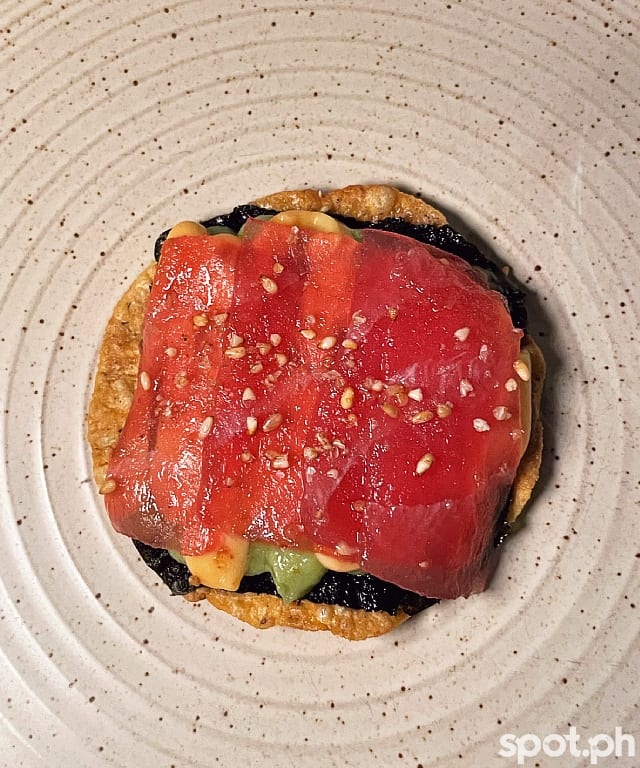
“One of the first dishes that I got to try [in the Philippines] was the ensaladang talong,” Garcia tells us. This inspired him to make the Eggplant Taco—a sprightly two-biter with smoky grilled eggplant brightened by calamansi juice; green mango pico de gallo; shrimp miso; and salsa macha, all over his famous blue-corn tortillas. This was followed by the Maguro Tostada, perhaps a reference to Los Tacos Azules’ Japanese home with its tuna nigiri-esque profile. Over crisp, nori-lined fried tortillas, Garcia layers seasoned maguro, guacamole, and chipotle mayo for a crisp, creamy, nutty, earthy, umami party on a plate.
Click to Enlarge
Eggplant Taco—grilled eggplant, green mango pico de gallo, shrimp miso, salsa macha. Photo by Patricia Baes.
Click to Enlarge
Maguro Tostada—seasoned maguro, guacamole, homemade chipotle mayo, nori tostada. Photo by Patricia Baes.
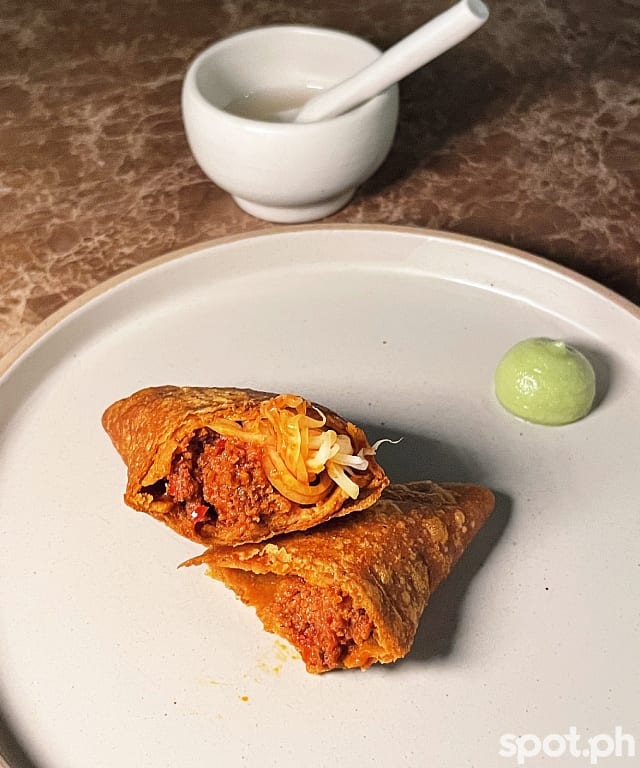
In the days leading up to the dinner, Garcia got to try a selection of Filipino street snacks—of which he was especially blown away by good ol' Ilocos empanada. “I love street food, and there was this lady making [these orange empanadas] in Intramuros,” the chef tells us. He pays ode to this in his own Empanada which brings together Mexican chorizo, jalapeño, and pickled green papaya in a masa crust tinged with ancho chili (this gives it its marigold color). With it came amazu, or reduced, sweetened vinegar, which lends brightness to the spiced half-moon pastry.
Click to Enlarge
Empanada—ancho masa, Mexican chorizo, jalapeño, pickled green papaya. Photo by Patricia Baes.
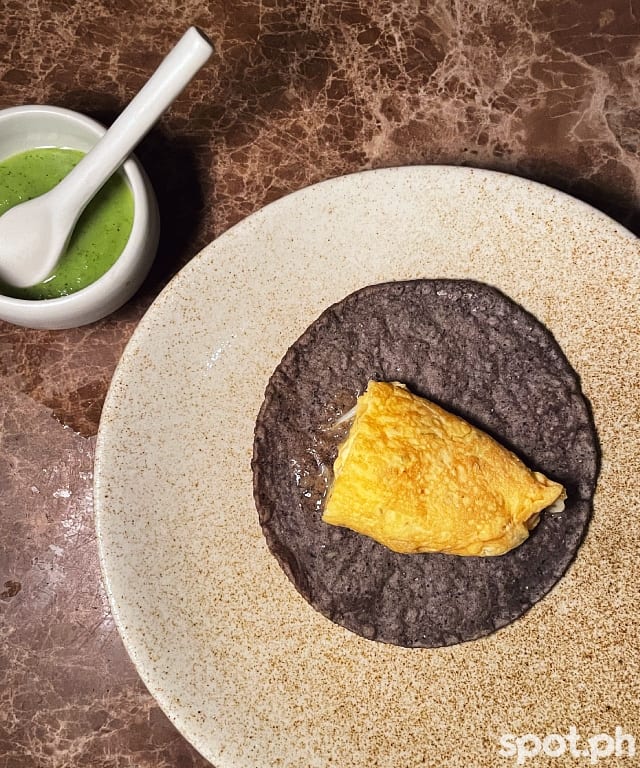
The chef then gave us a taste of one of his Tokyo signatures in the form of the Shirasu Taco, named after its main star: shirasu (Japanese baby sardines) from Yamari, a known specialty shop in Wakayama. Garcia folds the tiny, delicate-tasting fish into a silky omelette that’s then placed over a corn tortilla; a sidekick of zucchini-jalapeño salsa seals the deal, adding zest to every bite of the taco.
Click to Enlarge
Shirasu Taco—Japanese baby sardines, omelette, zucchini-jalapeño salsa. Photo by Patricia Baes.
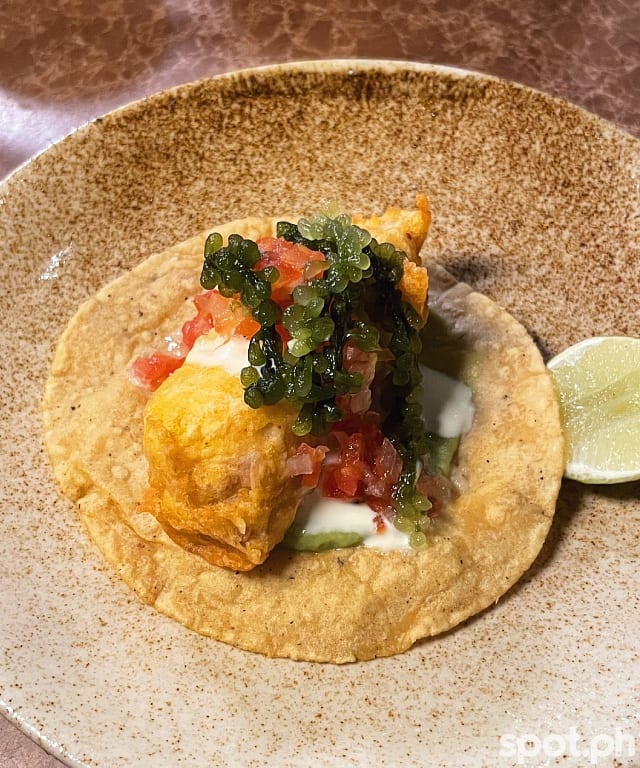
Garcia encountered lato or fresh seaweed during his trip to the Farmer’s Market in Cubao, and had the idea to make a taco that would feature the sea vegetable. “[It]’s one of my favorite vegetables that I tried during this trip,” Garcia shares. The result? The Filipino Batter-Fried Fish Taco, where the lato’s natural briny taste adds an ocean-y hum to beer-battered mahi-mahi; zingy pico de gallo (we’re all for the pops of brininess the seaweed gives); and spicy crema.
Click to Enlarge
Shirasu Taco—Japanese baby sardines, omelette, zucchini-jalapeño salsa. Photo by Patricia Baes.
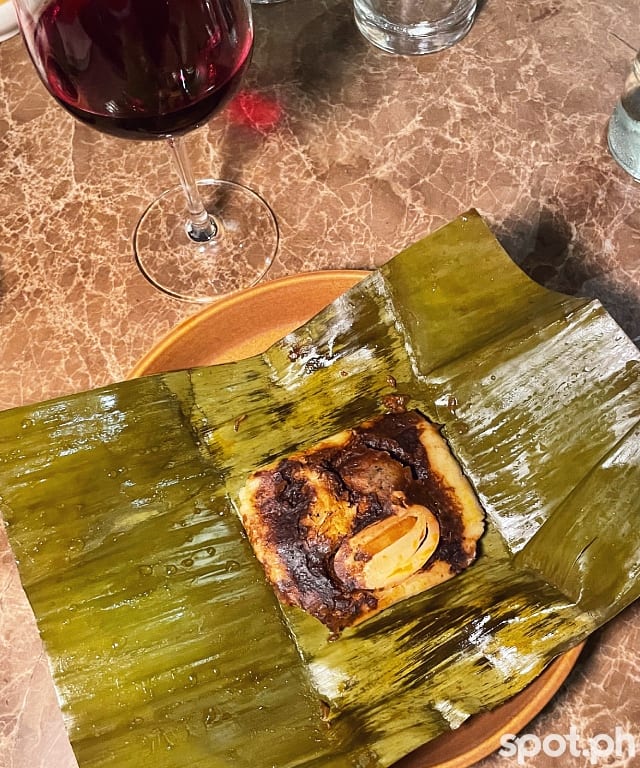
The Mole Tamales came as a parcel roughly the size of a deck of cards, wrapped in banana leaves—a distinguishing feature of the Veracruz style of tamales (not unlike Kapampanagan tamales, or suman malagkit) which this takes after. “We use a lot of banana leaves in Mexican cuisine, actually,” Garcia muses. “So it surprised me to see the [rice cakes and other delicacies] that [Filipinos] make with sticky rice.” He takes a page from Chinese zongzi a.k.a. machang for the filling, studding the masa with carnitas, salted egg, and longganisa; and for the tamales' characteristic sweetness, he adds in a sort of Philippines-fied take on mole Veracruzano, made with local bananas and guava. With it came pours of Yamanashi de Grace 2023, a Japanese red wine whose spiced, plum-y profile stood up to the tamales’ richness and smoky aroma.
Click to Enlarge
Mole Tamales—banana leaf, mole veracruzano, carnitas, salted egg, longganisa. Photo by Patricia Baes.
Dessert time involved digging into the Atole Ice Cream—that’s ice cream flavored a la atole (a traditional Mexican drink made with masa) and joined by hojicha oil, tres leches chunks, and burnt cream. Mexican meets a touch of Japanese here, for a fun flavor profile that easily resonated with us Filipinos.
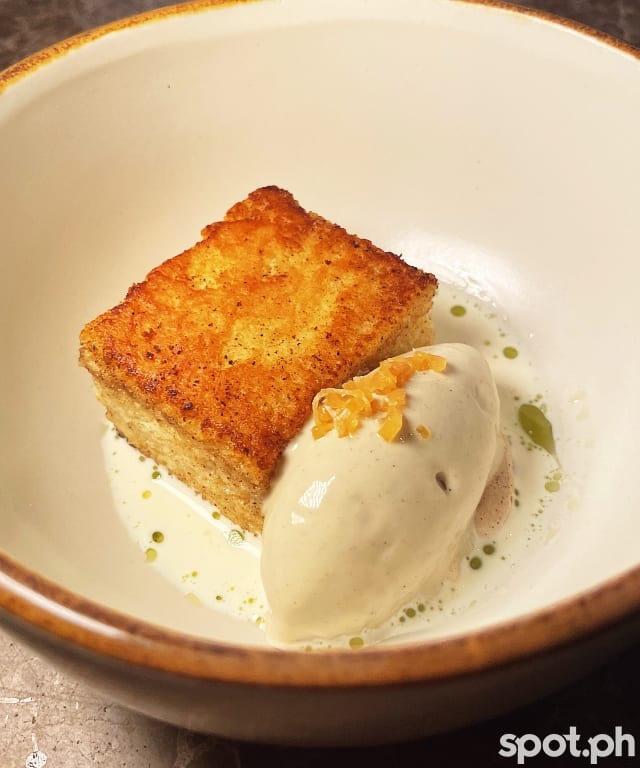
Click to Enlarge
Atole Ice Cream—hojicha oil, tres leches, burnt cream. Photo by Patricia Baes.
Through the dinner we saw a bit of everything—mostly the flavors of Mexico and the Philippines, whose deep ties make for a natural (and wonderful) pair. There was also a little bit of Japanese, whose affinity with the former two was a pleasant surprise. No wonder; if there's anything that can bring together even the most distant of nations, it's gotta be food.
For more information, check out the Instagram pages of Los Tacos Azules and Los Tacos Manila.
For Trish, food is as much a source of pleasure and fuel as it is an outlet for creativity; a medium by which stories can be passed on; and a way to connect with others.
You Might Also Like