Spot Fitness: A Beginner's Guide to Gymnastics
It's never too late to start now.

Published on Oct 7, 2026
(SPOT.ph) Gymnastics used to fly relatively under the radar in the Philippines—until Carlos Yulo flipped and tumbled his way to Olympic gold, helping fuel a new wave of interest in it.
The sport is often associated with kids that if you didn’t begin at a young age, it’s easy to think that the ship has sailed. But as you’ll realize in this guide, adult gymnastics is very much a thing. You don’t have to pull off anything remotely Olympian-level to try it, but it’s a proper workout all the same—and a pretty fun one at that.
If you’ve always wanted to try your hand at cartwheels and handstands, here’s everything you need to know before stepping onto the mat.
What is gymnastics?
Gymnastics traces its roots to ancient Greece, where the term was broadly used for physical training that included running, jumping, wrestling, and even dancing. The Romans adapted many of these exercises for military preparation, which is also where some familiar equipment got its start. Even the pommel horse has military roots: early versions were used to practice mounting and dismounting a horse.
The activity looked very different from the routines we see in gymnastics today, but the emphasis on strength, flexibility, and balance was already there.
The sport began taking its modern form in Europe in the 18th and 19th centuries. German educator Friedrich Ludwig Jahn is credited with turning physical training into something more organized, introducing apparatus such as the parallel bars. Today, gymnastics covers several disciplines, including artistic, rhythmic, trampoline, acrobatic, and aerobic gymnastics, among others.
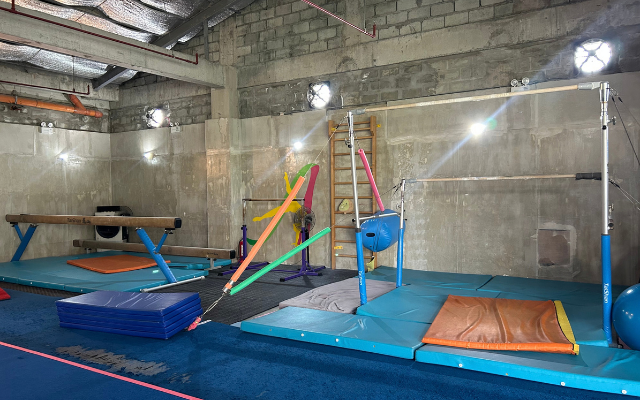
At its simplest, gymnastics is about learning how to move and control your own body in different positions—on the ground, in the air, and upside down.
The basics include movements you probably already know by name, like forward and backward rolls, cartwheels, bridges, and handstands. From there, gymnasts can work their way up to more complex skills such as walkovers, handsprings, and flips.
What makes gymnastics impressive is how much goes into making those movements look effortless. A clean cartwheel or steady handstand takes plenty of strength, balance, and control behind the scenes.
What do you need for gymnastics?
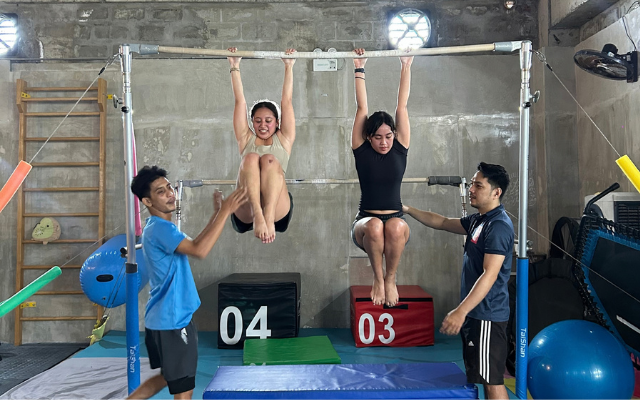
You can show up to your first gymnastics class in pretty much the same clothes you’d wear to the gym. Think a dry-fit or cotton shirt with shorts or leggings. More coverage is better, especially on top, since coaches may need to physically spot you while you’re doing certain skills.
You’ll also want to go barefoot rather than wear socks, as this makes it easier to feel—and grip—the floor. It’s also best to remove jewelry before class so nothing gets caught while you’re rolling, jumping, or going upside down. On that note, try not to eat a heavy meal right before class as well.
Other than that, just bring a water bottle and a towel.
What to know about gymnastics if you’re a beginner
Trying gymnastics as an adult comes with many, many questions: Do you need to be flexible? What if you can’t do a cartwheel? And are you actually expected to go upside down on your first day?
For answers, we spoke to Essa Dy, owner of Athletica Gymnastics, and Coach Mike, who teaches its adult classes, about what beginners should know before getting started.
You can start at any age
It’s easy to think of gymnastics as something you either start young or not at all—at Athletica Gymnastics, kids start as young as three years old—but adults can start from scratch, too.
“You don’t have to be there naman right away when you start,” Dy said. The bigger hurdle for adults is often intimidation. People tend to picture things like splits or advanced moves before they’ve even started. In reality, coaches work with what you can already do, then adjust the drills and conditioning from there.
Dy would know: she only started taking gymnastics classes in her mid-50s. A few classes were enough to make her see the results: training helped with things as basic as bending down and standing back up more easily: “Before I started the classes, I had a hard time picking up things on the floor, or my knees hurt.”
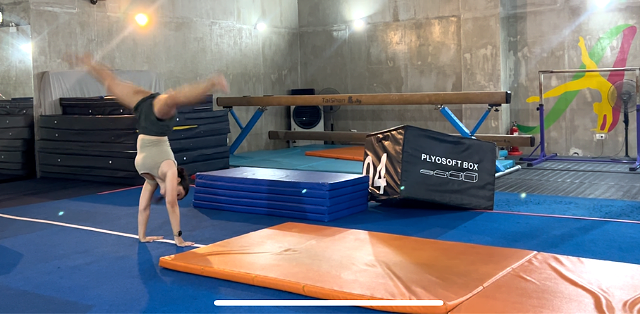
You also don’t have to force yourself through the entire class at the same pace as everyone else. If you’re tired, take a break and come back to the drill when you’re ready—something Dy and Coach Mike encourage beginners to do.
Expect a lot of drills and conditioning
Your first gymnastics class isn’t necessarily just prep work. Even as a complete beginner, you already get to try handstands and cartwheels—just in a more controlled, beginner-friendly way. A word of warning, though: a good chunk of gymnastics class is actually spent preparing your body to do them.
According to Coach Mike, classes start with a warm-up and stretching, followed by line drills and conditioning exercises that work your legs, arms, and core. And yes, all that preparation is necessary.
“We always condition before skills,” Coach Mike said. Even if you can manage a decent cartwheel, Dy explained that you still need proper technique to execute it correctly.
You'll also learn skills in stages rather than attempting the full movement immediately. For handstands, Coach Mike said beginners start against a wall before eventually working toward balancing without support.
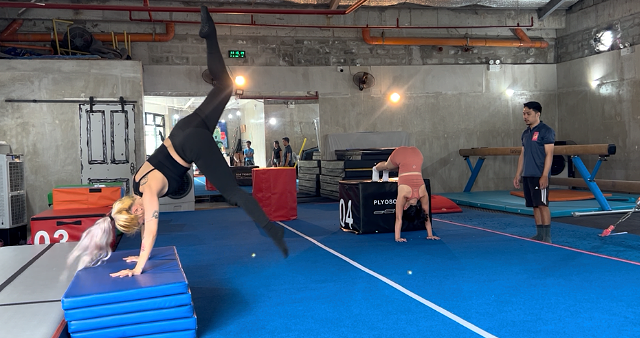
Oh, and don’t be tempted to skip the warm-up just to get to the fun part. Not that you're allowed to, anyway.
“You can't skip the warm-up. You have to wake up the muscles,” Coach Mike said, explaining that warming up helps prevent injuries.
Consistency gets you farther than starting ability
Just because you’re starting gymnastics later in life doesn’t mean you have to catch up with people who’ve been doing it since childhood. If you’re worried you’re too old, too stiff, or not strong enough yet, that’s not really the barrier. The point of the class is to build those things as you go.
“If you’re consistent, you can progress fast,” Dy said. She recommends attending classes two to three times a week, noting that some beginners may start noticing improvements in strength, flexibility, and everyday movement within a few weeks. “After three weeks, you’ll see results. Like in terms of strength, flexibility, and just being able to do things easily.”
Of course, how quickly you improve also depends on your starting fitness level.
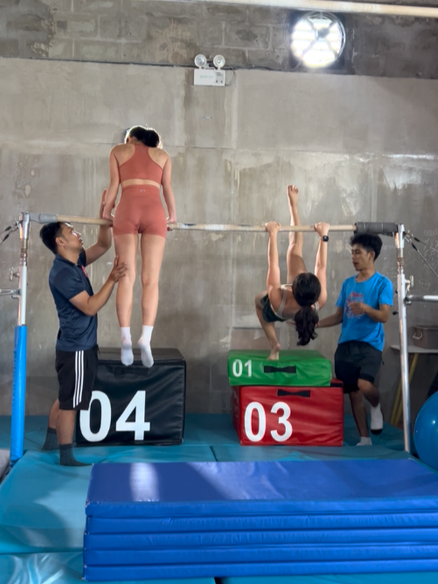
There's a catch, though: You have to keep at it. Dy shared that she can no longer do a handstand after taking a break from gymnastics: “When you stop, it stops.”
It's a good foundation for other sports
Gymnastics doesn’t just make you stronger. In one class, you’re also working on flexibility, mobility, endurance, coordination, and body control—which is why Dy calls it a more “holistic” workout. Jump drills build your legs and ankles, pull-ups and handstand work load your arms and shoulders, while rolls, bridges, and inverted positions force your core to stay switched on throughout the movement.
“It’s everything,” Dy says. She called gymnastics a good “basic sport” because the conditioning carries over to other activities, too. “Whatever sport you join after this, it’s going to be easy for you.”
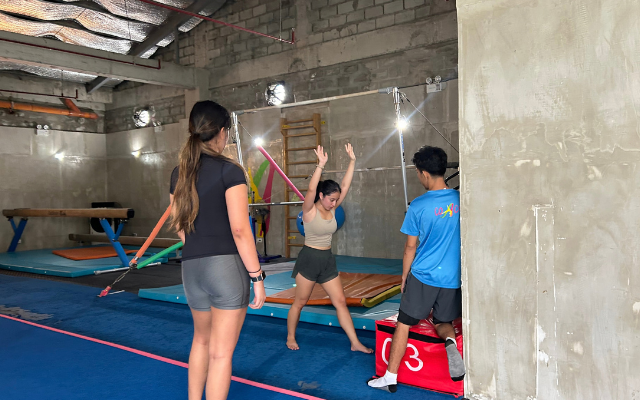
So while the obvious goal might be to finally get that cartwheel or handstand, you’re also building a pretty solid base for whatever you decide to try next.
Gymnastics facilities in Metro Manila
Athletica Gymnastics by SFCC
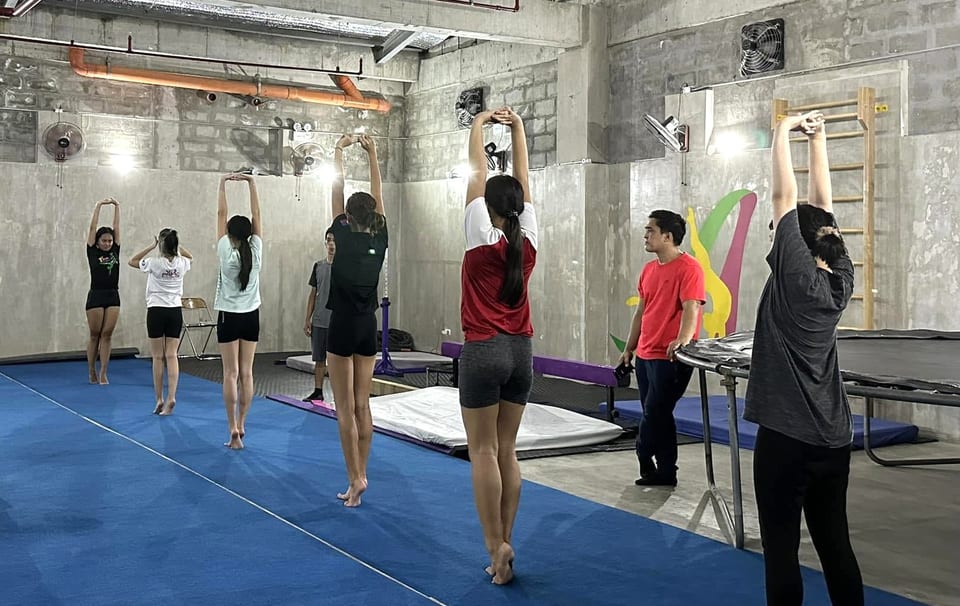
Branch: No. 70 Calle Industria, Bagumbayan, Quezon City
Schedule: Tuesday to Friday at 10:30 a.m. and Saturday at 5:20 p.m.
Rates: P250 for a trial class; P1,000 for a regular session
At Athletica Gymnastics, adults can sign up for dedicated beginner gymnastics classes even if they’ve never done the sport before. Classes start with conditioning before moving into beginner skills such as cartwheels, handstands, and pullovers on the bars, with coaches building up the strength and technique you need before progressing to harder movements.
If there’s one skill you particularly want to work on, Athletica also offers private classes, where the session can be focused more closely on your individual goal. That makes it a good option if you want the structure of a regular adult class first, then extra coaching once there’s a particular move you want to nail.
Also read: Try Your Hand at Gravity-Defying Jumps and Tumbles at This Adult Gymnastics Gym in QC
The Tumble Club
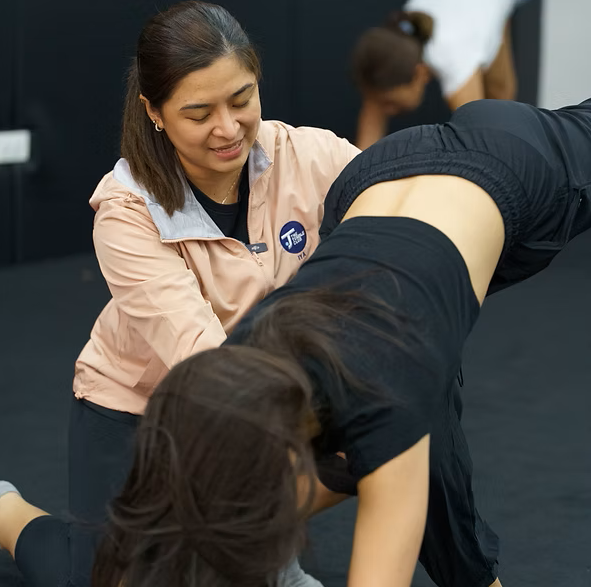
Branches: GF Daenerys Place, BF Homes, Parañaque City
Schedule: Monday to Wednesday from 6:00 p.m. to 7:15 p.m., Saturday from 3:00 p.m. to 4:15 p.m., and Sunday from 11:30 a.m. to 12:45 p.m.
Rates: P1,200 for a trial class/drop-in
The Tumble Club has branches in Greenhills and BF Homes, but its Adult Gym program is currently offered only at the BF Homes branch. Each 75-minute class combines what the studio describes as “dynamic exercises, targeted conditioning, and progressive strengthening.”
Adult classes are capped at a 1:8 coach-to-student ratio, so you still get room for individual corrections while working through beginner gymnastics drills and skills. For that reason, pre-booking is required.
Learn and Train Sports Academy
Branch: Units 2 and 3 V&O Building, Don Bosco Street, Makati City and 20 E. Maclang, San Juan City
Schedule: Wednesdays from 7:30 p.m. to 9:30 p.m. in Makati and Fridays from 5:30 p.m. to 7:30 p.m. in San Juan
Rates: P1,800 for walk-in but packages are also available
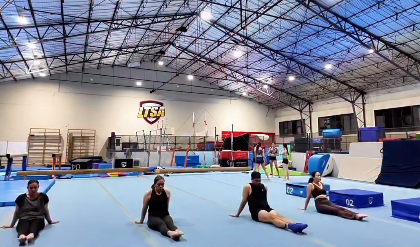
If you're interested in the apparatus side of gymnastics, Learn and Train Sports Academy (LTSA) offers the most traditional setup. Its facility is equipped for artistic gymnastics, so training can go beyond floor skills and tumbling as you progress.
That makes it the best fit if you want to understand gymnastics as an actual sport—not just learn a few recognizable tricks. You’re training in the same kind of environment built around apparatus work, technique, and structured skill progression.
Micah believes that writing is always political. Beyond the byline, you’ll find her bruising herself on a pole or doting on her beagle. Reach her at micah@spot.ph.