Unpacking How Carry Om Creates the Bags Taking Over Your Feed
Step inside the local bag brand's production lair.

Published on Nov 21, 2025
(SPOT.ph) Clouds of gray shroud the Makati skyline when we head out and venture to the Carry Om workshop. The mood a stark contrast to the vibrant and playful spirit of the fast-rising local brand we’re off to visit, and more in tune with Viktoria Salazar’s outfit of the day. The Carry Om co-founder is decked in an all-black ensemble of statement pieces in varying textures, looking like a vision as she descends the stairs. She’s all blinged out, too, nose-ring included. Her husband, Dhanvan Saulo, who functions as the brand’s Managing Director, announces Viktoria's arrival as if she isn’t dressed up to announce it herself.
But despite the “darkness” of her clothes, there’s nothing gloom and doom about Viktoria's presence. She’s the kind of personality who enters a room and charges it with her positive energy. It reminds us of the time she told DZMM's Winnie Cordero "Feel ko talaga, ako 'yung bida. Bidang-bida," in an interview with confidence oozing from every word.
.jpg?fit=cover&width=960&q=82)
There’s no mistaking she’s the source of the exuberance her Carry Om bags are known for. One look at her and you know she’s Queen of this lair, a home slash workshop wrapped in textiles of every shade. While rooms are sectioned to serve different purposes, the home parts and production parts bleed into each other, very much characteristic of spaces steeped in creative chaos. Yet it is here where Viktoria, Dhanvan, and their team find their rhythm and flow.
The beginnings
With its impressive quality and popularity, it’s hard to believe Carry Om is only nine months old. But its history actually goes way back. The brand’s roots can be traced all the way to the 1970s when bagmaker Yadu Saulo started Khumbmela Bags and his eponymous bag brand, Yadu.
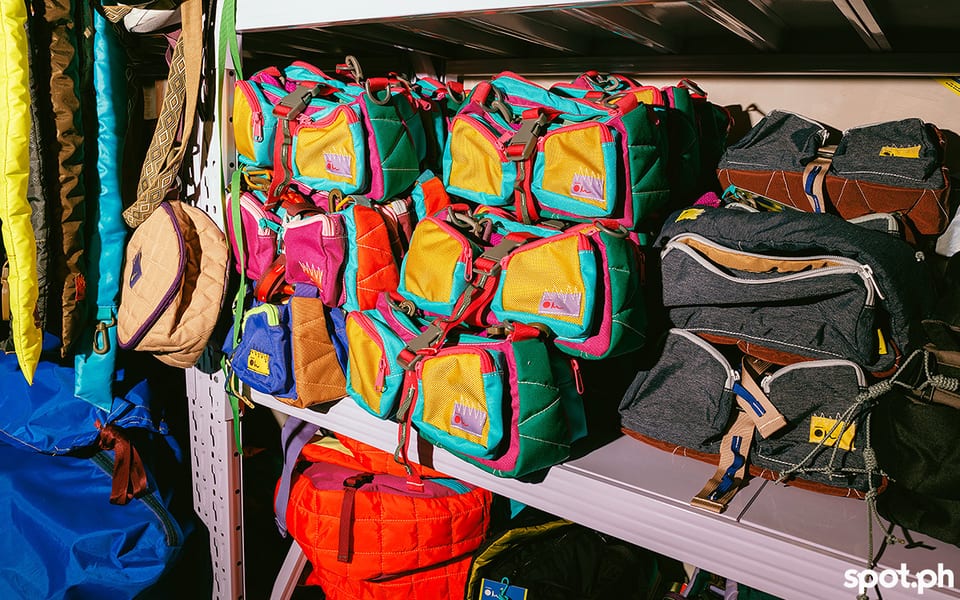
Marked by durability and—even in those early days—sustainability, Yadu’s bags were crafted with a patchwork design that used fabric from old clothes and tapestries. But the brand’s popularity sadly plummeted in the 2000s. Since its closure, it has struggled to find itself back in the bag business. Yadu’s son, Dhanvan, always had plans of reviving the brand.
It would take Dhanvan’s wife, and an illness, to make this happen. Viktoria faced the biggest challenge of her young life: She was diagnosed with Classical Hodgkin Lymphoma. With cancer treatment expenses mounting, her high school friends from Iloilo decided to help out.
“They made a fun run for me,” recalls Viktoria. So inspired by her friends’ gesture, and with a desire to create something that would express her gratitude, the industrial designer started making bags. When her friends insisted on buying them from her, that’s when she began to see the potential of making more.
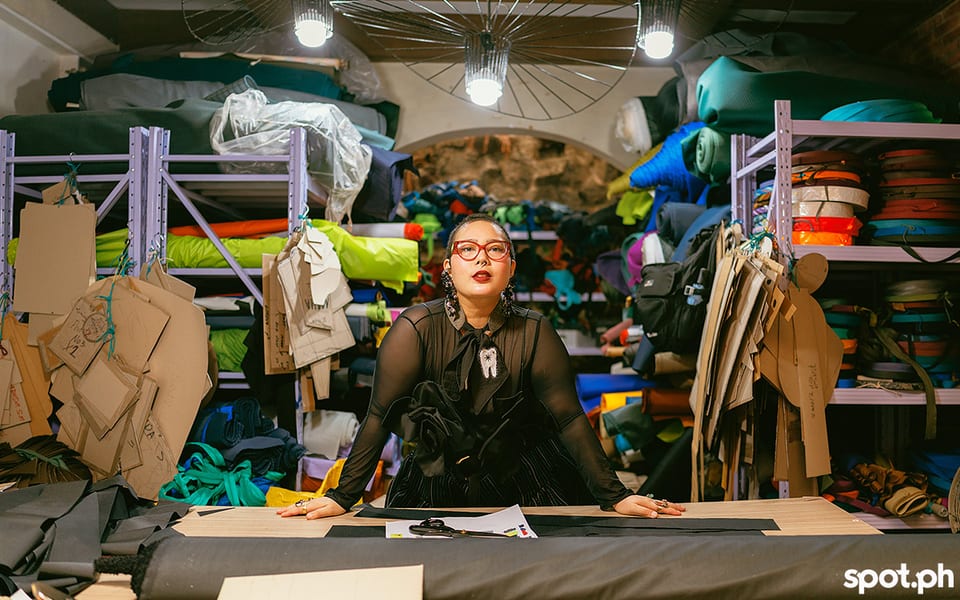
Today, Viktoria is a cancer survivor who looks back at that frightening episode of her life with tongue in cheek humor. When asked what pushed her to finally make the bags, she says “Desperation,” without missing a beat. Jokes aside, however, they did need the money to get through the hurdle but making the bags has become more than just a way to survive. Carry Om now stands as both a creative outlet and a way to fulfill a greater purpose in the local bag and fashion industry.
Viktoria summed it up perfectly in one of her social media posts for Carry Om: "I didn't mean to have a bag business....but cancer made me do it," she quips.
It wasn’t actually bags that Viktoria was set out to make—she knew nothing about bags, but high from the feedback of her friends and with access to to expert hands who knew bagmaking inside-out, it all just made perfect sense.
“The hands that made Khumbmela and Yadu before are the same hands making Om right now,” Viktoria proudly tells Spot.
In the beginning, the old guard meeting the new caused tensions to rise. Ideas clashed in creative battles where only one can emerge the winner. But Viktoria welcomed the challenges, embraced them, even. “Friction is growth,” she says resolutely, a smile gracing her face, happy that those tense days with bag master Yadu are over, and the bags born from their disputes now sit as backdrop to our shoot.
When asked what her favorite Carry Om silhouette is of late, Viktoria fondly points to the Gopi, saying that it was the design bagfather Yadu approved with little opposition.
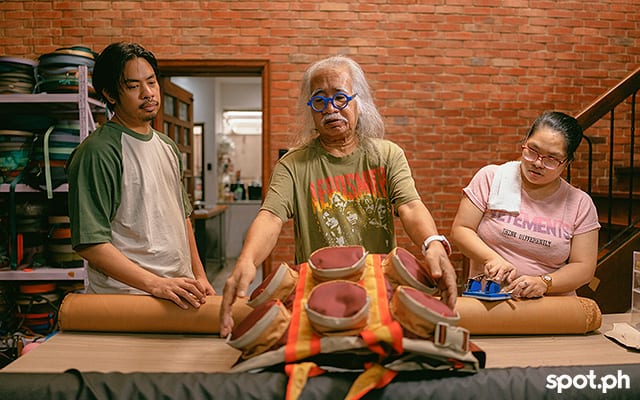
These days, arguments still take place at the workshop, but with each of them having their clear-cut roles, it just makes production a little easier. Dhanvan as Managing Director is concerned with sourcing materials. Viktoria as Creative Director sets the direction for how the bags look and how they’re worn on a body. Yadu, the Technical Director, with his decades of experience, makes Viktoria's visions come to life, translating her designs into the functional and sustainable bags we see on our feeds today.
A side conversation with Dhanvan perfectly sums up the group’s dynamic: If his father Yadu is form and Dhanvan himself is function, then Viktoria definitely brings in the funk. And really, don’t you need all three to stand out in a social media landscape that has all sorts of attractions vying for attention?
Viktoria knew she had magic in her hands. With bags so vibrant and well-made, it was only a matter of time before people took notice. Although she never predicted the kind of virality the bags would have and the love they would get from shoppers, she knew their team’s diligence, creativity, and vision would eventually have a moment in the spotlight.
“You can never have good design with bad quality. So we consider this good design not just because of how it looks, but because of [its] functionalities.”
Method to the madness
Spick-and-span workshops may look pleasing to the eye, but creatives would argue there’s little to trust in a place that feels too clinical and neat. Outsiders would be left befuddled by the “mess” at Carry Om but Viktoria and the team operate in this organized disarray with deft precision.
Deadstock fabrics are the heart of Carry Om’s designs. They never know what they’re going to get and how much, so Viktoria welcomes materials as they come, constantly brainstorming ways they can breathe new life into scraps. Once blueprints are ready, a piece is engineered and prototyped until it’s perfected. Only then can Carry Om’s staff–some of them seniors, most of them decades-long employees of Yadu–start production.
All their materials are sourced in the Philippines. “Because there are a lot of bag manufacturing companies here in the Philippines that are big. And with that mass production comes deadstock, comes retaso and that's what we get. Instead of them being thrown [to] the landfills, instead of [them] not being used for so many years tapos ma-eexpire lang siya and then wala,” says Viktoria.
Carry Om’s designs utilize paneled construction, so each item is basically a bunch of pieces coming together to create a bag. This means the body’s fabric is entirely different from that of the pocket. A pocket could use a green material for the front panel but have purple fabric for its sides, and finished with pink zippers for contrast. Smaller silhouettes warrant smaller cuts and patches, making cutting, sewing, and assembly quite the task.
Despite only starting production in February this year, “We have mastered it na rin naman to a tee,” adds Viktoria.

Clearly, the Carry Om team has developed a method to the madness, guided by masterful hands and decades of expertise. Viktoria has a cheat sheet for each colorway of every silhouette, detailing the cut, the fabric swatches, the color, and the construction. Since they deal with deadstock fabric, they have to catalog textiles as they come and Viktoria has a sheet that houses their corresponding codes. Cutters and sewers assemble the bags as instructed, and finishers handle details like edges, flaps, buckles, and straps. They have codes that will sound like a mystery to outsiders but keep everyone in the team on the same page.
Fighting for local in the global scene
Championing local and sustainable fashion has always been Carry Om’s north star. Sustainability is more than just upcycling materials and being stewards of the planet–it also means providing their team with living wages and honorable work that empower them to create. They do a pretty good job of that now, with a loyal customer base that sees the value in their bags.
“[The mananahis and cutters] are very important. Sinasali namin sila sa process. We’re very proud of them. They’ve been with us for years–from the start of Khumbmela. Right now, they’re seniors na! They’re the hands that make all of this possible,” says Viktoria.
While they empower their staff, they also want their Ommies–or what Viktoria calls Carry Om patrons–to feel a sense of pride when they’re wearing the bags.
“I want our customers to feel proud that this quality can be found in the Philippines, that we are capable of doing this,” Viktoria says. They are never underdressed when they have their Carry Om on. “What you're wearing, kahit naka-all black ka diyan, if you put this on you, you're a walking art piece.”
Carry Om to the future
Midway through the shoot, the original bagfather Yadu quietly makes an appearance, brandishing prototypes and bags yet to be released. We’re told that the samplng other manufacturers do in two weeks, he does in a just day or two. He’s been at it for almost 50 years, after all, and with every prototype he excitedly, proudly shows the Spot team, it looks like he can go on doing this for another 50 years.
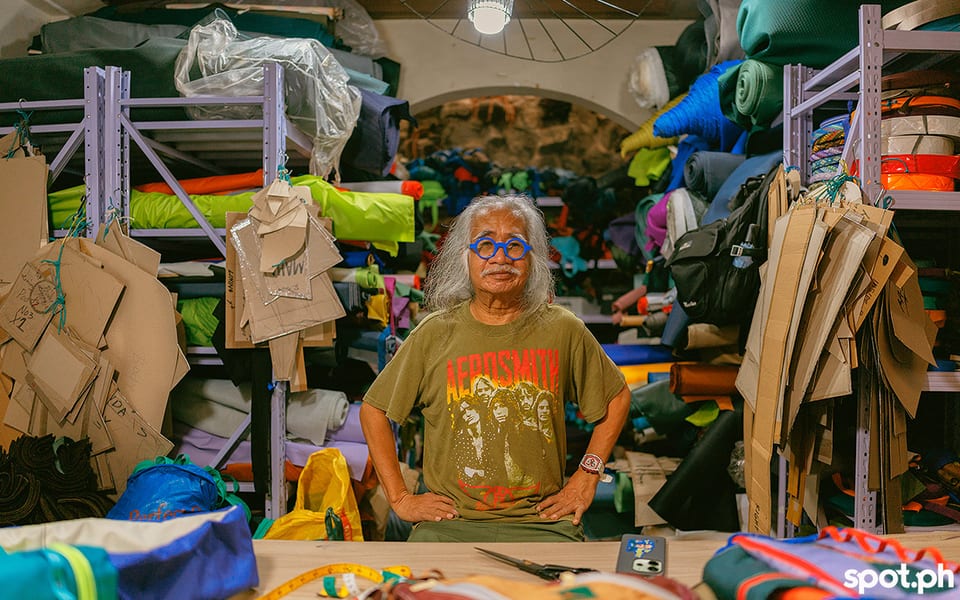
Despite being barely a year old, Carry Om has taken local bazaars by storm and has even won two awards from Arte Fino: Best Product Accessories for Fashion and the Modern Filipino Awardee. Recently, they launched a line of bags for kids–smaller in size but equipped with the necessary compartments for kids’ essentials. In the pipeline are accessories for pets–or Ompanions, as Viktoria likes to call furry friends. (Her own furry friend, Arya, named after the Game of Thrones character, trails her during the shoot). Beyond the production line, Carry Om hopes to be a reliable companion for Filipinos.
“Where do I find a colorful bag that's [of high] quality in the Philippines? It's Om. That's what we want people to think,” says Viktoria. “We want to be a household name, for those customers and for those people who want to find a funky bag they can literally use, not just pang-aesthetic lang.”
It’s hard to believe that a bag brand struggling to return in the 2010s now has buyers crossing their fingers that the colorway and silhouette of their dreams would still be available by the time the Carry Om bags get to the bazaar. But Viktoria’s survived cancer and transitioned to designing bags full-time. Dhanvan got the bag business up and running again, this time with family and the same team he grew up with. Yadu’s just brought out another unreleased bag silhouette we can’t buy yet. Nothing seems impossible. This team will “carry om.”
Words by Clara Rosales
Photographs by Jilson Tiu
Cover design by Warren Espejo
Videos by Jino Del MundoI
Also read:
Inside Muradito, Quezon City's Secret Wonderland of Plates
How Atom Araullo Tells The Stories of Our Time
Clara is fond of dissecting song lyrics and finding out how films are made. She also likes astrology, green tea, and dogs.