What's New
Applying for a U.S. Visa? You Have to Set Your Social Media to Public
New rule only applies to certain visa types.
Published on Jun 24, 2025
(SPOT.ph) Applying for a U.S. visa
is expensive, so you’ll want to do everything you can to have it approved. That
includes checking your social media before submitting that application—because the embassy will, too.
The U.S. Embassy in the
Philippines has just announced that visa applicants for the F, M, or J non-immigrant visas are now “requested”—but
really, it’s more required—to set their social media accounts to public,
effective immediately.
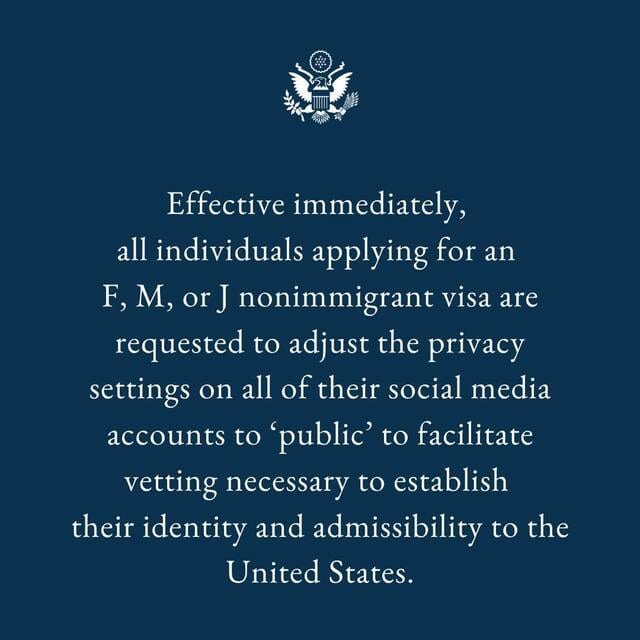
Click to Enlarge
Photo from Facebook/U.S. Embassy in the Philippines.
Consular officials have reportedly been instructed to search for "any indications of hostility toward the citizens, culture, government, institutions, or founding principles of the United States.”
“We use all available information in our visa screening and vetting to identify visa applicants who are inadmissible to the United States, including those who pose a threat to U.S. national security,” the U.S. Embassy in the Philippines said in a statement.
What are F, M, and J categories for U.S. visas?
Tourists are marked safe from this
new rule as the visa categories only apply to students and exchange program
participants:
F visa: For international
students pursuing academic programs at accredited U.S. institutions, including
universities and language schools. M visa: For students attending vocational or
technical training programs. J visa: For exchange visitors, including researchers,
scholars, interns, au pairs, and other cultural or educational program
participants.
Together, these categories account
for over one million international students and exchange participants in the
United States every year. The new policy applies globally to all nationalities—not
just Filipinos.
It's the latest development in the
U.S. government’s push to tighten visa screening under Donald Trump's presidency, but it isn’t exactly new.
Since 2019, all visa applicants have been required to provide social
media handles as part of the standard application process. What’s changed now
is that consular officers must be able to view your content—hence the requirement for a public profile.
Last May, the U.S. State
Department suspended all F, M, and J visa appointments, resulting in delays for
international students enrolling at Harvard and other universities. The visa appointments were only
resumed after this new vetting procedure was implemented in June.
It remains unclear whether failure
to comply with the request to set profiles to public will result in application delays or
denials, but honestly, who would want to risk finding that out?
Micah believes that writing is always political. Beyond the byline, you’ll find her bruising herself in a pole studio or napping with her beagle. Reach her at micah@spot.ph.
You Might Also Like