It's Clear 'Hawak Mo Ang Beat' Is a Viral Hit, But Who Made It?
Many are convinced it's AI-generated.
Published on Mar 26, 2026
(SPOT.ph) There’s no denying it: “Hawak Mo Ang Beat” is everywhere. It’s on Facebook Reels, blasting from jeepneys, popping up in noontime show segments, and soundtracking Zumba tutorials on YouTube. But for a song this viral, one basic detail remains oddly hard to pin down: Who actually made it?
We asked friends from the music biz, even a music channel executive, but it seems they're as clueless as we are. We sent the question to folks at Spotify but have not heard back. However, a quick search on the popular music streaming app points to OPM Music Studio, which appears to have the earliest upload of the song in 2025. The account has around 350,000 monthly listeners on Spotify, but beyond that, the page does little to clarify if there are real people behind the track. So internet users took it upon themselves to investigate. That is when the AI talk began to grow—and for many, the cover art was the most obvious place to start.
It's not hard to see why people might think the cover art for “Hawak Mo Ang Beat” is AI-generated: the text on the DJ booth is gibberish, the crowd looks artificial, the colors are hyper-saturated. On the OPM Music Studio page are other songs like “Sayaw Hanggang Umaga” and “Sumabay Ka Sa Beat,” which have the same AI-like visual tells. It doesn't mean, of course, that if the visuals look AI, then the song was created by AI, too—but it sure doesn't help convince people otherwise.

OPM Music Studio is not the only name linked to the song on Spotify. There's also a DJ Mogo, who has several collaborations of “Hawak Mo Ang Beat” under his name—the DJ Danzuy remix, DJ FUGA remix, and DJ Jahyson remix—all released in 2026. Like OPM Music Studio, DJ Mogo’s cover visuals also carry an unmistakably AI look, except his has a cool cat in aviator sunglasses taking over the DJ's booth.
The supposed original artist behind "Hawak Mo Ang Beat"
Unlike the vague trail left by OPM Music Studio, however, DJ Mogo appears to have an actual person behind the name. Online, some users have identified him as Sylvain Hernandez, a French national based in Tacloban. He was later featured on Kapuso Mo, Jessica Soho (KMJS), where he spoke about how “Hawak Mo Ang Beat” came together.
“I had those notes in my mind, from the cha-cha of Leyte until the very heavy drums of the Budots style. Here came ‘Hawak Mo Ang Beat.’ I wanted to create something musical but not heavy,” Hernandez said on the popular GMA News program.
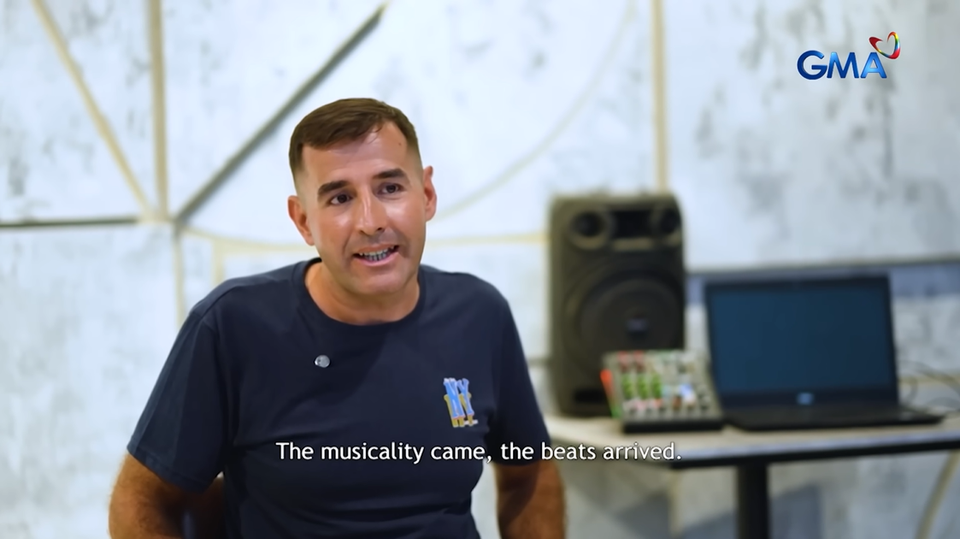
Hernandez said the song did not begin in Filipino. At first, he was still struggling with the language, so the track started out in French. It only began to take its final form with the help of his Filipina wife: “The musicality came, the beats arrived. The words arrived.” He said he used some very "high-standard software" which helped him "create the beat." Is it him singing? he asks in the interview. The answer: "Well, for now the secret will stay a secret."
Despite Hernandez's claim to "Hawak Mo Ang Beat," there are still those who believe it's created by artificial intelligence. In the same KMJS segment, music producer Gian Vergel tagged the track as clearly made with AI, as did other local outlets like DZRH and Sunstar. DZRH wrote: “The voice behind the viral hit was created using AI technology, crafted by sampling a pleasing vocal tone and transforming it into a full-fledged song. That’s why the singer can’t be identified—because there isn’t one in the traditional sense.”
It’s a claim Hernandez denies.
“It’s not AI at all. Because this song, I did it in a very, very simple way to reflect the feelings I have.”
Another thing that is unclear about all this: if DJ Mogo claims to have penned and produced the track, it doesn't explain why OPM Music Studio was the first to upload the song in 2025, at least on Spotify. All of DJ Mogo's "Hawak Mo Ang Beat" remixes came out later in 2026—around the same time he started uploading content on his Facebook and YouTube pages. SPOT.ph has reached out to Hernandez to clarify the song’s release timeline, his role in its creation, and whether any AI tools were used at any stage of production, but we have yet to receive a response.
UPDATE: Hernandez reached out to Spot on Monday, March 30, via email to issue this clarification: "I hold the earliest verifiable upload date for the original track. The release date on other accounts is a metadata entry and does not reflect when the file was actually created or made public." Sylvain told Spot he has the digital timestamps and project files to prove this, which he would show us later that day during an online exchange over Google Meet. In his email, he said that there "appears to be a misunderstanding of the platforms data; there is a confusion between the 'declared' release date shown on Spotify and the actual, verifiable upload date."
A global problem for music
This is where this story stops being just about one catchy, confusing viral hit. If anything, the Philippines is arriving late to a conversation that’s already been happening elsewhere.
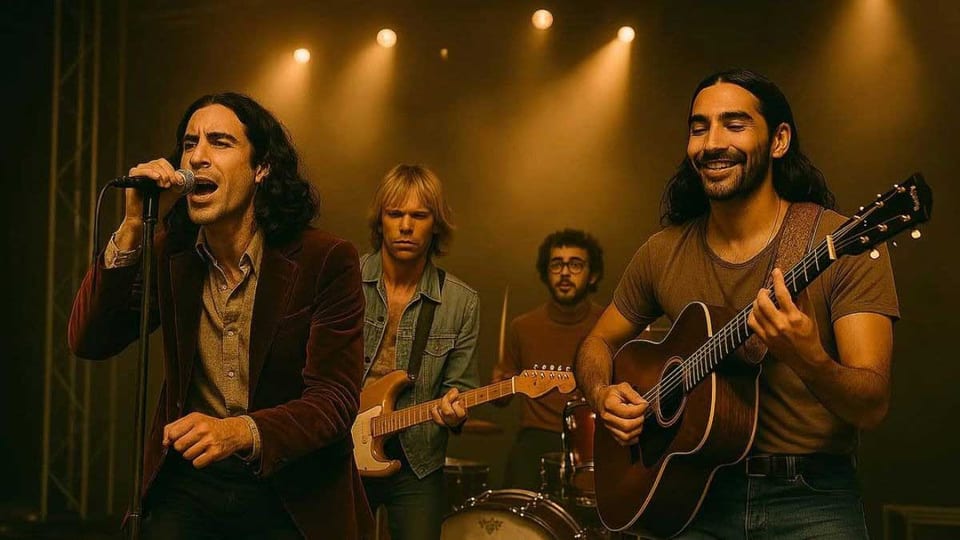
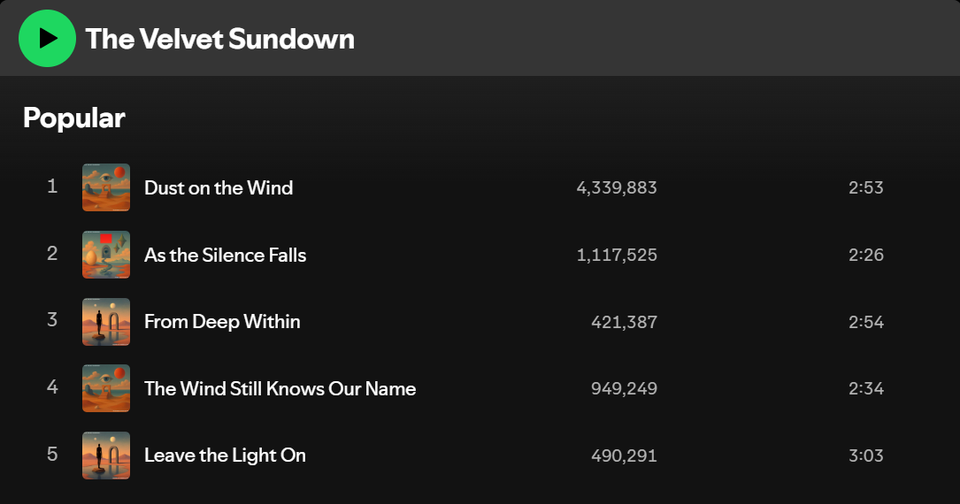
Earlier in 2025, a psych-rock act called The Velvet Sundown started showing up on Discover Weekly playlists. At first glance, the group's picture made them look like any other brooding band: four shaggy-haired guys on stage, each posed with their own instrument. The image is small enough that the illusion mostly holds until you click on it. It becomes clear these guys aren’t real guys after all.
The Velvet Sundown ended up releasing three full albums in 2025 before admitting that everything—the music, the images, even its backstory—had been created with AI. On its profile, the band is now more transparent, describing itself as “Not quite human. Not quite machine. The Velvet Sundown lives somewhere in between.”
It didn't take long for users to accuse Spotify of allegedly pushing AI-generated music on the platform through discovery tools like Discover Weekly and Release Radar, where recommendations can turn into streams, and streams into money.
It’s not just The Velvet Sundown, either. By November 2025, The Guardian reported that three AI-generated songs from different “artists” topped the music charts that week. Streaming app Deezer also estimated that 50,000 AI-generated songs are uploaded to its platform every day, making up roughly 34% of all submitted music. As more of these tracks slip into the mainstream, calls have grown for music streaming platforms to be more upfront about what is AI-generated.
It’s worth noting that AI-generated songs are not illegal in themselves, but they do open a messy ethical can of worms. For starters, consider how the AI was trained in the first place. Most music-generating AI systems don’t learn in a vacuum. Even if the final output does not directly copy a particular song or artist, they’re trained on massive datasets that can include existing songs, recordings, and vocals scraped from across the internet. A lot of that material is copyrighted, and in many cases, artists were never asked for permission or paid for its use.
While humans are getting better at detecting text from generative AI—cue ChatGPT’s love for the em dash, rule of threes, ‘it’s not X, it’s Y,' and other tells that real writers hesitate to use now—AI music is proving much harder to catch. The same study by Deezer found that 97% of listeners failed to identify an AI-generated track when it was played to them. This is not all that surprising: we’re experiencing a relatively new shift where listeners are dealing with something past generations never had to second guess.
The issue is no longer just whether Hernandez used AI. It’s how that question now surfaces when a song feels just a little too artificial or too hard to trace back to a real person. AI is already so woven into so much of how people work, make, edit, and publish. Music was never going to be exempt.
But the fact that we’re questioning it at all says something—it means we’re still paying attention. We still want to know who—or what—is behind the beat. And for now, that instinct to ask might matter more than having all the answers.
Also read: How the Black Eyed Peas Came Up With "Bebot"
Micah believes that writing is always political. Beyond the byline, you’ll find her bruising herself on a pole or doting on her beagle. Reach her at micah@spot.ph.