What's New
Faces Behind the Plates: These Chefs Are Serving Manila’s Stellar New Secret Dishes
Behind the Secret Menu’s exciting lineup of plates are these local talents.

Published on Jun 22, 2025
(SPOT.ph) The life force of any restaurant is its people—particularly its chefs, whose visionary minds, skilled hands, and nuanced taste buds come together to produce dishes that linger long in our minds after the last bite. The third edition of the Secret Menu by SPOT.ph and Esquire Philippines along with UnionBank features an especially star-studded cast of chefs. You’ve most likely seen and tried their usual bestsellers; now you get to to sample their sublime off-menu specials made especially for Secret Menu. But first, it's time you meet the faces that brought these once-just-delicious-ideas to life.

Click to Enlarge
Meet the chefs behind Secret Menu's sublime lineup of dishes. Photos by Hans Fausto, cover design by Warren Espejo.
Meet the chefs of the third leg of Secret Menu by SPOT.ph, Esquire Philippines, and UnionBank
Chef Jonathan Redoblado of a mano

Click to Enlarge
a mano's Chef Jonathan Redoblado. Photo by Hans Fausto.
Whipping up plates conveying Italy’s simple but nuanced flavors is no easy task, but it’s a task Chef Jonathan Redoblado embraces and succeeds in doing on the daily. After graduating with a BS-HRIM culinary arts degree at De La Salle-College of Saint Benilde, Redoblado spent more than a decade in Singapore working at the kitchens of Californian-Italian establishment Osteria Mozza (where he stayed 10 years, working under Chef Nancy Silverton), and Daniel Boulud’s db Bistro & Oyster Bar, both located at Marina Bay Sands at the time. Returning to the Philippines, these experiences were put to (very) good use as he landed a stint at Amado Forés’ much admired Italian spot a mano, where Redoblado is now head chef.
For Secret Menu, Redoblado helped bring to life a dish Amado envisioned, a tribute to his mother: the late, great Chef Margarita Forés. “On my mom’s last trip, she brought home a whole leg of jamón for me,” Amado tells SPOT.ph. “I wanted to make something in memory of that moment—and since she loved the jamón from Txanton, using it on a pizza felt perfect. I wanted it to feel like pan con tomate with jamón—but in pizza form.”

Click to Enlarge
a mano's Jamón Ibérico Pizza. Photo by Hans Fausto.
Nailing the Spanish flavor profile was initially a challenge, Redoblado admits: “It took me at least two weeks of testing the dish, trying new products.” After multiple tastings with the team, they decided on their final combo, using a mano’s white pizza base as a canvas over which they layer a zippy tomato salsa (a refreshing alternative to the typical cooked-down marinara); rich, silky jamón Ibérico de Bellota; lush and creamy Latteria Sorrentina Fior di Latte; fontina cheese; and peppery arugula. A drizzle of good, fruity olive oil seals the deal.
Each lush bite evokes the zest and enchantment of Mediterranean summers—just as the a mano men had intended. “What we would like the guests to feel is, [as if they’re] being transported to Spain by way of Italy," says Redoblado, "which is the pizza, right here in the Philippines."
Chefs Arlo Gregorio and Stephan Duhesme of Automat

Click to Enlarge
Automat's chefs Arlo Gregorio and Stephan Duhesme. Photo by Hans Fausto.
Chef Stephan Duhesme’s celebrated restaurant Metiz (sibling of Automat—more on that shortly) famously made it to the 48th spot on the 2023 list of Asia's 50 Best Restaurants—the only other Manila entry aside from Toyo Eatery in the top 50 that year. It’s a feat well worth celebrating, especially considering the restaurant only opened in 2019.
Duhesme has definitely come a long way from his early days, when he'd spend summers at ages 17 and 18 working part-time—as a waiter at a brasserie in Paris, and as a dishwasher at a brewery in Sanary Sur Mer. But things weren’t always smooth sailing for the French-Filipino chef. At 18, he applied for renowned cooking school École Grégoire-Ferrandi in Paris, but was rejected. “[I] don’t think they liked my proposed three-course menu that featured Filipino dishes,” he says with a laugh. Instead, he entered the Kedge Business School in Marseille. “I wanted to work in Paris after Kedge, and applied at restaurants for entry level management work and such but without a degree related to hospitality or cooking, my CV’s were completely ignored,” he says.
With that, Duhesme decided to fly to New York to gain experience, and landed a stint at Amy Besa and Romy Dorotan’s Purple Yam in Brooklyn. He further honed his skills at Matsunozushi in Tokyo; and Gallery by Chele and the now-closed Arrozeria in Manila. The chef also stayed three years in Bogota, Colombia, opening his first restaurant in 2015, dubbed Tria Neo Bistro (now closed). At Metiz, his first restaurant in Manila, Duhesme and the team take on Filipino cuisine with modern-day sensibilities, giving local ingredients—in particular, fresh produce from farmers who are mindful of sustainability—the spotlight it deserves.
Among Metiz’s early fans was Chef Arlo Gregorio, who worked his way from being an intern in 2021 to becoming the restaurant's current head chef. “I remember that in 2019, I ate at Metiz when they newly opened. And then I remember thinking to myself, for some strange reason, I knew I was going to end up here,” Gregorio shares. “A lot of the things that they do, until now, align with what I think food should be. A lot of [our] philosophies align.” There was no job vacancy at Metiz at that time but Duhesme presented Gregorio the option to apply as an intern. After five months of hard work, the young man was hired full-time.
Whereas most parents might encourage their kids to take up a more traditional (i.e., one that easily promises to be stable and income-generating) course in college, Gregorio’s mom was the cool opposite. “She was the one who told me, Arlo, I think you're going to die in an office job. Go to the culinary jobs,” Gregorio says with a laugh. And so he finished a culinary degree at Enderun and flew to Europe after graduating, interning at 108 in Copenhagen and Gastrologik in Stockholm. In the Philippines, he got to intern at Mecha Uma for three months. He was meaning to fly to the United States for a supposed gig when the pandemic hit. While practicing social-distancing at home, he got into making sourdough in his home kitchen. He took the opportunity to apply at Metiz when the opportunity arrived, and now we see his cooking shine bright as head chef of its sibling restaurant Automat which opened in 2024.

Click to Enlarge
Automat's ScallopJoy. Photo by Hans Fausto.
Automat spotlights the tastes that define the modern Manileño’s diet, which is distinctly Filipino while maintaining an openness to outside influences. The dining spot’s defining touch, however, is in how they make these modern-day dishes their own, often by going irreverent in their flavor combos and incorporating made-from-scratch elements like their house ferments.
Their Secret Menu dish, the cheekily named ScallopJoy, puts this into practice. The inspiration? Fried chicken—a dish of foreign origin that’s dearly loved by Filipinos, so much so that we have distinctly Filipino styles and ways of enjoying it. Instead of poultry, Automat uses Japanese scallops cured in kombu for subtle umami, then they're given a tempura batter with fried chicken seasoning and are deep-fried to a crisp. Each nugget is sliced and served over Sinapon rice from Kalinga, which gets a lush umami hit from fermented cucumbers and butter sauce with tuyo. In true Filipino fashion, the dish comes to completion with sauces (two, in fact!): creamy mentaiko-spiked mayonnaise, and good ol’ chicken gravy.
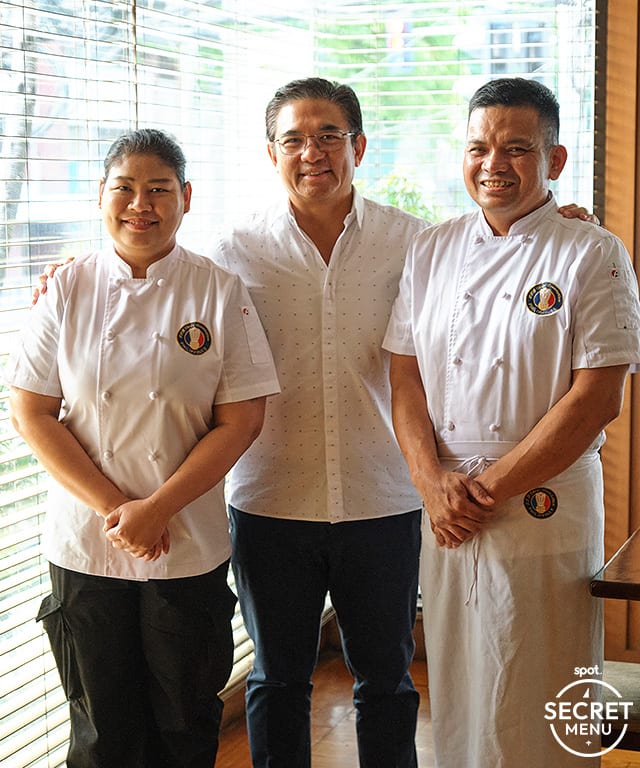
Chef Kanjana Kosidaphan of Azuthai
Click to Enlarge
Azuthai's chefs Kanjana Kosidaphan, Jay Gamboa, and Sherwin Estrella. Photo by Hans Fausto.
From Bangkok, Chef Kanjana Kosidaphan brings her expertise on the cuisine of her homeland to the Philippines via the Pasay Road classic Azuthai. She’s loved food and cooking from a young age, she tells us, and has worked for top hotels and restaurants in Thailand— at the Hilton International Bangkok, as a Commis III chef; at The Color Living Hotel, as a Comis I chef; at Kanom Chin Bangkok Restaurant, as a Commis II chef; at The Metropolitan Bangkok Hotel; and Michelin-listed Sra Bua by Kiin Kiin at the Siam Kempinski Hotel, as Chef de Partie. Prior to joining Azuthai, she also worked with Bangkok Air’s and Emirates Airline's (Dubai) catering legs.

Click to Enlarge
Azuthai's Kew Tod. Photo by Hans Fausto.

Click to Enlarge
Azuthai's Tom Yum Salmon. Photo by Hans Fausto.
Though Azuthai already has the staple Thai shrimp cakes on their regular menu, they got the idea to fuse it with the Pinoy's own crispy fried lumpia—thus giving birth to their Secret Menu entry, the Kew Tod. Here, a mixture of pork and shrimp fills giant wontons in half-moon forms—like a flat Ilocos empanada but with the crackly crispness of fried lumpia wrappers. Do give it a dip into the sweet and spicy sauce served on the side, and go to town with it. Also exclusive to the Secret Menu is the rainy-day appropriate Tom Yum Salmon, where chunks of imported salmon join a hot and sour broth perfumed with tomatoes, mushrooms, lemongrass, kaffir lime leaves, and fresh coriander.
Chef Albert Mendoza of Bar Pintxos

Click to Enlarge
Bar Pintxos' Chef Albert Mendoza. Photo by Hans Fausto.
“The reason I love Spanish cuisine is because it reminds me of simplicity at a certain point in life,” says Albert Mendoza, corporate chef and general manager of Bar Pintxos, which is part of the Gruppo Pintxos restaurant group. “I like the simplicity and complexity of Spanish cuisine, and I think there's a certain parallel between [that and] Japanese cuisine—because they both want to highlight the integrity of the product.”
Mendoza, whose resume includes stints at Gallery Vask, Gourmet Farms, and PRINT. Restaurant in New York, originally joined the Pintxos group in 2019 doing R&D; now he works as the group’s executive chef. At Bar Pintxos, Mendoza and the team highlight Basque cuisine and other dishes from around Spain.

Click to Enlarge
Bar Pintxos' Pintxo Platter. Photo by Hans Fausto.
As the name implies, the star of the menu are the pintxos—small snack-slash-appetizers popular in northern Spain, generally made up of a combo of proteins, veg, sauces, and other ingredients layered over slices of crusty bread, like a two-bite open sandwich of sorts. Bar Pintxos has got a number of pintxo variations on the lineup, and if you play your cards right, you can try more variants for less with their Secret Menu-exclusive Pintxo Platter. Priced at P910, the platter lets you try any three pintxos on the menu (with the exception of the Foie Gras, which would cost you an additional P250)—from the famous Jamon-Allioli, to the garlicky Chorizo y Huevos, to the savory-sweet Regatta (with goats’ cheese, tomato jam, caramelized onions, and jamon serrano), to the earthy-briny Escalavida (with roasted veg and an anchovy-balsamic reduction), to the creamy Txangurro Allioli (with crab meat and aioli) and more.

Click to Enlarge
Bar Pintxos' Canelone con Rabo de Toro. Photo by Hans Fausto.
Mendoza channels comfort in their second Secret Menu special: the Canelone con Rabo de Toro, a dish that was on their menu in 2023 and now is making its mighty comeback. “It’s a very classic, traditional Spanish pasta [dish] that normally a Spanish grandma would make,” says Chef Albert. “We're just happy enough that we have our own version of it, and I think it's quite amazing.” Here, al-dente cylinders of canelone pasta are stuffed with shredded braised oxtail, cooked for some 20 hours for supreme tenderness. After adding smoke oil, manchego cheese, and piparras pepper; it's off to the oven for baking. With the melt-in-the-mouth beef; the sharp, gooey melted cheese; the piquant pepper; and the deeply flavorful sauce, the resulting dish is just delicious stick-to-your-ribs stuff.
Chef Kier Ibañez of Bibio Wine Bar

Click to Enlarge
Bibio's Chef Kier Ibañez. Photo by Hans Fausto.
Bibio is among the spots focusing on natural wine in Manila, but they’ve got solid food game as well, and they welcome guest chefs into their kitchen from time to time. Initially a guest chef and now their Chef-in-Residence is Kier Ibañez of The Long Table, a pop-up venture based in New Zealand which visited our part of the globe in May.
Ibañez, whose dad hails from Negros, grew up in Cebu and moved to Oakland at 21. He specializes in what he calls Westernized Filipino cuisine: “So it's like a take on Western food, but the flavor is very Filipino. Kasi I think food represents who you are as a person. And I think that your food is like a reflection of who you are. So this is me learning Western food in New Zealand.” (In particular, we see Ibañez’ New Zealander side in his use of seasonal products when creating dishes.) “And then again, I’m sticking to my roots where I'm Filipino,” he tells us. “When I cook, it has to be a balance… it has to be sabroso. It's very Filipino, like [it’s] tasty.”

Click to Enlarge
Bibio's Octopus Ragu. Photo by Hans Fausto.
The starting point for his Secret Menu dish of Octopus Ragu? “There was like a phase when everyone was using octopus,” Ibañez explains. Many chefs would usually just use the tentacles and throw out the head, but in the name of sustainability, Ibañez had the idea of using the latter to make a deeply flavorful ragu, which coats al-dente strands of spaghetti noodles. The pasta is then topped with fried chunks of the octopus; crisped bits of longganisa for a meaty, garlicky hit; and a smattering of fresh herbs. It’s designed to be had with drinks, of which Bibio obviously has plenty of options. Asked for a reco, Ibañez endorses one of their orange (skin-contact) natural wines, or a Negroni.
Chef Rowen Amurao of Casuals

Click to Enlarge
Casuals' Chef Rowen Amurao. Photo by Hans Fausto.
Semi-hidden on the second floor of Oakridge Building in Paseo de Magallanes is a relative newcomer in the local dining scene, Casuals. The place opened just this year but is absolutely one to watch, in large part because it’s helmed by rising star Chef Rowen Amurao. The young Amurao has been cooking for 12 years now, and though he was initially urged to follow his dad’s footsteps and go the engineering route, he knew it wouldn't be right as math wasn’t his strong suit. Instead, he chose the culinary path, taking up Culinary Arts at DLS-CSB and heading to the U.S. for internships at The Farm at Canyons Village, Utah, and Grand Hotel in Michigan.
In the Philippines, Amurao also got to work for Argentinian steak house La Cabrera, but it was in Australia that he felt he truly found his “passion for cooking.” He spent seven years there, working at Hawker Hall in Windsor, a food court inspired by the hawker centers of Singapore and Malaysia; and Chin Chin in Sydney, which serves Southeast Asian fare with Aussie sensibilities.

Click to Enlarge
Casuals Dining's King Fish Collar. Photo by Hans Fausto.
For Secret Menu, Amurao says he wanted to “recreate the flavors” associated with his time working at the said Asian spots Down Under (Hawker Hall, in particular)—hence the birth of his Thai-inspired King Fish Collar. Fish collar, of course, boasts a supreme tenderness that makes it easily yield from the bone. Casuals seasons it just enough to enhance the natural taste of the fish, then roasts it in the oven and gives it a blitz with the kitchen torch for added smokiness. It’s served alongside a trio of accompaniments with Thai flavor profiles: a zesty green sauce made of green bell peppers, parsley, coriander, and garlic; prik nam pla, a seasoned condiment with Thai fish sauce; and a zippy papaya salad you can turn to in between forkfuls of the fish collar.
Chef Ronnie Zuniega of Cosmic

Click to Enlarge
Cosmic's Chef Ronnie Zuniega. Photo by Hans Fausto.
Chef Ronnie Zuniega has been cooking professionally for eight years but embraced a new challenge upon entering Cosmic. It was the first vegan restaurant on his resume, and where he had to find ways of veganizing Filipino favorites without having them lose their Filipino soul. “I [had to] totally adapt the Filipino cuisine… kahit hindi tayo gumamit ng animals,” he says. He turns to plant-based proteins, like soy and gluten, to replace the typical pork, beef, or chicken, employing tricks like freezing then defrosting tofu (which drains out more water) to get a meatier texture. Cosmic also makes its own vegan bagoong with soy beans for natural umami.

Click to Enlarge
Cosmic's Vegan Dinakdakan. Photo by Hans Fausto.
Cosmic’s regular menu is already full of gems that are hits with vegans and non-vegans alike, but the Secret Menu exclusive Vegan Dinakdakan isn’t to be missed. They nail the texture of the original with a mix of soy mock meat (which has charred, smoky edges and a meat-like fibrousness); mushrooms for chewiness; sliced green chili for a vegetal note and mild heat; red onions for a crisp, zingy contrast; and fried tofu.
Chef Rafael Lopez of Grace Park

Click to Enlarge
Grace Park's Chef Rafael Lopez. Photo by Hans Fausto.
As with many great cooks, Chef Rafael Lopez’s love for food was a love he got from his family. His grandma would cook for them every time they’d visit her in the province, but back in Manila, he had to cook for himself as his mom was busy with work. That, coupled with the fact that he often bonded with his mom by watching cooking shows together—Del Monte Kitchenomics, the shows of Sandy Daza and Heny Sison, and so on—gave him an appreciation of the cooking process. “Here [in Manila], [the] attachment I have is the necessity… that you have to cook for yourself.”
Initially wanting an engineering degree, Lopez switched gears two years in and shifted to a hospitality course. Afterwards, he did on-the-job training at hotels in Boracay and Siargao. In the latter, he was taken in at Nay Palad , working with Chef Marc Silvestre (now Executive Chef of Dr. Wine). “[Working there] really pushed me to be more organized,” he shares. “They really pushed me… from then on I started really becoming passionate about cooking.” While in Boracay, he met Chef Jorge Mendez, who ended up connecting him to Chef Margarita Forés. Lopez joined the Forés restaurant Grace Park in 2024. He started to work with Margarita around November, joining the late chef’s team for her highly anticipated collaboration with Chef Miko Calo at Makati Shangri-La in December.

Click to Enlarge
Grace Park's Rib-Eye Bistek Tagalog. Photo by Hans Fausto.
The Secret Menu-exclusive Rib-Eye Bistek Tagalog at Grace Park is a love letter to a well-loved, home-cooked Filipino dish. “Kasi... bistek is one of the substantial dishes [and viands] that we always have. I'm sure ‘pag nagse-set ‘yung mga nanay natin ng menu for the week, it's always part of [the lineup]. So, it's kind of reminiscent of our childhood as well.” It was, after all, always Margarita's goal to uphold Filipino traditions. Grace Park's take uses a richer cut of high-quality beef—Australian rib eye— that they marinade (enough to infuse it with flavor, but not too long it leaves the meat tough!), then grill for a good char and braise low and slow in a bistek-style sauce, rendering the meat tender as heck. True to the home-style version of the dish, it’s served with rice (steak rice, in this case) and a condiment of caramelized onions that you can turn to for balance.
Chef Gerwin Jurok of Green Bar

Click to Enlarge
Green Bar's Chef Gerwin Jurok. Photo by Hans Fausto.
In the earlier days of his cooking career, Green Bar’s Chef Gerwin Jurok was working the kitchens at top hotels and fine-dining restaurants: Resorts World Manila, Wolfgang’s Steakhouse, Conrad Manila. This solidified his cooking foundation, he shares, teaching him the discipline that could only come from strict systems and high standards. Joining Green Bar three years ago challenged him in a way he hadn’t felt before: “Noong pagpasok ko dito, nanibago ako kasi ‘yung environment, ‘yung kusina, walang meat, walang dairy products.” It was a challenge Jurok embraced, which has well paid off. To this day, Green Bar has a solid following for their vegan takes on typically carnivorous dishes, particularly from the West—burgers, burritos, and so on.

Click to Enlarge
Green Bar's Hoi An Chickun Rice. Photo by Hans Fausto.
The restaurant goes for a lighter, more refreshing Vietnamese profile in their Secret Menu special: the Hoi An Chickun Rice, a revised version of an old dish they used to serve, inspired by Vietnamese Hoi An chicken rice (cam ga hoi an). Unripe jackfruit, when cooked down, delivers a fibrous texture similar to pulled pork, while shards of yuba (tofu skin) add a welcome crispness that brings to mind chicken skin. These are served over lightly seasoned turmeric rice and garnished with fresh tomatoes, onions, and herbs—just mix everything together and dig in.
Chefs RJ Ramos and Alphonse Sotero of Lampara and Papillon

Click to Enlarge
Lampara and Papillon's Chefs RJ Ramos and Alphonse Sotero. Photo by Hans Fausto.
It was at a smoking area at Enderun Colleges that Chefs RJ Ramos and Alphonse Sotero first crossed paths. They were still students then. Today, they head two of Makati’s dearest restaurants: neo-Filipino bistro Lampara in Poblacion, and modern Southeast Asian spot Papillon in Salcedo Village.
Ramos admits he was never one to cook growing up. “I've been always interested in food, pero never cooked. I was 21 or 22 when I started cooking,” he explains. Previously, he was working for the Canadian Embassy and was meant to migrate to Canada and stayed there for a year, but it “didn’t work out.” Still, the experience forced him to learn how to make his own food. “Siyempre, it's expensive to eat out every day. So I started cooking for myself.” That led him down the path of not just learning how to cook but loving the cooking process itself—and entering Enderun to pursue it as a career. After graduating, he got to stage at 58 Tour Eiffel at the famous tower in Paris, and worked at formerly open, celebrated local dining spots Allium and Hey Handsome.
Sotero, on the other hand, was very much surrounded by food in his early years. “Growing up, like, the whole family cooks,” he shares. “I was exposed to a lot of family reunions na ‘yung family ko ‘yung nag-host. There were a lot of cookouts when I was younger. I would always be there in the kitchen.” Sotero initially took an engineering course, only to realize it wasn’t for him. The kind of challenge he did enjoy was one that involved cooking: his sister, a culinary student herself, taught him how to make carrot cake—and though Chef Alfonse had “failed several times,” he was determined to achieve success. “Naging drive ko siya. So I kept trying again and again until I got it right. That's what made me want to pursue [a career in culinary arts].” Post-Enderun, Alfonso landed a job as pastry chef at Hey Handsome, where he reunited with Ramos.

Click to Enlarge
Lampara's Bistek Hanger Steak. Photo by Hans Fausto.

Click to Enlarge
Turon, Lampara's way. Photo by Hans Fausto.
At Lampara, the two reimagine Filipino flavors in a contemporary light—case in point: the exclusive dishes they’ve come up with for Secret Menu. They give good ol’ bistek a sophisticated interpretation in the Bistek Hanger Steak, where a juicy strip of hanger steak is matched with a soy-citrus reduction that has a satisfying tanginess, plus a triple onion punch of onion jam, crispy shallots, and pickled onions. Sotero also gives French tarte tatin a bit of a Filipino spin in his Turon dessert, which stars streetside turon's fillings of jackfruit and banana in place of the tarte tatin's traditional apples in a crisp-caramelized pastry base.

Click to Enlarge
Papillon's Lobster Laksa. Photo by Hans Fausto.

Click to Enlarge
Papillon's Vietnamese Coffee Tiramisu. Photo by Hans Fausto.
They went on to open Papillon in 2024, where they dish out vivid yet elegant plates marrying their classical French training and their love for the vibrant cuisines of Southeast Asia. Their mega-impactful Lobster Laksa illustrates what they’re all about. Its broth owes its rich, heady, seafood-centric taste to their use of a French-style bisque base that’s infused with roasted prawn shells and hibe—then spiked with a laksa paste of shallots, garlic, galangal, lemongrass, and belacan. There’s also the Vietnamese Coffee Tiramisu, which is essentially tiramisu with a Vietnamese coffee-style twist that has the addition of a layer of spiced infused egg cream, similar to the egg foam in cà phê trứng.
Chef Valery Anthony of Lusso

Click to Enlarge
Chef Valery Anthony of Lusso. Photo by Hans Fausto.
Food has been near and dear to the heart of Chef Valery Anthony pretty much all her life. She’d often accompany her mom in the kitchen, and grew up reading cookbooks and watching food shows like Giada at Home and Barefoot Contessa on TV. Even as a kid, she already held a fascination for unusual ingredients: “At like 5 or 6, [while] other kids would eat French fries and chicken thighs, I would have deer sausage here at home, and cheeses. That's what introduced me to different foods and different ingredients. So that's what really piqued my interest into cooking. And I’ve always been playful with food.”
It’s no surprise then that in college, Chef Valery went on to study culinary arts at DLS-CSB. She then spent three months in Italy, studying at ICIF (the Italian Culinary Institute for Foreigners) in the first month; and interning at two-Michelin starred Ristorante Il Piccolo Principe at the Grand Hotel Principe di Piemonte in Viareggio, Tuscany for the remaining two months. She also got the fifth spot in the Young Chef Olympiad in India in 2019, competing alongside other young cooks from around the globe. That same year, she landed a job at Amado Forés’ a mano; eventually she moved to work for Margarita Forés’ catering leg and eventually, Lusso, which she's still with now.

Click to Enlarge
Lusso's Ikura & Sour Cream Tater Tots.
Lusso, of course, is known for embodying luxe on all fronts. But they sure know how to deliver comfort as well, as proven by their Secret Menu special, the Ikura & Sour Cream Tater Tots. “We wanted to incorporate more fun and playful items [in the menu],” says Chef Valery. The idea came about to do a sort of high-low approach, where they would pit together high-end ingredients with more casual eats. “That’s where we got the idea of pairing ikura and tater tots together.” The ikura functions more than as a glitzy topping here; it’s a juicy, briny counterpoint to the richness of the sour cream and the crisp exterior-soft interior of the potatoes.
Chef Mhel John Apilan of Ramen Marudori

Click to Enlarge
Marudori's Chef Mhel John Apilan. Photo by Hans Fausto.
Chef Mhel John Apilan previously worked at the Baguio Country Club and Bizu Patisserie, but was longing to take on Japanese cuisine—which led to him applying for the Nippon Hasha group of restaurants in 2018. “Iba din kasi ‘yung Japanese cuisine,” he says, raving about its flavor profile and distinct taste.
Today, Apilan is the head chef of Nippon Hasha’s well-loved tonkotsu ramen shop Mendokoro Makati. He’s also currently overseeing its sibling spot Ramen Marudori, which specializes in paitan (chicken) ramen. Compared to its porky cousin, Ramen Marudori’s paitan is just a touch lighter, but it’s rich in its own right and every bit as satisfying.

Click to Enlarge
Ramen Marudori's Special Tomato Tantanmen. Photo by Hans Fausto.
But don’t just take our word for it. Try Ramen Marudori’s off-menu Special Tomato Tantanmen and you’ll see what we mean. In the middle of a thick, rich chicken-based broth with ground sesame seeds—believe it or not, there’s zero dairy in the mix—sits a lightly stewed giant Japanese tomato that is literally (naturally!) fruit levels of sweet. Break it open and you’ll find a filling of meat that blends beautifully into the broth. There’s a balanced amount of fruity heat from the chili—this is tantanmen after all—but it all goes down like a warm hug.

Click to Enlarge
Ramen Marudori's Onigiri. Photo by Hans Fausto.
For an impactful (but not overpowering) sidekick, try their other Secret Menu item: the Onigiri, which has rice stuffed with your filling of choice—tuna mayo, salmon, or teriyaki chicken—and grilled over binchotan charcoal to a lightly charred, smoky, sultry finish.
Chef Miko Calo of Taqueria Franco

Click to Enlarge
Taqueria Franco's Chef Miko Calo. Photo by Hans Fausto.
Just when you think you’ve seen all there is to tacos, in comes Taqueria Franco—which goes the unexpected direction, giving the dish of Mexican origin a bit of a French-inspired spin, all thanks to Chef Miko Calo’s extensive French culinary background. Born to a food-loving family in Butuan, Chef Miko’s resume is nothing short of impressive: she studied Hotel and Restaurant Management at St. Scholastica’s College, worked the kitchens of Tivoli Grill (at the Mandarin Oriental Manila) and Hyatt Hotel Manila, then got the opportunity to study at the prestigious Ecole Grégoire-Ferrandi in Paris, France.
Calo then scored an internship at LA TABLE de Joël Robuchon, helmed by Chef Joël Robuchon himself—and from there got to work at Robuchon's restaurants in Paris, eventually becoming junior sous chef at L’ATALIER de Joël Robuchon and Restaurant Joël Robuchon in Singapore. Back home in Manila, in 2013, she set up the Underground Supper Club, a pop-up venture with her cousin RJ Galang, through which she’d hold dinners at different venues around the city. In 2019, she became executive chef of the now sorely missed Metronome, and just last year became the first Filipino chef to have a residency at a luxury hotel in Manila.

Click to Enlarge
Taqueria Franco's Fried Chicken & Caviar Taco. Photo by Hans Fausto.
The chef gives us a glimpse of her more casual side at her Salcedo Village taqueria, but make no mistake—she takes the food just as seriously here. “It's the idea of serious cooking, but non-serious eating,” Calo says of her approach at Taqueria Franco. She remains focused on proper technique—French techniques in particular, like sautéing and sauce-making—but is very much playful in the flavors she uses and the combos she puts together. “It's always going to be something that you’ll enjoy. You don't have to really think about it, you know what I mean?”
Their Secret Menu dish, the Fried Chicken & Caviar Taco, pits together the casual, (decidedly) junk-y treat that is fried chicken; and lush, briny, melt-on-the-tongue beads of caviar. “What it is really is the idea of high-low. Fried chicken is very common and caviar is kind of a luxury item. It's something that I've seen happening, even in Paris. So I thought, why not do it in a taco form?” The two ingredients are tied together with creamy-umami anchovy mayonnaise, then hugged by nutty buckwheat tortillas. Eat it like you would any taco: fold, hold, and dig in.
Chefs Noel Mauricio and Jackson Chua of The Underbelly

Click to Enlarge
The Underbelly's Chefs Noel Mauricio and Jackson Chua. Photo by Hans Fausto.
Ramen’s been a staple in many a food lover’s craving list in recent years, and The Underbelly is here to play around with the formula in ways you might not have seen before. Leading the kitchen of the Karrivin Plaza dining spot under the Tasteless Food Group are chefs Noel Mauricio and Jackson Chua.
Chef Noel has been with the Tasteless group for around 10 years now. Initially he was doing other creative pursuits, like aquascaping, but thought to channel this creativity into food, thinking that doing so would mean less likelihood of having to speak publicly. It turned out to be the opposite, the shy chef says with a laugh. He entered Enderun Colleges, then gained experience working at restaurants in America (he did an internship at The Mark Hotel by Jean-Georges in New York) and France (training at Les Jules Verne in the Eiffel Tower in Paris, and Le Pont de l'Ouysse in Lacave). Though Chef Noel’s training was very much classical French, upon its completion, he decided to focus more on creating flavors that felt more like home—like Japanese cuisine. “Everyone loves Japanese, especially Filipinos. I love Japanese food,” he says.
Chef Jackson Chua, meanwhile, grew up being an “observer” to his mom, aunties, and grandmas cooking in the kitchen—which later inspired him to try his hand at the craft himself. Initially it was just a hobby he’d do in his free time but in college he found himself drawn to the world of food. He decided to take up culinary arts at the Magsaysay Center for Hospitality, and landed a stint as Commis (junior chef) at Grand Hyatt Manila. He spent four years in Singapore, working for casual family restaurant chain Fish & Co. prior to joining the Tasteless Group of Restaurants in 2024.

Click to Enlarge
The Underbelly's FoMo Ramen. Photo by Hans Fausto.
While they usually stick to a not-quite-traditional, but more purely Japanese profile at The Underbelly, the two bring in a Filipino element in their Secret Menu item, the FoMo Ramen. FoMo here is a portmanteau of foie gras, a Japanese whisky-cured slab of which comes perched over a fried molo sheet over rice, and molo, the classic soup of Ilonggo origin which inspires the soup portion of the dish. You can alternate between the two components or experiment with mixing them together; you can also customize your dish with the trio of sawsawan (patis, chili, calamansi!) on the side. Either way, what you get is a surprisingly harmonious marriage of Filipino nostalgia and Japanese umami. And oh, is that buttery foie to die for.
Where to try their exclusive dishes
ICYMI, the Secret Menu is back—it's the third round of the special project of SPOT.ph and Esquire Philippines along with UnionBank. The restaurants mentioned are serving off-menu dishes to UnionBank credit card holders only between June 21 to July 21. Same rules as the first two runs: visit any of the participating restaurants and let the server know you’re ordering from the Secret Menu—they'll ask you to present your UnionBank credit card. Secret Menu items are available for dine-in and takeout, with no minimum spend required.
Read more about Secret Menu. Secret Menu is exclusive to UnionBank Credit Cardholders. Terms and Conditions apply. Available from June 21, 2025 to July 21, 2025. Terms and conditions apply. Per DTI Fair Trade Permit No. FTEB-227824 Series of 2025. Union Bank of the Philippines is regulated by the Bangko Sentral ng Pilipinas.
Photos by Hans Fausto
Cover design by Warren Espejo
Video by Miguel Mabanta
For Trish, food is as much a source of pleasure and fuel as it is an outlet for creativity; a medium by which stories can be passed on; and a way to connect with others.
Read more stories about
weekenderlch-00331Chef Jonathan Redobladoa manoChef Arlo Gregoriochef Stephan DuhesmeAutomatChef Kanjana KosidaphanazuthaiChef Albert Mendozabar pintxosChef Kier IbañezbibioChef Rowen AmuraocasualsChef Ronnie ZuniegacosmicChef Rafael Lopezgrace parkChef Gerwin Jurokgreen barchef RJ Ramoschef alphonse soteropapillonlamparaChef Valery AnthonylussoChef Mhel John ApilanmarudoriChef Miko Calotaqueria francochef Noel Mauriciochef jackson chuathe underbellysecret menusavvyseasonedchefsYou Might Also Like