

Navigating Internet Culture and Memes Through Mideo Cruz' Latest Exhibit
Meme Generators runs until July 4 at Kaida Contemporary Gallery.
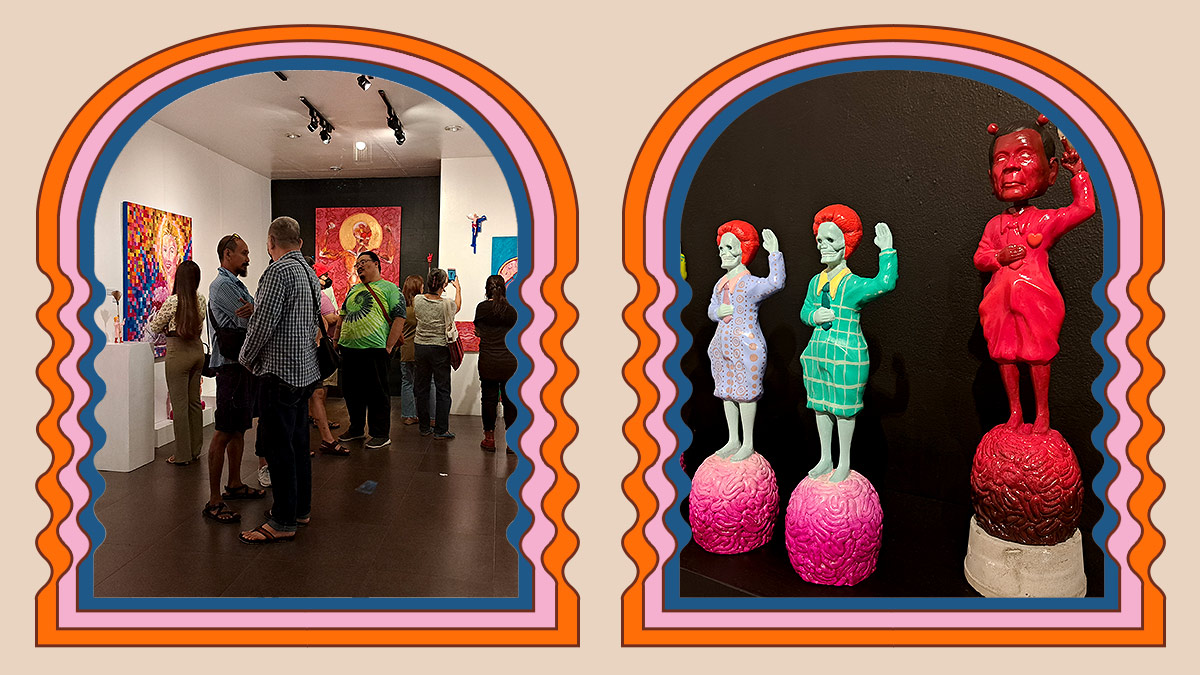
(SPOT.ph) Mideo Cruz, perhaps most known for a controversial art installation in 2011, often pushes boundaries with his politically-charged and confrontational artworks. His latest show Meme Generators is no exception to his provocative style. This time, he delves deep into unfinished work from his previous residency in San Francisco, as well as his more recent experiences in Internet culture.
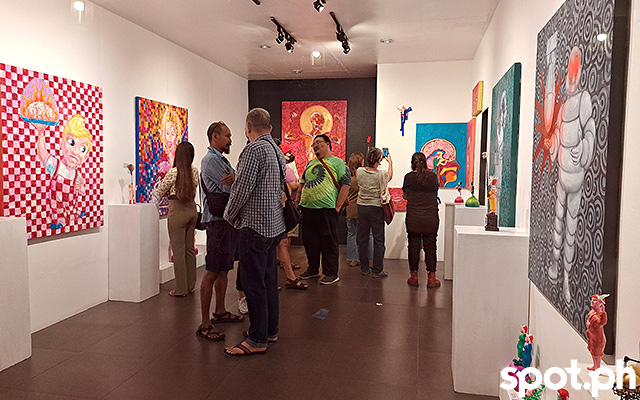
Meme Generators opened last June 18 at Kaida Contemporary Gallery in Quezon City, and will run until July 4. The intimate and homey art space that opened in 2006 lends itself well as Cruz once again challenges norms and power structures in his latest exhibition.
Mideo Cruz, Poleteismo, and the CCP Controversy
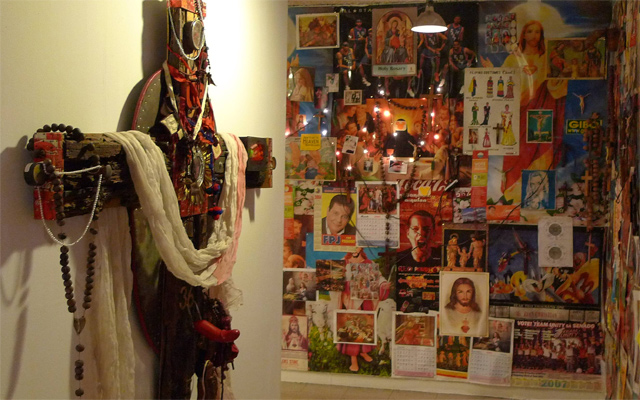
Cruz is no stranger to the volatile world of the Internet. His name and reputation are inextricably tied to Poleteismo, a controversial installation back in 2011. It was sensationalized by XXX, an investigative show by ABS-CBN. The production team framed the artwork as if from a hidden camera through a covert investigation, when in fact they had the consent of the exhibition venue, the Cultural Center of the Philippines. It created a furor online as the segment, clips of the segment, and various commentaries were shared, oftentimes lacking the proper context. The installation, at the very basic, is a commentary on Philippine society, but when the television show layered it with the much-debated Reproductive Health Bill—now a law, it invited the attention of the online world, becoming “viral” before Internet virality was commonplace.
Threats to Art and Artist
The events surrounding Poleteismo resulted in death threats, a senatorial inquiry, and ultimately, a premature closure of the exhibition. It became a touchpoint of discussion when it comes to art criticism, controversial art, censorship, and the role of institutions in difficult conversations and situations. It was also one of the early works to confront how the public that’s now powered by the Internet, voice out critique, share ideals and expectations, and make demands through tweets and Facebook comments and posts. The art world was caught unprepared for an Internet commotion; and though much has changed in over a decade, social media as a site of discussion became the norm to a certain extent.
Meme Culture
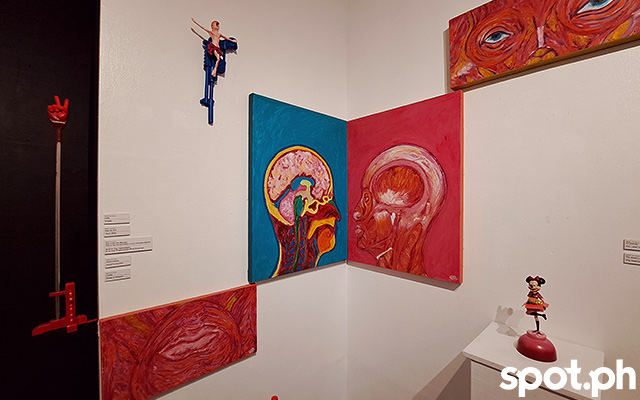
The solo exhibit Meme Generators is quite different, in that it has a more polished layout as well as a combination of paintings and sculptural works. At the same time, it pokes and prods socio-political framings of Philippine and global society.
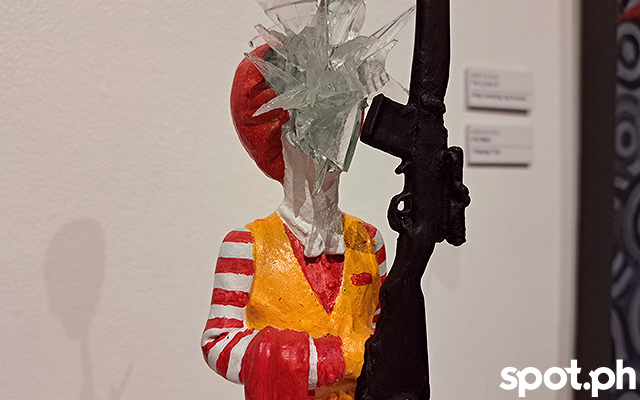
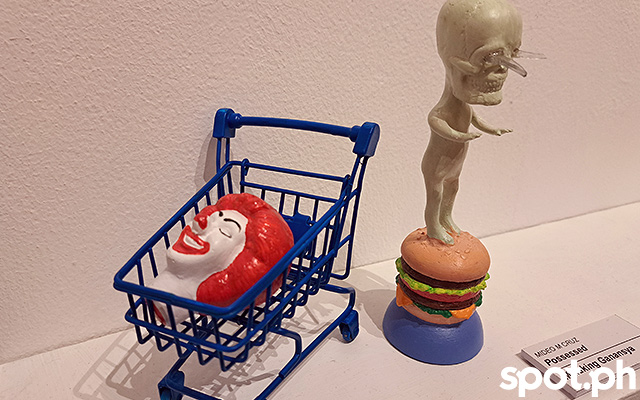
Technically, meme—as a phenomenon—predates the Internet. It is based on the works of Richard Dawkins, an evolutionary biologist, who theorized that similar to genes, memes are a means to replicate information while transforming such information in the process. While genes are physical, memes are cultural and could be influential in society. Internet memes, on the other hand, can be considered distinct from this. Yet, its ability to contain information or valuation, and the means to pass on and transform the information are quite similar. The popularity of Internet memes continues on, often adding or shifting meanings along the way as they make their way across the World Wide Web.
Philippine Politics and the Internet
It is undeniable that former President Rodrigo Duterte’s popularity among Filipinos was heavily influenced by Internet culture. One of his claims to fame before his presidency was about Davao City getting recognized as one of the safest cities in the world—the news widely circulated even through mainstream media and the Internet. But upon closer inspection, the data came from a crowd-sourcing site, rather than actual field research. Yet, the source hardly matters as the information spread online, carrying the implications along with it. Such reinterpretations are gleaned in Cruz’s pieces for Meme Generators.
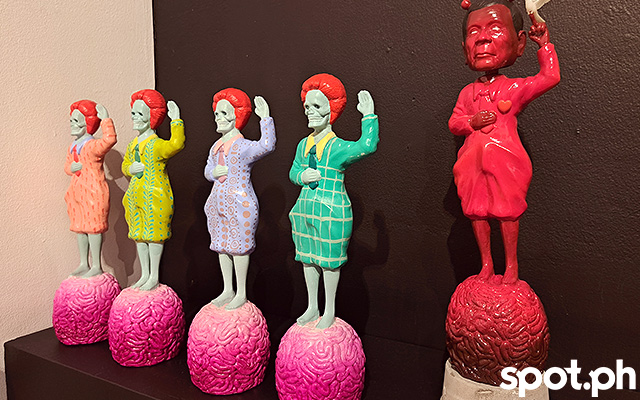
“Fiend and his Friends/ Ang Hokage at Ang Kanyang Chuwariwap” features a red sculpture resembling Duterte. On his head are round red objects almost mimicking Mickey Mouse, his left arm and middle finger raised as a white dove lays atop. Beside the red figure are four other skeletal heads with hair and similar styles of ties and shirt dresses as Ronald McDonald, but with bright colors and varying patterns. All the figures are stepping on brain-like ovoids, while the Duterte-like sculpture is on an extra pedestal. The sculpture is a commentary on the intersections of politics, post-colonial relationships, and the burdens of late capitalism in the Philippines. Despite the rough and bloody administration, Duterte remains popular among Filipinos, with popular imagery still spreading across social media platforms.
Global Politics and the Internet
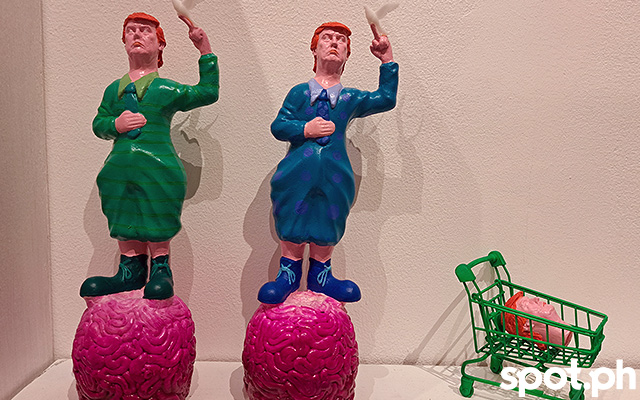
Cruz doesn’t stop with local politics. Spread around the space are images resembling former U.S. President Donald Trump, elected into office in the same year as Duterte. “Donald McDonald/ Ang Dinakilang Wasak” has several versions—one with the image similar to Trump, dressed in the style of Ronald McDonald but in bright and colorful patterns; another with his left arm and middle finger raised, and again the white dove on top. The ovoid-formed pink brains are also present, suggesting the assault on people’s intellect.
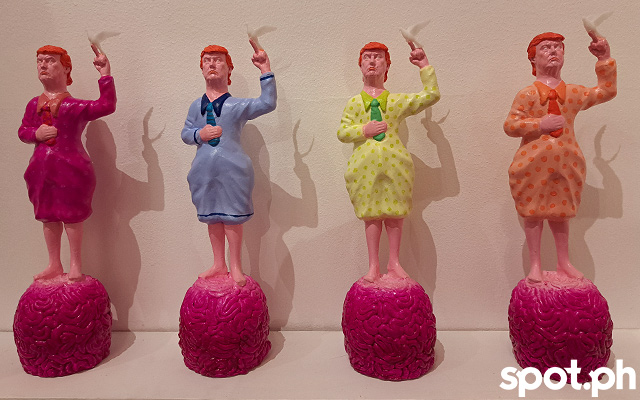
Trump’s election in 2016 is still under debate, with accusations of Russian interference as well as using social media and personal data to influence elections. Back in 2018, Facebook CEO Mark Zuckerberg testified in the U.S. Senate regarding Facebook’s relationship with Cambridge Analytica and the use of personal data in influencing voters during the 2016 election. Cruz’s commentary on online culture touches on unresolved problems, with the Internet and social media still playing a key role in politics.
Online Politics and Diaspora
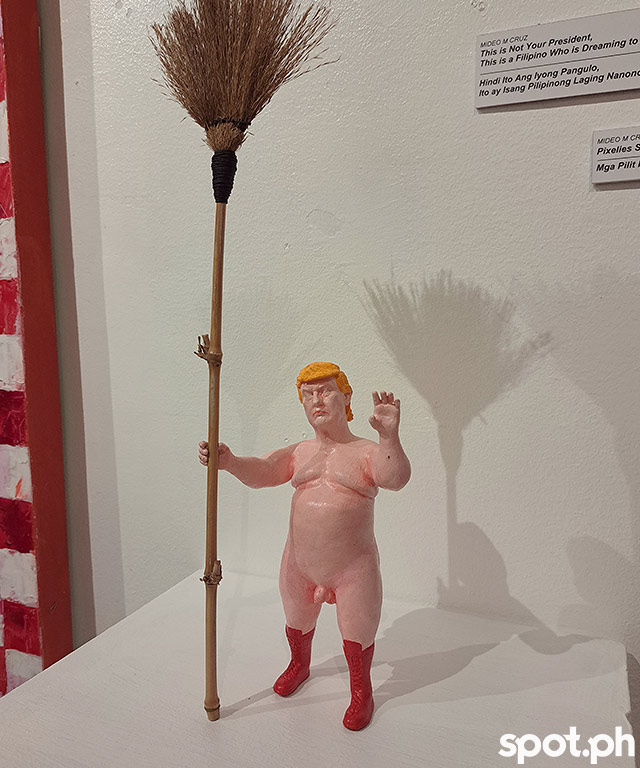
Another curious sculpture is “This is Not Your President, This is a Filipino Dreaming to be White/ Hindi Ito Ang Iyong Pangulo, Ito ay Isang Pilipinong Laging Nanonood ng Eat Bulaga,” where another figure resembling Trump stands naked while holding walis or broom. It may be recalled that Trump supporters stormed the U.S. Capitol in 2021, hoping to stop Congress from declaring Joe Biden’s presidential win in 2020. What caught the Filipinos’ attention was a walis-wielding masked person, later revealed as Filipino-American Kene Brian Lazo, when he plead guilty to charges made against him. The odd dissonance displayed by the immigrant is common. As Cruz addressed in the title, there is often an aspiration for whiteness—which means to say white privilege—among immigrant Filipinos.
Complicated Relationships
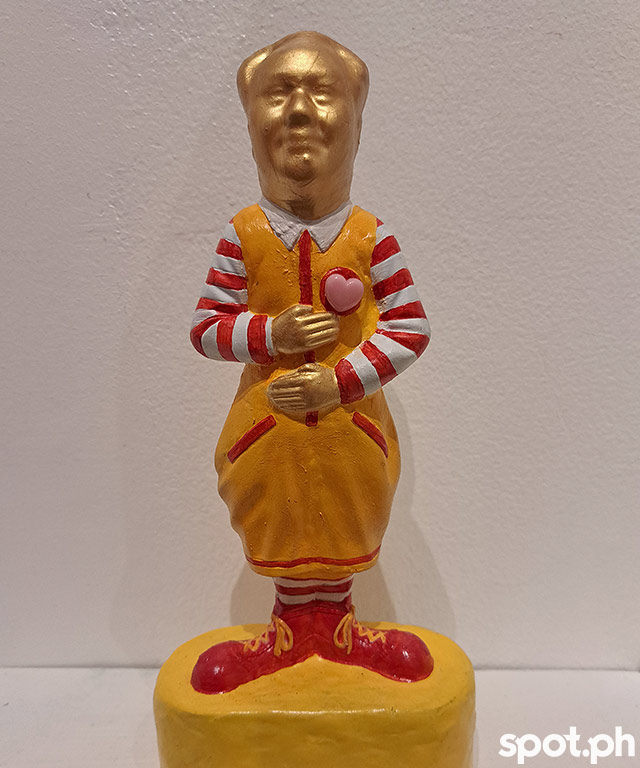
Contemplating Cruz’s sculptures is similar to putting together puzzle pieces, with his title the biggest clue in the conversation. Similar to the styles seen in his sculptures, the series with golden heads and one silver head wearing another Ronald McDonald style clothes in a different palette, resembles Mao Zedong, the former Chairman of the Chinese Communist Party. Yet, the title states, “This is Not The Great Chairman Mao, This is a Golden Tribute to Milton Friedman/ Hindi Ito ang Dakilang Si Mao, Ito ang Gintong Pagkutya sa Neo Liberalismo.” Milton Friedman is a U.S. economist and Nobel laureate who supports free-market capitalism and monetarism. The title attests to his outlook on a world economy that’s heavily skewed toward wealthier countries.
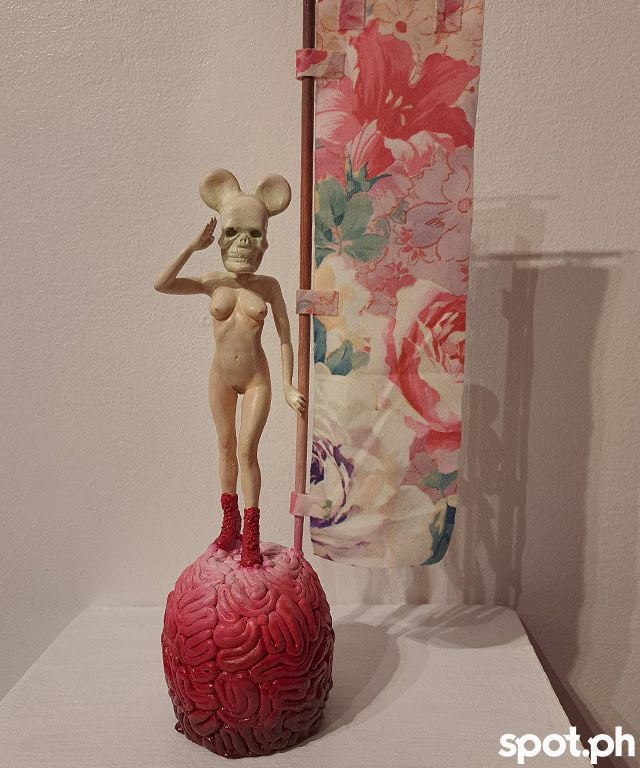
Philippines’ complicated relationship with China is also reiterated as shown in a naked sculpture with a skull head, Mickey Mouse ears, and red boots that carries a floral flag. It is titled “Let a Thousand Flowers Bloom – Anselm Keifer” and translated with Chinese characters rather than Filipino phrases. The referenced artwork is a gouache, sand, ash, and charcoal on two torn and pasted photographs–from Keifer’s series on the brutality of the Chinese Communist Party layered with Germany’s history of Nazism. Keifer’s title, which Cruz also lifted, is interpreted from Mao’s 1957 text, “Letting a hundred flowers bloom and a hundred schools of thought contend is the policy of promoting the progress of the arts and sciences.”
Pixels–Pixels and Lies
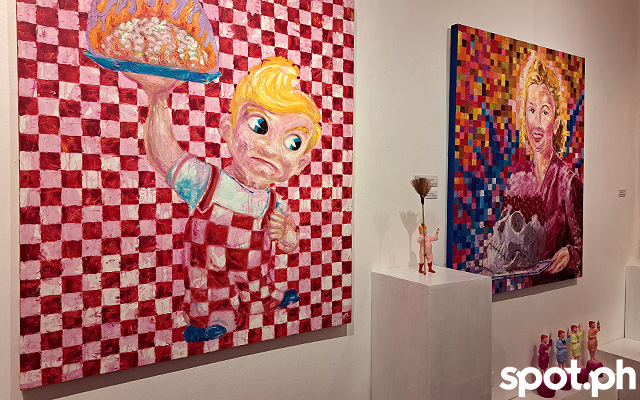
Going back to the Internet of the present are Cruz’s “pixelies,” the combination of pixels and lies. “Pixelies Savagery/Mga Pilit na Pagkukubli,” a pixelated blond woman holding a skull serving dish; and “Little Boy/Ang Malaking Pasabog,” a pixelated blond child holding a dish with a brain on fire, present the harshness and complications of engaging online. As humorous as Internet memes could be, it still unearths a darker side of society. It could be a place of critique, but also of lies and manipulations.
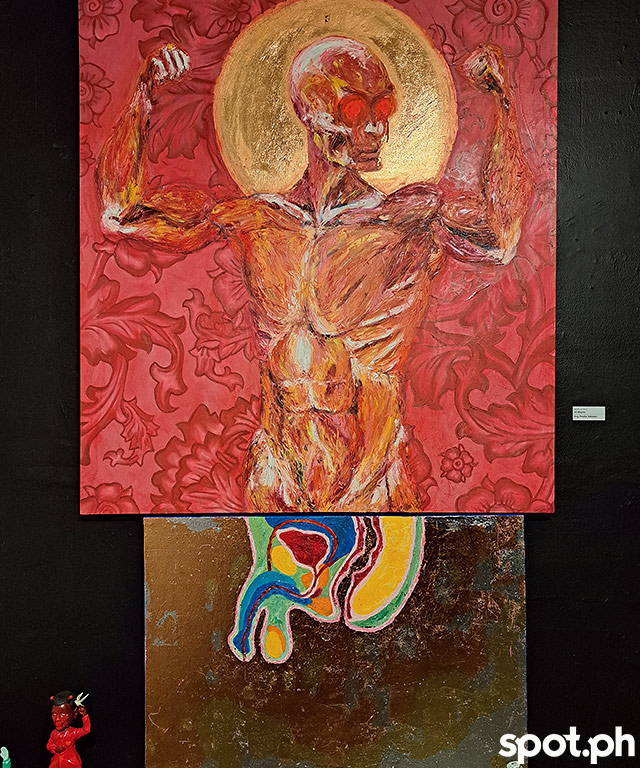
“All Mighty/Ang Pinaka Sakalam” also suggests a critique of religion and patriarch, as power relations skew towards the often male powerholders. Cruz’s paintings are thoughtful and teetering on controversial, but his powerful provocations are in his smaller-scale sculptural works.
From Age of Information to Disinformation
Though Meme Generators may not invite the same controversy as 2011’s Poleteismo, it continues on forcing the viewers to confront the uncomfortable. The works were harsh, the bright colors do not distract from the strong sociopolitical critiques they were meant to uphold. The internet itself changed when it first became truly visible in art criticism in 2011, as most controversies now are driven by algorithms rather than people coming together in their furor using their keyboards. The critical shift from the age of information into the age of disinformation happened in the past decade, putting into doubt the capacity of the Internet for meaningful exchange and critique. Despite of an in spite of these changes, Cruz continually navigates the shifting waters. Hopefully, with no death threats this time around.
Meme Generators runs until July 4 at Kaida Contemporary Gallery, 45 Scout Madriñan Street, Diliman, Quezon City.