

EXHIBIT REVIEW: Seeing through Lenses: Expanding Contemporary Photography
The exhibit is on an extended run at the CCP Bulwagang Roberto Chabet.

(SPOT.ph) Braille for the Seeing, which has an extended run on the third floor of the CCP Blackbox Theater, challenges both the artists and the viewer with the ideas and representation of contemporary photography. Before the ubiquity of cell phones and digital cameras, photography was expensive and mostly out of reach for Filipinos. Even the cheaper versions of Instamatic and point-and-shoot cameras meant spending on film, development, and printing. The economy was considered in taking photos and printing—then sharing and gifting. Though photography is a rich practice among artists, photographers, and photojournalists, it wasn’t fully utilized by many people until the era of the more affordable digital cameras and phone cameras shared on social media, skipping the development and printing costs.
Tracing the Rise of Digital Technology in Braille for the Seeing

Recognition of the uses and challenges of digital technology and screens is a tense thinking point for the exhibition. Rhaz Oriente’s "Iris Insight" (2023), which consists of 27 black and white photographs (transparencies) on three lightbox tables, looks into the effect of blue light on the eyes of the viewer. There have been a lot of conversations and concerns about the amount of screen time children have and the time people spend on gadgets. Though, admittedly, the distance created by spending too much time on technology is deeply felt and possibly harmful, there is also a sociocultural factor regarding technology use. Work has become digital—following people working from home or essentially working everywhere; communication is also increasingly digital—with people locally in the same vicinity but hours apart due to traffic or are currently in diaspora, relying on gadgets to feel closer to loved ones.
Filipino fascination with gadgets could be problematic, but some of such tensions also have sociocultural-economic roots. Oreinte’s inviting and provocative work hopefully transcends the surface narratives of time spent on screen.
Looking Back in the Dark Room
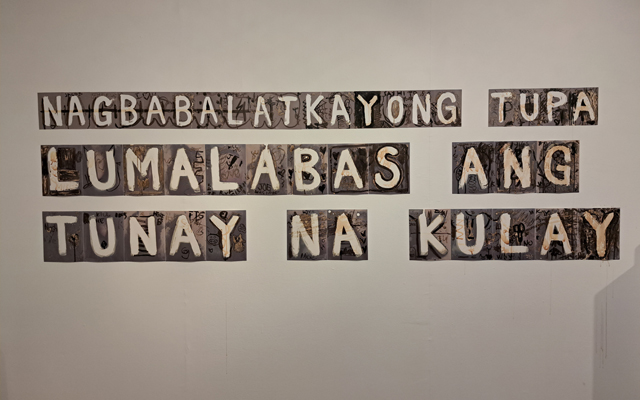
Teo Esguerra’s "Permanence" (2023), which includes light-sensitive photo-paper, fixer, and developer installation, unpacks and demonstrates the mystery of the darkroom for exhibition goers. Esguerra invites the viewers to alter the photo prints—with the fixer to lighten an area in the print and the developer to darken it. Though the darkroom process is more complicated, the interplay shows the effects of chemicals on the photo paper and how it shows or hides images. The photo paper installation shows an all-capital statement, "NAGBABALATKAYONG TUPA LUMALABAS ANG TUNAY NA KULAY." The marks made by the participants are visible, but the statement's message is clear, as it roughly translates to "pretend sheep show its true color," a play on the fraught and unstable politics in the country.
Archives as Photography
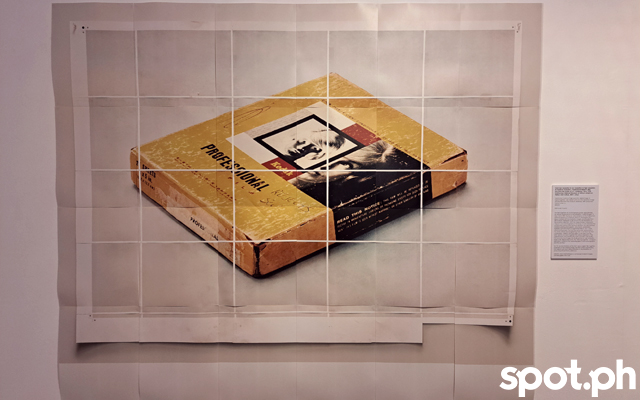
"From low resolution to low resolution to high resolution to medium resolution/ Professional Rejects (film box from the studio of H.C. Anderson, circa 1970, Smithsonian National Museum of African American History and Culture, 2007 1.30.6)" (2022-2023) by Stephanie Syjuco and "Hacienda Fortuna" (2022) by Angela Silva, the mother and daughter diaspora artists, show an engagement with historical objects and narratives, recreating and reengaging the object for a play of meaning and materials in the contemporary context and audience.
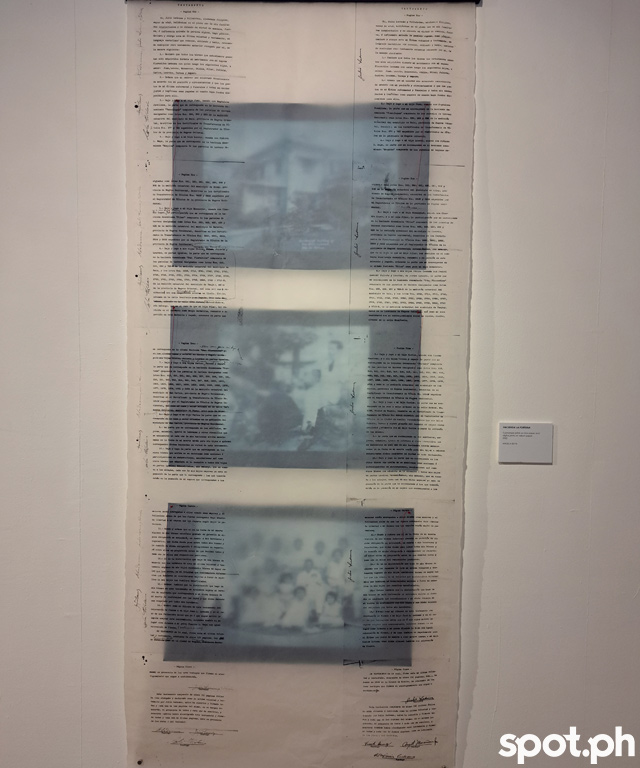
Syjuco chose to engage archives from the United States, while Silva unearthed local archival materials. The two works invite the looker to investigate, the hows and whys of the objects, and why the respective artists decided to present them in their current iteration—with the changing and shifting materials and meaning-making of photography.
Photography and Surveillance
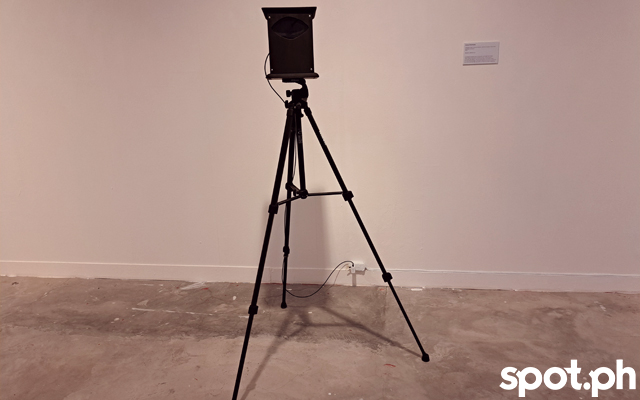
Shifting towards the camera as a machine is Miguel Lorenzo Uy’s "Scryer (Prototype)" (2023), obsidian mirror, microcomputer, camera module, mirror, and wooden enclosure, where it is described as "a camera module and a computer are inside the Scryer. When there is any kind of motion in front of the Scryer, it automatically detects and records videos and stores them in its disk drive/storage. The Scryer will record what is in front of it and will automatically stop until no motion is further detected." Though motion sensors are nothing new for cameras, Uy’s "Scryer (Prototype)" doesn’t demonstrate that the material does what it claims. It brings forward, though, the idea of surveillance which became more palpable with digital technologies and the advent of surveillance capitalism. At present, everything a person does, especially concerning technology, is recorded. Perhaps, not entirely in a personal sense, but mostly to support and manipulate a person to engage more in behaviors acceptable to the capitalists and bureaucrats.
Photography and Print
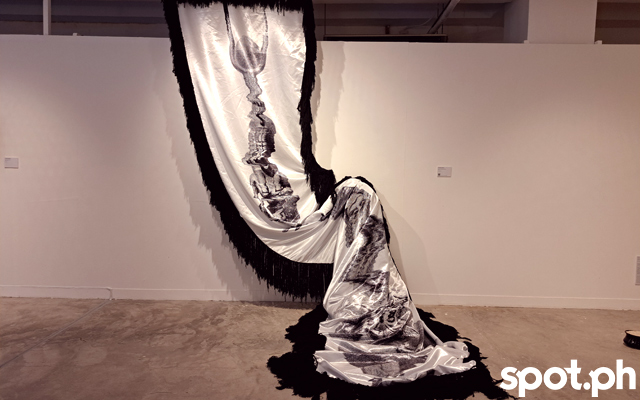
Pushing the definitions of photography is Jan Sunday’s "Flag of our Mothers"(2023), a print on satin with yarn fringe. Photography means "drawing with light," and the images produced are light captured in a light-sensitive material, though in more contemporary times, photographs also include images stored digitally. Though satin is not a light-sensitive material, the print on it appears to have been captured photographically, at first, then manipulated digitally before being printed on the satin. Depending on how strict or fluid the definition is, the discussion for photography as a material is ever-evolving. Featured on the satin are distorted images of Venus statuettes, commonly regarded as fertility goddesses. Though there is no substantial proof in prehistoric material culture, modern reading of the female-appearing statuettes designated them as Venuses.
Kaleidoscope and Camera Obscura
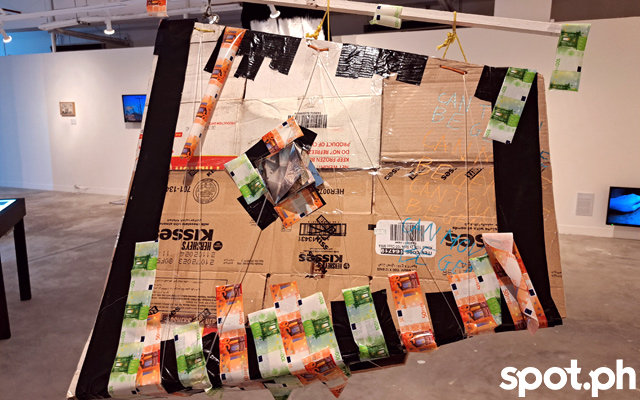
Facing similar challenges with the traditional definition of photography is Gerome Soriano’s "Kaleido, Misteryoso Seryoso Pilosopo Jusko" (2023), an acrylic cardboard, tape, C-print, and zine. His playful installation, meant for the viewers to interact with, does not technically capture a photograph but aids and invites the viewers to take it.
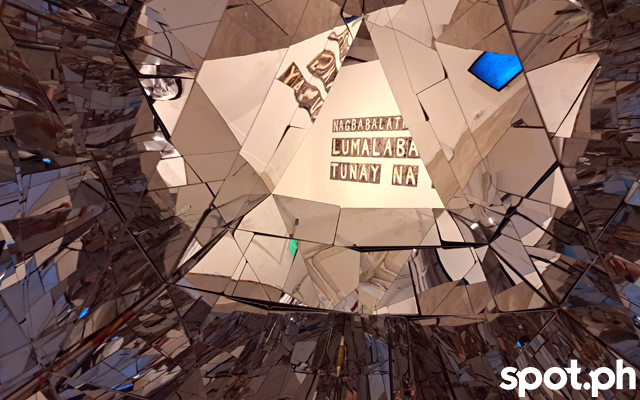
The kaleidoscope-like interior captures reflections, giving a different perspective of the other artworks on view and a fractured reflection of the viewer. It plays and captures light, and it just doesn’t transfer it into a light-sensitive material or digital storage. In a way, it functions in tangent to a camera obscura, capturing light and image. Still, instead of ascribing it to another material, it is dependent on an object outside of it to preserve the image. Camera obscura was used by painters to capture perspective accurately, and it is the starting point of cameras, while Soriano’s piece depends on a cell phone camera for another person to capture the image.
Prompts of Young Artists
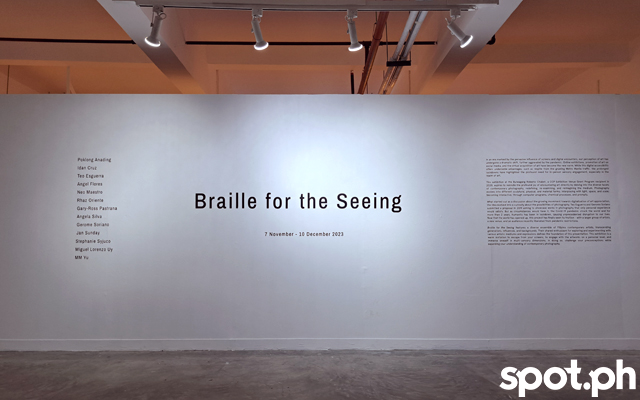
Braille for the Seeing is a fascinating, thought-provoking exhibition that invites the audience to look, investigate, and think about photography, the photographic process, and the implications of digital technologies as they traverse contemporary society. The show features long-standing contemporary art photographers who are more or less expected in photography exhibitions–MM Yu, Gary-Ross Pastrana, and Poklong Anading. Though their works are beautiful and add a layer of contemporaneity, the presence of newer artists in the scene gives a refreshing take to the prompt of the exhibition concept.
Adding to a Long-Established Practice
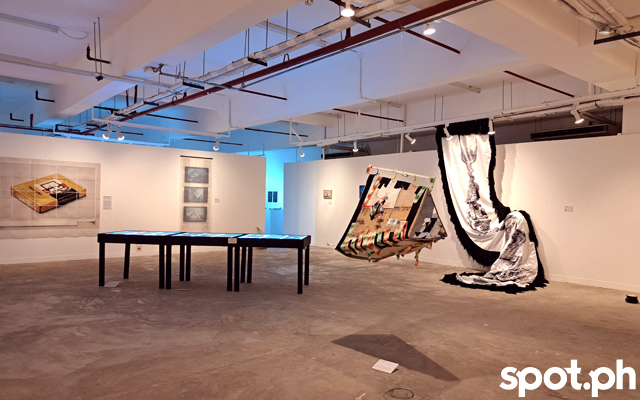
The provocations are varied, some to the point of skirting the definitions of photography itself–the interpretations are interesting starting points to the concept. The exhibition doesn’t define or redefine photography. Rather, it expands on existing notions, is conscious of contemporary realities, and attempts to look into the spaces between long-established practices. Initially conceptualized back in 2019, then affected by the long government lockdowns in 2020 and the following years, Braille for the Seeing finally found its footing in 2023. It is caught between questioning traditional notions of photography and uneasiness with the present digital environment. What remains to be seen is not a compromise but a fluidity in approaching the tensions of the prompt and revealing what they intended to see.
Braille for the Seeing runs until February 4, 2024, at Bulwagang Roberto Chabet, 3/F Tanghalang Ignacio Gimenez (Blackbox Theater), Jalandoni corner Sotto Street, Cultural Center of the Philippines Complex, Pasay City.
Also read:
10 Best Shows We Watched Onstage This 2023
Mark Your Calendars for Art Fair Philippines 2024