
Rethinking Land and Labor Through Art
Through the latest solo exhibits by Mark Salvatus and Frelan "Pakz" Gonzaga.
(SPOT.ph) Land and labor are inextricable concepts in the Filipino experience. Most who work the land with their hands do not own the land they work on. Despite being closest to the land, their capacity for ownership gets further away through the years, despite some efforts to make land ownership more possible through the agrarian reform of the past. This inconsistency in the Filipino experience translates to the more relatable experience of modern labor—the ones who work hardest and the most hours—the working class is furthest away from owning a business or at least getting an equitable living wage. With the stagnating salaries in the Philippines, the working class has always struggled, especially during uncontrollable inflation.
Such complicated sentiments and experiences permeate Mark Salvatus’ Relaxation is a State of Mind at The Drawing Room in Makati (February 17 to March 16) and Frelan “Pakz” Gonzaga’s Day Off at Gravity Art Space in Quezon City (February 23 to March 23). The two exhibitions evoke the ideas and thoughts of land, labor, and the ever-elusive ideas of rest.
Rice and Agriculture
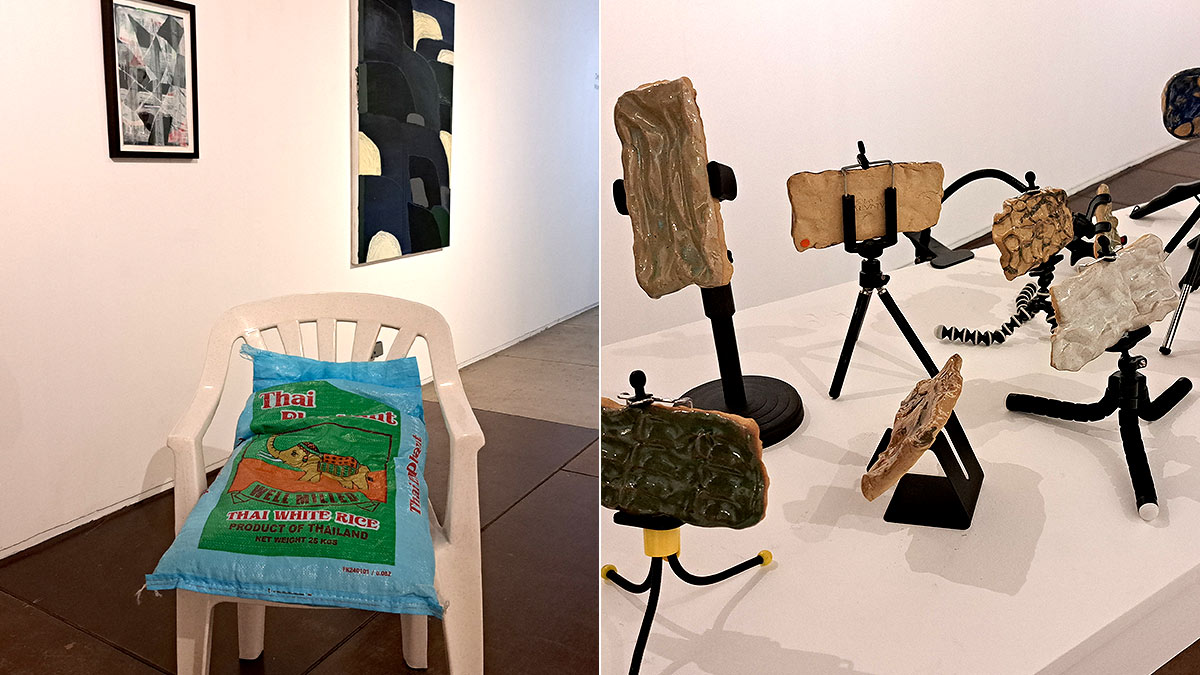
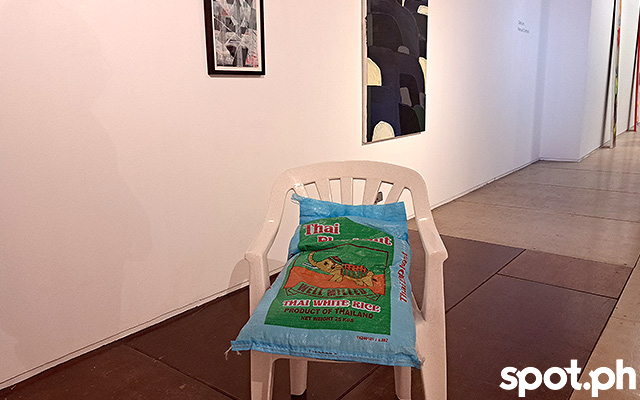
Salvatus’ Relaxation is a State of Mind is installed in the hallway of The Drawing Room—the vertical approach takes the viewer into the journey of the narrative, with new pieces interacting with artworks belonging to his previous series. Most eye-catching is his new series "Waiting" (2024), which has a rice sack filled with cotton atop a plastic chair. Some rice sacks are from foreign imports, while others are locally produced rice.
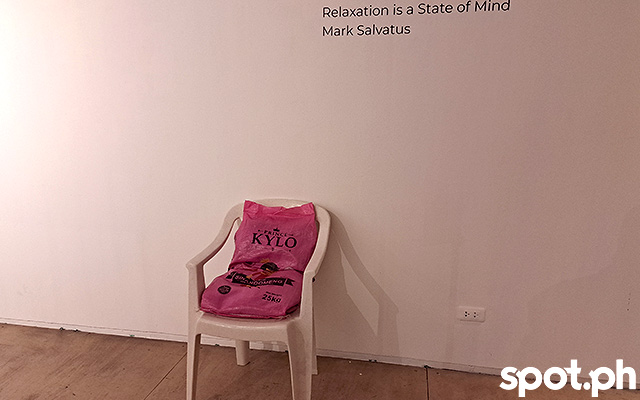
Salvatus’s more deeply felt pieces have always been the ones tied to the narratives of land—in this particular case, the concerning shift of the Philippines being one of the largest importers of rice, despite once being one of its largest producers, even leading research and scholarship on the subject with the establishment of International Rice Research Institute (IRRI) in the 1960s. Viewers are invited to sit on the chairs, relax, and perhaps contemplate the realities of our experience, as we lose our ties to the land and are now relegated to purchasing much of the produce in the market rather than giving market to our hard-working farmers.
Harsh City Life
Perhaps this is the state of mind Salvatus was referring to as we sit atop the issues of the day, relaxing in an air-conditioned art space. The situation we live in is discomfort and survival. Relaxation is possible through wealth, privilege, or perhaps the state of mind as is—yet long-term comforts are absent from most of the Filipino working class. Along the walls of the hallway are his "Scratching" series, the earliest are "We stood a moment so in a strange world" (2017) and "With a new city street it has to wear" (2018), produced before the COVID-19 pandemic.
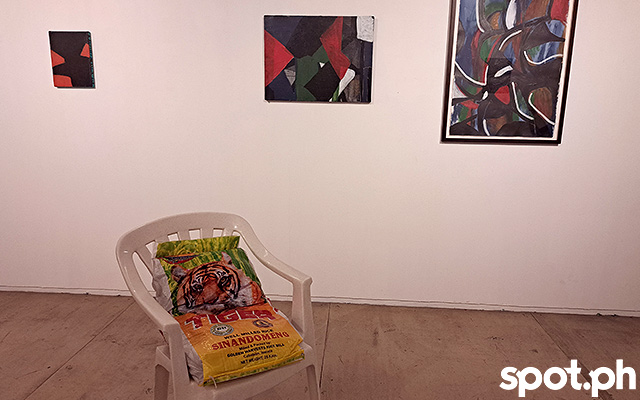
The "Scratching" series is Salvatus’s response to city life, with his background of growing up in Lucban, Quezon, a small provincial town known for celebrating the popular harvest festivities on the day of San Isidro Labrador, Pahiyas Festival. The grit and grime of the city has always invited deep contemplation for Salvatus, even years after his initial move as a student studying at the University of Sto. Tomas.
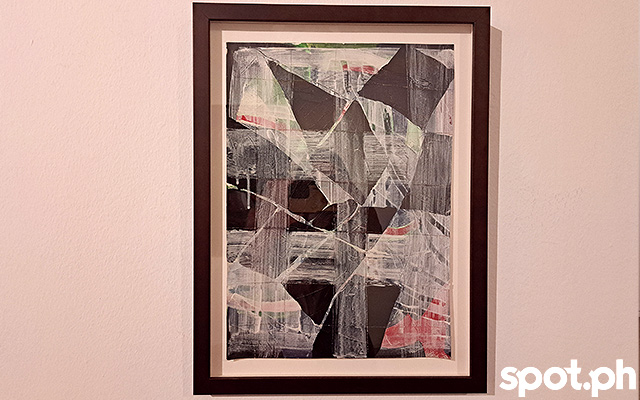
Though Salvatus regularly moves between Lucban, Quezon, and Metro Manila, the impact of the city continues to resonate in his artworks, as he literally scratches his acrylic on canvas paintings. The tactile act of scratching gives a deeply felt meaning to the harshness of city life compared to the pace of provincial living. Salvatus continued the series with more recent works, including "Can I ask you something? Is life better now?" (2023) and "Watch this space" (2024).
Tools of Modernity
Another notable new approach for the current exhibition is Salvatus’s "Tools" (2024) series, ceramic pieces mimicking disfigured cellphones placed on commercially available plastic stands. Glazed ceramics give an earthly reference to a communication device often regarded as an object displacing people from the here and now.
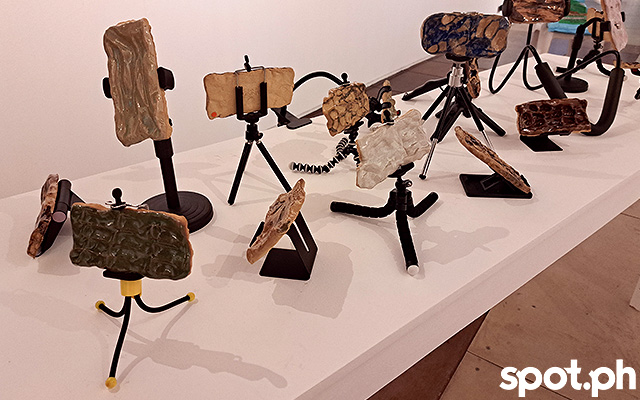
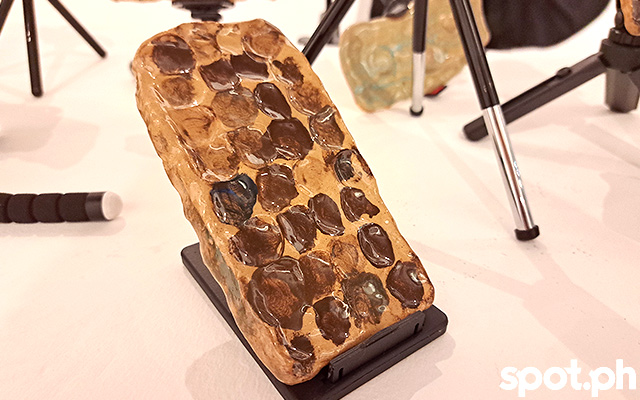
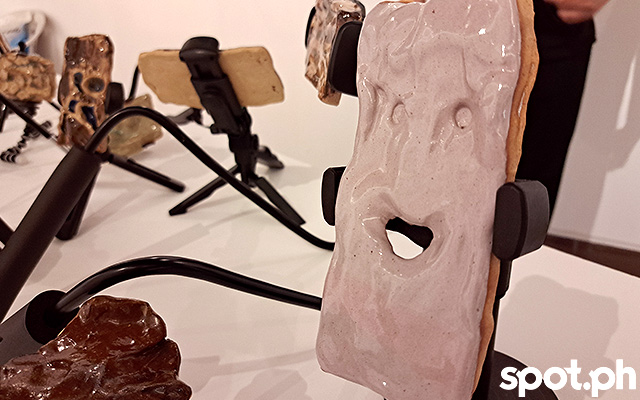
Though roughly made, the "Tools" series gives a textured approach to Salvatus’s struggles and discomfort with contemporary life. Tying to his concept of relaxation, what does it mean to be constantly present? In observing daily life in the city—commutes, restaurants, malls, parks–there are endless waves of people looking at their phones. Are they doing something productive? Are they relaxing? Are these questions relevant in the ephemera of existence? Though Salvatus’s multiple threads of narratives could be difficult to follow, the issues he picks up and responds to are relevant to everyday experience.
Combining Art and Design
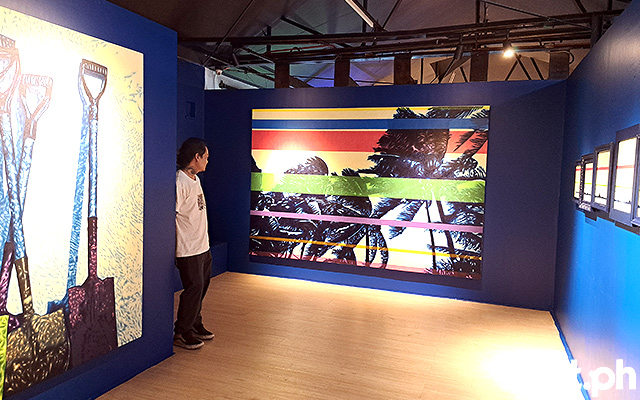
Gonzaga’s approach to labor and rest is more direct to the point, especially with the cohesively designed presentation of Day Off at the corner of Gravity Art Space (GAS). The walls were painted with a vibrant blue, while his large-scale works show the beachside with a blue hue and brightly-colored stripes present in his earlier works. Gonzaga’s approach plays with combining the painterly with graphics, veering away from the romanticized and picturesque representation of the countryside typical in traditional works. There are no rose-colored glasses or golden light, but rather taking a more brash approach, highlighting the grittiness in the canvas.
Remnants of Manual Labor
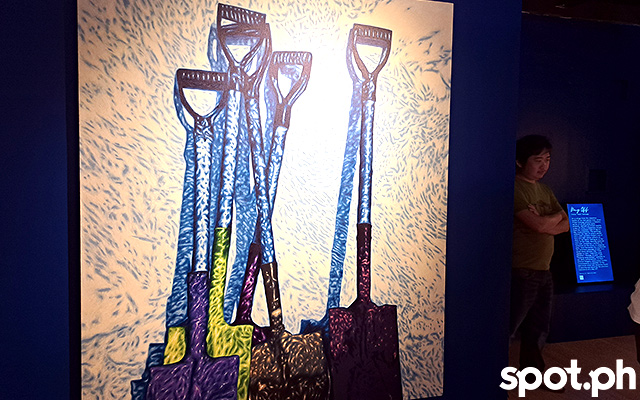
"Day Off" (2024), a large-scale oil on canvas piece, shows several shovels on the beach. The harsh lines and colors of the shovels depict those used in manual labor and construction rather than the playful plastic ones used for playing on the beach. Though the ideas of a day off, rest, or even vacation are suggested with the title and themes, the presence of objects ubiquitous in manual labor ties the small-scale solo exhibition back to the ground. There is no romance or fun in the concept; instead, it demands the audience to reconsider and recognize how a day off is a privileged concept.
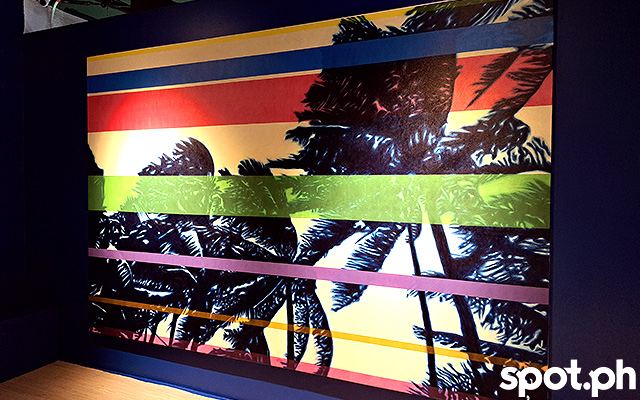
Gonzaga’s other large-scale piece, "A Moment" (2024), shows coconut trees blowing in the wind—the image is both restful and restive, as it could be a quiet moment of rest or harsh winds coming your way. The identifiable blocks of colored lines, typical of Gonzaga’s style, give a graphic feel and remind the audience of the remnants of technology and hurried city life.
Going to the Beach
The third piece in the exhibition is "Escape" (2024), a series of seven small-scale oil and spray paint on canvas, with blue frames in different styles. Exhibited together as one, the small pieces present the islands locals can visit, where, according to Gonzaga, costs are more affordable to locals—where they can picnic, relax, get away from the city, and pause for a while. They rent boats, bring food to eat and cook, and enjoy a moment to themselves. Such small moments are wonderful to have and reflective of possibilities.
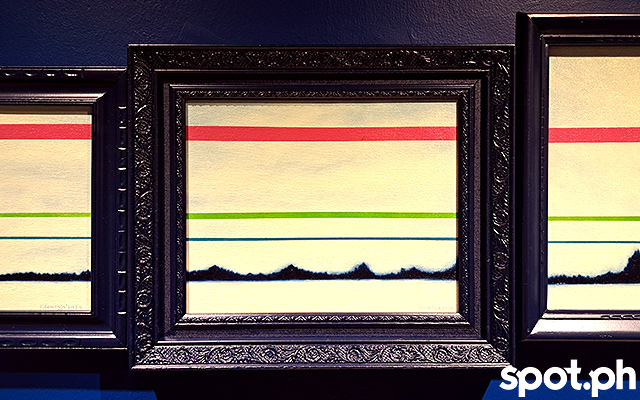
Yet, the power of Gonzaga’s works and overall installation is its cohesive design while confronting the realities of labor and the rarity of rest. With a strong background in street art, Gonzaga uses the approach in his oil on canvas, almost akin to putting graffiti on the wall, as solid shapes disrupt his oil textures.
Confronting Harsh Realities
Salvatus and Gonzaga confront the realities of Filipinos. We work, we labor, we do not own our land, and we do not get to rest. They explore the possibility of complex representation without going through the motions of expected visual language when dealing with social issues.
One challenge here is how it would translate to the audience—will they be challenged enough to pause and reconsider what is confronting them, or will they get isolated from the concepts and ideas of the work? Both are possibilities, but the important part is the artworks continue to ask questions and recognize the entangled narratives of complicated social situations. Whether it is in the disjointed but relevant threads in Salvatus’s approach or a unified, beautifully designed one in Gonzaga, the need to rethink is ever-present.