

Filipina Artist Patricia Eustaquio's Work Was A Hit In Art Basel HK
Beneath its obvious beauty is a powerful message.
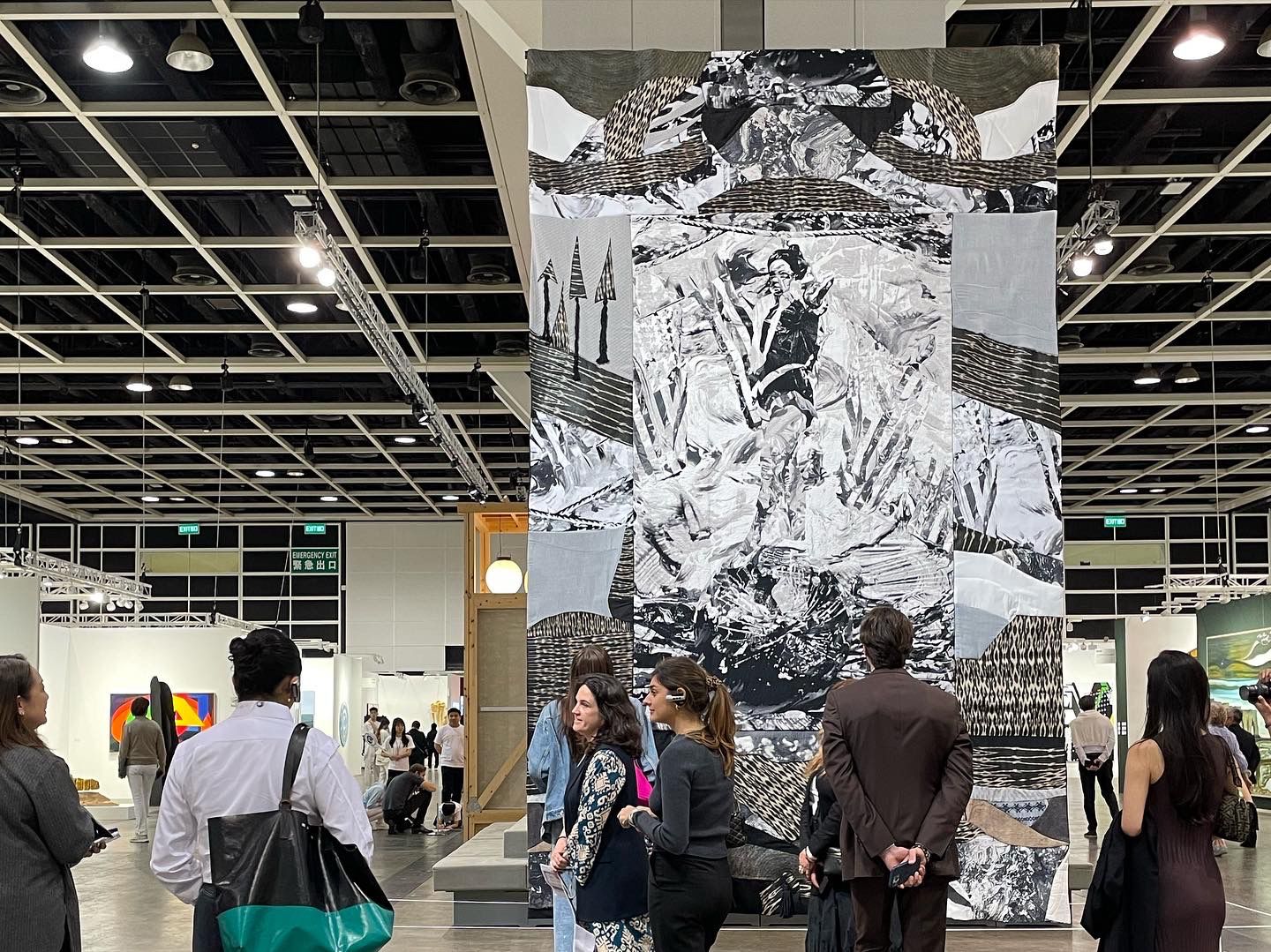
(SPOT.ph) The works of artist Patricia Perez Eustaquio often astound with their graceful quality and quiet beauty, and that’s exactly what her White Lies (Balanced on A Ball) did at the recently concluded Art Basel Hong Kong. While there were plenty of Filipino art-watchers and art collectors who flocked to the Hong Kong Convention and Exhibition Center for what is easily the biggest art fair in Asia (there were over 200 exhibitors this year from all over the world), Eustaquio’s towering tapestry, a hybrid of digital and Filipino native weaves hanging delicately from the venue ceiling, attracted an international crowd.
The piece was part of Encounters, a collection of 16 large-scale works spread throughout the fair, curated by ArtSpace Sydney’s Executive Director Alexie Glass-Kantor. It was a “crowd favorite,” says @artspotting_mnl, with many stopping and taking their time to gaze at the tapestry, taking pictures of it, having pictures taken against it. Every time Rachel Rillo passed by the art piece, “she was stopped by people to talk about it,” shares Isa Lorenzo. Rillo and Lorenzo are the forces behind Silverlens Gallery which represents Eustaquio. Another Eustaquio piece hung at the Silverlens booth at the fair. “We had many people coming to the booth from the Encounters work to see the piece there and vice versa,” continues Lorenzo.
Also read: Filipino Gallery Silverlens in New York: 'Nobody Here is Doing What We're Doing
White Lies was especially made for Art Basel HK
The piece was made especially for this month’s Art Basel, and Eustaqio worked on it for a year. “Basically I had a collection of found images, all photographs taken during the American occupation,” she tells SPOT.ph. “I found the photo of the woman really interesting, like she was standing, balancing on the world with American flags all around her. It is a sexual pose, but I found nothing sexy about it. One of the other photos I have is of a Mangyan aeta, only her face peeking out from a bush and it seemed to me they were captured by the same eye, even if they were not.”
The artist surely knows how to turn heads, yes—for how can one resist White Lies’ rich, vibrant allure, which Eustaquio so successfully achieves despite the absence of real color? But as Lorenzo says, the fact that it’s a beauty is just the hook and bait. Eustaquio is always saying something more powerful beneath the obvious exterior. She likes to paint “discards and detritus, wilted blooms and carcasses” which all appear hauntingly arresting in her hands, challenging our perceptions of what we know to be beautiful. In the case of White Lies, we have a Filipino-looking woman at the tapestry’s center, sporting a Western bathing suit, in a very precarious position of standing atop a ball, surrounded by Western flags and patches of ikat, banig and jute. “It’s very serious, which makes it so good and so successful as Art,” Lorenzo says.
Praise for Patricia Eustaqio's White Lies
The work caught the eye of foreign media, earning mentions in outlets as The Financial Times, Wallpaper.com, and ArtsHub.com in Australia. FT’s Jane Ure Smith called it “a state-of-the-art tapestry,” and described it as something that “subverts photography of Indigenous people dating from the time when the Philippines was an American colony.” Arts Hub described White Lies as casting “a critical lens towards history with a digitally woven tapestry that recreates a 20th century colonial photograph of a native Filipino woman. It’s an example of artists using technology to innovate materials and making, while engaging Indigenous Filipino artisans.”
But perhaps the best compliment came from curator Glass-Kantor herself, who was quoted as saying about Eustaquio’s piece: “What I hope to see at Art Basel Hong Kong and the future is embodied in this work.”
Also read: The Very Best of Hong Kong: A Six-Day Travel Guide to The Very Best to HK in 2023