

This Man Can Sell Millions Worth of Art In One Afternoon—What's His Secret?
Who are the biggest auction stars? Jaime Ponce de Leon knows their names.

(SPOT.ph) It’s two weeks before the first big auction event of the year and Jaime Ponce de Leon is breathless over the treasures his auction house has assembled. In the dramatically lit room at Leon Gallery in Makati, where we are surrounded by the best of the best—among them three Juan Luna paintings, an Alfonso Ossorio mixed media piece gifted by the artist to his friend Fernando Zobel, a rare series of Arturo Luz collages in varying muted shades of pink and orange!—Ponce de Leon’s welcome greeting is profuse with superlatives.
He tells me about the four “highly important” Nena Saguils: two figurative works exhibited in the legendary 70s art space Philippine Art Gallery, and two works from her Paris period—abstracts made during the time Yayoi Kusama was doing something similar, he says. And then he gushes about the 1961 Jose Joya from "Kapitan" Geny Lopez’s collection, and calls it the “the apex of Joya’s artistic output.” He points me to the “magnificent” Luz (“Excellent work in excellent condition.”), the “beautiful” Hidalgo, and a Christ figure by Juan Luna. “The most major of all of his Christ works.”

Not that I needed convincing: having gone around the showroom before my interviewee arrived, I’d already congratulated him for the stunning array of lots before we even sat down to chat. And having visited his previews the past four years, I’ve never seen this amount of drool-worthy lots, too, with every bit of Leon’s wall space occupied by a thing of beauty, each possessed of a different degree of desirability—whether it’s an Onib Olmedo work on paper, a humble image of a fish on a dahon ng saging by Vicente Manansala, or one of the early “diaphanous” Romulo Olazos.
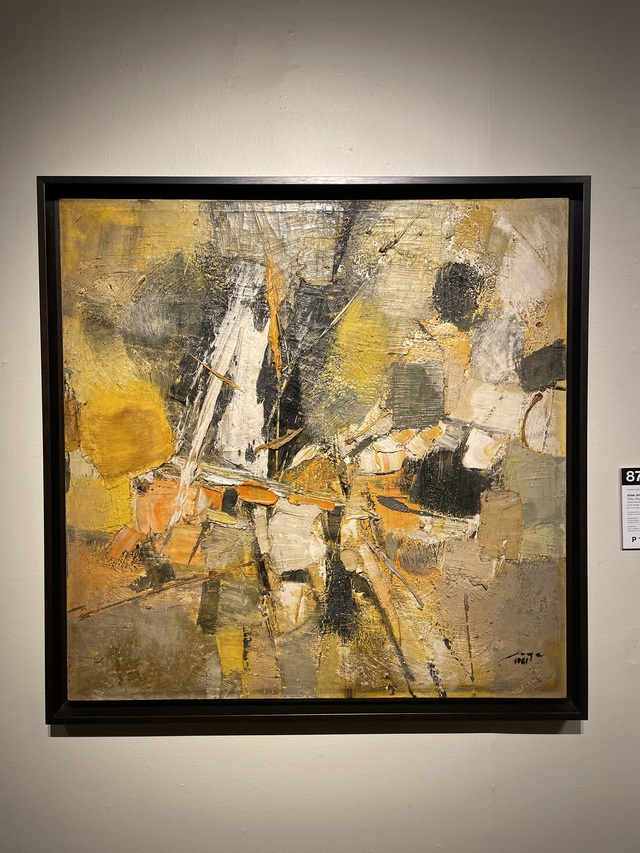
But I’m not here to drool. I’m here to ask Ponce de Leon about auctions—How does he gather all these works? How does one consign an artwork to him? How does he come up with the prices? Who are the current auction stars? And do they just happen or are they made? Also, why is he so successful? Weeks after, on auction day March 9, all these treasures, in just a matter of hours, will have new owners. The Joya from 1961 will be sold for P24.032 million (with buyer's premium, from a starting price of P16M), the beautiful Hidalgo for the same price (with buyer's premium, started at P12M), and Amorsolo’s “Mango Vendor” for P22,830,400 (with buyer's premium, starting price P6M).
His auction star Anita Magsaysay Ho, or at least her “Planting Rice,” an image of three women happily working in the rice fields, pulled in P26 million (starting price: P18M). Anita has been Leon Gallery’s biggest draw for the last four years. How did a painter from the 1950s, who captured very traditional images of women, Filipinas in Filipiniana garb, become a coveted painter for the present times? What does it take to be an auction darling?
What does it take to be an auction star?
It’s all about “importance and desirability to the collector,” says Ponce de Leon. “The big names are still there and they’re still as desired. Anita Magsaysay-Ho, Vicente Manansala. All the National Artists.” Theirs are the artworks that “people who have beautiful homes would want to have on their foyer or their living rooms,” adds Jaime. “These are the ones that are nice to show off to friends.” He laughs, as if surprised by his own candor. “Hey, come on, this is why we buy art. We want to have that status, that we have arrived. All of us want that.”
And then there are what he calls “the trophy pieces,” and based on the names he drops—Felix Resurrección Hidalgo, Juan Luna—he means works from the supremely gifted artists attached to the nation’s history. Better if they’re from that golden period when the Filipino artist was making an impression on the global stage, winning prizes for the first time in the art competitions in Europe. “It’s never a bad thing to have one of them,” the auction director says. “They’re rare, not easily accessible—but you have to find works that are documented.” By which he means they should have appeared in a magazine or periodical from its time, or a museum or gallery brochure from the period, essentially unequivocal proof they’re vetted by experts, that they’re the real deal.
There are other factors that make for an auction star: the rarity of an artist’s available works for one, making the competition to own a piece harder, pushing the artist’s price higher. Magsaysay-Ho, for example, is known to have only done a few paintings in her lifetime, and many of them were gifts to friends (read: harder to come by in the market). It doesn’t hurt Anita’s prices, too, that she carries that surname, certainly attractive to those not only building a collection but building an image in society.
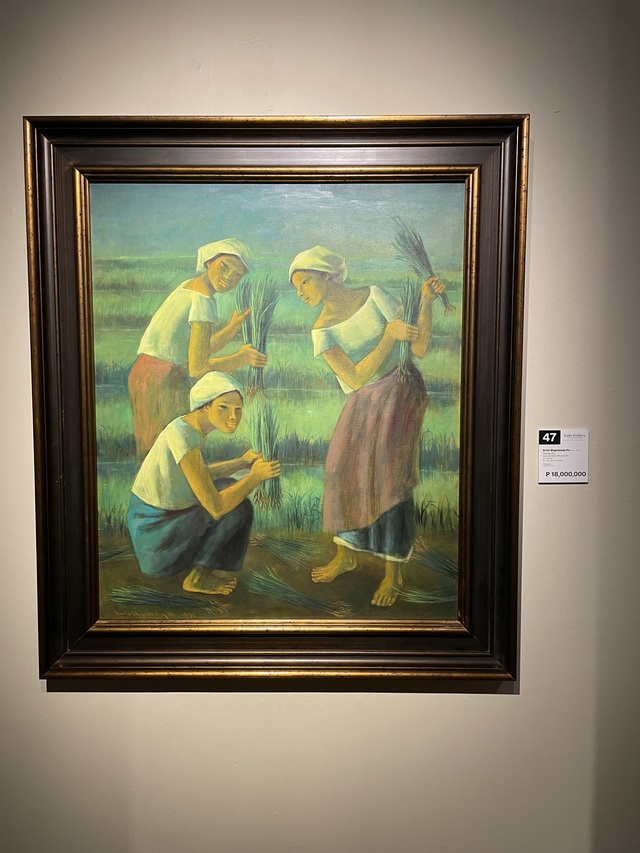
But it’s important of course that the works are visually desirable, beautifully composed, which Anitas are. And they could fetch for even more if they’re from a noteworthy period in the artist’s career (her egg tempera period is of particular signigicance), and when they address some occasional too-specific factors. A Chinese buyer might like Planting Rice, for example, because it depicts finding joy in the face of physical labor. Or another buyer might be reminded of his own “tres Marias,” says Jaime, or three daughters, if they see the Anita painting.
There also comes a time when the price itself of an artist’s work makes the work more attractive. But how does one artist’s price reach “alluring” heights? A lot of factors: “It’s the willingness of the collector to pay for something—that creates the value,” says Jaime. “When people are willing to pay a certain amount and they start fighting, it creates a price and an index of prices.” Jaime says Leon refers to auction databases for its pricing, like Artprice and Artnet. “That’s where you see how much an Anita of a certain size would go for.”
Barangay captain to auction director
Ponce de Leon and his auction house has been at it for over a decade now, first opening as a gallery in 2010 before becoming an auction house in 2013. Before Leon and its rival Salcedo Auctions, auctions in the Philippines were largely random events. And now with the two auction houses putting up four major auctions each every year, and online auctions in between, they have no doubt given the local art market a shakeup, influencing the going prices of artworks in galleries and elsewhere, igniting a new appreciation for works of local masters, reminding us that many of them were really quite ahead of their time. Leon and Salcedo have no doubt have a hand in introducing the present generation to artists already churning out remarkable work even before a Filipino art scene even existed.

Leon Gallery's Ponce de Leon is a charming, mild-mannered probinsiyano with an eye for the finer things. He took up Business Management in college and even had a stint as barangay captain in Dumaguete, his hometown. “Three years into my term I said I have to dream of bigger things,” he tells me. “I want to be a fish in a bigger pond, not in an aquarium.” He’s always been fascinated with beautiful objects, and pored over art books and fancied antiques even as a young boy in Negros Oriental. “That’s why when I came to Manila I took up interior design, because I was always drawn to making things beautiful.”
One of his early mentors was the art patron Marivic Vasquez with whom he would hang out a lot while still a student at the Philippine School of Interior Design. And then there was the late great collector and style arbiter Teyet Pascual with whom he became very good friends. “I got a lot of guidance from them, learned a lot about brands and cutlery and china and all these things—[they gave me] the foundation of having the best things.”
Being with Vasquez and seeing a lot of art shows together helped train Jaime's eye. “We go to galleries. Seeing everything helps form a good database in your mind.” And from Pascual, he most likely got the value of the relentless pursuit of the next big get, if he didn’t have it in himself already. “To always aspire for the best things, and when they’re available you go for it.” It’s likely the spirit that led him to his biggest catch so far: the Hymen, oh Hyménée by Juan Luna, long the holy grail of Philippine art, last seen in public some 130 years ago. It came out only in June last year, after secretly spending a few years in Jaime's custody, just in time for a big shebang: the 125th anniversary of Philippine Independence. (The Ayala Museum exhibition closes this March 24.)
“I had to scour every directory that had nobility in Europe, knocked on their doors to look for this,” he told me last year when I asked him what he needed to do to land the elusive Luna. “I had to muster the temerity to get introduced to the titled set. I had to befriend the person—one who tends the horses—of one of the sons of the Duchess of Alba to allow myself to enter the Liria Palace to possibly meet her. This was before the Liria was open to the public.”
“Naglalako” ng paintings
Going big time into art encouraged Ponce de Leon to further his education, supplementing what he already knew with short courses abroad: History of Art at the Sotheby’s Institute of Art in New York; a course on art care and art management at the Central Saint Martins in London; history of Modern Art in Paris; art law at the Christie’s school, also in London.
When I ask some of his friends about Jaime, they talk about the guy’s charm, his ability to make you feel like you’re the only person in the room, his hard work. And at least two friends brought up the trivia that he started in the art business “na naglalako ng paintings,” which I always found hard to believe—but only maybe because what I imagine in my head is a street vendor similar to those peddling Mabini art and going house to house under the heat of the sun.

“I was a dealer,” Jaime tells me. “And as a dealer you offer things to clients. And figuratively yes you can say that [naglalako ako], because you bring paintings to clients. Why not, you know? Even up to now when I offer things privately to a client, I still bring them [artworks] myself and carry them myself.”
These days, however, it’s the paintings that come to him, or to the Leon HQ in Eurovilla 1, that old building in the corner of Rufino and Legazpi Streets, to be consigned for the auctions. And not just paintings, too, but sculptures, antiques, letters and other ephemera from important periods in our history. “The process we have here is very simple, and can be done in a few minutes,” says Jaime. When a consigner arrives in the gallery, the object on offer is inspected, Leon offers estimates, and both parties agree on a value. Pieces with historical importance undergo a more comprehensive appraisal.
But while many seek Leon out, there are still times when Jaime would have to make his way to the treasures himself. “If there are things I know a particular family has and we could aid them in liquidating their collection, it could be a service we provide,” he says.
Jaime believes auctions give families a legit platform to sell art in a very transparent manner; it’s still the way the Rockefellers and Rothschilds of the world unload of their great valuables. Over the years, there have been many collectors and families of collectors who have entrusted their art and antiques to Leon, with many belonging to the country’s affluent clans. He’s offered collections from the likes of Don Benito Legarda, Don Enrique Zobel, the legendary tastemaker Don Luis Araneta, the late media titan “El Kapitan” Geny Lopez, the famous 70s writer Joe Guevarra, and the iconic actress-producer Armida Siguion-Reyna.
The auction house director says it was a long climb to earn people’s trust, and maintaining the house’s credibility is constant work. “Developing trust is the most essential aspect in the business of art, in the handling of someone else’s property,” says Jaime. “I strive every single day to retain the credibility I have built over the years, and I think being grounded is also very important. Whether you come here with an Amorsolo or a minor painting, we treat everyone with the same respect.”
Looking out for the next big get
Despite his success, the boy from Dumaguete continues to be a hard worker, and would even admit to being a workaholic. “I will die if I don’t do anything,” he says. “It’s more about achieving things, setting goals. Nothing is more rewarding as the feeling of success and being appreciated. I think that’s very human.”
Jaime is both art lover and a businessman “You have to be a good combination of both because it’s one thing to be passionate in art but business is very important: the decision to sell something you love from your collection is a business decision, something to be practical about, because resources are never infinite.” And so after his art education, he’s currently pursuing studies at Harvard Business. He says it’s preparation for the future. “We might be doing well but we can’t stagnate. We have to invest and evolve all the time, more so now that AI is such a big thing.”
In this room surrounded by artworks that will most definitely collect so much more than a hundred million come auction time, it’s hard not to share Jaime’s excitement. The sale will be for the benefit of the art residencies of deserving Filipino artists, an initiative of the Asian Cultural Council. Across our table is a large Geraldine Javier from 2008; at the end of the room is an H.R. Ocampo inspired by a dancing Margot Fonteyn during her Manila visit; on the other end, a rare Roberto Chabet hangs near a 1978 Fernando Zobel. Everywhere else, there's a Bencab, a Cesar Legaspi, a Lao Lianben.
It’s no easy task assembling such a stellar lineup, and to do it more than four times a year is an astonishing feat. “You have to make sure every auction is better than the last, and now I think we have the best auction in the history of Leon Gallery!” Jaime says almost giddily. “Which is what we thought the previous auction was!” The guy may be the auction director of note but he’s really a collector at heart, a hunter, seeker of beautiful things, and one that would stop at nothing to get his hands on the next big get. “Everyday I’m looking for something that could top [the previous achievement],” he says. “We’re only as good as our last find, right?”