
Request sa Radyo: How A Wordless Play Got Lea + Dolly to Say Yes
And it will speak volumes about devastating loneliness.

(SPOT.ph) Lea Salonga won’t be singing in her next stage production in Manila. She won’t be talking either, at least not much. It’s not that she’s playing someone who’s mute. It’s that the entire play itself, Request sa Radyo, is almost entirely wordless.
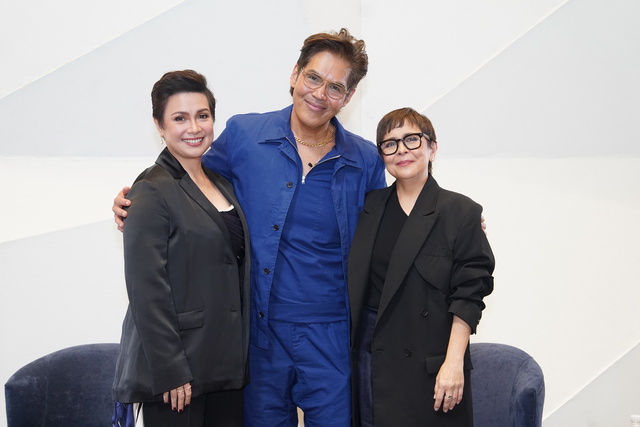
“There’s no 45-minute vocal warm-up,” the Tony- and Olivier-winning star said during a recent three-way conversation with Golden Globe nominee Dolly de Leon and Emmy-winning Filipino-American set and costume designer for stage and screen Clint Ramos.
De Leon is Request’s other headliner, Ramos the show’s producer and creative director, and last month's gabfest—called Conversations in Spotlight—kicked off the promotional activities for the show which opens October 10th at the Samsung Theater.
Request sa Radyo is a daunting challenge
Salonga’s early jubilation at not having to use her voice at all for the play was tempered rather quickly with the realization that the material presents a particularly singular daunting challenge. “It’s like, Oh crud! I better figure this out because we don’t wanna bore the audience to death.”
De Leon had the same initial reaction when she was approached to star in Request. “I’m so happy na walang lines because the thing I hate the most about acting is memorizing lines!” she said. “But I’m terrified about boring audiences to death kasi there’s nothing happening.”
But of course there’s a lot that’s going to happen onstage. “We’re moving around and doing things for the audience to get a hint of what the character is going through, but no words are spoken.” Salonga echoed de Leon’s idea of the show. “Even though there’s a lot happening in this tiny apartment, how do we keep it interesting without saying anything, without music?”
A peek at the New York rehearsals for Request sa Radyo.
The previous life of Request sa Radyo
Adapted from a landmark play written in 1971 by German playwright, author, actor and film director Franz Xaver Kroetz, Request sa Radyo is described as “a masterpiece of modern theatre, which transforms the mundane into the extraordinary through silence and leaves audiences contemplating the depths of solitude.”
The play captures a night in the life of a woman living by her lonesome in an apartment. For this adaptation, the woman is a Filipino migrant care worker. It opens with the OFW arriving home at the end of a typical work day and ends, a little over an hour later, with what has been described as “a final devastating act.” She is totally alone with no one to talk to the entire time.
De Leon knows this kind of modern life very well. “It’s not a concept that’s alien to me because I’ve experienced that,” she noted.
That experience came courtesy of a recent 6-month shoot in Germany for the second season of the limited drama series Nine Perfect Strangers starring Oscar winner Nicole Kidman who also serves as producer.
“I come home from work so tired and I can’t even call my kids because it’s 3 a.m. na sa Manila pero 10 PM pa lang sa akin [in Munich],” the Triangle of Sadness star explained. “I had no one to talk to.”
This “shedding a light on what that particular life is like” is what excites Ramos the most about the play. “It’s truly a voyeuristic look into this woman’s life and what this idea of connection means to us.”
He noted that the World Health Organization has declared loneliness as the next epidemic, affecting 3 out of 5 women over 50. He said it is a wide affliction among OFWs, in particular, “who are essentially beasts of burden outside the country caring for strangers when they ought to be caring for their own families.”
De Leon cited an exact figure, 1.9 million. She said one of the things she will have to always keep in mind throughout the project is that “it’s not about me. I am not doing this to perform. It’s to tell 1.9 million people’s story all over the world, who are away from home, who are so lonely.”
Describing the play as almost like a hybrid of performance art and theater, Ramos said Request makes him think about what acting really is, “a conveyance of human behavior that doesn’t necessarily have to have human words.”
Or music. Which is apparently an issue with some Salonga followers. “I read comments on social media saying that, since you’re not singing and saying anything, I’m not gonna go,” the voice of Mulan and Alladin’s Jasmine shared.
Which is fine by her. “It’s their choice. They can opt out. I won’t be offended.”
Ramos was quick to remind people that the Tony and Olivier awards that Salonga received early in her career were for Best ACTRESS and not Best Singer. Audiences who will ignore Request will be missing out on a one-of-a-kind theater experience, especially in this side of the world. Ramos has seen the show four times — four different versions in three countries — and raves that it’s one of the most riveting plays he has ever seen. And with his kind of work, he has seen a lot.
As though that alone isn’t already inviting, the Manila performance will have theater powerhouses Salonga and De Leon alternating in a very limited engagement. “If theater were the Olympics, here are two Olympians,” Ramos noted. Olympians who are gold medalists at that.