

Spot Shelf: Filipino Journalist Writes About Covering News in Countries of Conflict
The seasoned broadcast journalist's essays will take you from Sulu to Gaza.
Products and services recommended on our websites are independently selected by our editors. If you buy something through our links, Summit Media may earn an affiliate commission at no extra cost to you.
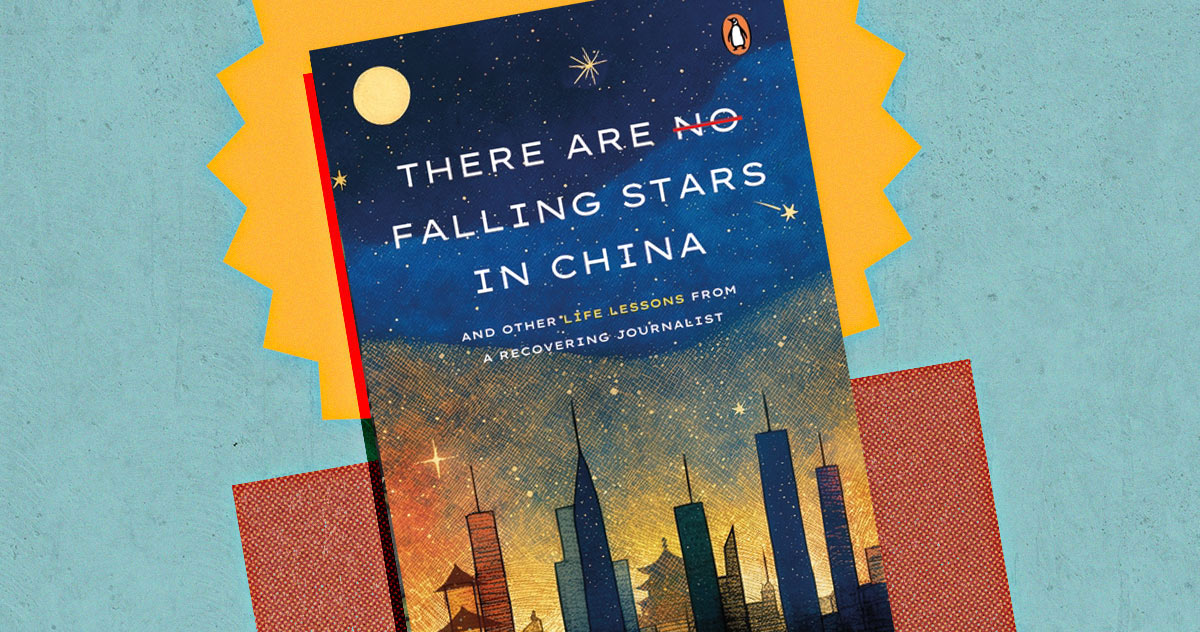
(SPOT.ph) There is no better time to read Marga Ortigas' There Are No Falling Stars in China and Other Life Lessons from a Recovering Journalist than now.
The slim volume is a collection of essays culled from her over two-decade long career as a Filipino broadcast journalist working for two of the world’s biggest news agencies: CNN International and Al Jazeera. Most of those years were spent covering news in conflict zones—or "conflicted" areas as she calls them—across five continents and dozens of countries. She has been sent on assignment to Baghdad in the wake of Saddam Hussein’s deposition and even covered the funeral of slain Hamas leader Sheikh Ahmed Yassin in 2004 in Gaza.
This brings us back to my opening statement—there’s no better time to read it than now.
Here are five reasons why you should read There Are No Falling Stars in China and Other Life Lessons from a Recovering Journalist by Marga Ortigas:
Elegant and Eloquent
There is much to be admired about Ortigas' writing style. It has the precision and incisiveness of a seasoned journalist, which she is.
There is also, however, an elegance and eloquence found primarily in creative writing that runs throughout her prose. This should come as no surprise, as the same publishing house published her first novel, The House on Calle Sombra, in 2022.
Her essays read like poetry at times, lyrical and evocative, yet detailed and precise, such as when she described Baghdad: "When I recall Baghdad now, it is always in tones of russet and bronze. The color of sepia and dusk, through a veil of timeless shamal sandstorms. The hue of the copious cups of native cardamom chai we drank in the bureau."
A Treasure Trove of Information
With each essay set in a different country, one should expect a crash course on various topics from history to culture, politics to current events.
I didn’t know there existed an enchanting place called Hatra in war-torn Iraq until I read about her (mis)adventures when what was supposed to be an investigation in Iraq’s autonomous Kurdistan region, turned into a detour to the capital of the first Arab kingdom.
I have absolutely no clue there is an island called Yap in Micronesia, where money “meant little” and where true wealth is measured by the size of stone coins—literal coins made of stone—you owned.
I’m quite familiar with the plight of the Palestinians of Gaza and the West Bank. Still, it is through Ortigas' recounting of her experiences crossing the infamous Erez Pass that I gained a deeper understanding of the everyday indignities these people must endure. Her account was so visceral I almost felt the heat of the sun beating down my back as I awaited Israeli soldiers to bark their orders.
Allow me to borrow the writer's words: "Operated by the Israeli military, Erez Pass is one of the most fortified border crossings in the world meant to protect the country from those it sees as its greatest enemies. Its neighbors. I wrote in my notebook then that it made Baghdad—with its heavily armed guards, endless concrete barricades, and thick, thick blast walls seem like Disneyland."
There Are No Falling Stars in China also gives readers an intimate peek into the lives of journalists, particularly those assigned to the world’s most difficult places. She sometimes talks about her mixed feelings as a journalist, wherein she finds herself straddling that thin line separating fulfillment from frustration.
In her Gaza essay, she reflects on life as a news correspondent: "Journalists often speak of ‘parachuting into a story’—we got dropped in then pulled out. Rapidly digesting and reducing people's realities to less than two minutes of TV. That is the privilege of the job, and its cruelty. Those we ‘cover’ don't have the luxury of ‘escape’ and must deal with the truths of their existence once the news cameras are gone."
Ortigas lets us in on a roller coaster ride of emotions, from joy to despair, hopelessness to optimism, even letting us see her vulnerabilities at times, especially when she was denied a leave request when her mother was rushed to the hospital.
She writes: "My North American line manager refused to grant my leave request, putting it thus—We all have parents who die. I have told this story in writing once before and I repeat it here because I am still stunned by the callousness. Anyone who would say such a thing lacks the empathy required to work in news."
Inspiring but Not Pedantic
Ortigas’ reflections, rooted in decades of journalistic experiences in some of the most troubled spots on earth, brim with wisdom. Inspiring but not pedantic, the words of wisdom punctuating each essay inspire thought and reflection.
One of my favorite closing lines in the book is from her Jerusalem essay, when she reflects on the "shared humanity" she experienced there. She writes: "Faith and hope have always transcended borders. And it's surprising what you might see when you have no expectations."
Armchair Travel Companion
With the essays set in various countries across five continents, There Are No Falling Stars in China is a travelogue of sorts. It’s no Lonely Planet or Fodor’s, but expect a more intimate and insightful kind of writing not so different from how the late Anthony Bourdain saw the world—a mix of awe and curiosity (at times pessimism), but always with a dash of optimism and faith in our humanity.
Her prose whisks you to faraway lands, those we only see on National Geographic or Discovery Channel, and she does so in such a way as if we’re traveling with her. Some places may have seen death and destruction far too often in recent history, but she can always find the good and the worthwhile, even in places where all hope seems lost.
Like how she ruminated on her Christmas in Albay, in the shadow of an angry Mayon: "What a beautiful sight, indeed—when even the threat of calamity could not dampen a deep-seated trust in life's majesty? I was away from my family that Christmas, but the people of Legazpi showed me that there's more to a burbling volcano than doom…In the face of misfortune, they chose to hold on to a silver lining. No matter how faint it might have looked through all the ash."
A Much-Needed Dose of Optimism
A scroll through one’s news feed reveals how broken the world has become. From the never-ending war in Ukraine to the increasing violence in Israel and the Palestinian Territories, it looks like the future for humankind is bleak and desolate.
But Ortigas' essays teach us to hope against hope and to leave room for optimism to keep burning because no matter the conflict, there is always the chance for even the faintest shimmer of humanity and hope to shine through.
Who better to teach us such life lessons than her, who has been a witness to death and destruction one too many times—from the jungles of Sulu to the foot of a restless Mt. Mayon, from the smog-choked streets of China to a Japan reeling from an earthquake and tsunami of such awesome magnitude, from the desolation of Baghdad to the open-air prison that is Gaza? Always there is hope.
Allow me to end this article with a quote from the book’s epilogue, which deftly condenses the author's outlook on life and its many ups and downs, twists and turns:
"Point is: I always preferred to look beyond what I was told was ‘real' and tried to find something ... more. Something less confined and a little more magical. That extra bit of special.
I guess, early on, something within told me there had to be more than what could be seen. Or touched. That reality itself could not possibly be limited to what we arrogantly thought we knew.
That we couldn't allow ourselves to be trapped and defeated by—or feel victim to and wallow in—sadness and despair because of life's injustices. So, yes—I believe in fairies...and angels…and time machines...(and Star Trek)...and miracles. Funny then that a 'dreamer’ like me (as I was often called) would end up working in journalism. Or maybe—serves me right?"
So why should you read Marga Ortigas’ There Are No Falling Stars in China?
Read it for the elegant prose and the wealth of information. Read it for the words of wisdom and to be whisked away to lands unknown.
Above all, read it as a reminder that in even the darkest of times, there is always reason to hope and to let our shared humanity shine through.
There Are No Falling Stars in China and Other Life Lessons from a Recovering Journalist by Marga Ortigas (Penguin Random House, 2023) is available on Shopee and Lazada for P1,032.
Links are updated regularly and as much as possible but note that products can run out of stock, discounts can expire, and listed prices can change without prior notice.
For more discounts and deals, check out Spot's exclusive vouchers.
Also read:
Patricia Evangelista's Some People Need Killing Is an Ode to Truth
Isang Dekadang Resty Is a Relatable Novel About the Child of an OFW