
A Gen Z Author and Gen X Komikero Unite to Create Cybernetic Manananggals in This Graphic Novel
A rising young indie author and a legendary comics creator collab on Makina.

(SPOT.ph) As an advertising creative, Katrina F. Olan was used to running on agency time. But her co-creator, Ian Sta. Maria, was based in Denmark, which meant notification pings on the project they’d be working on would come at very odd hours indeed.
“It would be just, like, random times,” recalled Kat with a laugh.
For his part, Ian worked as an artist in global toy company LEGO. Working from the woods of Billund, inspiration could strike any time—whether Ian was on the treadmill or in front of his PlayStation 5. But when the muse beckoned, Ian heeded the call. Picking up a pen, he’d draw one fantastic image after the other.
Kat remembers receiving one drawing in particular. Think of a manananggal, but wreathed in a black carapace of armor, with cape-like wings crackling with plasma. It was myth meets mecha—right up the indie sci-fi author’s alley. But she racked up her brains for a story to accompany Ian’s art, until her brain hit upon an unexpected prompt: What would famed nature documentary narrator Sir David Attenborough say if he saw something like this out in the wild?
Behind the making of Makina Graphic Novel
The science fiction graphic novel Makina is the fruit of Ian Sta. Maria and Kat Olan’s twin labors. Inside this book are 59 jaw-dropping illustrations where Filipino myth, folklore, and pop culture collide with a cyberpunk aesthetic—like a gigantic mecha kapre, or cute little robots queuing up at a fuel station shaped like a sorbetero cart, or a jeepney, armed to the teeth in a far-future Manila hellscape.
Here’s how they split the work. Ian drew all the art himself, in between working at his day job. He also wrote some of the flash fiction that accompanies each piece. But for many of the stories, he collaborated with a young, up-and-coming author just making her mark in the world of self-published science fiction.
The pair were two generations, and two worldviews, apart.
As a Gen X-er who came up in the age when an X-Men comic could sell a million copies, Ian has spent more than two decades as a Filipino komikero. He remembers a comic convention in his alma mater in the late ‘90s, with bad haircuts, oversized tees, and Image co-founder and Pinoy comics trailblazer Whilce Portacio in attendance. He sold his first comics there and made P7,000—a not-insignificant amount of money in those days.
After graduating from his fine arts course, he enrolled in the school of hard knocks known as the Philippine advertising industry. “Sinisigawan ka habang tinatapon sa mukha mo yung mga kwento mo,” he not-so-fondly remembers. He paid his dues while doing his comics on the side—the acclaimed fantasy Skyworld, the gritty Sixty-Six—before he moved to LEGO and created Salamangka, a graphic novel series that was, in many ways, the predecessor of Makina.
Katrina F. Olan, meanwhile, is a borderline Gen Z-er, and grew up at a time when superheroes and sci-fi ruled the box office, even as sales of actual comics plummeted. She learned early that, to make your work known—especially as a young Filipino creator—you had to have the social media smarts to stand out. She learned that lesson early with her debut novel, the steampunk adventure Skies Above.
“Kung matapang ka, mag-self publish ka,” she said. “Kasi you're exerting your own time, effort, and money to gamble whether or not your book is going to make it or not. Obviously, Skies Above, by traditional publishing metrics, did not make it.” But Kat was undeterred. “It was a great first self-published novel.” And what’s more, when she took a second crack at self-publishing, she knew exactly what she needed to do better. She made a business plan. She sent samples to book enthusiasts on Instagram. She invested a lot of time and effort in fostering a community on social media.
That second novel, Tablay—a mecha adventure set in a near-future Manila—landed at the start of the pandemic, and, thanks to viral word of mouth, became a runaway indie success during the lockdown. It was her contribution to the growing ranks of Pinoy science fiction novels, directly inspired, not just by the video games and the television shows of her youth, but also by the overflowing creativity of the Pinoy indie convention scene she witnessed when she was hawking Skies Above. “Because I was like, ‘How come all of these people make great Filipino stuff? Why can’t I make that too?’”
Also read: Meet the Pinoy Comic Artist Who Works for LEGO
Pinoy sci-fans embrace their graphic novel
Ian Sta. Maria sees a lot of his own story in Kat Olan’s creative journey. Except, as he wryly noted, “It wasn’t called self-publishing during my time. It was called xeroxing and stapling.”
There were a whole lot of things that separated this Gen X komikero and this Gen Z author, but that was a creative challenge that they both relished when they both started working on Makina. “I loved the yin and yang,” said Ian. “Kat is very structured and organized. I am not.”
Kat initially found their first back-and-forths very daunting. When she received one of Ian’s drawings in the mail, she was stumped, blocked, and just a little bit frightened. “Kasi it was like, how else am I going to tell the story? Ang ganda na ng picture, 'di ba? It seemed like it already existed in its own world.”
To make her stories live beside Ian’s illustrations, she had to find new ways to tell stories. A drawing of a hoverbike racing over a post-apocalyptic Philippines got her thinking, “What if he’s a delivery rider just trying to make it home before sundown, across some very dangerous terrain?” And that became Chapter 30, entitled “One Last Ride.”
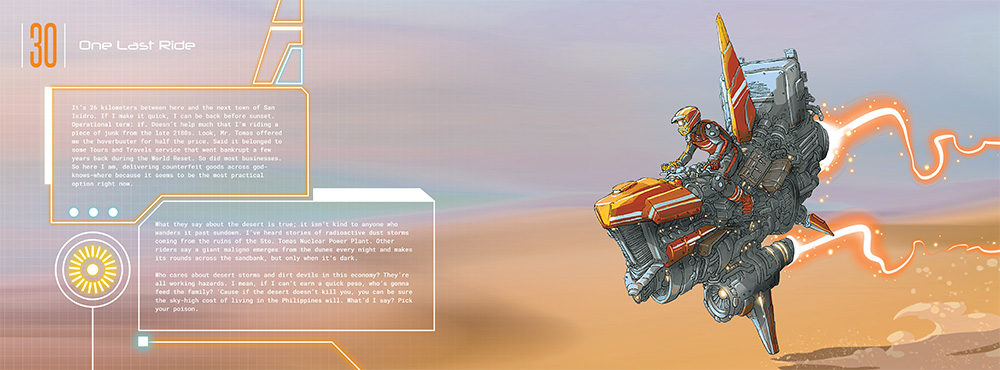
For his part, Ian was excited about the new perspectives his co-author was bringing to his work. “My voice is not always the best thing to listen to when telling a story,” he said. “Hearing a story from other people actually makes something better.”
Openness, collaboration, and a healthy amount of creative tension: this was the secret sauce that made Makina work. Despite the huge difference in time zones, the two found themselves excitedly exchanging stories, drawings, and notes. It all came together in less than a year. And then, last September 2023, Ian got on a plane and flew back to the Philippines for the launch of Makina at the Manila International Book Fair. He and his co-author posed for a joke-y photo where they shook hands, spoofing the kind of press release fluff the two of them had probably worked on in their respective advertising careers.
Then, in front of a packed room of fans, they began signing books.
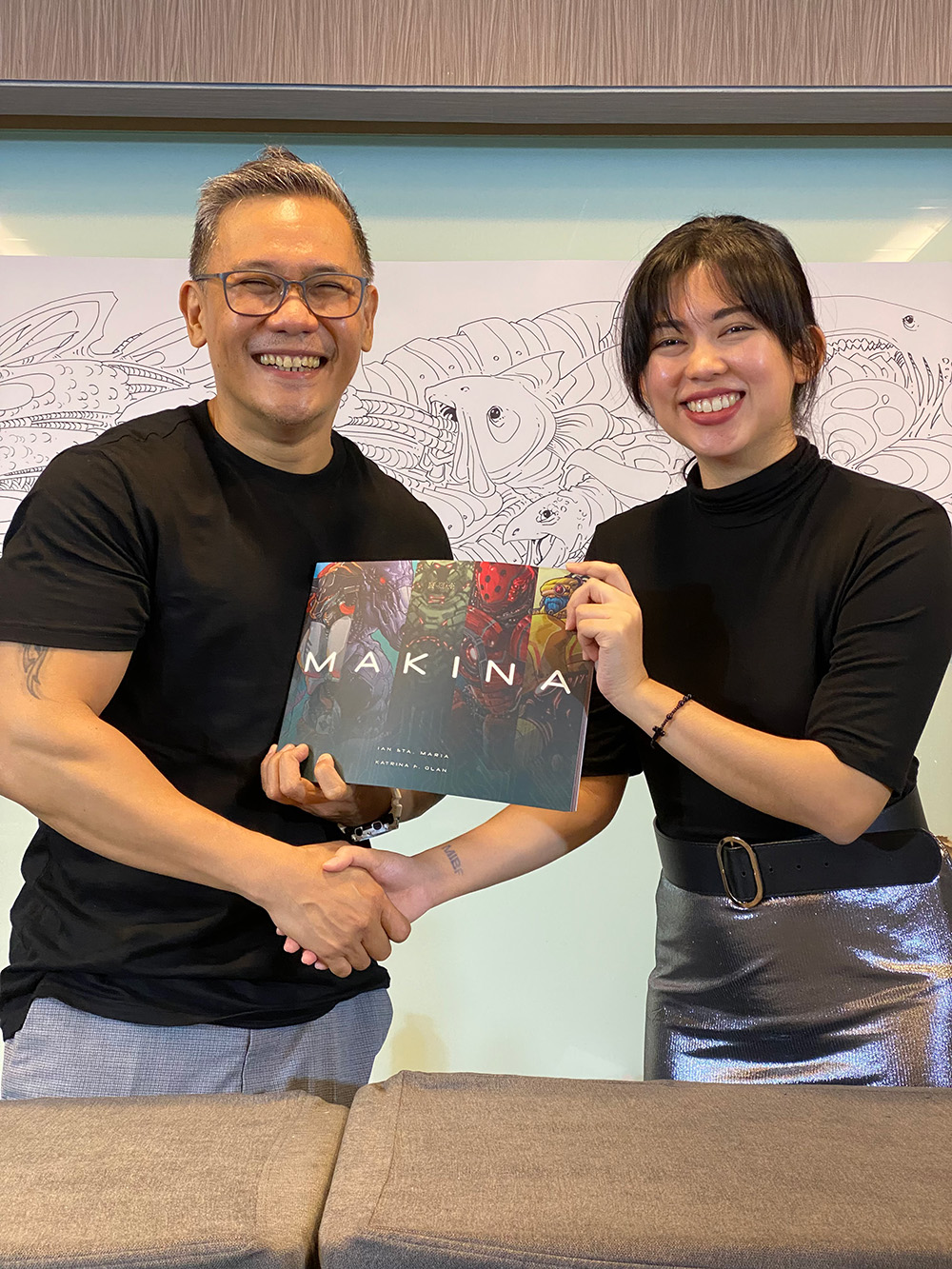
Months after the successful launch, Kat has a theory about why Makina became such an unexpected success. “Readers like two plus two, but they never want four,” she says over a Zoom call. At the other end of the line is Ian, safely back in Denmark, listening. “They only want the two plus two. Gets mo? Because if you give them four, you’re just dictating everything that they should think. But a great writer, a great artist will only give them two plus two, so that the readers have the joy of bringing the two together to make four.”
Makina (P675) is available at Lazada, Shopee, National Book Store, Fully Booked, and major bookstores nationwide.
Hey, Spotters! Check us out on Viber to join our Community and subscribe to our Chatbot.