

The Story of Berg’s: How a Pre-War Shopping Mecca Keeps Its Spirit Alive in Today’s Escolta
Before Hub: Make Lab, there was Berg's.

(SPOT.ph) Today’s Escolta is worlds away from the busy, elegant shopping hub it was way back in the latter years of the Spanish Colonial Era through the vibrant American Colonial Era and the busy Port-War years. La Puerta del Sol, La Estrella del Norte, Heacock’s Department Store, Crystal Arcade, Brias-Roxas, Kairuz, Fanlo, Lissar, Beck’s, Hamilton, Oceanic Commercial, Chiok’s, Soriente Santos, and Syvel’s were just some of the shopping haunts of the time, names one can now only find on the pages of history books, old magazine ads, and social media posts in Facebook groups like Manila Nostalgia.

Among the early retail stores in the country that to this day stirs up fond memories in the hearts and minds of Manila old timers is Berg Department Store which was located at the ground floor of the Perez-Samanillo Building, now known as Escolta’s First United Building. Today, that space is Hub: Make Lab, a place for the city’s young creatives, a collection of curio shops, a barbershop, a vintage clothing store, a serious coffee shop called The Den, and more. That’s why even young millennials and Gen Zs have come across the name Berg’s—they see it when they visit the building. It’s printed on the chest of a shirt, and it’s the name of a delicious coffee drink, the one with coconut milk and Muscovado sugar, at The Den.
Also read: These Vintage Photos of Binondo, Escolta, and Divisoria Will Remind You of Manila's Glory Days
Hub: Make Lab in Escolta Is a Cool New Space for Unique Finds
Escolta Once Was: Berg Department Store
The Berg Department Store was founded in 1939 by Ernest Berg, a German-born entrepreneur who migrated to Manila after WWI. As recounted by his daughter, Evelyn Emberg Empie in her book, “A Child in the Midst of Battle,” Ernest was born the eldest of six children in 1901 in a small textile manufacturing town just outside Cologne in Western Germany. When his father, a textile engineer went off to war, Ernest was left to take care of his mother and younger siblings. His father might have survived the war but he was soon killed in a motorcycle accident. The young Ernest had to work to support the family while studying at the same time.

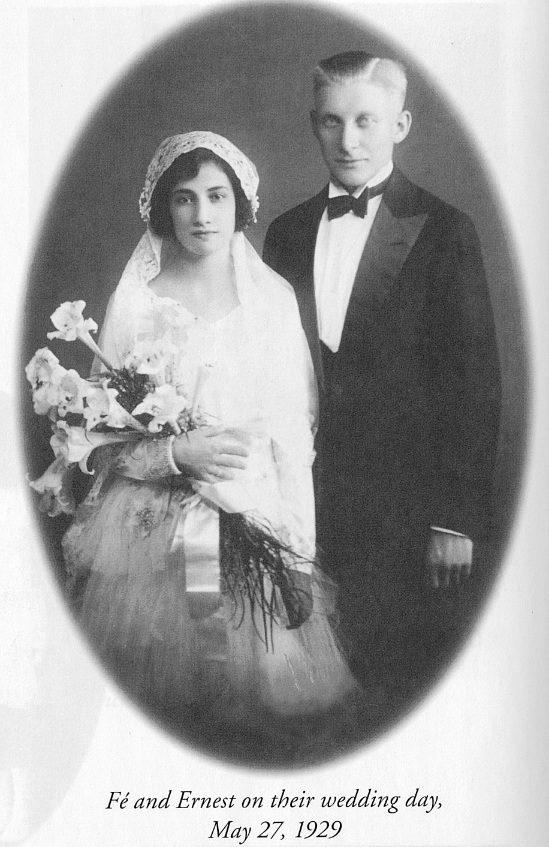
Seeing no future for him in the local textile industry, Ernest decided to seek greener pastures in America. He and his younger brother left Germany on a motorcycle with a sidecar, going across Europe and Asia. As proof of Ernest’s enterprising nature, to help support themselves on the trip, he wrote accounts of his adventures and sold his stories to the hometown newspaper. Two and a half years later, Ernest and Aldred caught a freighter in India bound for the United States. But when they steamed into Manila Bay, Ernest, it says in the book, “was so taken with the warm tropical setting and the beautiful sunsets…that he postponed his passage to America for two decades.” But of course it could just be that he ran out of money.
As recalled by daughter Evelyn Empie, Ernest’s mind “was restless, always working…(he) had forward-thinking ideas, and the drive and competence to realize them.” An article in The Tribune dated August 22, 1940 recounts the growth of Ernest’s business empire:
“In 1930, Mr. Berg opened a small store in Iloilo. From this modest beginning grew a large business (and) today he has 32 stores scattered all over the archipelago. He has three stores in Manila: the store at 666 Rizal Avenue which deals in automobile accessories and spare parts; the service station at Mabini and Isaac Peral (now U.N. Avenue in Ermita); and the Escolta department store”—initially known as Red Star Store and later Berg Department Store, or simply Berg’s.
Mr. Berg’s choice of location was also fortuitous as it was the former location of Lyric Music House, a dealer in music sheets and musical instruments which Ernest’s wife Fe Romero Mandelbaum, a concert pianist, must have frequented.
In its earlier days, the Red Star Store sold mostly merchandise for home use: chinaware, glassware, silverware, electrical appliances, kitchenware, curtains, bath towels, and practically every item which housewives needed everyday. Going over the recollections of those who lived during that time, however, Berg’s is best remembered for their ready-to-wear clothes, babies’ wear, men’s wear, ladies handbags and accessories, costume jewelry, cosmetics, shoes, gift ware, Christmas cards, and toys.
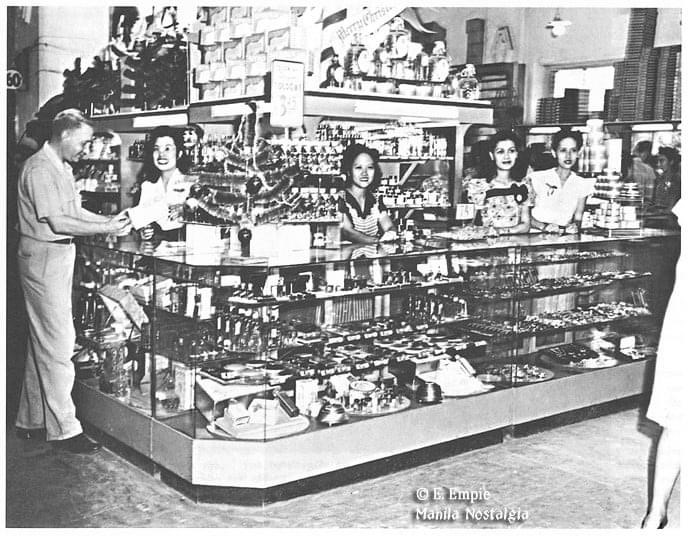
“Whenever I meet old-timers from Manila, they excitedly tell me that Berg’s Escolta is where they went to buy outfits for special occasions,” Evelyn recalls in her book. “I was fascinated with Dad’s store, and often went there to look at the merchandise.” Evelyn also says in blogger Lou Gopal’s Manila Nostalgia blog post: “The store was beautiful, full of glass cases and shelves. On one of the shelves in the toy section, I saw a doll that was so beautiful I thought I needed to have it. I asked my dad if I could take her home. Daddy asked me if I had the money to pay for it. I still remember how shocked I was. ‘But daddy, you own the store so the doll belongs to you. Can't you give it to me?’ Then and there I was privy to a dissertation on profit and loss, and inventory control. I told him I wanted to work at the store so I could get money to buy the doll.
“That Christmas, which was 1939 when I was 7 years old, daddy put me in charge of the Christmas card section. He pulled up a footstool to the cash register, showed me how to use it, I knew enough subtraction to make change, and I had my first job as a salesgirl. I remember a young man coming up to me and saying he needed a Christmas card for his girlfriend. The two of us started reading cards until he found the perfect one.”
Reading the comments of Manila old-timers on posts about Berg’s in Manila Nostalgia, one realizes how the toys were such a hit. Emmanuel Imperial recalls: “Yes. Berg’s toy display was a spectacle to watch when we would stroll along Escolta after dining at T. Pinpin (St.) to bring down what we have eaten. (However), the only item that my parents bought me there was a plastic submarine hat.”
Oscar Lagman recounts: “Berg’s was where I nagged my father to buy me those imported toys like those electric-powered trains and those authentic-looking Colt 45 (guns) that I saw in many Errol Flynn and Randolph Scott cowboy movies. No, my father never bought me any toy from Berg’s. He bought me those imitation pistols hawked on the sidewalk. They lasted a week.”
Bobby Manansan also recalls a toy he hankered for but never got, as it was too expensive: a Mobo Bronco Riding Horse of pressed steel which was made in England. As Jose Resurreccion says: “The toys on display over Christmas…created challenges for our parents as they pried us out of the store and store window.”
Others, like my husband, remember their parents buying them clothes and shoes for special occasions at Berg’s. My husband distinctly remembers his mother buying him and his brothers white, knee-length shorts and formal white shirts for Christmas. Others remember buying shoes “which lasted forever” until they were outgrown.
A photo taken during the Japanese Occupation reveals that during the war, Berg’s Escolta was taken over by a shop named Nan Ko Soo, whose sign replaced Berg’s. As recalled by Evelyn in her book, her father was “forced to supply the (Japanese) Imperial Army with truck batteries and other items from his Red Star Auto Stores inventory. (While), on the other hand, Dad knew the allies would eventually win the war, and that he risked arrest for collaborating with the enemy. So by day he cheerfully supplied batteries to the Japanese, by night he secretly donated money to the guerillas…I later learned that a sympathetic priest passed along Dad’s donations to the guerillas…Dad also demanded a receipt, proof that he had aided the American cause.”

However, after the war, Ernest Berg’s German roots made him an easy target. As it says in the book, “Guerilla pesos and receipts from the priest, his guerilla contact, did him no good. After a summary investigation, Ernest was imprisoned.” President Manuel Roxas would soon grant amnesty to suspected collaborators. Ernest was freed on July 6, 1946.
The man would rebuild his store “one floor at a time, eventually restoring it to full operation.” After moving his family to the United States in 1945, Ernest stayed behind in Manila to keep running the business. The original plan was after the store became operational, he would sell out and join his family in the U.S. But destiny decreed something else and Ernest and Fe were divorced in 1950. That same year, Ernest married his longtime secretary, Mimi Yak, and settled in Hawaii.

As seen in a photo of Escolta on the cover of This Week magazine, Berg’s was already up and running by December 1946 in time for the Christmas season. As narrated in Lou Gopal’s Manila Nostalgia blog: “In 1951, Sy Lian Teng, (a Chinese immigrant from Amoy, China who owned Cosmos Bazaar), bought the Berg Department Store from Ernest Berg. The Fifties and the Sixties would see the Escolta district come back to life although not with its former sparkle and renown. Still, Sy enjoyed (anew) the glory days of Berg’s.”
As further recounted in Gopal’s story, like the Pre-War Berg’s, the Post-War Berg’s was a family-run business, with Sy’s second wife, Emerenciana, his son, Roberto, and wife, Lorraine, helping him run the store. In 1979, upon learning that the former Perez-Samanillo Building was up for sale, Sy Lian Teng purchased the part of the ground floor occupied by Berg’s plus the 3rd, 4th, and 5th floors from the family of Jose Cojuangco, Sr., the father of future President Corazon Aquino.

Due to changing times, Manila’s premiere shopping districts would shift to the Makati Commercial Center, the Greenhills Shopping Center, and the Araneta Center in Cubao, and due to his struggle with labor problems, Sy Lian Teng decided to close Berg’s in 1982. The family continued to lease out their acquired spaces in the building which eventually was principally managed by Sy’s son, Roberto, and his wife, Lorraine.
Also read: 10 Fun Things to Do in Binondo, Escolta, and Malate
From Berg's to HUB: Make Lab, Escolta Remains
Today, the First United or F.U.B. Building is enjoying a rebirth, thanks to the generous support of Robert and Lorraine Sylianteng, and the passion of its resident creatives and merchants. According to its Facebook page, “The HUB serves as an incubation space for those who wish to experiment in a more stable and sustainable setting. It is open to sellers and concessionaires of crafts, interesting artworks, limited edition merchandise, innovative food items, upcycled clothes and accessories, independent clothing labels, DIY wares, vintage goods, and refurbished antiques.”

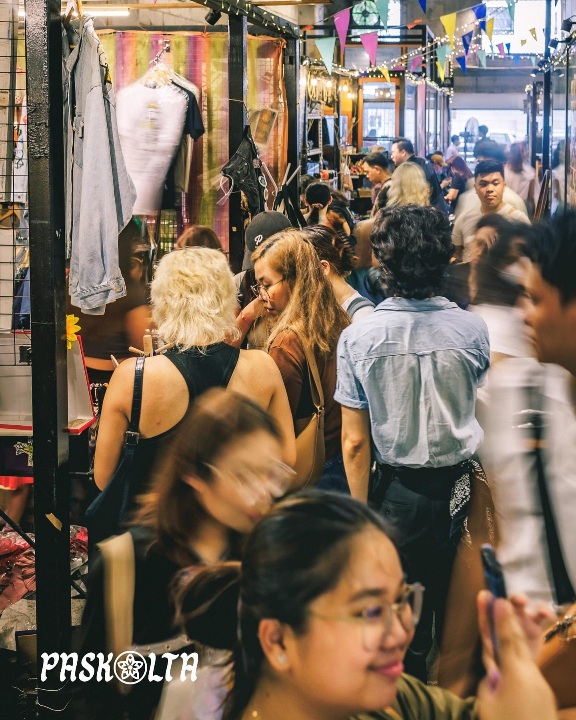
This Christmas, the Paskolta event opened at the HUB, continuing the Berg’s tradition of giving Christmas cheer to shoppers but with a twist. Instead of the imported ready-to-wear clothes, shoes, toys, houseware, ladies’ bags, shoes, accessories, and cosmetics Berg’s was known for, one can find here reworked and relaxed vintage Filipiniana wear from GloriousDias; hand knitted caps and tops from The Morning Hooker; Boksi Kardis reversible tops reworked from vintage bedsheets; old magazines; colorful artwork from Kukonices; funky stickers from Alien Opinions and Darna Letters; live hand-lettering by Edwin Tayao; artisanal candles from Crescent Island Candle Co.; jewelry from Getceleste and Helga Crafts; and more. Indeed, Berg’s spirit of Christmas cheer lives on.
The author wishes to thank Mr. & Mrs. Robert & Lorraine Sylianteng, Mr. Lou Gopal of Manila Nostalgia, and Ms. Evelyn Berg Empie for providing and sharing valuable information and photos on the history of Berg Department Store, as well as all those who shared their memories of Berg's in Manila Nostalgia.