

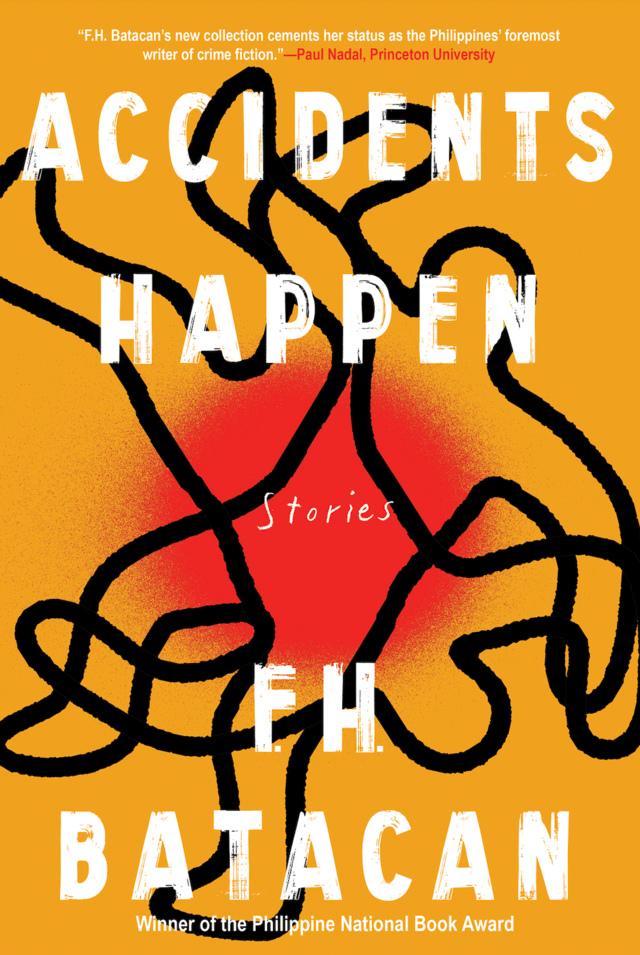
Accidents Happen: Stories Wonderfully Frustrating and Familiar
"It's like I lure you in with the good catering and now you're stuck at this awful party with me."

(SPOT.ph) I purchased F.H. Batacan’s second major release in a moment when I think I’ll finally have time to read: when I’m sure I’m about to be denied a visa, and my original flight is coming up.
That the said visa gets approved almost two days after that flight took off is important; it means that I find myself traveling alone, save for my luggage and a fresh copy of Accidents Happen, sobbing quietly in the center aisle seat of a red-eye flight as the other passengers snooze through the crampedness of the cabin. I have just finished reading One Cry, a story that for various reasons challenges what my inner circles confirm to be a sturdy—at times scary—exterior.
I have more than once told Batacan (to her face, mind you) “literally how dare you,” through tears I either cannot or refuse to make coherent. She writes what is perhaps too true; she writes what is ugly; “I write when I’m angry,” she says. “Damay ko na rin kayo.”
The characters of Batacan's world
Happy endings and redeeming qualities are not the author’s specialty, nor would she ever strive for such a thing. Through the lens of her signature procedural, journalistic-adjacent style, there emerges a predictability to evil—the ordinary and overwhelming kind rather than the fantastical but ultimately surmountable—that becomes obvious once the innuendo of pomp and process is stripped away.
Yet the stories of Accidents Happen are not without the thrill of a twist, as well as the dread of recognition, to the point that for as long as one has meaningfully engaged with the world outside of one’s personal bubble, the subtext explodes into a 3D model of the obstacle course that is polite society. “I’ve either made or had [the meals in the stories], and you might have, too,” explains Batacan, “and you almost certainly know those people.”
I do know them—the portly, falsely pleasant people who have tried to bribe me into speaking favorably of them with a glimpse into their glittering world; the gruff officer who thinks he can scare me into rescinding a complaint; the shopkeeper or security guard who feels they must somehow placate me with some version of English when I speak and understand Tagalog just fine. “I sometimes get the critique that I write caricature rather than character,” says the author, “but it must be said that [the Philippines] tends to be a caricature of itself.”
I finish all the stories two or three nights into my trip, in between settling in, eating everything my sister makes, and sightseeing. I shoot a message to the author to ask if she’d rather I email her my questions for this very interview; she hits me with “Wait, what? That was real?”
“Oh my god, yes,” I half-screech in disbelief. “I was going to read your book anyway, you know.”
“Call na lang, para masaya!”
Mirror, mirror
Her stories in this book come together in a manner that she won’t take credit for—“I’m not that smart,” she laughs—demonstrating masterfully that “fiction” doesn’t necessarily equate to “categorically untrue.” They are simultaneously unrelated, fictional incidents and vignettes of a grim reality, only disjointed in who they involve at the time in which they’re set.
The first story, for which the whole collection is named, chisels at the wall we believe comes naturally between us and the invisible witnesses to our lives; the second challenges the reader to not take any sense of agency for granted; both, as with most of the others, are products of supposedly bygone eras that find themselves cycling back. “The difference between then and now is the difference between peacetime and war,” says their author. Everything after that appears to be forged by fire; Batacan reveals an unrelenting new urgency to write as much as possible following last year’s cancer diagnosis.
And whether we, her audience, can attribute the eerie currentness of the entire collection to that major life event or to the unpleasant patterns of history is difficult even for her to say. The newer tales featured don’t feel any less timeless, nor do the edits for a post-post-pandemic era rip you from your reading experience.
Kicked out of Eden
Batacan’s approach to crime fiction is ultimately a quiet unmasking of society, and Philippine society especially; even Smaller and Smaller Circles was a callout of our oddly pious ways and under-the-rug pseudo-solutions, stemming from the many frustrations over her colorful career. The taboos are, perhaps correctly, not the most shocking parts of the stories in which they appear.
“It’s really the way we snake our way to the truth and hope it falls like an apple into our laps,” she says, “when we already have an inkling that we cannot handle the truth.” And we as a culture never seem to learn that biting that apple gets us booted from the garden, wishing we’d never asked.
I don’t mean to make the collection sound bleak and heavy—despite both the approach and general theme, the reading is compelling and far from cumbersome. The reappearance of Smaller and Smaller Circles’s Father Saenz gives a sense of the passage of time, of natural change; while some may think he’s too jaded, I’d beg them to consider that the man is a priest and a forensic anthropologist whose help the police often enlist and whose advice they just as frequently dismiss. Batacan might not say it, but I will: Do the damn math.
I know I’m going to lend my father this book once we’re back in Manila; “I can tell I’m going to enjoy it,” he says. He’d already started it on my sister’s couch in Canberra, putting it down only when he remembered I was still working. Crime fiction is absolutely his thing, but Batacan’s abandonment of the classic whodunnit slant urges the reader to ask the more difficult questions. Why? Why did that promising girl have to pay for the temper of an entitled man? Why can’t Saenz get any further? Why am I suddenly so angry—
There it is; the author’s trap. “It’s like I lure you in with the good catering and now you’re stuck at this awful party with me,” she declares through unapologetic laughter.
And that’s sort of the secret, whether she means for it to be or not. That’s how F.H. Batacan becomes the writer for the once-voracious reader who wants to reclaim that identity. Despite the seriousness of the genre, there’s a levity and ease to the style that dispel any sense of intimidation without giving it all away. “As a writer, I like to live in the gray areas,” she says. “I find that the stakes are somewhat higher if that tension I build goes nowhere—does he make it? You know what you want the answer to be.”