

Unli Coffee, Be Your Own Barista + More Things You Missed at the Manila Coffee Festival 2023
It was a celebration of all things coffee.

(SPOT.ph) Coffee is the real hero of our everyday lives. After all, some of us can't function without at least one cup a day. So it's just fitting to celebrate it in many forms along with thousands of coffee aficionados at the three-day Manila Coffee Festival 2023 where the main character of the Philippines' biggest coffee festival to date is—you guessed it—coffee.
Coffee chuggers who attended the event held at the Marriott Grand Ballroom in Pasay City on March 17 to 19 weren't judged for carrying three cups at a time. At the annual festival—where over 100 exhibitors from all over the country congregate to hail what is arguably nature's best stimulant—inhaling coffee's aroma and savoring each sip is acceptable.
As we count the days to its next installment, let's recall what happened at this year's event.
Also read: The SPOT.ph Guide to Coffee
Here's what went down at the Manila Coffee Festival 2023:
The Single Origin Bar took our taste buds to different regions with its wide variety of locally-sourced, hand-sorted coffee beans, prepared just the way you like it: via pourover, espresso machine, French press, or other coffee machines. This way, anyone and everyone—from amateur cup-of-joe drinkers to coffee snobs—can enjoy unlimited coffee.
For those looking for more adventure in a cup, the Manila Coffee Festival 2023 introduced the Double Shot Bar where coffee marries alcohol to take that caffeine buzz to a whole new level. Here, Agimat showed us the perfect way to down both at the same time by concocting the Sultanate Spritz, a sweet drink made of Kanto Salted Caramel Vodka and Sultan Kudarat cold brew. Give it a try at home but be careful as this is a deceptively lightweight (read: traydor) drink, according to those who tried it (including this writer).

Outside the bar, folks from Destileria Limtuaco & Co. showed attendees how to enjoy coffee in ice cream and in cocktails as they had us try their Espresso Martiki Milkshake (with rum, coffee liqueur, Falernum, pineapple chunks, and Amadeo gelato) and Affogato Martini (with Napoleon VSOP, coffee liqueur, Orchid Crema de Cacao, milk, and Amadeo gelato). The Luzon highlands were also represented with coffee wine and other drinks from Kalinga.

What surprised us during the event is the unlikely combination of coffee and fruits. Coffee Hour, which came all the way from Zamboanga, brought its single-origin excelsia coffee with notes of jackfruit. It's best paired with hantak, a Tausug delicacy made with flour, eggs and sugar served druing special occasions. A few stalls away, Ugnayan showed us how to do manual pourover of locally sourced beans with taste notes of pomelo, butterscotch, and dark chocolate.
Kape Natividad from Tanay, Rizal blew (or should we say, brewed) us away with their Cocodamia (iced Americano with buko juice) and Black Summer (iced Americano with watermelon)—two drinks that their barista Alfred Quisquino assembled just three days before the event. The result: naturally sweet, refreshing caffeinated drinks that are perfect for summer. Curious? Head over to its branch where it will soon brew its unique drink, according to Quisquino.
For coffee aficionados who want a spill-proof way for their daily caffeine intake, Another Coffee introduced us to two treats that's perfect for snacky folks: chocolate-covered coffee beans and what they call Kopicones. Remember the tip of ice-cream cones where the bottom is filled with chocolate? That's essentially what Kopicones are, except they're made with crushed coffee beans sans the ice cream. These snacks come in three different flavors: dark chocolate, white chocolate, and matcha. If you missed the festival you can have it delivered to your home.

Several booths also encouraged attendees to be active participants in the coffee-making process. At the Brewing Grounds booth, you can brew your own cuppa and make latte art for free with the help of its baristas. Three-day coffee bootcamps are also held in different parts of the country so you can immerse yourself in coffee-making from farming and roasting to brewing coffee.
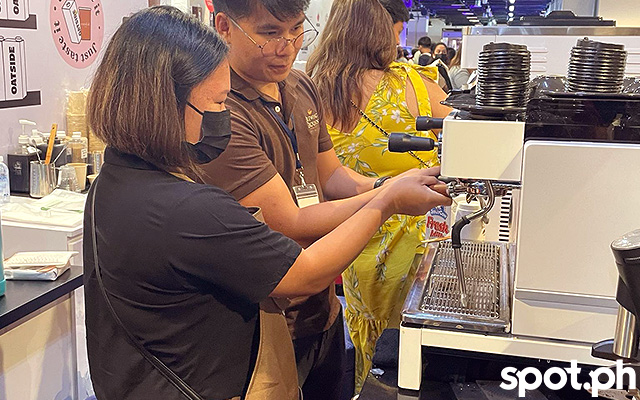
The festival also showcased exhibitions and brewing and mixing demonstrations at the Manila Coffee Festival Theatre, while it featured farmers and coffee experts at the Kape Talks.
Coffee Flexes Its Influence Beyond Beverages

More than chugging coffee, the festival is a celebration of arts and culture from the regions where it is harvested—and a testament to how this humble bean inspired the lives of many Filipinos. The Art Hall features the works of the Association of Coffee Artists of the Philippines, Mulat Art Movement, Sentro Artista, and Kape, Sining at Kultura in different mediums. Coffee art were also made on the spot. Multiethic and multilingual music were also performed during the event.
The festival also introduced attendees to Ammin Acha-Ur, a traditional mambabatok from Butbut tribe in Kalinga, where Apo Whang-Od, the oldest and most popular mambabatok, resides. Those who were feeling extra adventurous lined up to get tribal tattoos at the festival hall.

Ultimately, the Manila Coffee Festival Is for the Farmers

More than a feast of this delicious liquid energy giver is the celebration of hands behind it all: the farmers.
"The Manila Coffee Festival 2023 has always been and will always be about supporting our hardworking local coffee growers," it said on Facebook as it ramped up support for the event.
The company Bugkalot Coffee, which partnered with the Bugkalot tribe from Nueva Vizcaya to grow coffee under a joint profit sharing agreement with the community, believes that events such as this one allows them to know more about the current market and to bridge the gap between coffee farmers and consumers. More than the monetary gains, the festival is a space for them to understand the taste of coffee consumers and how to improve their services, said its CEO Joseph Tanchi.
"Part of our ethos is, aside from just helping them in terms of livelihood, it's also raising the dignity of farmers, the communities and the indigenous peoples," Tanchi told SPOT.ph.
"If you really want to empower them to stand on their own, we believe it will be harder, the road will be longer, but long term it would be better for them."
"It's also an opportunity for farmers to come down to Manila, have a change of pace, enjoy the city, enjoy staying at a hotel, have some food, so it's a combination of all those things."
For coffee farmers Sonny Nangitoy and Eleanor Collado, events such as this one empowers them as more people discover what local farmers can bring from their farm to every Filipinos' dining table.
"Malaking tulong po itong ma-discover ang ating kape at makilala, marami po tayong nagiging contact," said Nangitoy.
"At least ang pakiramdam, nai-inspire sila, 'yung self-esteem tumataas din kasi sa ganitong paraan. Malaking halaga sa aming farmers na maipakita na malaki ang aming kahalagahan," said Collado.
The Philippines' pioneer annual coffee event is patterned after its sibling festivals in London, New York, and Amsterdam. It was first held at the World Trade Center in 2019, paused during the height of the COVID-19 pandemic, and was back in 2022 in Intramuros.
For more information, check out Manila Coffee Festival’s Facebook page.
Hey, Spotters! Check us out on Viber to join our Community and subscribe to our Chatbot.