
This Quirky Whisky Bar Was Shipped by Its Japanese Owner from Kansai to Manila
This Japanese whisky bar doesn't serve Japanese whisky. But character, it has plenty of.
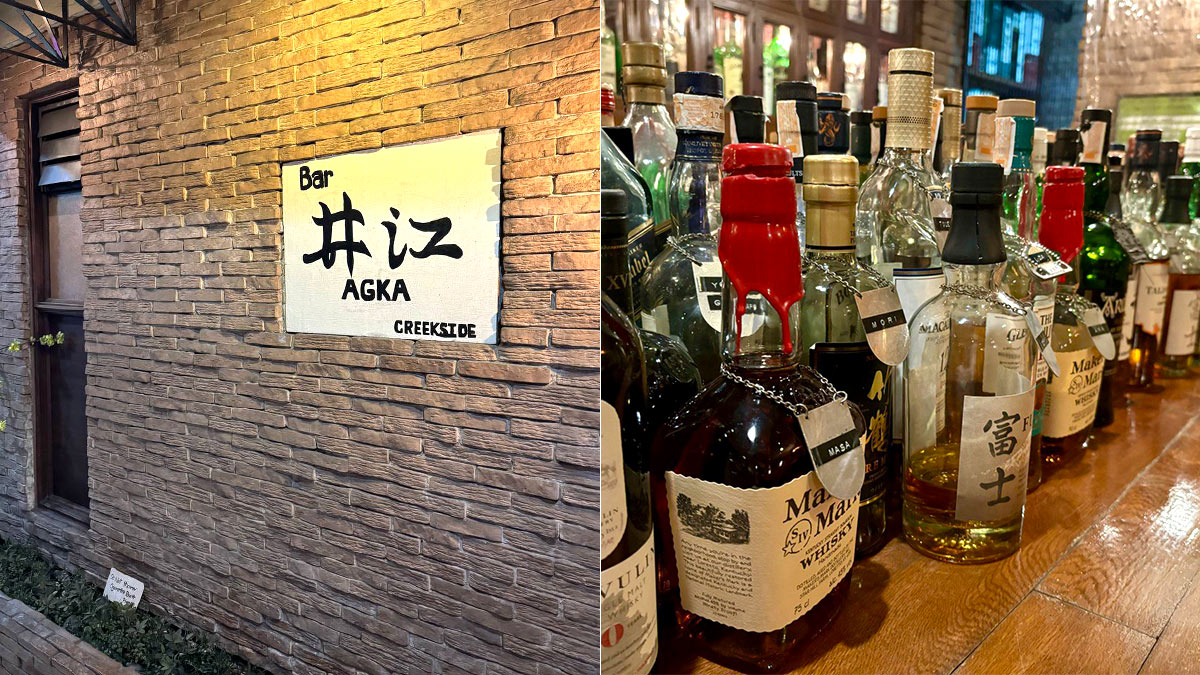
BAR Ie (also called BAR AGKA)
Room 5A, Mezzanine Floor, Makati Creekside Building, Amorsolo corner V. A. Rufino Street, Legazpi Village, Makati City
Contact: 0927-426-0311
“Sitting in bars and cafes
Writing songs about songs
And plays about plays
But how rarely we dare
To write something that says
Anything about bars and cafes”
— ‘02: Be True to Your Bar, The Magnetic Fields
(SPOT.ph) Building a writer’s bar in Makati is impossible. First, it must be reasonably quiet—perhaps with café-volume music and chatter. Second, it must be somewhat affordable to drink there. And third, it must be profitable, or it shuts down within a year or two. To be quiet, it can’t be full. To afford not being full, it must charge more for drinks. And to survive while being neither full nor expensive, it must at least have cheap rent (bye, Makati!).
This is why you will hardly find people pulling out laptops in bars—and why we need to deal with white TikTokers complaining about Filipinos working in Starbucks. Even if you bring out a pen and paper at the literal Writer’s Bar in Raffles Makati—you might get a weird look from the society types. Never mind that the bar charges 810 pesos for a Sidecar—at least famed imperialist Rudyard Kipling once stayed in Raffles Singapore. Heritage!
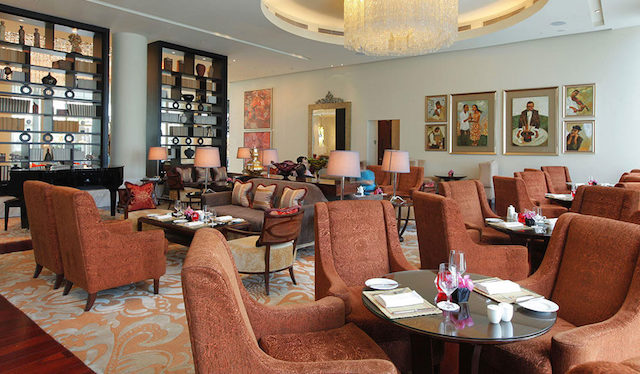
So, barring the occasional lost (but generous) soul who invests in a cheap, quiet night place in the CBD, a bar in Makati is pretty out of reach for the typical writer, and the typical Filipino. But we love them anyway. Many of us spend our days in jobs we cannot stand so we can afford a messy night at the bar, which helps us stand our jobs a little longer. Or, more eloquently delivered in the Verve’s 1997 hit Bittersweet Symphony: “Trying to make ends meet—you’re a slave to money, then you die.”
Also read: Cubao Is Now a Fine Spot to Have Crafty Cocktails—Here Are 4 Bars We Recommend
For the writer, more than drinking sinful amounts of alcohol, the best medicine for this kind of misery is story—to at least come away from these nights with something to tell. For bar owners (bless them), it is a challenge too. How does one build a place where things happen? Where, even if a modern-day Dostoevsky can no longer afford to write Crime and Punishment in them, writers can still hope for a night to write about when they get home? At the very least, these nights, and these places, still exist. And these humble essays—not quite reviews—attempt to chronicle them. They are not always the best known, or even the best rated, bars. But they are bars with the possibility of story—which, maybe, is what keeps us going out, instead of just drowning our sorrows at home.
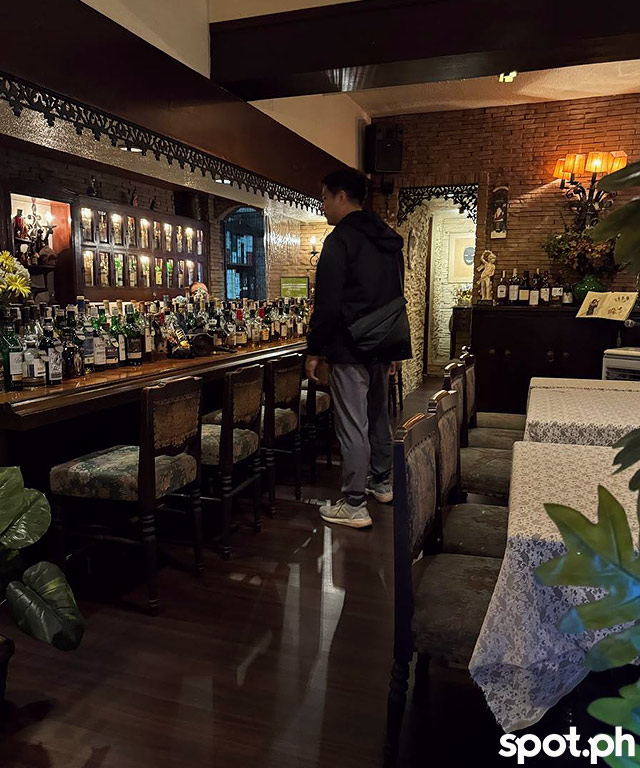
Take a look at BAR Ie, an under-the-radar Japanese bar in Makati:
I first heard of BAR Ie, also called BAR AGKA (read: "BARAG KA!"), from my friend Ali Sangalang, who put up his own bar called Big Fuzz in Creekside Amorsolo. In the midst of renovation, Ali and his partners wandered into the neighboring BAR AGKA and found themselves in a charming, well-maintained, and indubitably Japanese whisky bar—which serves no Japanese whiskies, mind you.
The interiors are patterned after a traditional Japanese kissaten (reminiscent of Persona 5’s Cafe Leblanc, for gamers). The bar counter is polished narra wood—more than fifty years old. The piano looks antique. The CD player teleported from the 90s, and the chairs with aged but clean upholstery. It is a stunning departure from the rest of the Creekside complex, whose public toilets sometimes have rats swimming in shit. No, the toilet in BAR AGKA is serene and Japanese-styled, with tasteful art on the walls.
In one of their evenings in the bar, Ali and his friends met a sociable businessman who poured them free (and expensive!) whisky until they were all drunk. Charmed by this prospect, I asked him to take me there.
BAR AGKA is in fact not the real name of BAR AGKA. It is BAR Ie in Japanese—AGKA is merely the combined initials of its owners, and is meant to be a subtitle of sorts. Of course, it is also the easiest (and only) way for non-Japanese drinkers to refer to the place. Behind the bar are married couple Kaz and Irene, and in between them and the customer are at least a hundred whisky bottles, dogtags hanging around their necks, bearing the names of their owners.
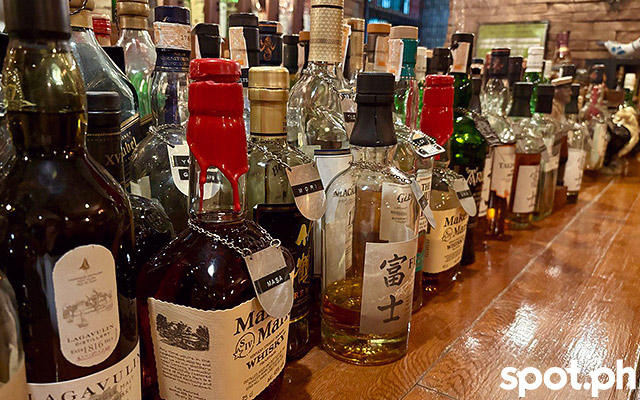
Whisky at BAR Ie
On a Friday night, Ali and I were alone in the place. A miscalculation. Their clientele, Irene says, is majority Japanese—and most of them went home for the holidays. But this allowed us to ask about a little institutional history, as Irene poured us glasses of Caolila (P600) and Talisker (P500).
BAR Ie originally existed in Amagasaki—an industrial city that stands between Kobe and Osaka. Kaz, the owner—or master, as the Japanese would call him—plied his trade there for 38 years before family circumstances had him planning a move to Manila. But, unable to abandon his home of 38 years, he had the entire bar crammed into a container and shipped to the Philippines.
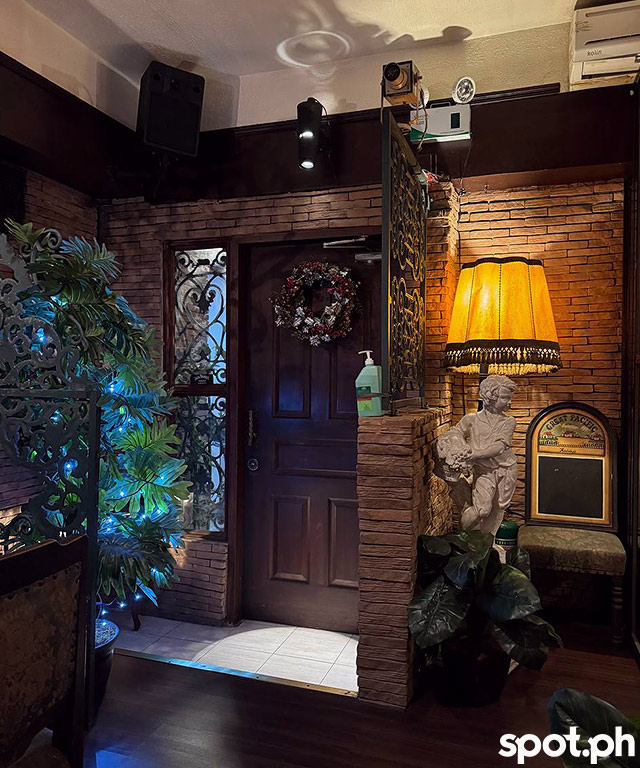
Master Kaz doesn’t speak much. He sits at the end of the bar and answers Irene’s questions. “Dad, how old is the bar counter?” Irene asks. “50 years,” he answers. “Dad, how much did it take to ship this all here?” she asks. “About two million yen,” he answers. One imagines them in their home, where they keep only dogs, talking pretty much the same way. Irene tells us that pretty much everything in the place, except the flooring and the walls, is exactly what Kaz had in Japan—the chairs, the tables, the cabinets, the art, and even the door.
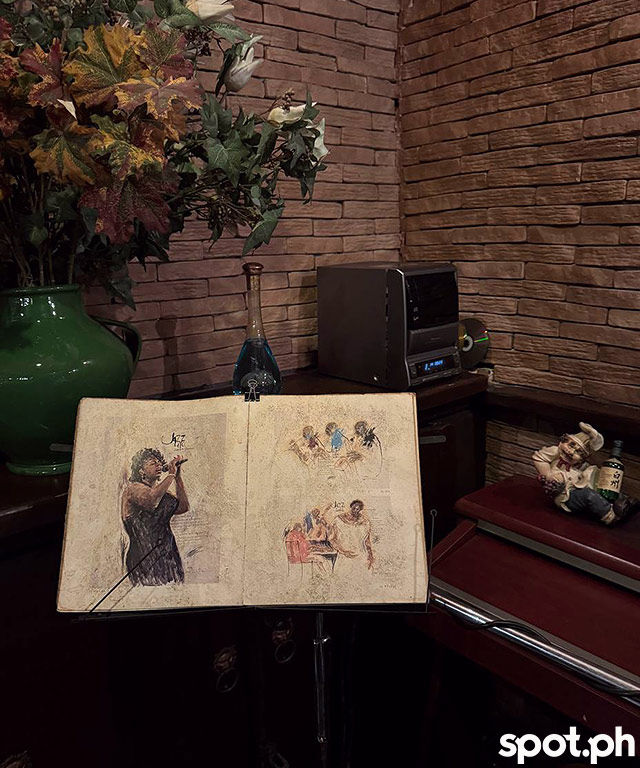
It is not something we can always put in words, but people have a sense for this kind of devotion. We know when a place is cared for. We know when it is a 1 of 1. BAR Ie is the only branch of BAR Ie. It is not a chain; it is not one of many branches; there are no quotable quotes about drinking tequila plastered on the walls. Its two proprietors clean and run the place every day, and their loyal customers are loyal not to a brand—but to this single married couple.
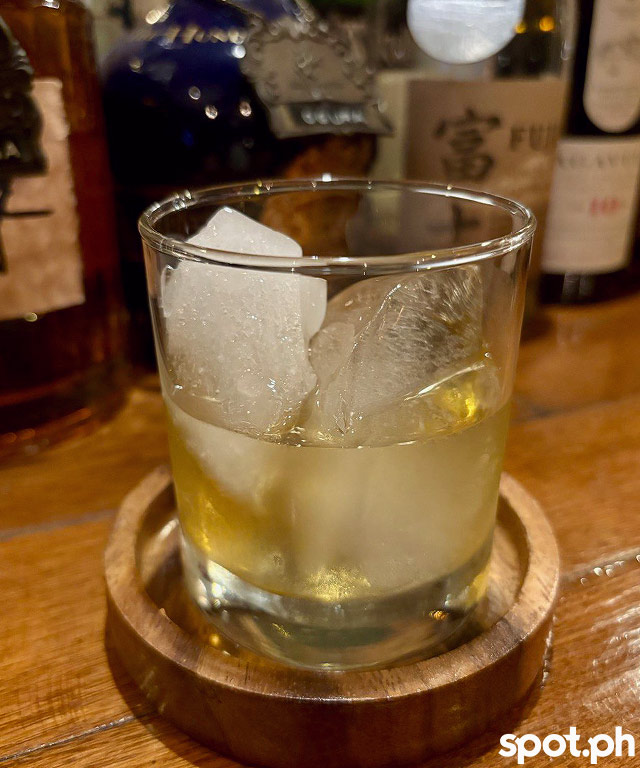
The background music is anonymous jazz (they used to have bands come by, Irene says!) and the whisky is whisky. No cocktails. No complexities in the palate, apart from the whisky’s own. The only decision to make is neat, a splash of water, or ice—and the only food in the menu is a curry rice that Master Kaz has perfected over the years. Otherwise, it is Nagaraya, Nova, and green peas for the guests.
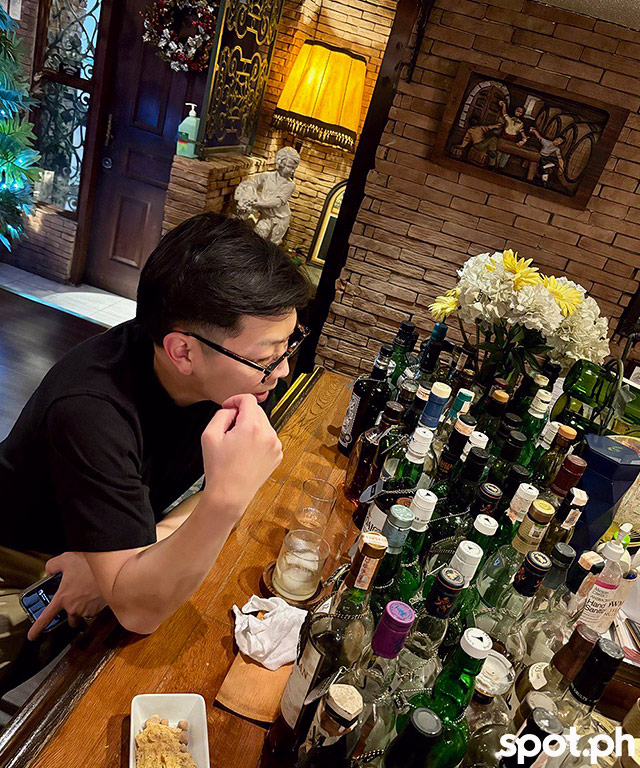
At BAR Ie, one might look around and think to themself: Yes, this is the only place this bar can exist—nowhere else. The Master remains quiet, perhaps because this place-making feels more like his language.
“I have prepared this place for you,” he might say. “I hope you enjoy.” And it is indeed a delight. There are only two people behind the counter, and the other guests, it they arrive, would be foreign. You are anonymous here—you are not your job, not the school you went to, not the citizen outside the door weighed down by their country. Any friends you make must like you for you. You are in a bar that serves nothing but whisky and curry rice. And when your glass arrives in front of you, you know it has traveled down the Pacific Ocean—a long way—a far longer way than you’ve come—before finally arriving.
“What time do you close?” we ask Irene. “Depends,” she answers. “If people are having a good time, we can go as late as 12:30 or 1 a.m. But tonight it’s only you two, so we might close up soon.” Which is another perk of running your own place, just the two of you for the last 12 years. Just like their bar, which was sent here with no thought given to cost, driven by pure devotion—Kaz and Irene can play it by feel.
Hey, Spotters! Check us out on Viber to join our Community and subscribe to our Chatbot.