

The Dream Coffee Champions T'Boli Farmers in Every Cup of Joe
Seven years into social entrepreneurship, The Dream Coffee's Larissa Joson continues to stay rooted.

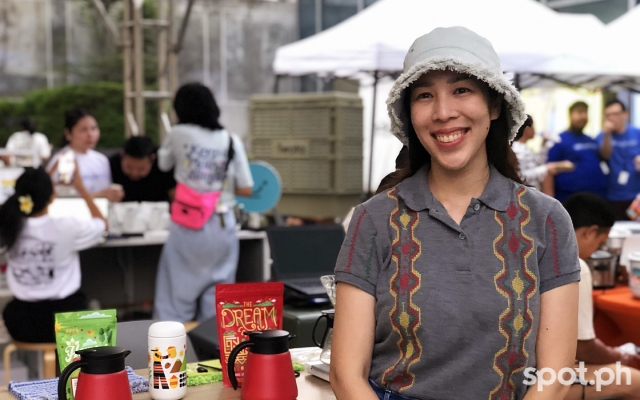
(SPOT.ph) We’re in an oasis of green in a sea of grey, a specialty cafe across Legazpi park in Makati. Journalist and social entrepreneur Larissa Joson doesn’t rush through her coffee (a flat white), pausing between sips to savor the hard, careful work of the farmer, trucker, roaster, and barista who brought her this cup.
Six years in the biz, she now knows how it is. Since 2018, she’s run The Dream Coffee, a coffee processor focused on beans grown by T’boli indigenous communities in the highlands of Lake Sebu and South Cotabato, supplying coffee retailers across Metro Manila and beyond while also selling roasts and blends directly to consumers.
Also read:
The SPOT.ph Guide to Coffee
Under-the-Radar Coffee Shops in Marikina City
The story of The Dream Coffee
As of press time, with new coffee processing facilities, TDC has now expanded to aid coffee farmers from nearby provinces, and their latest line of coffee, the Homecoming series, is based on this collaboration. They plan to help even more coffee farmers in the future.
I’m supposed to be interviewing her, but many times, her storyteller side comes through and she starts interviewing me. It feels less like a formal interview however, she has something about her, something every good storyteller has, that makes you want to open up and share.
She finds out we have parallel experiences in community fieldwork and we light up, connecting over witnessing people returning to themselves. Our conversation pauses, the silence comfortable like a well-balanced, expertly brewed white coffee, sweet and textured without relying on sugar.
“So much of the good things about the Philippines can be found outside the cities,” she muses, taking another sip.
Within But Not of the System
After interviewing Joson, I ask friends—friends who took business courses, who’ve worked as AVPs and consultants for financial institutions and conglomerates, who’ve run their own profitable businesses—if it makes textbook business sense to disclose the things Joson does to her suppliers, the T’boli people.
It doesn’t, is their general consensus.
But like many social entrepreneurs, profit is not Joson’s sole goal. And business owners who’ve worked directly with her sing a different tune.
“The Dream Coffee has some big-name clients,” shares Kathleen Soriano, who co-owns No Perfect Cup, a specialty coffee shop in Marikina Heights, “but Iya and her team have always treated us like we’re just as important, even including us in their cupping events; and they have more than eagerly supported us in our own events.”
“Part of the culture I hope to establish with The Dream Coffee is a counterculture approach to things," shares Joson, who has bylines in Preview, Vogue, and Smart Parenting, to name a few. "I don’t necessarily see vulnerability as a liability but as an asset.”
In Freakonomics: An Economist Reveals the Hidden Side of Everything, co-authors Stephen Dubner and Steven Levitt reveal a concept known as information asymmetry, where sellers leverage their buyers’ lack of insider information to overprice products, and this applies apparently to both drug dealing and most insurance sales. It’s practices like this that social enterprises like TDC rejects.
Soriano’s ethos also aligns with Joson’s. “No Perfect Cup, just as The Dream Coffee, was built with the community in mind. And community for us includes everyone from our suppliers, to our team, and all the people we get to serve coffee to," she tells us. "Businesses normally follow a linear approach but allowing ourselves to be open with the community we’ve built creates a positive feedback loop, a supportive environment that allows each and every one growth, with each sector of the community benefiting from one another."
“When we did a review of our finances,” Joson reveals, “majority of our earnings really go back to the community in the form of infrastructure, new facilities. We don’t have to keep chasing after the next buck.”
In November 2023, together with Cebu-based cafe institution Bo’s Coffee, TDC opened a new coffee mill in T’Boli, and it has since helped farmers in neighboring Sultan Kudarat province.
Joson describes herself during the early days as “the backroom girl, listening and observing” as her dad did most of the initial talks and trust-building with the T’boli. She only took on the responsibilities associated with executive decision-making a year and a half ago.
I bring up the issue of CEO pay gaps, and how unjust it is to see workers—who create value for the company and deliver key services to customers—take home less, in some cases, so much less that they can’t even afford leisure or education, something Adam Smith himself cautioned against in The Wealth of Nations.
“Our general rule of thumb,” Joson shares, “is that I shouldn’t be earning any more than five times that of the lowest-paid employee. I will only get a raise if everyone gets a raise. And often, the raises don’t happen for me. Because everybody’s salaries were raised, the business wouldn’t afford much reinvestment [if I got a raise too].”
I ask if she gets heartbroken from sometimes having to bear witness to how institutions have repeatedly exploited people like the T’boli. Outside, the late-year weather remains crisp, the sun bright but not scorching, dappling the sidewalks as its light cuts through canopies of old acacias.
After a thoughtful pause, Joson expounds. “If the work comes with being affected by the things that you see or hear, I think it’s worth it, because we’re able to create systems that work. So yeah, compassion hurts, the vulnerability can be very heavy, but if it means being able to create a culture of transparency, and being able to create systems that work in favor of marginalized communities, then ... it’s all worth it.”
And it seems the T’boli themselves have come to embrace TDC. “I’m very thankful each time there’s a new farmer who works with us. They’ve also got their own internal vetting. When we’re able to tell them, “oh, we’ve been doing business since 2017, these are the sitio we’ve been working with and we’re still working with to this day,” it gives them a sense of, “okay, these aren’t your run-of-the-mill traders who come in then disappear.”
In 2018, TDC was working with 16 T’boli farmers, as of press time, they’re working with 50 farmers, T’boli and otherwise, in South Cotabato and Sultan Kudarat.
“There have been months,” Jason continues, “where I didn’t take a salary because the priority was to make sure the farmers get income. A lot of people tell me the business is very inspirational ... they use the world “noble.” But the reality is it’s very difficult, this business is not for everybody.”
And if we had to go back to the coffee, there’s no denying the quality of TDC’s roasts, which Soriano shares was her shop’s main blend when they started out, until they were able to brew their own house blend. No Perfect Cup still releases limited-edition blends using TDC beans.
For Joson, it really is about both ends of the value chain: “I’m also very grateful that we work with roasters and cafes who understand what we’re doing. If they find our coffee “too expensive,” it’s easy for them to just say no. But if they understand that what they’re paying for gets reinvested back into the T’boli community, this in turn becomes a tangible way of helping them.”
An Unlikely But Ultimately Homebound Calling
Joson looks back at how she started: “I never thought I would be an entrepreneur or do anything with business. I always saw myself as a writer or a communicator. I didn’t even know raw coffee beans were green.” Today, she continues to take on both marketing and journalism projects.
During her youth, she would sometimes accompany her dad, a social worker, on community visits. It was in 2017 when “we ended up taking this hike in T’Boli where we saw that they had coffee cherry trees, especially Arabica. They weren’t really doing anything with it. The community’s mindset at that time was that “it wasn’t really worth doing anything with the coffee” because the prices [offered by middlemen] were so cheap.”
I ask if poor logistical infrastructure and lack of processing facilities and knowledge were also factors and Joson vigorously nods.
“Who planted the trees?” I ask. It takes decades for a single Arabica cherry to mature before its fruit can be harvested, its seeds processed and roasted into coffee beans.
“No one knows,” she reveals. Not even the T’boli. There’s hearsay, but no definitive answers. Some say a missionary planted the trees, others say the missionary only discovered the trees. Regardless, the T’boli—who aside from coffee have other livelihoods—were long sitting on a gold mine, and now they’re finally able to experience its treasures.
In a 2021 policy brief, the Philippine Department of Trade and Industry listed coffee as a high value crop (shortened to HVC), defined as a “nontraditional” (relative to crops like rice or coconut) crop whose proper cultivation can potentially yield a higher-than-average return-of-investment to the farmer or cooperative planting it.
The data gathered shows that even if roughly 9% of the Philippines’ total land area is used to grow all HVCs, their yield contributed a whopping 25% to total value of agricultural production across the country.
As such, Joson’s dad saw potential in the coffee trees as Joson recalls him saying: “If we have a way of processing these coffees at a certain quality, that would be better. And to purchase it at a price higher than the current market value. Would you be interested in doing that sort of project? We have to sell this. So can you create a brand?”
And that, Joson smiles, is how The Dream Coffee was born.
Storytelling is her specialty, but specialty coffee is where her heart now is. Since 2018, she’s been using her knowledge in journalism, storytelling, and marketing for the cause she continues to choose to this day.
The T’boli people honor their Dream Weavers, who’ve traditionally made Tnalak, a textile weave whose patterns are inspired by dreams the weavers get during sleep time.
“Even the coffee packaging,” Joson shares, “was reviewed by T’boli elders. It was really representative of them. One of the biggest compliments we received was when one of the tribe members looked at the design and said kami ito (“this is us”).”
As the years went on and her ties with the T’boli deepened, Joson began to realize that “a lot of the things [urban] society espouses now, like caring for the environment, buzzwords like sustainability, those are inherent qualities to indigenous people. They’ve always maintained a connection to nature, a connection with each other, they base their actions on what’s good for the community, not just the individual.”
Spending two weeks in South Cotabato and two weeks in Metro Manila each month, Joson shares that “home” is both worlds, and that sometimes, being in Mindanao is more grounding than being in the Metro.
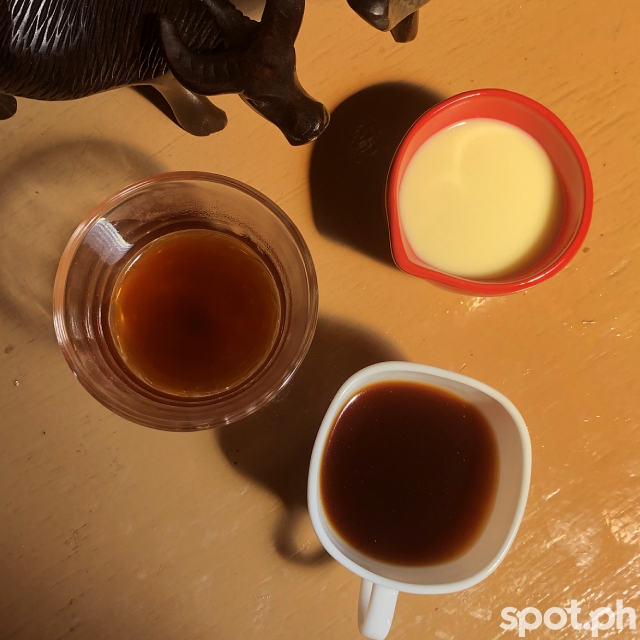
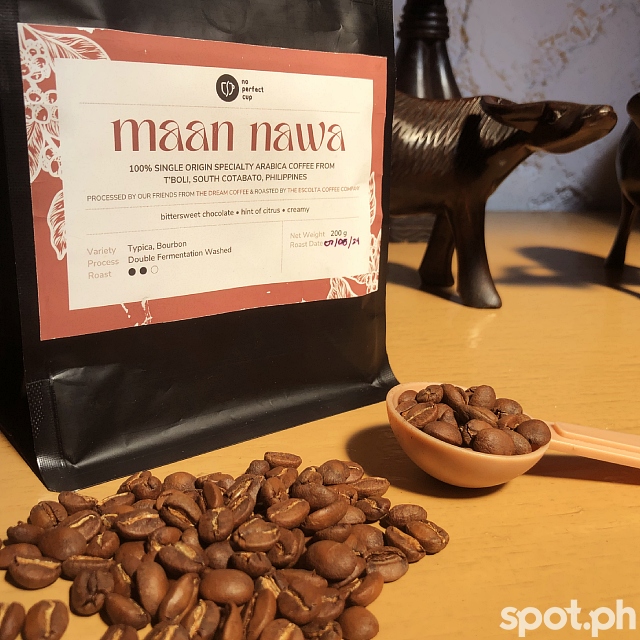
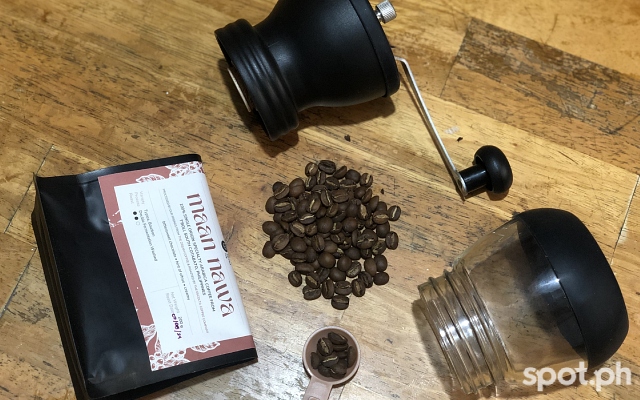
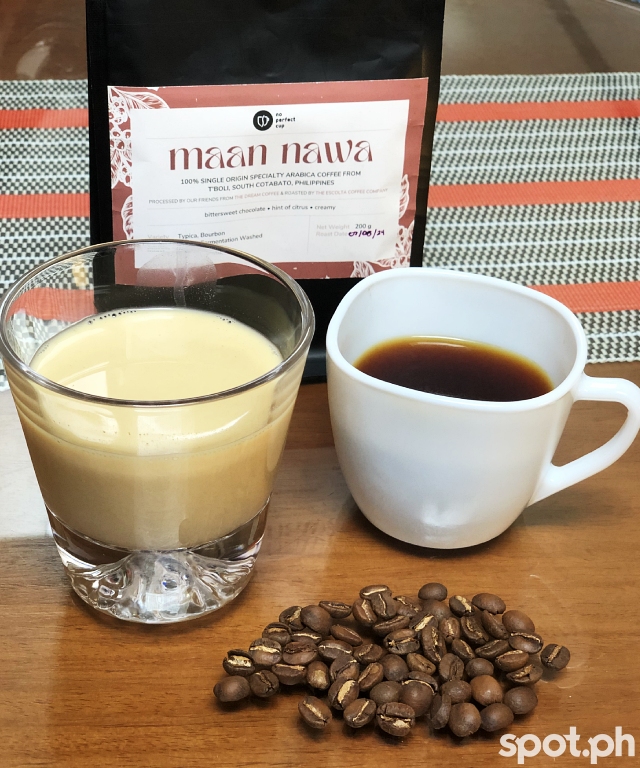
Weeks have passed since our interview. The national weather agency declared the official end of the rainy season, and as I write, the sun is fully and truly out all while the northeast monsoon sweeps away last summer’s humidity. I take this chance to photograph a batch of TDC beans, some gifted to me, others purchased even before I met Joson for this assignment.
The sunlight highlights the roast quality: the love, attention, and collaboration that went into each bean. I work slowly, so as not to spill, waste a single bean. I then ground and brew them, serving them black with side of milk, or white, milk mixed in, their colors teasing the flavors—lightly acidic, full-bodied, both base and standalone drink, everything a good Arabica should be—from each pull. I take more photos.
An hour later, the coffee’s aroma continues to permeate the indoor air even as the used grounds sit on a small bin by the sink. The cups, grinder, coffee press all lie drying.
An airplane roars overhead.
After a period of liaisons, marketing, and events in the metropolis, Joson should now be flying to her second of two homes, to her found family, to the highlands and communities that have come to welcome her. I imagine her smile as she drifts off into a nap amidst a sea of clouds, the languid waters of Lake Sebu whispering to her when she lands.