

MOVIE REVIEW: The Super Mario Bros. Sings the Right Notes of Nostalgia
How this flick gets the tunes just right.

(SPOT.ph) Music, while an artistic medium in and of itself, has always been a cornerstone of the language of cinema. Even back in the era of silent film and when scene dialogue was displayed through title cards flashed between shots of the actors, music served as the undercurrent of all emotion felt within the cinema. Your guide through the story, as integral as the composition of the frame and the cutting between shots.
After all, you have classic themes like those of John Williams’ Harry Potter and Ennio Morricone’s The Good, The Bad, and the Ugly, which have become so intricately woven into the identity of their franchises and genres that it’s difficult to imagine their worlds without them.
The music of classic video games is no different. It’s practically impossible to not recall the “World 1-1” theme of the original Super Mario Bros. game on the NES when thinking on the Mario franchise, or the melodic monk-like chant theme of the Halo franchise. There’s no denying that a lot of what music accomplishes, even in as early as the era of 8-bit synth music, brings the audience deeper into the story and into the emotions of character—and that’s already with video games being an implicitly immersive and lived-in experience.
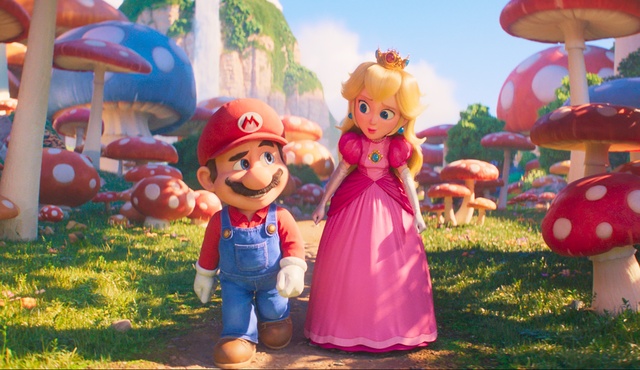
Evidently, it was also music that turned out to be the key to understanding Illumination Entertainment’s latest animation venture, The Super Mario Bros. Movie. Unsurprising for the nearly 50-year-old franchise (yes, you read that right), there were numerous ways to unpack this adaptation; does it honor the Mario legacy? Is it a love letter to the franchise? Is it an entertaining kids movie? The answer, as it turns out, could be found by listening to the music.
Also read: 10 Upcoming Video Game Adaptations That Might Actually Be Good
The Super Mario Bros. Movie Review
Listening to the Super Mario Bros. Movie, one trend becomes loud and clear relatively quickly: the biggest moments of the story are accompanied by either only contemporary pop songs or music from the original game. Want to see a training montage of Mario going from average plumber to the Mushroom Kingdom jumpman? Here’s one set to “Holding Out for a Hero.” Interested to see what a day in Mario’s life in Brooklyn is like? Here are a couple sequences set to “No Sleep Till Brooklyn” and “Mr. Blue Sky.”
While using pop songs isn’t necessarily against crafting the identity of a film’s world, most uses often delve into the territory of simply acting as “jukebox tunes,” or attempts to bring life to an otherwise empty scene via playing a random song. This feels most evident in the film’s use of “Take on Me” as our entry theme into the world of Kong’s, Jungle Kingdom.
For a setting that takes up a relatively large portion of the film’s middle act, it does feel off that its central identity is introduced to us by “oh, look, it’s that song you know!” Then again, that does ultimately come to represent its section of the film appropriately, as the Jungle Kingdom act is a rush through various Mario references and naming games. From Donkey Kong to Cranky Kong to the cat suit, the blue mushroom, and finally to Mario Kart, the film definitely loves playing the game of how fast you can recognize its source material.
The settings of the Mushroom Kingdom and Bowserland are not that different, as they essentially just source the original games’ soundtracks and add some modernized filler to substitute as the score for those locales. This lands better than the use of pop songs, as the original games’ soundtracks do have an identity of themselves associated with them, but it ultimately robs the film, as its own separate Mario property, of any originality or standout heart. There’s no investing into Mario as his own character in this film, other than that he walks, talks, and acts like Mario the video game character that we know.
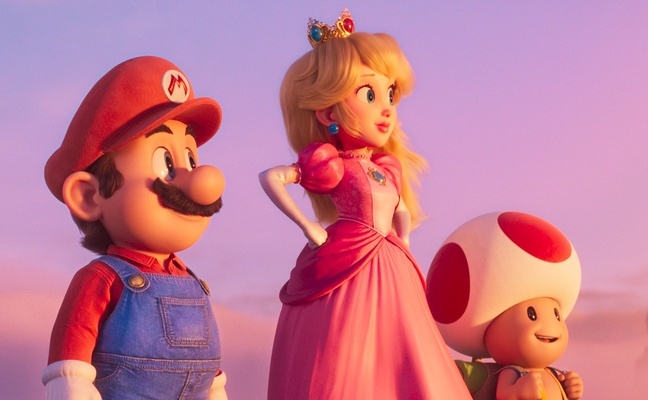
Perhaps not uncoincidentally, the only character in the story that feels like his own character— outside of what we recognize him as in the games—is the character that gets his own musical number: Bowser. Jack Black does tremendous work not only as a comic actor but for crafting an unexpected character for the villain Bowser to play. You most especially see his lovesick, awkward interpretation of the character shine in his shortlived solo number “Peaches,” and it’s exactly this making the character their own that would’ve made the movie just that more compelling and a cut above standard animation projects.
Still, you’ll find yourself swept up by the nostalgia and the clear appreciation, love, and care the filmmakers have for the Mario franchise, especially if you’re a longtime fan of this generational game. It beats unfaithful, out-of-left-field adaptations of the property, but we hope future Mario films (and we’re no doubt getting more of those) make more compelling arguments for why Mario “Jumpman” Mario is a character that’s compatible with transcending from the console to the big screen.
Rating: 3 out of 5 Spots.
Also read: 10 Video Game Releases That Have Us Excited in 2023
The Super Mario Bros. Movie is now showing in cinemas.