
The Manila Film Festival's 12 Shorts, Reviewed
Last two days to catch them!
(SPOT.ph) The Manila Film Festival is the latest addition to the local film festival scene. For their first edition, they gave grants to eight students to produce short films and commissioned four professional filmmakers to make new shorts as well. The 12 films have been split into two programs, all of which are showing at Robinsons Manila until June 11, and Robinsons Magnolia on June 10 and 11.
As with all festivals, the films are of varying quality. But the highs here are remarkably high, which points to the success of the workshops held for the student filmmakers by the festival. There’s a lot of potential here even in its first edition, and one can only hope it continues to grow.
Here are short reviews of all 12 film from the Manila Film Festival, starting with Set A:
NANANAHAN (dir. Dwein Baltazar)
The program kicks off with a banger. Nananahan stars Ronnie Lazaro as a patriarch of a family that resides in what appears to be a used goods store. Shot in black and white, the short depicts a grim existence of sitting in the dim light, waiting for customers to arrive, resigned to a repetitive existence where everyone just keeps doing the same things over and over. One of them dribbles a basketball endlessly. Another preens in front of a mirror while seemingly not having anywhere to go. A schoolgirl goes through a workbook on the stairs.
Slowly, the movie reveals its game, with these characters unable to hold on to anything, as everything is for sale. It suggests that even the people are for sale, part and parcel of this broken life of commerce. This film is just beautifully put together, all of its elements coming together to create this haunting atmosphere that points to a sadness that is difficult to grasp.
UNA’T HULING BIYAHE (dir. Vhan Marco Molacruz - Colegio de San Juan de Letran)
This film does a great job of expressing a deep love for the architecture of the City of Manila, all while telling the story of a young man who has put his studies on hold in order to support his pregnant girlfriend. For the meantime, he works as a driver of a motorcycle taxi, ferrying passengers through the streets of Manila while struggling with what he really wants out of life. The riding scenes take special care to shoot the building that the main character is passing, highlighting the unique details of these old Manila constructions.
It kind of feels like the story ends up taking a backseat, the movie just vaguely moving through a plot that has our young rider learning some lessons from an older rider played by Nonie Buencamino. It resolves in a rather pat way, and the biggest impression it leaves is its abiding love for these structures.
Also read: This is Why The MMDA Is In Charge of the MMFF
AN KUAN (dir. Joyce Ramos - Pamantasan ng Lungsod ng Maynila)
Billie and Emma’s Zar Donato plays Igra, a student who has moved to Manila from Samar on a swimming scholarship. Her mother, who doesn’t speak Tagalog, has come with her to the big city, and immediately sets out to find a job, but finds that she isn’t at all suited to life in Manila. Igra, on the other hand, is set on capitalizing on the opportunities presented by her new setting, particularly in the realm of hooking up as a young lesbian.
The film’s biggest strength is its playful sense of humor. It plays on probinsyana tropes in a loving way, pitting these characters against an uncaring city that just seems so unfriendly. It touches on the differences between generations, the absurdities of imperial Manila, and a search for identity as someone comes of age. It’s smart, fun stuff that makes one excited for what else might be to come from this filmmaker.
HAPPY (M)OTHER’s DAY (dir. Ronnie Ramos - University of the Philippines)
Elementary-aged student Sabrina (Amber Jershley Gomez) has a dilemma: the school’s Mother’s Day event is coming up, but she doesn’t have a mother. She instead has two dads, played by Precious Paula Nicole and Phi Palmos. The film then follows Sabrina at first, and then her parents, as they all try to find a way to get the school to be more inclusive. It’s a sweet little story that’s really brought to life by the acting, on the way to a feel-good ending.
As a narrative, it can feel a little thin, with some issues resolved offscreen. It’s a very charming tale, though, with charming leads that go a long way in making it feel very nice. It could be a little better paced. A lot of its scenes are done with long takes that leave a lot of dead air, giving the film a staccato rhythm that doesn’t help its comedic rhythm.
PINILAKANG TABINGI (dir. John Pistol Carmen - Bicol University)
Kids Tupe and Tantan are young cinema fans, though neither can really afford to go watch a movie at a cinema. They have a favorite film, but they’ve only watched it on a camcorded recording on a pirated DVD. When the disc gets scratched out, they set out to get a new one.
The opening sequence has the kids play-acting the roles in their favorite film, which is some sort of fantasy action movie. And this little short from Bicol does a pretty decent job of mimicking the aesthetic of that kind of movie, presenting a disproportionate sense of scale that is genuinely impressive. The story, though, largely becomes a simple fable that leaves us with the moral that we shouldn’t watch pirated films, which doesn’t work very well.
SHORTEST DAY, LONGEST NIGHT (dir. JP Habac)
The second film from a professional filmmaker is JP Habac’s which follows an artist (Adrian Lindayag) on the opening night of his exhibit, fretting over some test results. Over the course of the evening, he makes a connection with another man (Vaughn Piczon), who has been thrown out of his home for his sexuality.
What follows is a discourse on safe spaces for the LGBTQIA+ community, with the two characters sharing experiences in which they felt unsafe. The vibes are cool, and at times it feels like the movie is circling something profound. But on the way there, there’s a lot of stilted dialogue that never quite generates the emotion the film seems to be looking for, all of it ending with a sad song that seems to be filling in for what isn’t there.
Here are the Manila Film Festival entries from Set B:
MAY AT NILA (dir. Sigrid Andrea Bernardo)
This tale of reincarnation spends most of its runtime with Maria Clara and Oriang (Elora Espano and Veronica Reyes), lovers during World War II. Oriang is a Huk, and Maria Clara is a comfort woman, and amidst the chaos of war, with enemies on both sides, Maria Clara visits her lover in her mountain hideaway for a night of passion.
This feels like it might work better as a longer film. There’s so much to tackle, but the film is so limited in its scope. And sometimes one gets the impression that it needed the span of a slow cinema film, lingering on silences and nuances in the way these characters interact. There’s a very abrupt development near the end of the movie that really needed time to be earned.
THREEFOR100 (dir. Cedrick Labadia - iAcademy)
The film takes place in an ukay-ukay, following the travails of its young caretaker who is constantly being berated by her Chinese boss. Left to her own devices, she lapses into a world of fantasy, imagining a romance with an inanimate object.
It just all feels very random, with very little connecting its disparate parts. It might launch into a lip-synced musical sequence. Or it might have us listening to bits of an absurd radio drama. And then something supernatural happens that doesn’t get explored very well. Also, the shop owner speaks in exaggerated pidgin Tagalog, playing up the Chinese-ness in a way that feels pretty regressive.
BALLAD OF A BLIND MAN (dir. Charlie Garcia Vitug - De La Salle University College of St. Benilde)
A young woman is stuck at home having to take care of her ailing father, played by Joel Saracho. Guilt seems to be keeping her from leaving and escaping her father’s emotional abuse, but as she continues to deal with his outbursts, she gradually gains the courage to stand up for herself.
The short feels like it’s missing a bunch of pieces; little bits of narrative that could form a fuller picture of this dysfunctional relationship. For a while, it’s even kind of unclear what specific malady her father is beset with, as it never really seems to matter much that he’s going blind. If not for the title, one might mistakenly assume that the father is just kind of generally irascible, instead of suffering from something that is taking away one of his means of experiencing the world.
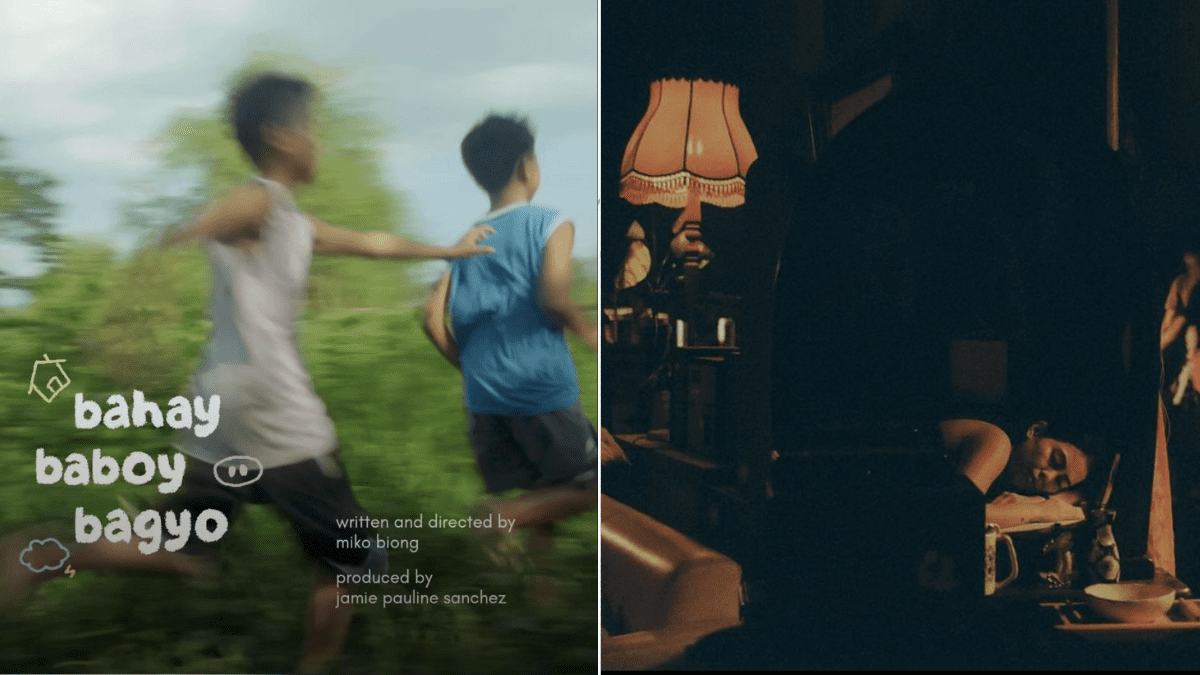
BAHAY, BABOY, BAGYO (dir. Miko Biong - University of the Philippines)
The short opens with a kid looking at a condominium building in the distance, stating that some day, he’s going to live there. This sets the frame for a portrait of a community under threat of losing their homes, as a politically-backed development seeks to demolish their whole neighborhood.
All of this is taken from the perspective of children, who fill their days with little games, not really understanding the gravity of everything going on. This is a lovely film that speaks firmly without having to say much at all. It just depicts a lovely friendship between kids, showing us what could be lost as a drive for urban development tramples on communities. It’s a great short imbued with feeling, and for my money, it’s the best among the student shorts.
Also read: Criterion Channel Now Carries These Filipino Movies
LUMANG TUGTUGIN (dir. Pepe Diokno)
The film is set during Martial Law. Therese Malvar is a university student visiting home after the death of her father. Her mother, played by Sue Prado, is urging her to stay over, and to come back home permanently. But the house is laden with horrible memories, and the horrors come to fore as the student finds herself unable to escape.
This is essentially a horror movie, where all the terror is derived from the suggestion of cycles of abuse that have kept women trapped in toxic situations for decades. The climactic sequence of this film, which is largely captured in one long take, is astounding and genuinely powerful as a piece of filmmaking. Wonderful stuff from a filmmaker who seems to have really found a groove as an artist.
The Manila Film Festival is currently screening at Cinema 3 in the Midtown Wing of Robinsons Manila until June 11, and at Robinsons Magnolia on June 10 and 11.