

Gladiator II Feels More Like a Sequel Than A Remake
Director Ridley Scott is so determined to make this sequel so very entertaining.

(SPOT.ph) “Are you not entertained?” may be the catchphrase most associated with Gladiator, but to director Ridley Scott, it may well be a mission statement for the sequel.
Here’s a quick rundown of what you’ll see when you buy a ticket to Gladiator II on December 4: warriors astride rhinos; a flooded Colosseum teeming with sharks; a decapitation using two crossed swords; whatever those shoddy-CGI, demon baboon creatures are. How can you not be entertained? You could say that with all the blood, gore and close-ups of wounds getting stitched up, Scott is making an uncomfortable statement on how movies have become the new gladiatorial arena, the fix that satisfies our bloodlust, but you would be mistaken. The 86-year-old director is simply using his muscular skill at mounting large-scale epics to—you guessed it—keep you entertained.
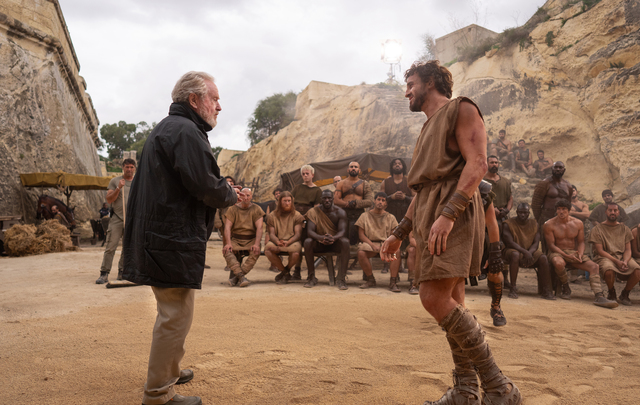
That bluster certainly doesn’t run deep into the script by incoming scribe David Scarpa (who wrote Napoleon and All the Money in the World for Scott and takes over writing duties from David Franzoni). At its heart, Gladiator is a male Cinderella story: the saga of an underestimated man who then fights and slashes his way to the top to attain cathartic vengeance. But if the Oscar-winning original could be called a father, the 24-years-in-the-making sequel isn’t just a son—it’s a DNA clone. Gladiator II feels less like a sequel than a remake.
What Gladiator II is all about
This time, the plot revolves around Paul Mescal’s Numidian warrior, who—spoiler alert!—is quickly revealed to be Lucius, the exiled son of Russell Crowe’s Maximus and Connie Nielsen’s Lucilla. Rome’s thirst for conquest soon brings it into contact with the remote North African port where Lucius is ensconced, and when the leader of the Roman force General Marcus Acacius (Pedro Pascal, giving conscience-ridden gravitas to a brief role) orders that Lucius’ wife (Yuval Gonen) be killed in the name of invasion, a new vendetta is born—one that will lead Lucius all the way from the shores of Africa to the decrepit heart of Rome.

Does Mescal ably fill Crowe’s breastplate? Physically, yes: Mescal bulked up for the role so he could convincingly fill the screen as a battle-hardened warrior. But Scarpa’s script barely gives him anything new to distinguish himself. Mostly his Lucius is confined to soul-piercing glares and a sense of simmering rage. Mescal embodies the frustrating inadequacy of the sequel: Full of physical swagger, but psychically paper-thin.
Mescal honed his magnetic screen presence on small-budget indies, so he can’t help but reach for that intimacy in Lucius’ quieter moments. Whether he’s splinting the arm of his Numidian mentor Jugurtha (Peter Mensah, a veteran of the Starz swords-and-sandals series Spartacus) or getting stitched up by the volunteer physician to the gladiators Ravi (Alexander Karim), Mescal can’t help but twinkle. It’s the only time his Lucius betrays hints of his charismatic, people-person underbelly...but it is a soft, open presence totally at odds with the sequel’s craven objective of fulfilling its male audience’s immersive contemplation of the Roman Empire.

Elsewhere, Connie Nielsen is trapped by her mandate from the original film, which is to swan about worrying over what the men are doing. Supposedly, in the intervening decades since she sent her son away to protect him from the ruthless power games of the capital, she has used her primacy as the daughter of an emperor to build a rebel network to challenge the corrupt powers-that-be. And yet, the moment Lucius reappears on the scene, all she does is suss out clues to his identity (he recited a poem by Virgil...egads!) and then tremulously beg for him to be saved.
Meanwhile, Joaquin Phoenix’s Commodus needs two emperors to stand in for him: twin brothers Geta (Joseph Quinn) and Caracalla (Fred Hechinger). Commodus was a formidable presence in the first Gladiator, a man-child who murdered his father, who is then beset by power-hungry bitterness and a cringe-inducing lust for his sister (ew). Sadly, Geta and Caracalla can’t even fill one of Commodus’ sandals: Easily manipulated, parading around in kabuki makeup, and slouching toward their downfall, they are the Roman equivalent of Beavis and Butt-head.
Denzel's movie
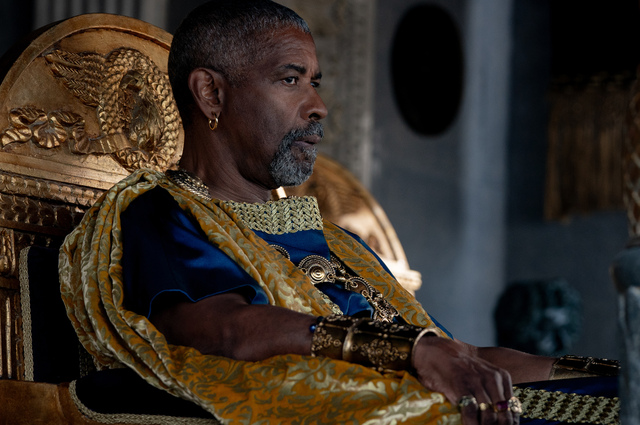
The real villain turning the gears behind the scenes is Denzel Washington’s Macrinus, a Roman power player who profits from his stable of gladiator slaves and has a one-to-one correspondence with Oliver Reed’s Proximo from the original. Much has been said about how Washington’s scenery-chewing turn makes him the frontrunner nominee for a best supporting actor Oscar; I say his preeminence is born of the fact that the script gives him the most to do.
Macrinus has more than just wealth on his mind, he has an actual agenda: A former slave himself, he has a deep cynicism of all this talk of “the dream of Rome”—he sneers at its egalitarian ideals and is willing to connive his way to the top to prove it a pipe dream. Whenever Washington walks into a room, it isn’t the grand sweep of his caftans that command attention; his squinty-eyed performance tells you that his character is playing chess while everyone else around him is playing pick-up sticks.
And speaking of that “dream of Rome”: It is an odd consequence of Scott’s superficial, all-entertainment-all-the-time approach to the sequel that the more Lucius uses it as a pep talk to his band of swarthy gladiators, the more abstract it seems. What is it, exactly? Why is an exiled heir to the throne, who grew up defending a remote African province, suddenly buying into it? Scott is too enamored with putting ships in the middle of the Colosseum to bother pondering that question.
But imagine, if you will, a Gladiator sequel told from the viewpoint of Macrinus: a follow-up that sets Succession in ancient Rome, where audiences aren’t just told that gladiators are currency but are instead steeped in three-dimensional power plays with actual life-or-death stakes. Alas, that isn’t the story Gladiator II wants to tell...and that’s why it is merely entertaining. Scott is already talking about Gladiator III—if he wants these movies to stay with audiences long outside the cinema, he should think more outside the Colosseum.