

Spot Movie Reviews: The Room Next Door
The existential drama stars Tilda Swinton and Julianne Moore.
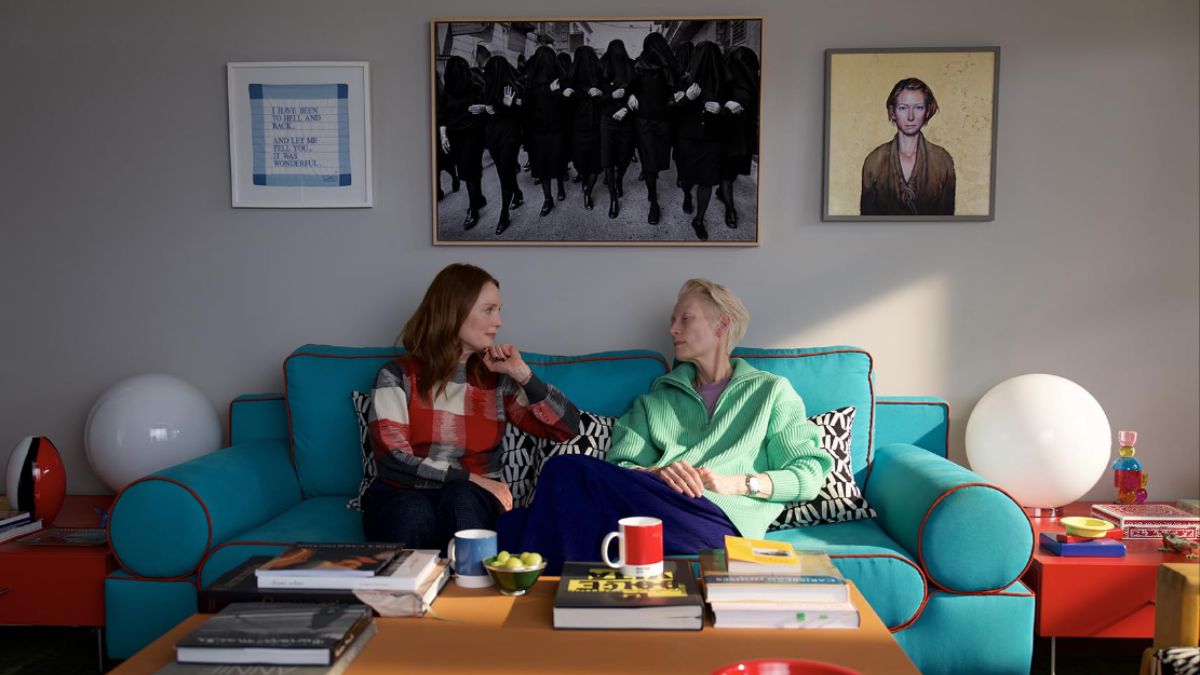
(SPOT.ph) Even with summer tentpole movie season long behind in the rearview mirror, moviegoers are once again converging on the cinemas and packing up movie theater seats this pre-holiday season. Between the unsuspecting blockbusters of the Kathryn Bernardo-Alden Richards reunion Hello, Love, Again and the long-awaited film adaptation of the Broadway smash Wicked, the annual QCinema International Film Festival rolled out into cinemas this November, highlighting “hidden gem” indie films from both local and international productions and giving audiences a lens to view cinema through some lesser amplified POVs.
One hotly anticipated film among the rest was The Room Next Door from acclaimed Spanish filmmaker Pedro Almodóvar. Continuing Almodóvar’s streak of films examining mortality and generational trauma such as 2021’s Parallel Mothers and 2019’s Pain and Glory, The Room Next Door centers around the rekindled friendship between an author with a particular fear of death (Julianne Moore) and a war photographer diagnosed with terminal cancer (Tilda Swinton), who’s looking for a companion to assist her in coordinating her own death.
Also read: Everything You Need to Know About QCinema International Film Festival 2024
SPOT.ph’s The Room Next Door Review (Part of QCinema 2024):
One striking visual motif of The Room Next Door is nature, in the literal sense. It’s a film that’s perpetually surrounded by the environment and the main characters constantly make note of particular flora and fauna that normally just serve as backdrop. The main chunk of the film takes place at a remote Airbnb surrounded by forest and sunlight, where Swinton’s character Martha wants to be her final resting place, as opposed to a hospital room surrounded by and hooked up to a bunch of machines.
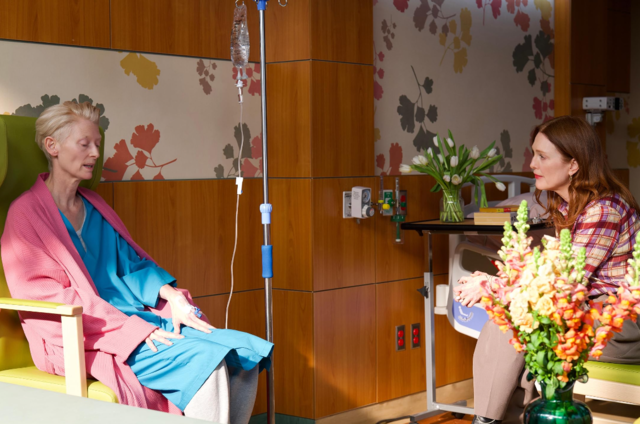
The first act of the film highlights this contrast, with Martha constantly framed within jagged and metallic confinements of New York City, as she rants about how suffocating it is to be kept alive—yet kept suffering—by the advancements of modern medicine. You understand the urgency of her feeling trapped that ultimately leads to her decision to propose to Moore’s Ingrid that she end her own life—which itself is a scene that starts off inside a building in the middle of the city, where Ingrid is most against the idea, but then jarringly cuts to Martha’s apartment surrounded by both actual and painted plantlife, as Ingrid slowly comes to empathize with Martha’s decision. It’s no coincidence as well that Martha literally opens a balcony door for fresh air as she yearns for freedom from her ailments.
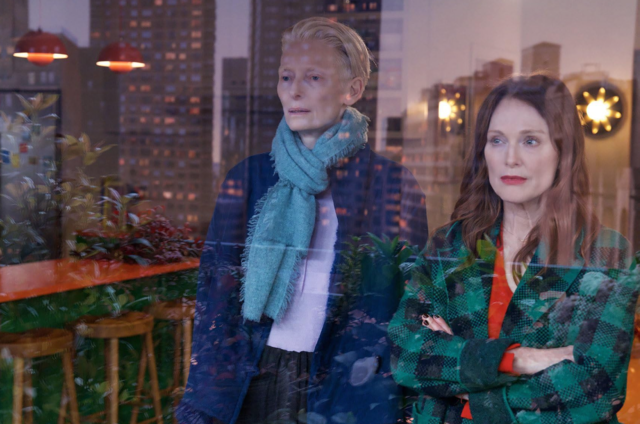
Nature is at the very heart of the film, as Ingrid even states in the film’s opening scene that she doesn’t see death as natural. As the two women head out to their remote escape, it’s a meditation—and a reckoning—for Ingrid as to what is indeed natural in the modern world. The lines become blurred for Ingrid; literally, as the Airbnb they stay at is mostly surrounded by glass sliding doors, leading to some gorgeous shots of the characters seemingly walking through both the modern and natural worlds.
The film doesn’t have a lot of side characters, but when they do show up, they appear in these sort of vignettes that also work to examine the theme of nature. Whether it’s Martha’s baby daddy appearing only in flashbacks, who’s world completely flipped upside down after returning home from a war he had no stakes in; a gym instructor who only appears for a scene, talking about how unnatural it is to coach clients these days due to a gym policy preventing close contact; or the overzealous police officer who sermons about how inhumane it would be for a terminal patient to take their own life; these tension-filled side stories all on reflect on how maybe structured around anything natural.
Not even to mention the film’s most prominent supporting character, John Turturro’s Damian, a staunch climate change activist who alienated his own family due to some a fostered cynical worldview. It’s his somewhat conflict-oriented (in the few scenes we see of him) relationship with Ingrid that helps solidify Ingrid’s growth, but also thankfully gives her something in the film to do outside of her relationship with Martha.
The film overall is a relaxing drama with some charming bits of dark comedy. Nothing too radical or anxious-inducing—so something appreciated for the current times. It’s a slow-drip acceptance of entropy as a part of the natural cycle of things. Death, rebirth, then again. All as poignant and calming as seeing the first hint of snow fall over the treeline at the onset of winter. The reveal at the end, while both heartwarming and chuckle-inducing, underscores this completely. "The door was open." It’ll eventually close again, but that’s okay.
Also read: Here Are the Movies You Shouldn’t Miss This November 2024