

The Gladiator Movies: What is Fact, What is Fiction
Loved the movies? Now here's what history tells us.

(SPOT.ph) It is commonly accepted that whenever Hollywood slaps an “Inspired by true events” or “Based on a true story” label on a movie, that there will be liberties taken with the facts. Two or more people may be combined into a composite character; conversations may be imagined; events may be rearranged or eliminated—all in the service of a coherent narrative.
These decisions fall under the purview of “artistic license.” Just how far these licenses extend, however, is often up for debate. The 2001 biopic A Beautiful Mind, the Ron Howard-directed life story of Nobel Prize-winning mathematician John Nash (Russell Crowe) who famously suffered from schizophrenia, has been criticized for diverging significantly from the events of the life of its subject. Last year’s Maestro, meanwhile, had Bradley Cooper coming under fire for practically ignoring composer Leonard Bernstein’s sexuality to focus on his marriage to Felicia Montealegre (Carey Mulligan), when it could be argued that his same-sex proclivities deeply colored his union with the Argentinean actress.
Still, these movies could be justified as having taken their liberties in good faith, arguing that the filmmakers had opted to tackle the spirit of their subjects rather than their literal truths. But on the other end of the spectrum are films for which “inspired by true events” is a stretch. One egregious example would be The Greatest Showman, the 2017 musical “inspired” by the life of P.T. Barnum (Hugh Jackman), which romanticized the circus impresario to the point of completely erasing his despicable nature. (For starters, Barnum exploited an enslaved woman for entertainment, even charging admission to her autopsy.) It makes you wonder why the filmmakers didn’t come up with a completely fictional character to begin with.
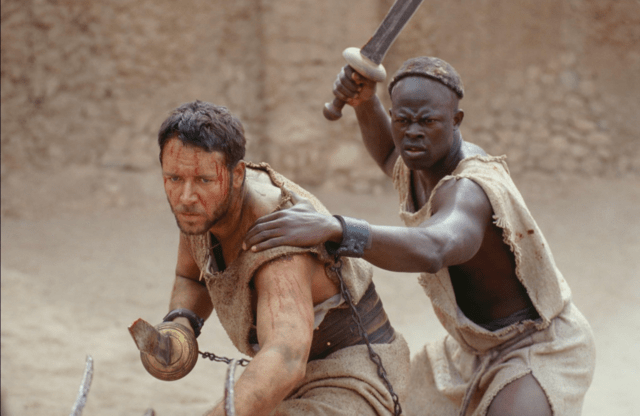
Under that category could be classified the two Gladiator films. While these sword-and-sandal epics have never been marketed as faithful representations of history, their insistence on using actual personalities from the Roman Empire as characters make them fair game for some historic fact-checking. So after you’ve seen both movies, check back here so you don’t get your fiction mixed up for fact. (Thanks to the YouTube channels Told in Stone from Greek and Roman historian Garrett Ryan and History Tea Time with Lindsay Holiday for their concise yet comprehensive timelines.)
The story of Gladiator
(WARNING: Spoilers follow!) In the first film, which came out in 2000, the dying emperor Marcus Aurelius (who reigned from 161 to 180 CE and was played by Richard Harris) decides to pass over his son, the unstable Commodus (Joaquin Phoenix), handing the reigns of the empire over to his trusted general Maximus (Russell Crowe) as regent, with an eye to restoring Rome as a republic. Despite being a family man, Maximus is revealed to have had a prior relationship with the emperor’s daughter Lucilla (Connie Nielsen); this further angers the erratic Commodus, who is portrayed as having incestuous desires for his sister.
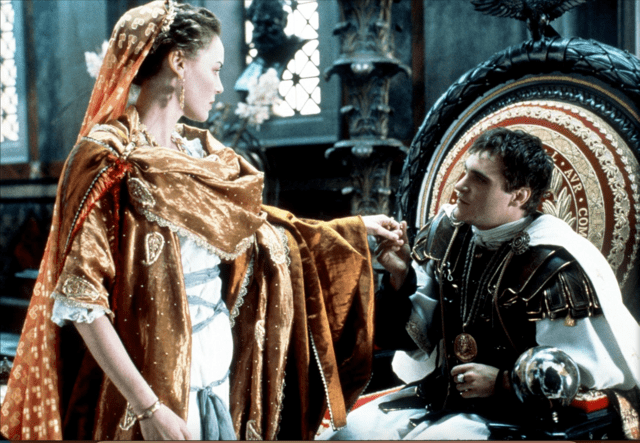
In short order, Commodus murders his father and has Maximus sold into slavery in modern-day Spain. Maximus reluctantly participates in gladiatorial tournaments across the empire, his prowess eventually bringing him back to Rome. With an ego compelling him to fight his crowd-pleaser of a former general, Commodus is killed in hand-to-hand combat by Maximus. Before succumbing to his own wounds, Maximus inquires after his young son Lucius (Spencer Treat Clark) to Lucilla, who tells him she has spirited their son away from Rome for his safety.
The real history behind Gladiator
The film’s hero, Maximus, was a fictional character entirely conjured from the imagination of screenwriter David Franzoni. According to history, Lucilla was first married to Marcus Aurelius’ co-emperor and adoptive brother Lucius Verus. And then, after a plague during a campaign against Germanic invaders killed Lucius Verus, she married again, this time the general Claudius Pompeianus, with whom she had her son Lucius.(Pompeianus probably served as inspiration for Maximus.)
Unlike the common practice of anointing an adopted and capable young man as a successor, and contrary to what was portrayed in the film, Marcus Aurelius put his five-year-old son Commodus in the direct line of succession, giving him the title of Caesar. But the heir apparent proved too immature and immune to the teachings of the scholars and generals (which included Pompeianus) his father hired to tutor him. When Marcus Aurelius died at 58 of natural causes during a military campaign in modern-day Vienna, 18-year-old Commodus ascended to the throne fair and square.
Commodus ignored his administrative duties and instead threw himself into the perks of his position as emperor, becoming popular with his subjects by arranging ruinously expensive gladiatorial spectacles in the Colosseum. There is no evidence that Commodus had incestuous leanings toward his sister—in fact, Lucilla was 10 years her brother’s senior and probably despised him for his ineptitude. Lucilla actively plotted to topple Commodus from the throne. After a botched assassination attempt, Commodus had Lucilla exiled to the Isle of Capri and then, spurred by his increasing paranoia, had her executed by a Centurion guard a few months later.
After a reign punctuated by repeated assassination attempts, corruption and famine, Commodus grew more and more egomaniacal. He fancied himself the reincarnation of Romulus, the mythical founder of Rome, and fashioned himself into a gladiator, even though the opponents he faced were caged beasts and hobbled warriors equipped with inferior weapons. On New Year’s Eve 192 CE, Commodus was strangled in his bathroom by a wrestler bribed by his mistress and some advisers whom Commodus had put on an execution list, ending his 15-year reign of terror.
The story of Gladiator II
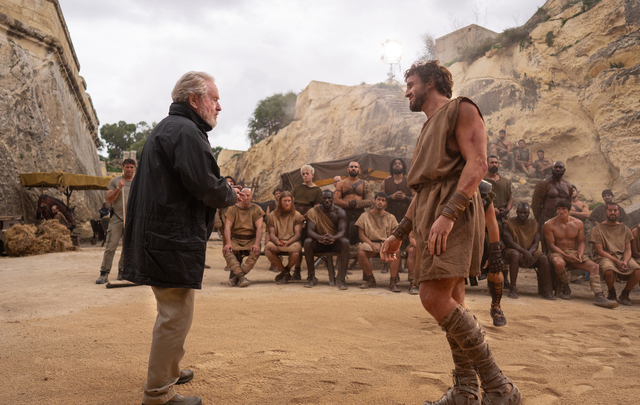
(Don’t worry—no spoilers here.) The sequel takes up 16 years after the events of the original film. After living a quiet life as a warrior in the North African port of Numidia, Maximus and Lucilla’s long-exiled son Lucius (Paul Mescal) battles the Roman general Marcus Acacius (Pedro Pascal) when the empire invades the remote province. Lucius swears revenge upon the general when he orders Lucius’ archer wife be killed during the heat of battle.
Captured by slave owner Macrinus (Denzel Washington), Lucius also proves to be a fierce gladiator, and Macrinus recognizes that his new acquisition could be his entrance to the highest echelons of power in Rome, specifically into the inner circle of twin emperors Geta (Stranger Things’ Joseph Quinn) and the syphilitic Caracalla (The White Lotus’ Fred Hechinger). Meanwhile, Lucilla has realized that Macrinus’ new fighter is her long-lost son and begs her husband to make sure he is kept safe. And who does her husband happen to be? Marcus Acacius—the man Lucius has sworn revenge upon.
The real history behind Gladiator II
Lucilla didn’t live long enough to be in the sequel, and most disappointingly, her son Lucius was never a gladiator nor in serious running to be an emperor, instead serving as a loyal consul—essentially, a bureaucrat—to Emperor Septimius Severus, who ascended the throne after a bloody civil war and competing claims of emperorship precipitated by the death of Commodus, dubbed the Year of Five Emperors.
Lucius never served as a warrior for Numidia. By the early third century, which is when Gladiator II is set, Numidia had already been a Roman province for hundreds of years.
Co-emperors Caracalla and Geta inherited the throne in 211 CE, after their father Septimius Severus’ 18-year reign. They weren’t twins, although the 23-year-old Caracalla was only 11 months older than his brother. In the film, Caracalla and Geta seem to rule in harmony, with Geta taking the dominant role. But the historical Caracalla and Geta actually hated each other, establishing separate courts and plotting against each other for the better part of a year. When tensions became untenable, Caracalla asked his mother Julia Domna to arrange a meeting with his brother to hash things out. But as Geta lay waiting at their mother’s chambers without his armed retinue (as per the terms of the truce), Caracalla arrived with his bodyguards, who promptly stabbed his little brother to death.
Caracalla had his brother’s likenesses and statues destroyed and had his name struck from the record. Contrary to his portrayal in the sequel, Caracalla wasn’t soft and debauched, but battle-hardened by fighting next to his father in the campaigns he waged to protect the empire’s borders. He even kept a pet lion next to his throne...not a monkey as shown in Gladiator II. And while Caracalla was short-tempered and brutal, there was no evidence that his erratic temperament was due to syphilis (which wouldn’t even appear in Europe until at least 1450, a period of expansion associated with the Renaissance).
Caracalla then ordered the massacre of 20,000 of his brother’s supporters...including Lucius, who was executed at the age of 34. Not quite as glorious a death as fighting in the Colosseum.
In the spring of 217 CE, Caracalla was assassinated by one of his bodyguards. The real mastermind was probably the praetorian prefect, a high office with extensive legal and administrative functions held by...Macrinus, an Algerian-born lawyer who ascended the ladders of power in Rome but, unlike Denzel Washington in the movie, never owned a gladiatorial school nor actually became a senator.
What is the Dream of Rome anyway?
You’ll be hearing this phrase often when you watch both movies. But first, a fact-check on what Rome was like during the time of Gladiator II.
Ancient Romans did not, in fact, drink coffee—the beverage wouldn’t reach Italy until the 17th century. Romans also did not read folding newspapers, another modern invention. Rome also did not have a gigantic gate; the city was instead surrounded by suburbs and cemeteries, not—as the movie portrays—by expansive fields.
Gladiators never fought feral, throat-ripping, CGI baboons. Romans did, however, train monkeys to perform tricks in the arena, often having them dressed in costumes riding herd animals like goats. There’s also a scene where Paul Mescal’s Lucius confronts a warrior riding a rhinoceros. This must have been a special fight, indeed—rhinos only appeared in the Colosseum once or twice a century, for the simple reason that they had to be transported and kept alive all the way from sub-Saharan Africa, a region that lay beyond the borders of the empire.
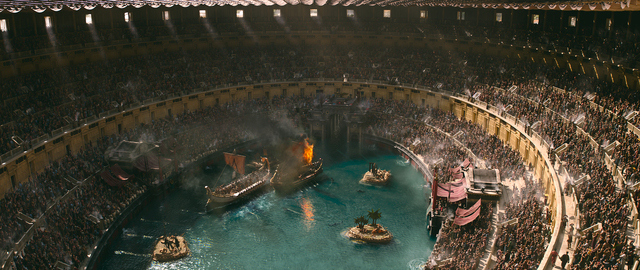
Another exciting set piece in the sequel is a mock naval battle in the Colosseum. These naval battles may have been staged early in the Colosseum’s history, but once those maze-like tunnels and cages had been installed under the arena, filling the Colosseum with water and then draining it would have become prohibitively difficult. And importing sharks from the Mediterranean to make these naval battles more interesting? Forget about it.
But on to that “dream of Rome” shtick. A major plot driver in both movies is a secret cabal of conspirators plotting to wrest power away from emperors and make Rome a republic—meaning a state ruled by representatives from the citizen body—again.
But by the reign of Caracalla, after two-and-a-half centuries of imperial rule, the system had become too entrenched: soldiers needed emperors to pay them; citizens needed emperors to feed them; and even the “plotting” senators needed emperors to give them offices and patronage.
The underlying weakness of Gladiator II arises from the fact that “the dream of Rome” is never really portrayed as anything other than a gladiatorial pep talk; the film doesn’t really venture out of the Colosseum and into the streets and homes of Rome’s populace, enough to show us in concrete terms what a huge difference an idealized, republican vision of Rome could be.
In short, “the dream of Rome” is only name-checked like the historical figures at the center of the movies’ plotlines—characters used in name only, deployed to give some heft to what is essentially Hollywood’s wispy dream of what the Roman Empire was like.